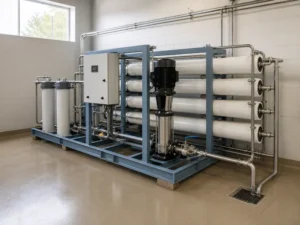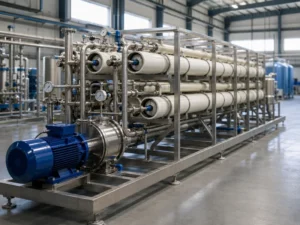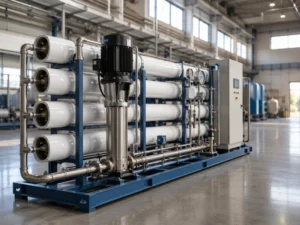

The types of commercial water filters in foodservice and commercial buildings sort onto three axes: treatment mechanism, position in the plumbing, and the equipment protected. Which axis decides a purchase depends on hardness, the utility’s disinfectant, and peak flow.
Most sites end up running two or three mechanisms in sequence. Sediment removal, carbon adsorption, softening, scale control, membrane separation, and UV disinfection each leave something behind for the next stage. Certification is what makes any of it checkable, and which standard applies depends on whether the unit is a plumbed commercial assembly or a point-of-use device.
Types of Commercial Water Filters by Treatment Mechanism
Seven treatment mechanisms cover almost all commercial duty, and which one a site needs depends on whether the target contaminant is suspended, dissolved, ionic, or living.
What makes this equipment commercial is duty cycle, not filtration chemistry. The same carbon and the same membranes appear in residential product. A commercial train has to hold flow while several water-fed appliances draw at once, so the pressure drop across a loaded cartridge decides it. A figure printed on a clean cartridge filter housing understates that.
| Mechanism | What it acts on | Certification to ask for | Known limit |
|---|---|---|---|
| Depth or pleated sediment cartridge | Suspended solids, rust, sand, scale fragments | Assembly: ASSE 1087. Claim: NSF/ANSI 42 particulate reduction class | No effect on dissolved matter, hardness, or taste |
| Activated carbon adsorption | Free chlorine, taste and odour compounds, some organics | Claim: NSF/ANSI 42 for aesthetic claims, NSF/ANSI 53 for health-related claims such as lead, cyst, VOC | Capacity is consumed in service, and performance falls as contact time drops |
| Catalytic carbon on chloramine duty | Chloramine, which reacts more slowly on carbon than free chlorine | Claim: NSF/ANSI 42 chloramine claim | Needs longer contact, so a flow rating earned on free-chlorine duty does not carry over |
| Cation exchange softening | Calcium and magnesium hardness, exchanged for sodium or potassium | Assembly: ASSE 1087, which includes bypass flow and backsiphonage testing during regeneration. NSF/ANSI 44 is written for residential softeners | Raises sodium or potassium depending on the regenerant used, and leaves TDS, chlorine, and organics in place |
| Scale inhibition by sequestration or crystal modification | Deposition of scale on heated surfaces, while hardness stays in the water | IAPMO/ANSI Z601, scoped to residential and similar water-heating applications. Where a chemical is dosed, that chemical needs an NSF/ANSI/CAN 60 listing and a stated maximum use level | Hardness remains, so it does nothing for a TDS complaint |
| Reverse osmosis | TDS and many dissolved ionic and molecular species, with actual rejection set by the membrane and the operating conditions | NSF/ANSI 58 covers point-of-use RO systems. A commercial-scale skid sits outside that scope, so verify the assembly to ASSE 1087 plus manufacturer-validated rejection data | Produces a reject stream, and oxidants must be removed upstream for chlorine-sensitive polyamide thin-film composite membranes |
| Ultraviolet disinfection | Inactivates bacteria, viruses, and cysts | Claim: NSF/ANSI 55 Class A at 40 mJ/cm² for microbiologically unsafe water, or Class B for reducing non-disease-causing bacteria in a disinfected supply | Removes nothing physically, leaves no residual downstream, and rated flow is tied to a design UV transmittance |
Three Axes That Get Mixed in Most Filter Type Lists
Commercial filter type lists run three independent axes together, and reading them as one ranked menu is the most common reason a site buys a stage it already has.

The first axis is mechanism, meaning what physically happens to the contaminant. The second is installation point: point-of-use cartridges serving a single machine, against point-of-entry equipment treating the whole incoming line. The third is target equipment, which is how supplier catalogues are arranged, so an “ice machine filter” and a “coffee filter” may hold identical media in different housings.
Mixing the axes produces comparisons that cannot resolve. Reverse osmosis and point-of-use are not alternatives to each other, since one names a separation mechanism and the other names a location. An RO unit can sit in either position. A quote that identifies only one of the three axes is incomplete, and it cannot be compared with another quote on equivalent terms until the other two are filled in.
The installation axis also has a formal definition worth using. ASSE 1087 requires a plumbed unit to be categorised as point-of-use or point-of-entry, and applies both sets of requirements where a device is both. Commercial modular systems rated below 4.0 gpm (15.1 L/min) count as point-of-use devices under it, which gives the axis a testable line.
Certification Layers for a Plumbed Commercial Assembly
Commercial filtration certification works in two layers, and which layer applies depends on whether the unit is a plumbed assembly or a point-of-use device. The assembly layer covers the unit and its components. The claim layer covers what the product reduces.
ASSE 1087 sits at the assembly layer. Its scope is plumbed-in water treatment devices and components, point-of-entry and point-of-use, in buildings such as businesses, schools, hospitals, hotels, and restaurants. Process water, wastewater, and residential product fall outside it. Its requirements run to service flow and pressure drop, bypass flow and backsiphonage during regeneration, and structural integrity. It also tests a 24-hour pressure loss, cycle life, and material safety to the drinking water component standards.
The claim layer is where the NSF/ANSI drinking water treatment unit standards apply, and each one is scoped tightly. Standard 42 covers aesthetic claims and 53 covers health-related claims, both for point-of-use and point-of-entry systems. Standard 55 covers UV systems by class. Standard 58 covers point-of-use RO systems on supplies that are microbiologically safe and of known quality. A listing to it says little about a skid producing a thousand litres an hour. Editions move as well, so confirm the one in force where you certify.
Three of the seven mechanisms have no residential-style mark to look for on commercial duty. Most specifications go wrong right there. Softening is covered at claim level by a standard written for residential softeners; scale reduction by a protocol scoped to residential water heating; large RO by a standard scoped to point-of-use. On those three, an absent logo proves nothing. What remains checkable is assembly certification plus vendor test data: peak service flow and hardness leakage for a softener, independent scale-reduction data for an inhibitor, rejection validated at your feed conditions for RO.
Two component standards get quoted as one and are not interchangeable. NSF/ANSI/CAN 61 addresses health effects from materials in contact with drinking water, while 372 addresses lead content, and neither is a contaminant-reduction claim. The same distinction applies to dosed chemicals. A sequestering phosphate needs an NSF/ANSI/CAN 60 listing with a maximum use level. That standard sets health effects requirements and does not establish performance, so the listing confirms the chemical is safe to add and not that it controls scale.
Matching a Filter Type to the Water Problem on Site
Symptom-first selection works for commercial water problems when you trace the symptom to a measured cause before choosing a cartridge.
| Symptom at the point of use | Cause to test for | Verify first | Mechanism that addresses it |
|---|---|---|---|
| White scale on elements, boilers, steam pans | Calcium and magnesium hardness | Total hardness on the incoming line | Exchange softening or scale inhibition |
| Chlorine taste in ice and brewed drinks | Free chlorine residual | Residual measured at the tap in service | Activated carbon sized for the flow |
| Taste complaint survives a fresh carbon cartridge | Chloramine in place of free chlorine | Disinfectant form named in the utility’s water quality report | Catalytic carbon with longer contact time |
| Cloudy ice, grit in strainers | Suspended solids or line debris | Turbidity, plus the condition of any upstream strainer | Sediment stage ahead of everything else |
| Flat or harsh taste after an RO retrofit | Very low TDS permeate | The equipment maker’s mineral or alkalinity window | Blending valve or a mineral stage after the membrane |
| Flow drops at peak service, short cartridge life | Pressure drop across a loaded cartridge | End-of-life pressure drop against housing rating, at peak simultaneous draw | Larger housing or parallel stages, sized on feed flow |
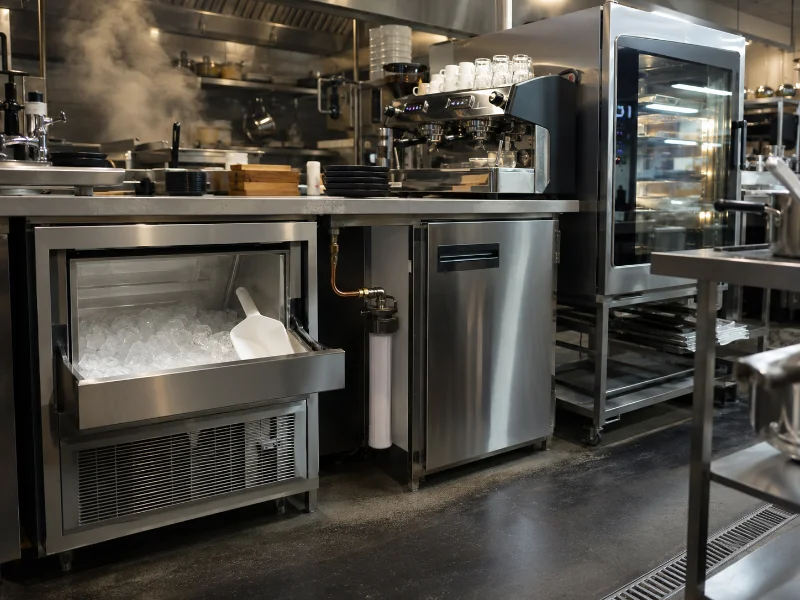
One symptom with two possible causes is the case that costs money. When a softener is specified against a taste complaint without confirming the disinfectant form, the complaint usually survives the installation and a carbon stage has to be added afterwards. The disinfectant form is a published fact. Confirm it in writing with the utility that supplies the building.
On lines with no upstream strainer, the finest cartridge in the train tends to be the component that loads first. That is where to look when flow falls off during service.
Why Most Sites Run Two or Three Stages in Sequence
Staging in a commercial train follows from mechanism: each stage leaves a residue for the next, and the order comes from particle size, required contact time, and where disinfection has to sit relative to storage.
- Particulate removal first, ahead of any multi media filter or membrane, so the expensive stage is not loaded with sand.
- Carbon for oxidant removal ahead of chlorine-sensitive polyamide membranes, within the oxidant limits the membrane manufacturer publishes.
- Hardness control before the membranes and before heated surfaces, by exchange or by inhibition depending on whether the dissolved load also has to come down.
- Reverse osmosis where TDS, not taste, is the driver.
- Disinfection last, downstream of any storage vessel and as close to the point of use as the layout allows.

The lamp position follows from the mechanism. UV disinfection inactivates organisms without removing them and leaves no residual, so any carbon bed, tank, or long pipe run downstream of the lamp is an uncontrolled surface again. Put the lamp last. Rated flow for a UV chamber comes from validated dose at a design UV transmittance. Transmittance is not a restatement of turbidity: colour, dissolved organics, and iron move it at the same turbidity reading. A rated flow quoted without its design transmittance cannot be applied to your water.
Sizing carries a similar consequence. Under steady-state operation, excluding flush and concentrate recycle, feed flow can be approximated as permeate flow divided by design recovery. A site producing about 1,000 L/h at 50 % recovery therefore draws roughly 2,000 L/h through everything upstream of the membranes. Prefilters and softeners chosen against the permeate number will be about half the size the train needs. Size softeners on peak instantaneous service flow as well as exchange capacity.
What to Confirm Before Choosing Between Filter Types
Total hardness and the disinfectant form in the incoming supply are the cheapest inputs to obtain, and the two that narrow a commercial filter shortlist fastest. Neither closes a specification alone.
The remaining variables converge together, and this pair locks first. Hardness determines whether an exchange or inhibition stage exists in the train at all. Disinfectant form sets the contact time a carbon stage needs. Beyond those two, the protected equipment decides the rest, so work through the inlet water window in its manual, which commonly specifies alkalinity, pH, chloride, and total chlorine alongside hardness.
Membrane equipment adds temperature, feed pressure, and a fouling index. UV adds transmittance, iron, and manganese. Every commercial assembly, whatever the mechanism inside it, is also judged on peak flow, daily volume, and end-of-life pressure drop.
For a single espresso machine on municipal water with moderate hardness, a rated carbon cartridge and a scale-control stage are usually enough. An RO unit there only adds a drain load and pressure equipment the site does not need. Reverse osmosis earns its cost when a measured TDS or a specific ion sits outside what the equipment or the recipe tolerates. Where the housings sit, how the drain is routed, and how the treated water is piped are a separate engineering review.
Where Commercial Filter Types Stop Being Interchangeable
Read as one ranked menu, the types of commercial water filters send sites to the wrong purchase. Read as three axes with two certification layers, the choice usually collapses to a train of two or three stages. Hardness and disinfectant form are the pair to obtain first. On softening, scale control, and large RO, ask for the assembly certification and the vendor’s test conditions, because the familiar mark you are looking for may not exist for that duty.
Before quoting, we ask for hardness, disinfectant form, peak simultaneous draw, and the inlet window from the equipment manual. The same TDS reading points to different trains depending on those four.
If hardness is already handled and TDS still sits above what the equipment tolerates, size on feed flow. Then check that number against the rated operating envelope of the commercial reverse osmosis system for sale you are considering. If hardness is the only finding, an exchange or inhibition stage closes it for a fraction of the cost.
FAQ
Rely only on filters carrying a validated microbial reduction claim for the target organism. An absolute pore-size rating on its own does not establish equivalent performance against cysts, bacteria, and viruses. The standards list the three as separate claims for that reason.
Rated service cycle sets the ceiling and site conditions decide how much of it you get. Certification testing under standards 42 and 53 measures reduction across a rated volume at a specified flow and challenge water. That is a laboratory ceiling under one set of conditions. Inlet turbidity, daily volume, and proximity to the housing’s pressure drop limit all shorten it. Replace at the rated cycle or earlier when pressure drop or monitoring data requires it. Taste and odour checks can catch failure of an aesthetic chlorine claim, but they are not valid indicators of health-related contaminant breakthrough.
No. A water softener system targets one class of contaminant, and a single-tank unit stops treating while it regenerates.
Yes for brewing. Blending puts back part of what the membrane removed, so the number to aim at is the alkalinity floor the brew equipment specifies, and going above it undoes the reason for the retrofit.
Check the listing itself, because a complete system, an individual cartridge, and a component are certified separately, and material requirements differ between point-of-use and point-of-entry products. A listing on a cartridge does not extend to the manifold it screws into.
Related Posts
Best Commercial Reverse Osmosis System: How to Judge One Before You Buy — The judging criteria behind the rated-envelope check in the closing section, before a commercial RO quote is accepted.
Water Treatment System Components: Matching Each Part to Your Source Water — Part by part, what sits behind the assembly, cartridge and component distinction in the certification section.
How Much Does a New Water Treatment System Cost? — What the cost comparison at the end rests on, where an exchange stage closes the problem instead of an RO retrofit.
Does RO Water Remove Minerals? — The mineral side of the blending question in the FAQ, and why the brew equipment specifies an alkalinity floor at all.
Reverse Osmosis Application: Which Water Problems It Actually Solves — Which measured water problems justify the reverse osmosis rows in the symptom table above.