
PE Plastic Water Tanks
We supply PE plastic water tanks as standard components within complete water treatment system packages — each tank sized, fitted, and configured to connect directly to upstream filtration, RO membranes, softener resin vessels, or dosing equipment without field modification. Our standard range covers 100 L to 25,000 L in rotomolded LLDPE and HDPE, with orientation, color, and accessory packages matched to your site conditions, stored liquid, and downstream equipment requirements.
Choosing the Right PE Grade: LLDPE vs. HDPE
Not all polyethylene storage tanks carry the same engineering profile. The grade decision — LLDPE or HDPE — sets the temperature ceiling, wall stiffness, and chemical compatibility envelope before a single fitting is specified.
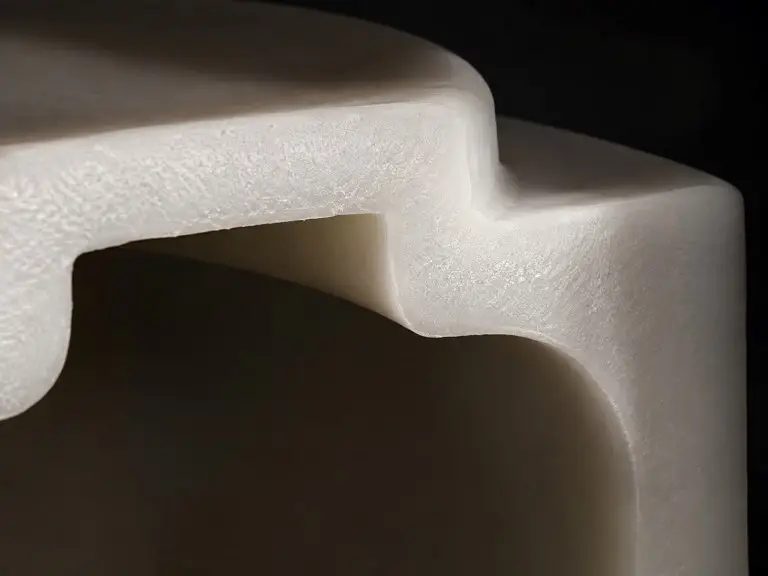
LLDPE — Linear Low-Density Polyethylene (Standard Specification)
LLDPE has a density of 0.918–0.940 g/cm³ and is our default for rotomolded industrial water storage tanks. Its molecular structure gives it higher impact flexibility than HDPE, so the wall absorbs minor point loads and site settlement without cracking. LLDPE operates continuously between -20 °C and +60 °C; above that ceiling, wall stiffness degrades under hydrostatic load. For potable water storage, RO permeate collection, and softener brine tanks, food-grade virgin LLDPE is the correct specification.
HDPE — High-Density Polyethylene (Structural and High-SG Applications)
HDPE sits at approximately 0.960 g/cm³ and offers higher wall stiffness. We specify HDPE when a tank must carry soil pressure and vehicular cover loads in underground installation, or when the stored liquid has a specific gravity above 1.3 and the additional wall strength is needed. HDPE’s short-term heat resistance extends only marginally beyond LLDPE’s, so the 60 °C continuous ceiling applies in non-pressure water storage service for both grades.
XLPE — Cross-Linked Polyethylene (Not Standard for Water Treatment)
Cross-linked PE offers the highest resistance to concentrated oxidizing chemicals, but it is not required for standard water treatment applications — potable water, brine, RO permeate, or dilute process water. If your application involves concentrated acid or bleach storage above standard working concentrations, we review the liquid type and concentration before specifying any tank material.
| Property | LLDPE | HDPE |
|---|---|---|
| Density | 0.918-0.940 g/cm³ | ~0.960 g/cm³ |
| Continuous temperature range | -20 °C to +60 °C | -20 °C to +60 °C |
| Impact flexibility | High | Moderate |
| Wall stiffness | Standard | Higher |
| Food-grade potable water | Standard specification | Available |
| Manufacturing method | Rotational molding | Rotational molding / blow molding |
| Best suited for | Potable water, RO permeate, brine, dosing day tanks | Underground tanks, high-SG liquids, structural load applications |
Standard LLDPE walls are designed for liquids up to SG 1.5. If your stored liquid exceeds SG 1.3, provide the liquid type and we will confirm whether the standard wall geometry is sufficient or whether HDPE or a heavier wall specification is needed.
Where PE Tanks Appear in Your Treatment System
PE tanks occupy multiple positions in a water treatment train. The correct capacity, color, and fitting configuration differs by position — what follows maps each installation point and explains how we size it.
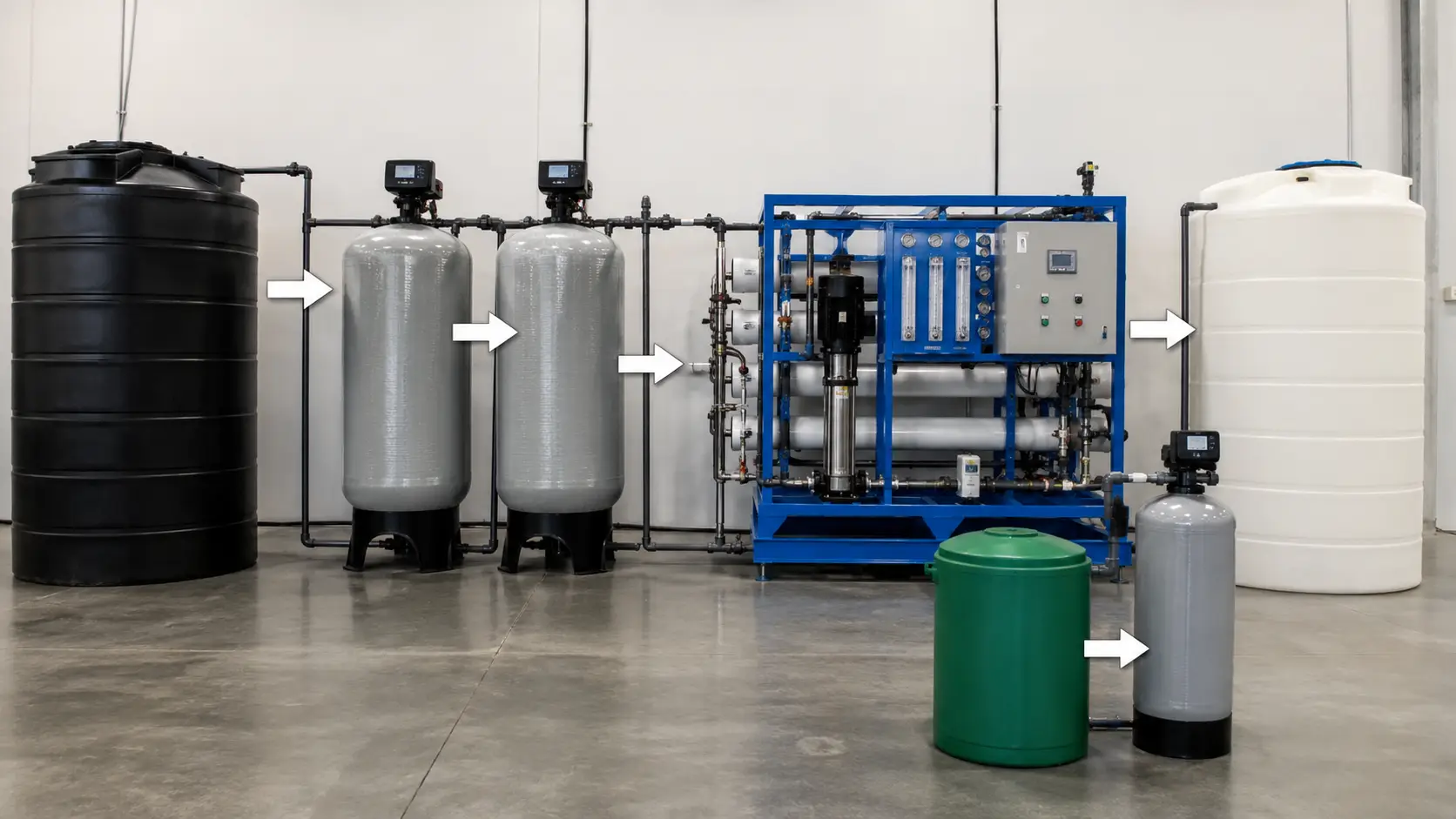
Raw Water Day Tank
6–12 hours feed volume; typical 3,000–25,000 L; black UV-stabilized LLDPE is recommended and specified for outdoor siting in high-UV climates.
RO Permeate Storage
4–8 hours RO output; a 5 m³/h system at 8h buffer equals 40,000 L, normally split across practical tank banks.
Brine/Salt Tank
Sized to resin vessel volume and regeneration frequency; a 2,000 L tank at 200 L/day salt draw gives about 10 days of reserve.
Chemical Dosing Day Tank
Typical 100–1,000 L; LLDPE is compatible with chlorinated water at 200 ppm or below, while concentrate storage needs review.
Process Water Buffer Tank
30–60 minutes of peak process demand; batch processes must span the full cycle time plus planned maintenance windows.
A raw water holding tank upstream of multimedia filters, quartz sand filters, or carbon pre-filters normalizes feed flow variability and protects treatment equipment from intermittent supply interruption. For commercial or municipal RO systems processing 5–20 m³/h, we normally size this tank for 6–12 hours of raw water supply, with the final volume adjusted to inlet reliability, pump cycling pattern, and inter-supply intervals.
Post-membrane permeate storage is sized differently because the RO produces at a steady rate while downstream demand is variable. A 5 m³/h RO system designed for an 8-hour buffer requires 40,000 L of storage, but we usually split that volume across two or three tanks so delivery, installation, cleaning, and isolation are practical. For potable or food-grade service, white food-grade virgin LLDPE supports visual inspection during routine maintenance.
Softener brine storage is calculated from resin vessel volume, salt dose, and regeneration frequency rather than from system flow alone. A softener drawing 15 m³/h with a 100 L/cycle salt dose and twice-daily regeneration consumes about 200 L of brine per day, so a 2,000 L tank provides roughly a 10-day operating reserve for weekends and scheduled shutdown periods.
Tank Configuration: Orientation, Capacity, Color, and Fittings
PE tank configuration is a set of matched decisions across orientation, capacity, color, access, and fittings. These decisions must be made before production begins — there is no field-modification equivalent for a rotomolded one-piece tank.
Tank Orientation: Vertical, Horizontal, Underground
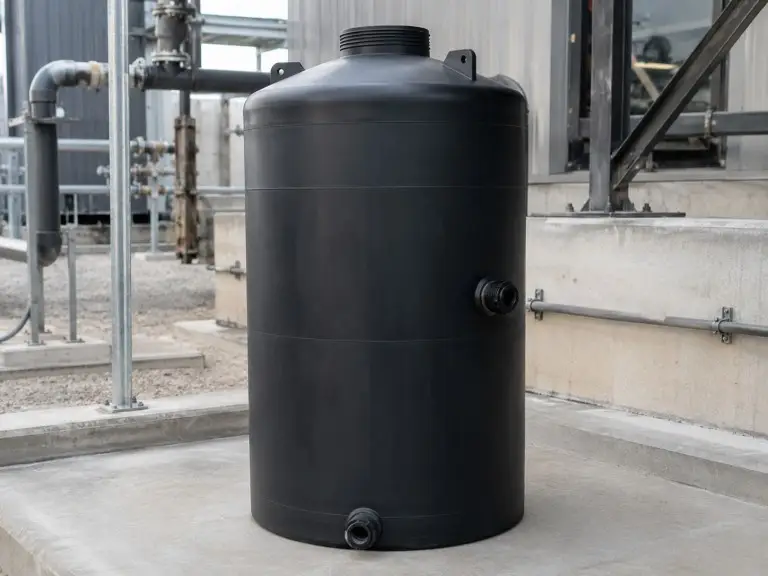
Vertical Cylindrical
Default for minimum footprint installations. It is the most stable under full liquid load, needs the smallest base area relative to capacity, supports all standard fitting positions, and covers the full 100 L to 25,000 L range.
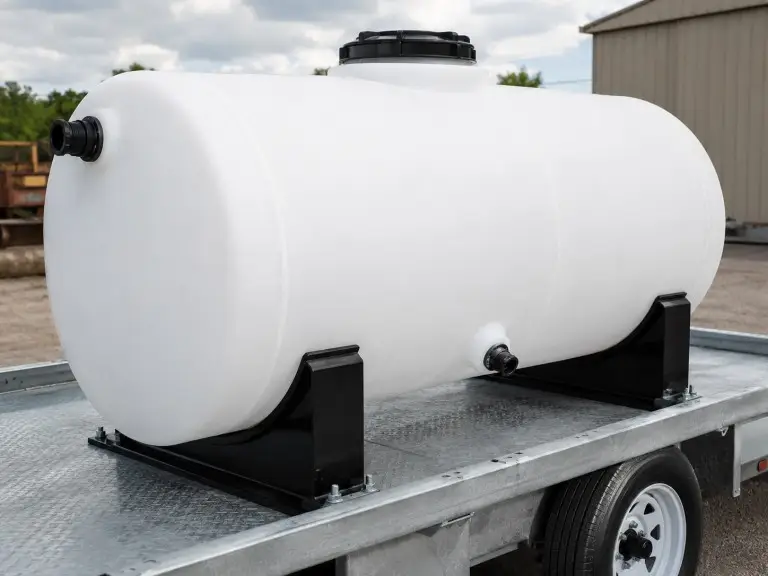
Horizontal Cylindrical
Suited for trailer- or skid-mounted systems where installation height is constrained. Horizontal tanks require saddle supports, and saddle material, spacing, and bearing area are confirmed per tank diameter and capacity during engineering.
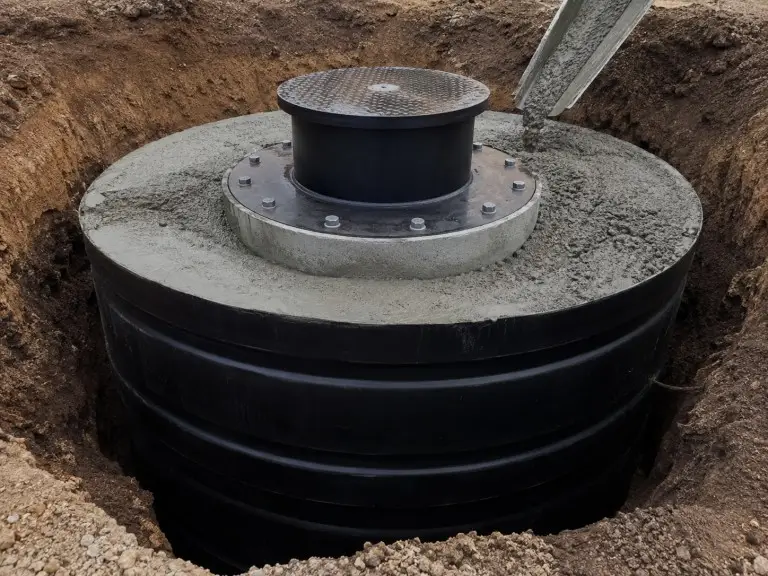
Underground
Specified in black HDPE with load-rated flanged covers and a flanged access riser. It requires concrete surround or engineered backfill, and the cover load rating must be confirmed as pedestrian, light vehicle, or heavy vehicle.
Capacity Range: 100 L to 25,000 L Standard; Multi-Tank for Larger
Our standard production range is 100 L to 25,000 L. For total storage requirements above 25,000 L, we configure multi-tank banks with a common manifold, shared level control, and coordinated overflow-drain routing — engineered as a system rather than a collection of individual tanks. Custom single-tank engineering above 25,000 L is available on request.
Color Selection and UV Stabilization
Black
UV inhibitors are compounded into the LLDPE resin before molding for through-material protection. Black UV-stabilized LLDPE is recommended and specified for outdoor service in Southeast Asia, the Middle East, and Africa.
White / Cream
Food-grade specification for indoor potable and beverage service. It allows visual inspection, but direct high-UV outdoor sunlight will cause algae without shading.
Blue
Conventional water service identification where local pipework color coding applies. Useful for multi-tank installations where potable water and raw water service lines require at-a-glance differentiation without opening access covers. Material grade stays the same as black or white; color is the choice.
Custom RAL
Available for OEM system packages where brand or project color standards apply. Custom RAL production requires longer lead time than standard black, white, or blue runs; confirm the RAL code and order quantity at the inquiry stage so production scheduling is aligned before the order is placed.
Lid and Access Options
- Vented screw lid — standard for tanks 500 L or below; atmospheric equalization during fill and drain cycles.
- Flanged bolted manhole — standard above 1,000 L; sealed lid integrity with personnel access.
- Ladder-access manhole — standard above 10,000 L where interior maintenance access is required.
Fittings and Accessories
- Threaded BSP or NPT: 1 in. to 4 in. for standard pipework connections.
- Flanged: DN50 to DN200 for large-diameter process pipework.
- Bulkhead fittings with EPDM or FPM gaskets for wall-mount connections.
- Sump outlet at the tank base for complete drainage without residual pooling.
9 standard accessories: Float valve port · Level sensor port · Overflow tube · Vent pipe · Tank stand · Saddle supports · Insulation wrap · Skid frame · Custom documentation
All fitting positions are molded into the tank shell during production. Field drilling of PE tanks is structurally inadvisable and voids the manufacturing integrity of a rotomolded vessel.
Black LLDPE is opaque to visible and UV radiation throughout the wall thickness; this is a through-material property of the pigmented resin, not a surface finish. That matters in warm climates because light-driven algae growth inside a white outdoor tank can foul downstream filter media within the first operating season. White or cream tanks remain the right choice for indoor potable and beverage service because the operator can inspect clarity and wall condition without opening a dark vessel.
Capacity above 25,000 L is not treated as a simple catalog upsizing exercise. We configure multi-tank banks with balanced inlet manifolds, coordinated overflow and drain routing, common level control, and isolation logic so one tank can be cleaned or serviced without shutting down the full water treatment train. For rooftop tanks, we also review slab loading and delivery access; for underground tanks, the HDPE body, riser, cover rating, backfill, and traffic load all become part of the engineering scope.
Accessory selection is tied to how the tank will be controlled in the system. A float valve port supports automatic fill control, a level sensor port supports ultrasonic, float-switch, or electrode detection, and an overflow tube protects the installation from overfill when upstream pumps continue running. Vent pipe sizing must match fill flow so the vessel is never pressurized during rapid filling.
PE Plastic Water Tanks Across Five Application Contexts
PE tanks occupy multiple positions in a water treatment train — from raw water pre-storage and RO permeate collection to softener brine, chemical dosing, and commercial fire reserve. The correct tank specification differs by position; the following covers each application context with sizing logic and material requirements.
RO Permeate Storage — Potable and Food-Grade
White food-grade virgin LLDPE eliminates metallic migration risk and allows visual inspection of water clarity. A 10 m³/h RO system with a 6-hour buffer requires 60,000 L, typically split across a two- or three-tank manifolded bank. For bottled water plants — beverage lines, bottling, dairy — food-grade material compliance is confirmed at engineering review.
Softener Brine Tank
LLDPE is widely used for water softener brine service — no lining or cathodic protection required. A 2,000 L brine tank at 200 L/day draw provides approximately a 10-day operating reserve. Sizing depends on resin volume, regeneration frequency, and brine draw concentration; confirm compatibility for high-concentration or unusual liquids.
Chemical Dosing Day Tank
Antiscalant, coagulant, and dilute disinfectant at working concentration are within the LLDPE compatibility envelope for standard water treatment applications. Typical sizes are 100–500 L for commercial systems. For concentrated bleach stock, oxidizing acids, or proprietary blends, we run a compatibility review before confirming a PE specification.
Raw Water Pre-Storage — Intermittent Supply Sites
Where borehole pump cycles, variable municipal pressure, or rainwater harvesting creates intermittent supply, a pre-storage tank lets RO and filtration equipment run at steady design flow. Typical sizing is 6–12 hours of treatment feed demand. A 10 m³/h system with an 8-hour buffer requires 80,000 L, normally split across multiple tanks. Black UV-stabilized LLDPE prevents algae growth that would foul pre-filter media downstream.
Hotel and Commercial Building Water Reserve
PE tanks serve as rooftop gravity reserves, fire protection reserves, and cooling tower make-up tanks. A 5,000 L LLDPE rooftop tank is significantly lighter than a stainless equivalent — a practical structural loading advantage. Underground fire reserves use black HDPE with rated covers. Compatible with water filtration systems for commercial use packages.
Technical Specifications for Industrial PE Water Storage Tanks
The following specification table covers our standard PE plastic water tanks product range. Values apply to rotomolded LLDPE construction under standard operating conditions unless stated otherwise. Consult engineering for conditions outside the stated boundaries.
| Parameter | Specification |
|---|---|
| Standard capacity range | 100 L – 25,000 L; custom engineering available for larger |
| Material grades available | LLDPE (standard), HDPE (structural/underground) |
| Manufacturing method | Rotational molding – seamless one-piece construction |
| Tank orientations | Vertical cylindrical, horizontal cylindrical, underground |
| Operating temperature range | -20 °C to +60 °C continuous (non-pressure service) |
| Operating pressure rating | Non-pressure – atmospheric vented only; not rated for positive pressure |
| Specific gravity limit | SG <=1.5 standard walls; consult engineering for SG >1.5 |
| Chemical compatibility | Potable water, dilute NaCl brine at any concentration, chlorinated water <=200 ppm, dilute acids/alkalis; verify concentrated or reactive chemicals |
| UV stabilization | Standard for outdoor-grade tanks; UV inhibitors compounded into resin, not surface-applied |
| Color options | Black, white/cream, blue, custom RAL |
| Lid/access options | Vented screw lid <=500 L; flanged bolted manhole >1,000 L; ladder-access manhole >10,000 L |
| Standard inlet/outlet fittings | BSP/NPT threaded 1 in.-4 in.; DN50-DN200 flanged; bulkhead fittings |
| Accessories | Float valve port, level sensor port, overflow tube, vent pipe, insulation wrap, tank stand, saddle supports, skid frame |
| Base requirement | Flat, continuous, stable surface; no point-load supports; no underground penetrations beneath tank base |
| Service life | 10+ years industrial service under standard operating conditions |
| Manufacturing quality system | ISO 9001. CE documentation confirmed by supplied package and destination market. Resin documentation, food-contact declarations, and project-specific test reports available on request. |
| OEM/ODM | Available – custom capacity, color, fitting layout, accessories, documentation |
Applicable Standards & Documentation Scope
| Item | Scope |
|---|---|
| ASTM D1998 | Reference standard for one-piece rotationally molded polyethylene tanks; applicable where project specifications require |
| Potable water contact | NSF/ANSI 61 or FDA 21 CFR 177.1520 per tank model, resin grade, fitting, and gasket — confirm applicable standard at inquiry by destination market and end use |
| Resin documentation | Virgin LLDPE / HDPE resin COA, SDS, and food-contact declaration available on request |
| Manufacturing quality system | ISO 9001 certified; CE documentation confirmed by supplied package and destination market |
| Factory QC | Wall thickness inspection, fitting leak test, dimensional check, and packing inspection included with every order |
| Project documents | GA drawing, nozzle layout, and packing list supplied with order; factory test report available on request |
When PE Is Not the Right Choice for Your Project
PE plastic water tanks cover a wide application range, but they have defined limits. The following boundary conditions are stated explicitly so you arrive at the correct tank material before the order is placed.
Operating Temperature Above 60 °C
LLDPE and HDPE tank walls begin to deflect under hydrostatic load when continuous liquid temperature exceeds 60 °C, below the material melting point. Hot water buffer tanks, solar thermal storage, and process hot water pre-storage exceed this boundary. For temperature-controlled storage above 60 °C, our insulated water tanks with stainless steel inner vessels and polyurethane insulation are the correct solution.
Pressurized Service of Any Kind
All PE storage tanks in our range are atmospheric-vented, non-pressure vessels for gravity feed and gravity drain, with the interior equalizing through the vent at all times. If your system includes a pressurized feed tank, pressure accumulator, or any vessel operating above atmospheric pressure, PE is the wrong category. There is no pressure-rated PE tank in our range.
Steam Clean-In-Place (CIP) or Validated Sterilization
Where cleaning-in-place at steam temperatures is required — common in dairy, beverage, and pharmaceutical production — PE cannot withstand steam-temperature cleaning cycles and is not appropriate for validated sterilization. Our stainless steel water tanks with electropolished interiors and chemical cleaning spray balls are the engineering standard for this condition.
Underground Installation with Vehicular Cover Loads
Standard vertical LLDPE tanks are designed for above-grade installation on a flat slab. Underground installation subjects the tank to soil pressure, backfill compaction forces, and surface traffic loads that require HDPE material and a load-rated cover assembly. Confirm excavation dimensions, cover load rating, and surround material specification at inquiry stage.
Concentrated Chemical Storage — Compatibility Review Required
Dilute water treatment chemicals fall within PE compatibility at standard working concentrations. Concentrated oxidizing acids, sodium hypochlorite above standard disinfection concentrations, or industrial blends outside standard water treatment use require a compatibility review. In some chemical storage applications, our FRP water tanks with application-specific liner construction are the correct solution.
One-Piece Rotomolded Construction and Manufacturing Standard
Every PE plastic water tank we supply is produced by rotational molding — a manufacturing process that forms the entire tank body as a single, seamless piece from the base to the lid flange. There are no welded seams, no bonded joints, and no internal surfaces cast into multi-piece shells.
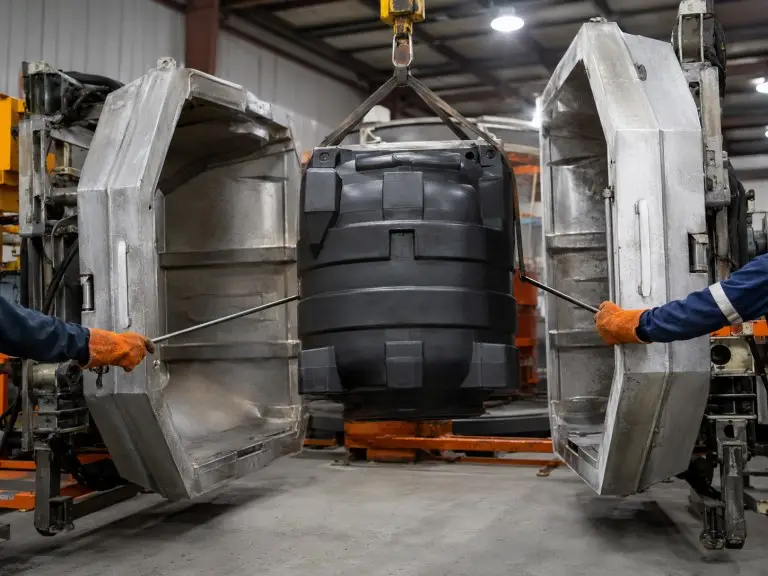
This construction method matters in water treatment applications because seam failure — joint delamination, weld bead cracking, or adhesive bond degradation — is the primary long-term failure mode in multi-piece alternatives. A rotomolded PE tank has no seam to fail. Wall thickness is uniform throughout the tank body; the process distributes material evenly across corners and curved transitions, rather than thinning at bends as can occur with injection or blow molding. This uniform wall geometry is the engineering basis for our SG and temperature boundary statements. We use food-grade virgin LLDPE or HDPE resin in standard water storage tank production, and UV stabilizers are compounded into the resin before molding.
Established in 2016, Qingdao Hiju Thermal Power Co., Ltd operates from a 70,500 sqm facility with 21,000 sqm of production workshop in Qingdao. Our team includes 78 technicians and 28 engineers supporting production, quality inspection, and project engineering. We export to more than 20 countries and regions across Southeast Asia, the Middle East, Africa, South America, and Central Asia.
OEM and ODM production is available for tank capacity, body color, fitting layout, accessory package, labeling, and documentation. For project packages, we coordinate the tank specification with upstream pumps, filters, softeners, RO systems, dosing equipment, and downstream distribution so the delivered tank does not require field drilling or improvised pipework.