
Stainless Steel Water Tanks
When your process demands that stored water arrive at downstream equipment in precisely the condition it left your treatment system, material selection is not an afterthought. Stainless steel water tanks are the correct choice where potable water purity, RO permeate integrity, or food-grade compliance cannot be compromised by material leaching, rough-surface biofilm accumulation, or structural inadequacy under sustained load. We manufacture SUS304 and SUS316L tanks in both modular assembled-panel and shop-fabricated welded-cylindrical configurations, from 0.5 m³ compact building-supply units to 2,000 m³ and above for industrial buffer and fire protection reserve applications.
Choose the Right Grade First: SUS304 or SUS316L
The most consequential specification decision on a stainless steel tank project is material grade. Most buyers ask the question after they have already priced the tank; we ask it during the first engineering conversation because specifying 304 in a 316L environment, or over-specifying 316L where 304 is entirely adequate, both produce the wrong outcome — either early pitting failure or unnecessary capital cost.
The key metallurgical difference is molybdenum. SUS316L contains 2–3% molybdenum, which significantly improves resistance to pitting corrosion initiated by chloride ions. SUS304 does not contain molybdenum and is susceptible to pitting in sustained chloride-aggressive environments, particularly when surface temperature rises.
| Application Condition | Chloride Exposure | CIP / Cleaning Agent | Recommended Grade | Surface Finish |
|---|---|---|---|---|
| Potable water supply, municipal water source, most commercial building storage | Low municipal treated water | Periodic alkaline rinse | SUS304 | 2B or BA standard |
| RO permeate / demineralized water buffer from a non-chloride source | Negligible | Periodic flush | SUS304 | 2B standard |
| RO permeate buffer downstream of seawater or brackish-water desalination | Residual chloride possible | Agent per process owner | SUS316L | 2B or electropolished |
| Coastal or marine-environment installation | Airborne chloride present | Per maintenance schedule | SUS316L | 2B minimum |
| Food-grade ingredient water, CIP-cleaned process vessels, beverage contact storage | Low to moderate; chlorinated CIP agents possible | Chlorinated alkaline or acid cleaning cycle | SUS316L | Electropolished, available to food-grade surface finish on request |
| Pharmaceutical purified water or WFI buffer | Negligible closed system | Validated cleaning cycle | SUS316L | Electropolished to hygienic design standard on request |
| Fire protection reserve from municipal supply | Low | Infrequent flush | SUS304 | 2B standard |
| Industrial process cooling water in a closed treated loop | Low to moderate | Per chemical treatment programme | SUS304 or SUS316L depending on inhibitor chemistry | 2B standard |
NOTE — Regulated Applications: For pharmaceutical purified water, WFI-related buffer, and semiconductor-grade applications, tank configuration must be reviewed against the required sanitary design standard, surface finish specification, documentation package, and validation scope. Final compliance must be confirmed against the user’s process specification, validation protocol, and applicable local standard.
Our position: SUS304 is the correct grade for the majority of potable water, building supply, general industrial buffer, and fire reserve applications where the source water is municipal-treated and chloride-aggressive environments are absent. SUS316L becomes mandatory for chloride-aggressive water, coastal installations, aggressive chemical cleaning with chlorinated agents, and any application where the process owner specifies electropolished hygienic surfaces.
We supply both grades from our own workshop and confirm grade recommendation as part of every project review — not as a default upcharge. For projects in food production where downstream compliance requirements shape the tank specification, see our bottled water plants to understand how the full treatment train, from source water through to storage, is specified as an integrated system.
Construction Type: Welded Cylindrical vs. Modular Assembled Panel
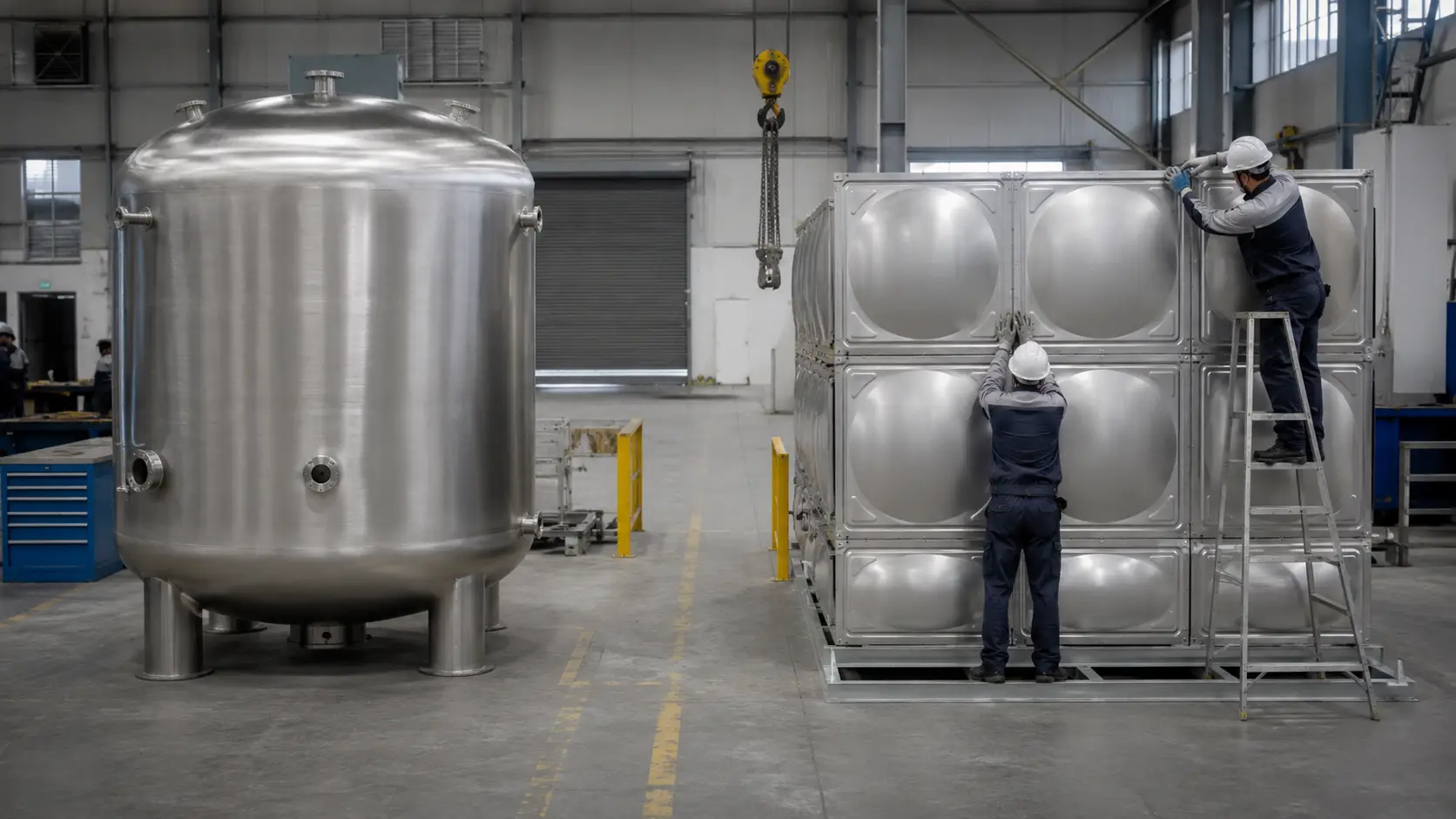
Both types use stainless steel sheet at the grade you specify. The construction method determines sealing reliability, site assembly complexity, shipping logistics, pressure capability, and long-term inspection requirements. Understanding this trade-off before ordering saves significant project cost.
| Criterion | Welded Cylindrical | Modular Assembled Panel |
|---|---|---|
| Sealing method | Continuous TIG-welded seams; no gaskets in the primary structure. | Pressed stainless steel panels bolted together with food-grade elastomeric gaskets at every joint — EPDM standard for potable-water and non-aggressive service; silicone for elevated-temperature food applications; NBR as alternative where available. Gasket material confirmed against stored water chemistry, temperature, disinfectant exposure, and any food or potable-water contact documentation requirement. |
| Pressure capability | Atmospheric and pressurized; rated to project requirement; ASME-qualified units for pressure vessel service. | Atmospheric storage only, open-top or vented; not suitable for sustained positive pressure. |
| Site assembly | Shop-fabricated units arrive complete; very large diameter vessels require on-site welding. | Panels ship flat and are assembled on-site by trained installation crew using torque-specified bolting; no welding required on site. |
| On-site labour requirement | Shop units need crane and rigging crew only. Field-welded large tanks need certified welders, hot-work permit, and post-weld inspection such as radiographic or dye penetrant testing. | Standard installation crew with torque wrench and panel lifting equipment; assembly is shorter because no hot-work permit, certified welder mobilisation, or post-weld inspection is required on site. |
| Shipping | Finished cylindrical vessel; diameter limits container-shipped sizes; large tanks require over-dimension transport. | Flat-packed panels fit standard 20-ft or 40-ft containers regardless of final tank volume; freight economics improve for large or remote-site projects. |
| Panel standard | Not applicable. | Standard panel sizes: 1,000 x 1,000 mm, 1,000 x 500 mm, 500 x 500 mm; capacity designer-selectable by length x width x height combination. |
| Wall thickness | 2 mm-6 mm depending on diameter and working pressure. | 1.5 mm-3 mm sheet; internal structural supports up to 6 mm for larger panel configurations. |
| Best for | Pressurized buffer tanks, sterile pharmaceutical storage, high-integrity hygienic vessels, and smaller capacity up to about 50 m³ for shop fabrication. | Large atmospheric storage from 100 m³ to 2,000 m³+, site-access-limited installations, and projects where container shipping is cost-critical. |
| Inspection schedule | Annual visual inspection; no gasket wear component. | Annual inspection including gasket condition check and bolt re-torque if indicated; gaskets are a serviceable consumable with replacement budgeted every several years depending on chemical exposure and thermal cycling. |
| Lead time driver | Shop welding capacity and vessel size. | Panel manufacturing lead time and on-site crew availability. |
Engineering note on on-site welding costs: Buyers who compare a modular panel tank price to a field-welded large-diameter tank unit price are not comparing the same project cost. A field-welded stainless steel tank requires certified welders, hot-work permits for enclosed or rooftop installation sites, post-weld cleaning and passivation, and in many jurisdictions a third-party weld inspection. These items routinely close the apparent unit cost gap between modular and field-welded options, and in some site conditions exceed it. We make this visible at quotation stage so your project budget is accurate.
Applications and Buyer Scenarios
Stainless steel tanks serve fundamentally different functions depending on process position. The design requirements — grade, surface finish, accessories, and connections — differ meaningfully between applications. Use the table below to locate your scenario, then confirm with us during the engineering review.
| Application | Required Grade | Typical Capacity Range | Key Design Requirement | Notes |
|---|---|---|---|---|
| RO / DM permeate buffer tank | SUS304 for non-chloride source or SUS316L for seawater/brackish desalination | 2 m³–200 m³ | Materials must not re-introduce contamination; hygienic filter vent; fully drainable; no dead legs. | Immediately downstream of RO or DM system, upstream of distribution or second-pass feed. |
| Hotel and commercial building domestic water supply | SUS304 | 5 m³–100 m³ | Manhole access, level indicator, overflow and drain, internal ladder, vent, and dosing port if required. | Replace concrete or galvanized steel cisterns; superior hygiene baseline; for integration see water filtration systems for commercial use. |
| Fire protection reserve | SUS304 | 20 m³–500 m³ | Volume must meet local fire code; outlet at low point for fire pump suction; compliant overflow or drain; level alarm connection. | Municipal supply fill, static storage, low maintenance frequency, no treatment equipment required in most configurations. |
| Food-grade ingredient water | SUS316L | 1 m³–50 m³ | Electropolished interior available on request; spray-ball clean-in-place connection; sloped bottom; hygienic vent; no external surface dead legs. | Source is post-RO or post-softener treated water; chemical cleaning cycle must match grade and finish. |
| Pharmaceutical purified water buffer | SUS316L | 0.5 m³–20 m³ | Hygienic design, electropolished interior available on request, weld documentation, passivation certificate, orbital welding on connections if specified. | Confirm process owner’s validation requirements before specifying; we supply to hygienic design, while GMP validation is buyer’s process-owner responsibility. |
| Industrial process cooling water | SUS304 or SUS316L | 5 m³–500 m³ | Working pressure if pressurized; chemical treatment dosing connection; level control; make-up water inlet; drain. | Grade depends on cooling water chemistry and inhibitor programme — send water treatment report for grade confirmation. |
Process position decides the specification
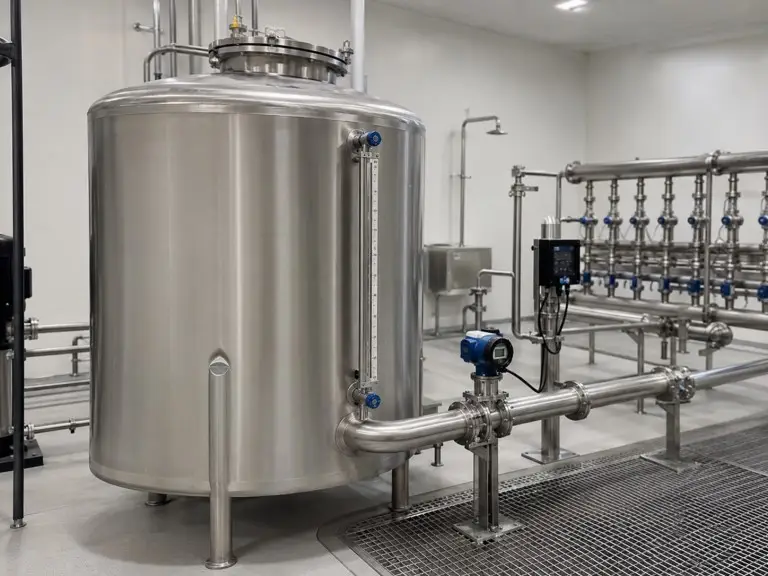
A fire reserve tank and a pharmaceutical purified-water buffer may both be stainless steel, but they are not the same product. The first is code volume, suction connection, overflow, and inspection access. The second is surface finish, weld documentation, passivation, drainability, and validation support.
We review the operating position before finalizing grade, surface finish, accessories, and connection schedule so the tank supports the treatment train instead of becoming a contamination, access, or maintenance weak point.
Engineering Decisions and Boundary Conditions
When Stainless Steel Is Not the Right Choice
Stainless steel water tanks are not the correct choice for every project. Being clear about the boundaries reduces misquotes and prevents the more serious outcome of a tank failure in service.
- Do not use stainless steel without liner upgrade or specialist consultation for concentrated acids such as hydrochloric acid, sulphuric acid, or phosphoric acid at elevated concentration. These corrode both 304 and 316L through different attack mechanisms; lined steel or HDPE are the appropriate choices.
- Do not use stainless steel for concentrated alkalis above pH 13 at elevated temperature without specialist review.
- Do not assume SUS316L is unlimited in sustained high chloride concentration combined with elevated temperature. Even 316L has a practical pitting threshold in hot chloride-aggressive media; send water quality data if uncertain.
- For potable water applications where the budget constraint makes stainless steel unviable and low chemical-interaction risk justifies a composite alternative, PE plastic water tanks cover cost-sensitive domestic water and light commercial applications within PE’s envelope.
- For large open-yard storage where tensile-to-weight ratio and UV resistance outweigh hygienic surface requirements, FRP water tanks are the appropriate alternative within GRP’s chemical compatibility range.
- Where thermal performance is the primary design driver — solar buffer, hot-water storage, or cold-water hold in high-ambient environments — insulated water tanks address thermal requirements that grade selection alone does not resolve.
If your application sits at a boundary — moderate chloride, intermittent chemical contact, or mixed service conditions — send us the water analysis. The recommendation is made on the actual condition, not a default assumption.
Potable-water contact certification such as NSF/ANSI/CAN 61, WRAS, ACS, or local authority approval is confirmed by destination-market requirement and project specification — not a default standard scope for all catalogue tanks. Confirm at inquiry with destination country and application.
Common Engineering Mistakes and Boundary Conditions
Specifying 304 for a coastal installation
Buyers in Middle East or Southeast Asian coastal projects sometimes default to 304 because it is familiar and less expensive. In our experience, 304 tanks in coastal outdoor exposure without protective coating commonly show surface pitting within a few years, with the rate depending on distance from shoreline, prevailing wind direction, and surface cleaning frequency. 316L is the minimum grade for outdoor coastal exposure; protective coating is still advisable in high-salt-spray zones regardless of grade.
Comparing modular panel price to welded price without total project cost
A modular panel tank quoted at a lower unit price and a field-welded vessel at a higher unit price are not equivalent comparisons until hot-work permits, certified welder day rates, post-weld inspection fees, access scaffolding, fire-watch staff, and insurance endorsements are added. We provide both types and will give a straightforward total-cost comparison for your site conditions.
Assuming atmospheric tank connections can be upsized on site
Connections — inlet, outlet, drain, manhole, and sensor ports — are set during fabrication. Drilling or cutting stainless steel panels on site without controlled passivation creates localized corrosion sites. Order the complete connection schedule before fabrication. If equipment is added after installation, plan for a formal field modification with re-passivation.
Oversizing the tank without considering water turnover
Long residence time in a potable water tank at ambient temperature accelerates disinfectant depletion and potential biological regrowth. For municipal-supply potable water storage, size to a realistic turnover cycle, typically a full tank turnover at least every 24–48 hours as recommended by most water authority hygiene guidelines. A 200 m³ tank for a facility using 10 m³ per day creates a hygienic maintenance problem that no tank material resolves without a robust disinfection programme.
Not accounting for floor load when planning modular panel tanks
A 100 m³ modular panel tank filled with water exerts approximately 100 tonnes of dead load on the floor structure, plus tank weight and dynamic load from fill and drain cycling. Many buyers specify tank capacity and installation floor without providing a structural load assessment. We request floor load data as a standard quote input for installations above ground level.
Stainless Steel Water Tank Specifications
| Material grade | SUS304 / SUS316L; specify at order because grade cannot be changed post-fabrication. |
|---|---|
| Tank type | Modular assembled panel; shop-fabricated welded cylindrical; horizontal cylindrical on saddles. |
| Capacity range | 0.5 m³ to 2,000 m³ and above; panel tank volume designer-selectable by L x W x H configuration (capacity above approximately 500 m³ subject to site structural assessment, crane access, hydrostatic load, and applicable local code). |
| Working pressure | Atmospheric open-top or vented standard; pressurized closed vessels available, rated to project requirement per applicable standard. |
| Panel size | 1,000 x 1,000 mm / 1,000 x 500 mm / 500 x 500 mm pressed stainless panels. |
| Wall thickness | 1.5 mm-3 mm sheet for panel type, height-dependent; 2 mm-6 mm welded cylindrical; internal structural supports up to 6 mm. |
| Surface finish | 2B standard; BA; electropolished to food-grade surface finish available on request for food and pharma applications. |
| Standard connections | Inlet, outlet, bottom-flush drain, overflow, manhole top or side, level-sensor ports, vent for open tanks, or pressure-relief valve for closed tanks. |
| Accessories | Internal/external ladder, handrail, float valve, level indicator, insulation jacket optional, heating-element port optional, spray-ball CIP connection available for food/pharma units. |
| Standards | CE; ISO 9001; ASME available for pressure vessel applications — confirm scope at quotation. |
| Customization | Custom geometry, non-standard panel configuration, connection layout, integrated skid, OEM/ODM available. |
All specifications above apply to standard configuration. Custom requirements — non-standard working pressures, oversized manholes, special connection schedules, seismic anchoring, elevated temperature service — are reviewed case by case. Send your project requirements for a configuration recommendation.
Hygienic and Food/Pharma Documentation Scope
- Material certificate: SUS304 / SUS316L mill certificate per batch.
- Surface finish report: available when electropolishing is specified.
- Passivation record: completed post-welding, supplied on request.
- Weld map and weld inspection record: available on request for hygienic-design vessels.
- CIP spray ball, sanitary vent, sloped bottom, full drainability: confirmed at design stage for food/pharma units.
- GMP validation: buyer’s process-owner responsibility; we support with documentation but do not contract validation.
Stainless Steel Water Tank Manufacturing and Quality Assurance
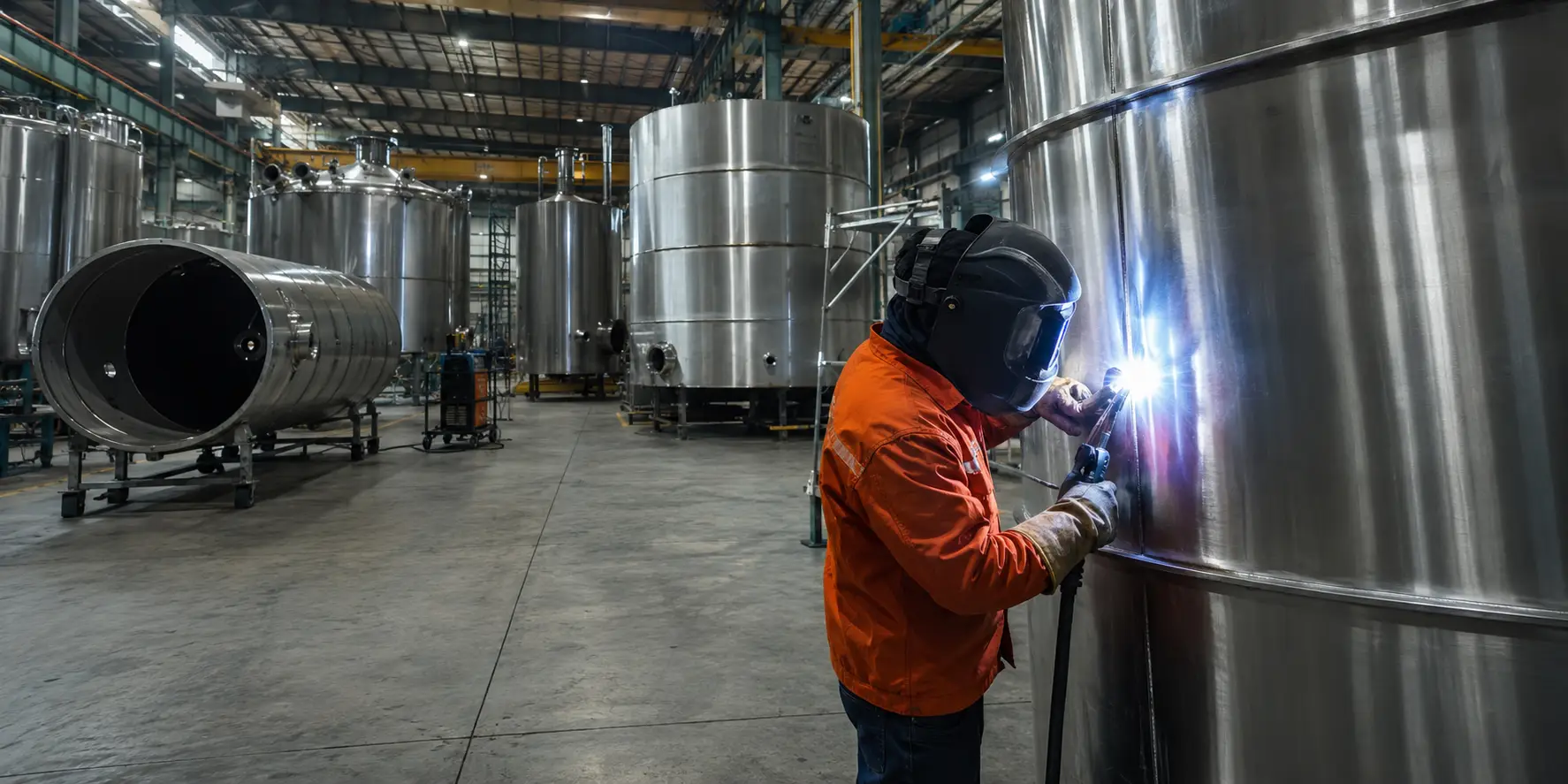
Every tank we ship leaves our Qingdao fabrication workshop, where all stainless steel seams are TIG-welded by certified welders and post-weld passivation is completed before shipment. Electropolished surface finish is available for food-grade and hygienic-design applications; we do not claim a specific Ra value as a universal standard offering because the target finish specification is confirmed with the process owner during engineering review.
Modular panel tanks use precision-pressed panels with torque-specified bolting and food-grade elastomeric gaskets at every joint. Panel forming tolerances are held to minimize gasket face irregularity, which is the primary site of long-term seal degradation.
21,000 m²
Fabrication workshop
70,500 m²
Total facility footprint
78
Technicians
28
Engineers
Certification scope is stated clearly
Certifications: CE, ISO 9001, ASME. Our ASME qualification supports pressure vessel fabrication where this code is required; atmospheric storage tanks are manufactured under ISO 9001 quality management with CE marking for export compliance. Certificate scope is confirmed at quotation — we do not apply pressure vessel code stamps to atmospheric storage units, and we do not misrepresent the applicable standard.
We have exported water treatment equipment and storage tanks to 20+ countries and regions, with primary markets in Southeast Asia, Middle East, Africa, South America, and Central Asia. OEM and ODM manufacturing is available for distributors and system integrators who require custom branding, modified geometry, or private-label documentation.
What to Send Us for a Requirements-Based Review
We size, grade-specify, and configure every stainless steel tank order against your actual project conditions. Send us the following:
- Application — potable water supply / RO or DM permeate buffer / fire protection reserve / food-grade ingredient water / pharmaceutical PW buffer / industrial process water / other.
- Required net capacity — in m³; if you have a daily demand and turnover cycle, send both.
- Water quality data — if available: source water TDS, chloride content, pH, temperature; if RO permeate, confirm RO system and source water type.
- Material grade preference — or describe the operating environment and we confirm the grade recommendation.
- Construction type preference — modular panel or welded cylindrical; if no preference, describe site access constraints and we recommend.
- Working pressure — atmospheric open/vented or pressurized; if pressurized, state required operating pressure in MPa or bar.
- Connection schedule — inlet pipe size, outlet pipe size, drain, manhole location top or side, sensor ports, and special connections.
- Downstream equipment — pressurization pump set, UV sterilizer, distribution system, or other.
- Installation site — indoor/outdoor; floor level or rooftop; floor load capacity if above grade; headroom; available rigging or crane access.
- Shipping destination and project timeline — country, port, or site address; estimated order date and required delivery window.