
Water Storage Tanks Supply for Industrial Water Treatment
We manufacture and supply stainless steel, PE, FRP, insulated, brine, raw water, and pure water storage tanks — covering every storage stage from raw water intake through RO permeate and ultrapure water distribution. Whether your project calls for food-grade vessels, corrosion-resistant fiberglass, or a pressurized variable-frequency supply unit, we configure the right tank from a single factory source. Manufactured under ISO 9001 QMS; CE documentation and ASME scope provided where applicable to the specific tank type and destination market.
Water Storage Tanks Supply: Products for Every Project Stage
The eight products in our water storage family cover a capacity range from 100 L brine tanks through multi-hundred cubic metre industrial vessels. The first selection variable is always material and function: what the tank holds, at what pressure, and at what temperature determines which product is the correct starting point.
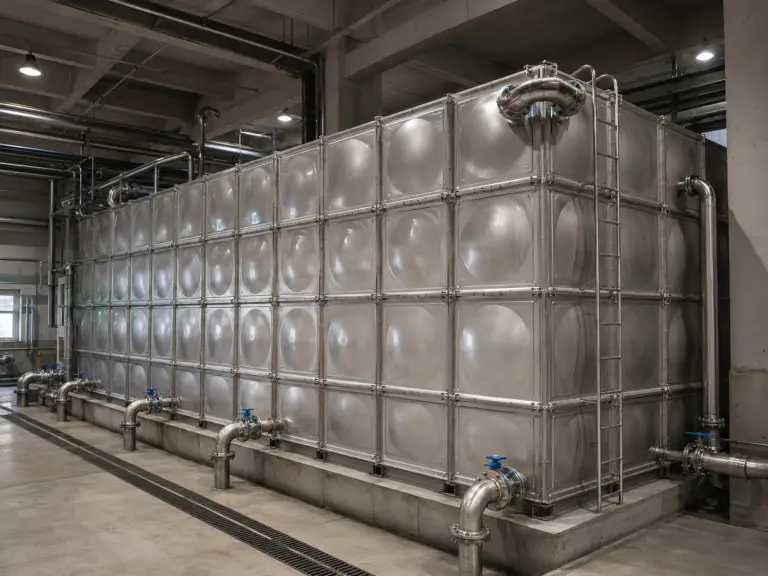
Stainless Steel Water Tanks
Food-grade and industrial storage in SUS 304 for standard applications; SUS 316 where elevated chloride concentration or pharmaceutical hygiene standards apply. 0.5–500 m³.
Stainless Steel Water Tanks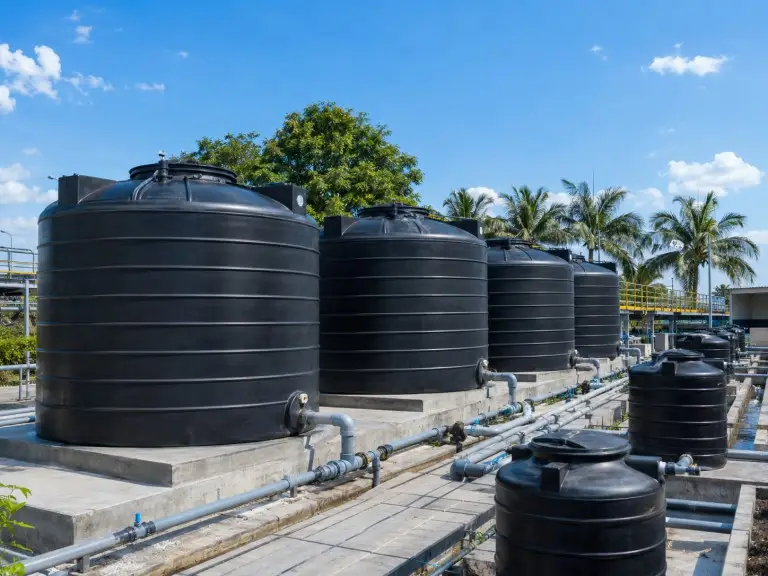
PE Plastic Water Tanks
Atmospheric-pressure storage for raw water, brine, and chemical dosing solutions. Chemically inert to most acids, alkalis, and saline water. 0.1–100 m³.
PE Plastic Water Tanks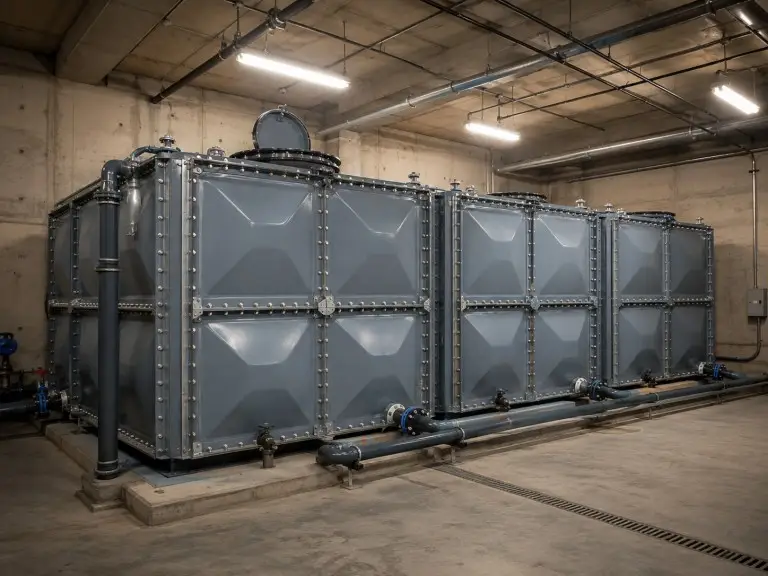
FRP Fiberglass Water Tanks
Large-volume corrosion-resistant tanks for aggressive industrial process water, high-salinity, and acidic media where metal corrosion is a maintenance risk. 1–500 m³+.
FRP Fiberglass Water Tanks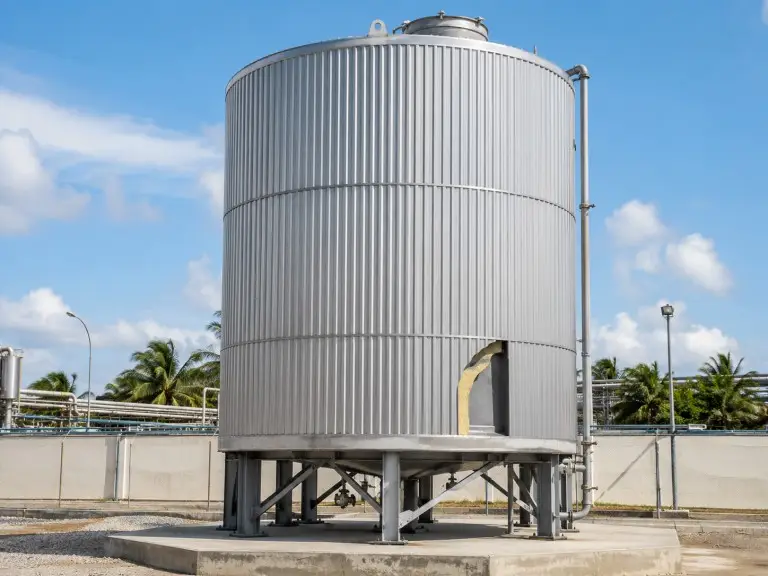
Insulated Water Tanks
Hot water storage and cold-climate outdoor installations. Polyurethane foam jacket sized to the operating temperature differential and ambient conditions. 0.3–50 m³.
Insulated Water Tanks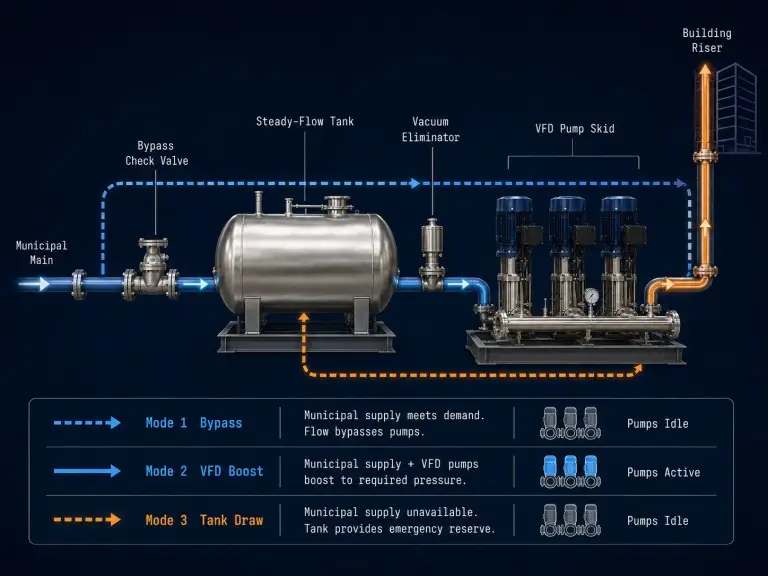
Non-Negative Pressure Water Supply Equipment
Variable-frequency pump sets for high-rise buildings — direct municipal mains connection, superimposing pump pressure without a break tank or negative-pressure risk.
Non-Negative Pressure Water Supply Equipment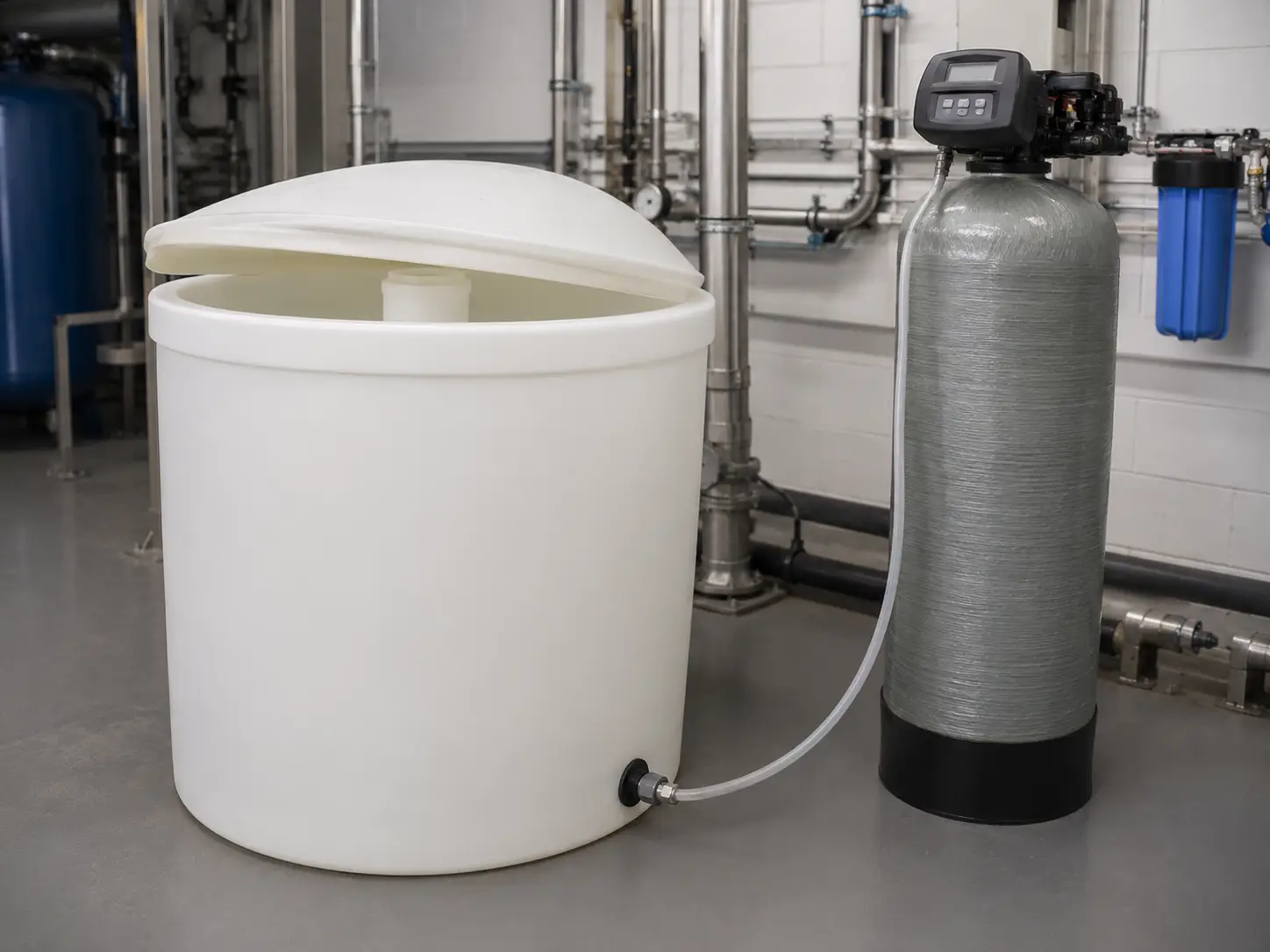
Salt Tanks and Brine Tanks
Saturated NaCl brine storage for ion-exchange water softener regeneration. Sized to match the softener salt dose per cycle and regeneration interval. 100–2,000 L.
Salt Tanks and Brine Tanks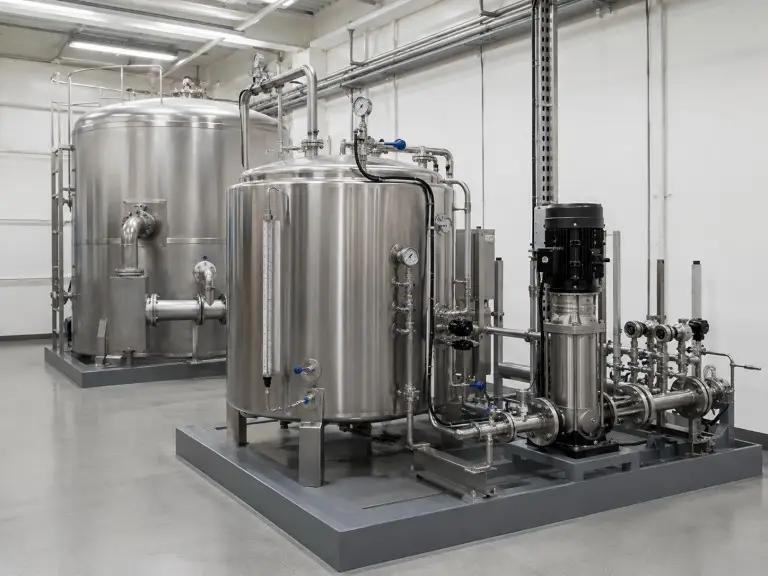
Raw Water Intermediate Tanks
Buffer storage decoupling source supply from the pre-treatment train. PE for standard mineral raw water; FRP for high-salinity, acidic, or corrosive source water. 1–200 m³.
Raw Water Intermediate Tanks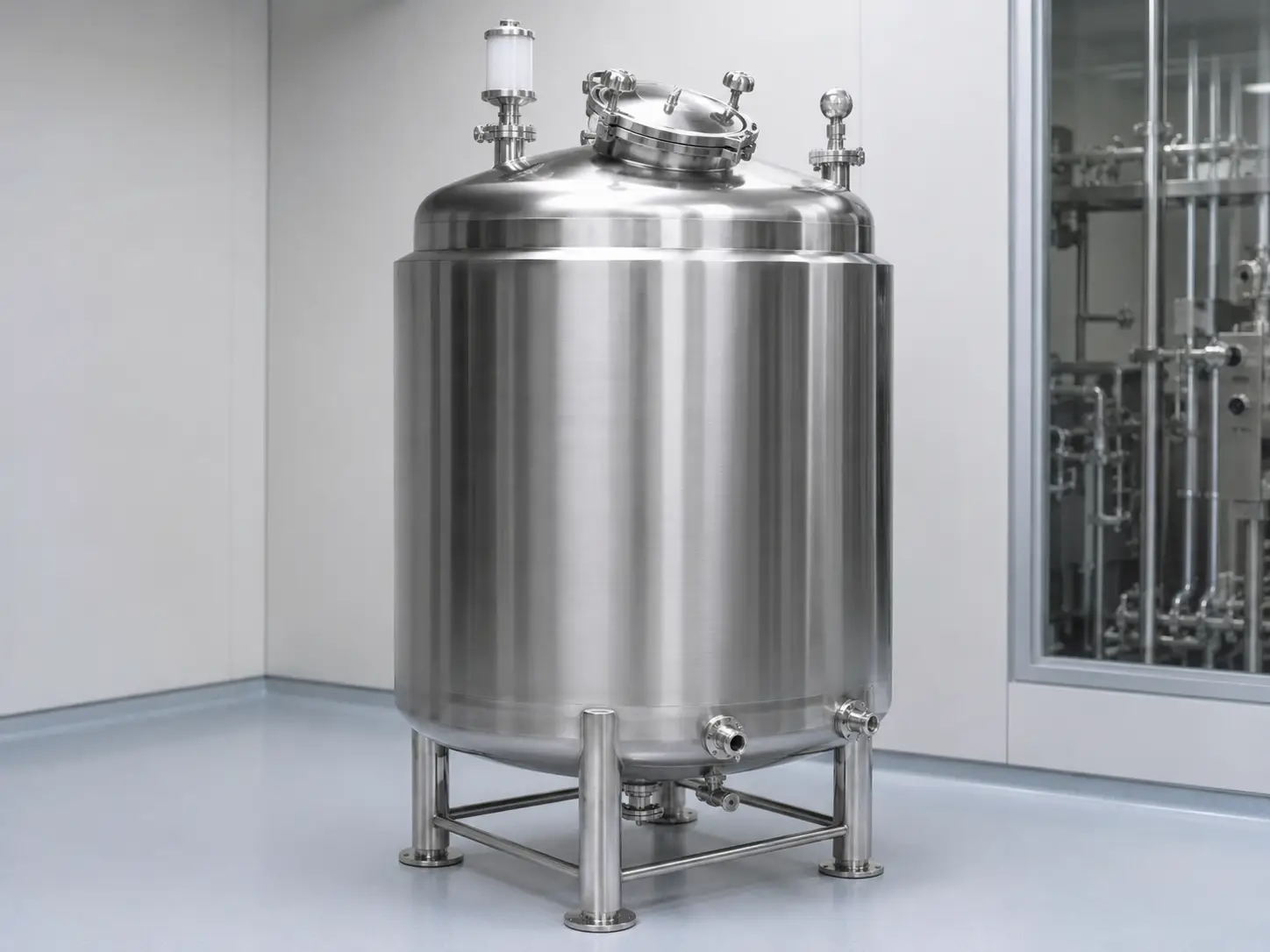
Pure Water Storage Tanks
RO permeate and EDI product water storage in non-leaching food-grade PE or electropolished sanitary stainless steel, with 0.2 µm sterile vent filter required. 0.5–100 m³.
Pure Water Storage TanksChoose the Right Tank Material Before You Size the System
The material type governs everything downstream: pressure rating, temperature boundary, water compatibility, and regulatory compliance. The table below maps six material families across the variables that matter for water storage tanks supply selection. Use it as an initial routing guide — final material specification is confirmed during our engineering review against your project’s water analysis, operating conditions, and regulatory requirements.
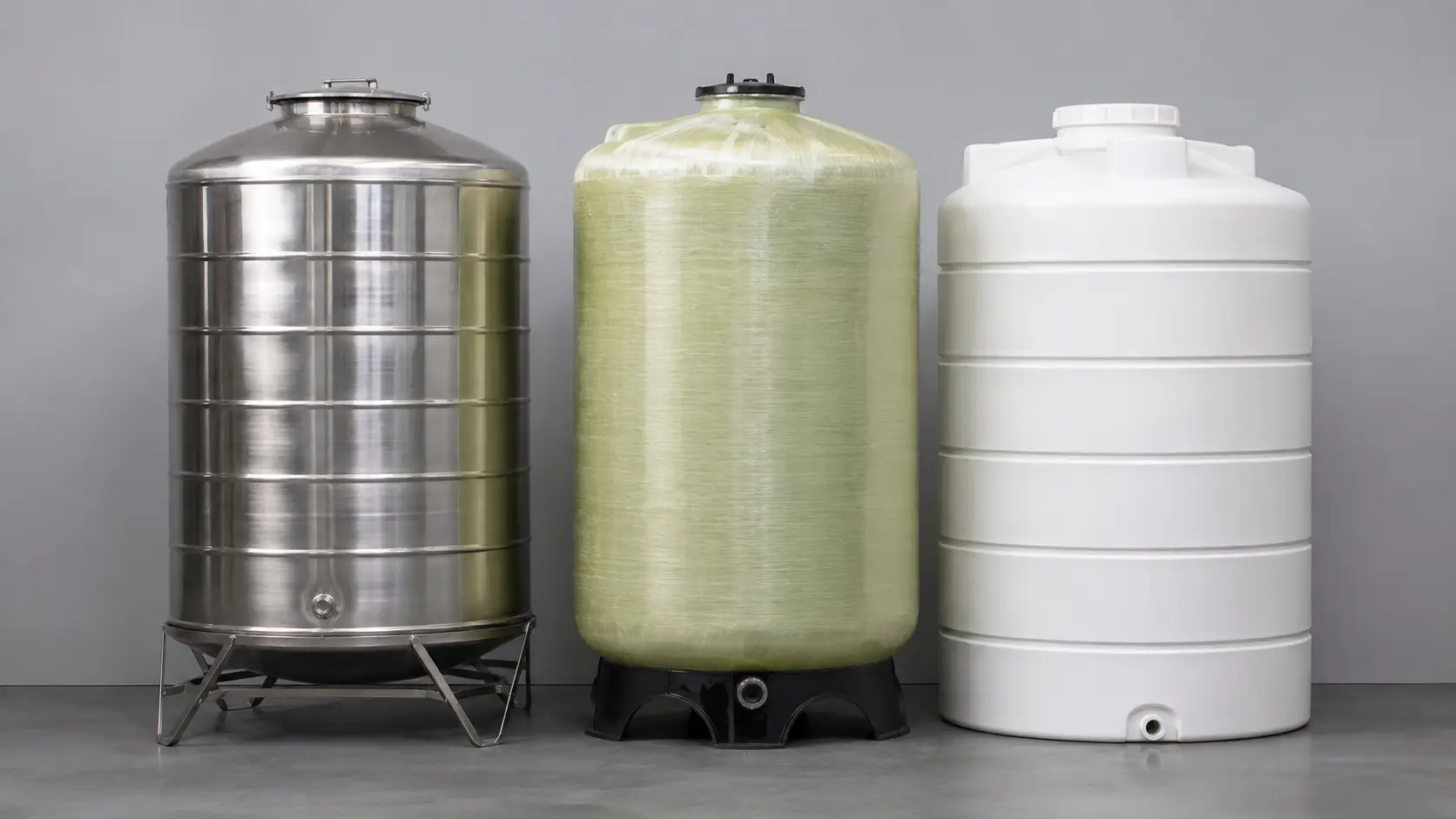
| Material | Stored Water | Pressure Boundary | Temperature Range | Capacity Range | Key Limitation | Manufacturing Scope / Compliance Notes |
|---|---|---|---|---|---|---|
| SUS 304 Stainless Steel | Potable, food-grade, RO permeate, general industrial | Atmospheric or pressurized vessel | -10°C to 100°C | 0.5 m3 – 500 m3+ | Elevated chloride content: use SUS 316 instead | CE documentation; ISO 9001 QMS; food-grade contact material grade |
| SUS 316 Stainless Steel | Potable water with elevated chloride, seawater desalination permeate, pharmaceutical | Atmospheric or pressurized vessel | -10°C to 100°C | 0.5 m3 – 500 m3+ | Higher material cost than 304; not required for low-chloride fresh water | CE documentation; ISO 9001 QMS; food-grade / pharmaceutical-grade contact material grade |
| HDPE / PE | Raw water, brine, chemical solutions, agricultural water | Atmospheric only – not for pressurized supply | -20°C to 60°C | 0.1 m3 – 100 m3 | Not for pressurized supply; not above 60°C | CE documentation; ISO 9001 QMS; food-grade PE resin for applicable grades |
| FRP / GRP | Corrosive process water, industrial wastewater, saline/acidic water | Low to medium, design-specific | -30°C to 80°C | 1 m3 – 500 m3+ | Not suitable for food-grade contact without food-safe liner; not for high-purity water | CE documentation; ISO 9001 QMS; food-safe liner resin required for potable-water contact |
| SUS + PU Insulation | Hot water supply, cold-climate storage | Matches inner vessel material | 4°C to 95°C hot; -20°C ambient cold | 0.3 m3 – 50 m3 | Insulation specification must be confirmed against ambient temperature differential | CE documentation; ISO 9001 QMS |
| PE Brine Tank | Saturated NaCl brine for softener regeneration only | Atmospheric | Ambient, 5-40°C | 0.1 m3 – 2 m3 | Not for general water storage; sized per regeneration cycle | CE documentation; ISO 9001 QMS |
Chloride note: The decision point between SUS 304 and SUS 316 turns on chloride ion concentration in the stored or circulating water. This threshold is not a fixed number that applies universally — it depends on temperature, pH, dissolved oxygen, and contact time. We ask for your water analysis data at inquiry so we can confirm the appropriate steel grade for your project rather than defaulting conservatively to the higher-cost option where it is not warranted.
Design standards reference: PE tanks — atmospheric use only; food-grade resin specification confirmed by application. FRP tanks — resin type, liner, design pressure, and wall thickness confirmed per project. SS tanks — material grade, plate thickness, weld inspection, and hydrostatic test by configuration. Pressure vessels — ASME Section VIII or equivalent where applicable. Drinking water contact — NSF/ANSI 61 / WRAS / ACS per destination market; confirm at inquiry.
Applicable Standards & Documentation Scope
| Item | Scope |
|---|---|
| ISO 9001 | Quality management system for factory and supply process |
| CE documentation | Applicable where required by EU directives for the specific tank type and destination market; confirm at inquiry |
| ASME | Applicable to pressure vessels or pressure-rated assemblies only; available on request |
| Material certificate | SUS 304/316 mill cert; PE food-grade resin certificate; FRP laminate specification — available on request |
| Hydrostatic / leak test | Available for pressure vessels and sanitary tanks on request |
| Drinking water contact | NSF/ANSI 61 / WRAS / ACS — confirm by destination market and application; not default for all standard catalogue tanks |
| GMP / FDA / USP / EP | Project-specific configuration required; not standard catalogue scope — confirm requirements at inquiry |
If Your Project Is This Type, Here Is Your Storage Equipment Route
Different industries put water storage equipment under different constraints. The temperature requirements of a food factory CIP station, the pressure requirements of a high-rise hotel supply system, and the material compatibility requirements of a municipal chlorination process each route to a different tank type. Use the four scenarios below to match your project type to the correct starting point.
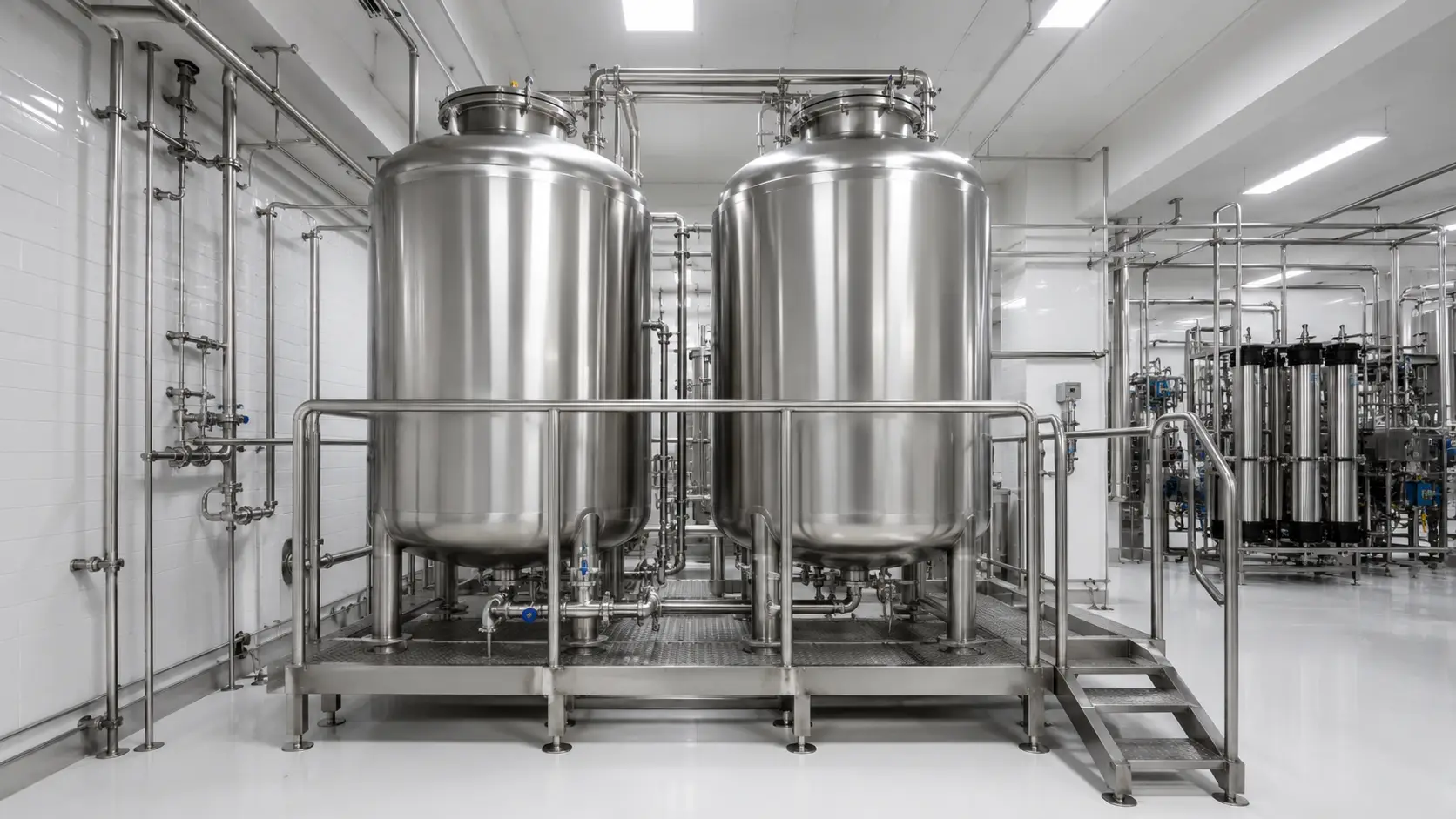
Food and Beverage Manufacturing Water Storage
Food and beverage plants require ingredient water, CIP water, cooling water, and boiler feed, each with different quality and temperature profiles. SUS 304 or SUS 316 tanks are used where water contacts product directly, while CIP hot water is typically held in an insulated stainless tank at 70-85°C. Raw water ahead of pre-treatment can use PE or FRP depending on chemistry.
Hotels and Commercial Building Water Supply
High-rise hotels and commercial buildings need pressure support to upper floors and thermal storage for peak domestic hot water demand. A non-negative pressure unit superimposes variable-frequency pump pressure on the mains connection, while an insulated tank at 60°C or above holds domestic hot water reserve. The plant room softener also requires a correctly sized brine tank.
Municipal and Community Drinking Water Supply
Municipal and community water supply projects need large-volume raw water and treated water storage to handle daily demand peaks and interruption resilience. A PE or FRP raw water intermediate tank buffers intake source flow against treatment plant steady throughput. Treated water is held downstream of filtration and disinfection in stainless steel or FRP depending on local water chemistry.
Water Treatment System Integration – Softener, RO, and Filtration Plants
System integrators usually need storage equipment at three or more points: brine tank sized to the softener regeneration salt dose, raw water buffer tank sized for RO feed continuity during backwash cycles, and pure water storage sized to RO permeate output versus downstream peak demand. Because we manufacture these tanks alongside softeners, filters, RO systems, high-pressure pumps, and membranes, we configure storage volumes to match cycle times instead of treating the tank as an afterthought.
For complete system context — storage equipment integrated with filtration, softening, and disinfection — see our food and beverage water treatment, hotel and commercial building water treatment, and municipal and community drinking water solution pages.
Where Storage Equipment Fits in Your Complete Water Treatment System
In a complete water treatment flow scheme, water storage tanks supply equipment appears at multiple functional points — and each requires a different specification. The four integration points below describe how each storage equipment type connects to the upstream or downstream process stage it serves.
Raw Water Intake Buffer
A PE or FRP atmospheric tank at the source intake decouples supply reliability from treatment plant operation. Without it, any pump downtime, mains pressure variation, or filter backwash starves the downstream train.
Buffer volume = flow rate (m³/h) × interruption time (h) + backwash reserve + safety margin
Softener Brine Preparation
The brine tank holds dry NaCl and dissolves it to produce saturated brine at ~26% concentration. Volume must cover at least one full regeneration cycle without refilling — undersizing causes hardness breakthrough, often misdiagnosed as resin failure.
Volume = full regeneration dose ÷ 315 g/L (NaCl at ~26% saturation)
Post-RO Permeate Storage
RO membranes produce permeate at a constant low flow rate; downstream demand is variable. Without a storage buffer, the RO system cycles on and off at peak demand rate, causing pressure transients that shorten membrane life. Food-grade PE or sanitary SS with 0.2 µm sterile vent is required.
Buffer = peak demand flow − RO steady output; 0.2 µm sterile vent mandatory
Building Supply Pressurization
Where mains pressure cannot reach upper floors, a non-negative pressure unit maintains direct mains connection and superimposes only the required boost — preserving residual mains pressure as a base and eliminating the break tank atmospheric drop.
VFD output = demand − mains residual; minimum residual pressure must be confirmed
Built and Export-Certified at Our Qingdao Factory Since 2016
We have been manufacturing water treatment equipment at our Qingdao facility since 2016. All storage equipment is designed, fabricated, quality-inspected, and pre-shipment tested in-house before export.
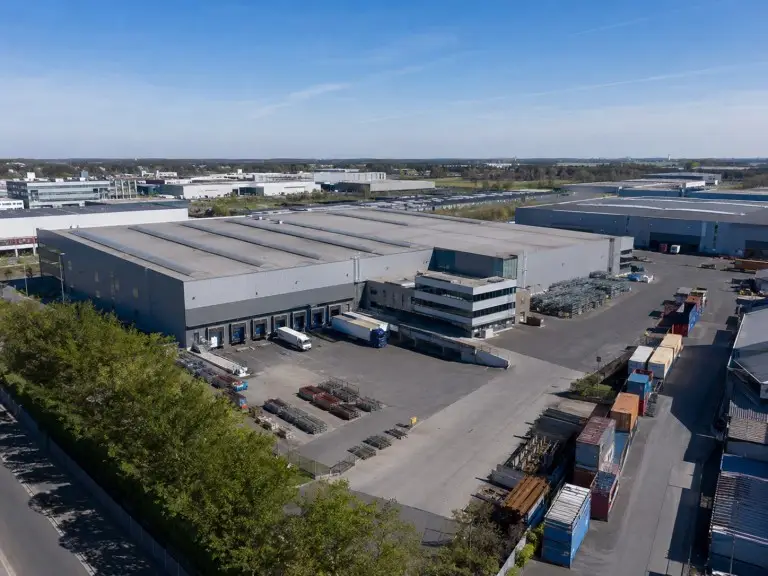
Established in 2016, our Qingdao facility handles design, fabrication, quality inspection, and pre-shipment testing in-house before export. All storage equipment leaves the factory with documentation confirming material grade, dimensional inspection, and applicable certification scope.
CE documentation and ISO 9001 certification are standard with our export shipments. ASME-related documentation scope is reviewed for applications where pressure vessel certification is required — applicable to the specific tank type and destination-market requirements, not uniformly across all tank types.
Custom manufacturing is available for buyers who require custom dimensions, outlet configurations, nameplate branding, or material grades beyond our standard range. All custom scope is confirmed at engineering review stage. Exported markets include Southeast Asia, Middle East, Africa, South America, and Central Asia.
Five Mis-Selection Patterns That Cause System Problems in the Field
Most specification errors in water storage tanks supply selection are not obvious at procurement — they surface during commissioning or field operation. The five patterns below are the most frequently corrected at our engineering review stage.
PE Tank on a Pressurized Supply Line
PE tanks are atmospheric-pressure vessels. Connecting one to a pressurized supply line — often on cost grounds or because a PE tank is already on site — deforms the tank wall at the connection point under sustained pressure, eventually causing joint failure.
SUS 304 in Elevated-Chloride Water
Coastal groundwater, desalination permeate with residual chloride, and long-contact chlorinated municipal water all drive pitting corrosion in SUS 304. The damage is microscopic and invisible until the inner surface is significantly compromised.
Standard Tank for RO Permeate Storage
RO permeate is low-TDS and highly susceptible to recontamination. Ordinary PE leaches trace organics that elevate TOC; unpolished stainless steel surfaces harbour biofilm in a low-flow tank environment. Water quality achieved upstream is negated in storage.
Brine Tank Volume Undersized for Regeneration Cycle
A brine tank smaller than one full regeneration dose runs dry mid-cycle. The softener draws dilute or absent brine through the resin bed, producing hardness breakthrough — regularly misdiagnosed as resin fouling or degradation rather than brine starvation.
Uninsulated Tank in a Sub-Zero Outdoor Installation
An uninsulated SS or PE tank where ambient drops below 0°C loses stored water temperature rapidly. In dead-leg sections or low-flow periods, water freezes, expands, and cracks fittings or tank wall connections — typically on the first severe frost of the season.
Inputs Required to Prepare Your Storage Equipment Configuration
To prepare a water storage tanks supply configuration and quotation for your project, we need the following information. You do not need to have all details finalised at first contact; the more you can provide, the more specific our preliminary recommendation will be.
- Application type: drinking water / food-grade / pharmaceutical / industrial process water / chemical storage / softener brine / RO permeate / building supply
- Required storage volume: m3 or litres; peak demand flowrate if relevant
- Source water quality: water analysis or TDS / hardness / chloride ion / pH / temperature range if available
- Operating temperature: stored water temperature; ambient temperature range at installation site, especially minimum ambient for outdoor installations
- Operating pressure: atmospheric storage or pressurized supply; downstream equipment operating pressure if relevant
- Installation location: indoor / outdoor / rooftop / basement; above-ground / underground; climate zone
- Downstream equipment: softener / RO system / filter train / hot water distribution / point-of-use outlets
- Outlet and fitting configuration: number of inlet and outlet connections, inspection manhole requirement, overflow, drain, instrument connections
- Certifications and export requirements: destination country; any specific certification standard required by project specification or local authority
- Project timeline and quantity: project start date, delivery window, number of units or total volume
Frequently Asked Questions
The questions below address the most common material selection, system integration, and compliance decisions buyers face when specifying water storage equipment for export projects.