
Commercial RO Water Filter System for Tap and Municipal Water Feed
We engineer commercial and industrial reverse osmosis systems for tap water and municipal feed sources. When your supply line is city water, treated surface water, or low-TDS municipal supply and your process requires reliable dissolved-solids reduction, a tap-water-fed commercial RO machine is the route we evaluate first.
Our engineering team reviews your feed water analysis before finalizing system configuration. Flow rate, operating pressure, pretreatment scope, and recovery design are outputs of that review, not fixed catalog numbers.
Is Tap Water RO the Correct Route for Your Project?
A tap-water-class system applies when feed TDS stays below approximately 1,000 ppm and the source is municipal or treated surface water. The table below lists the inlet parameters we check — any value outside these boundaries shifts the system to a different route.
| Parameter | Tap Water RO Fit Condition | Notes |
|---|---|---|
| Feed TDS | ≤ approximately 1,000 ppm | Municipal and tap water typically ranges 100-600 ppm. Above 1,000 ppm requires a different membrane class. |
| Feed turbidity | < 5 NTU before pretreatment; < 1 NTU at RO membrane inlet | Pretreatment selection depends on raw turbidity. |
| SDI | ≤ 3 at RO membrane inlet | SDI above 3 at the membrane indicates insufficient prefiltration. |
| Free chlorine | Residual oxidants removed; non-detectable free chlorine at membrane inlet | Standard polyamide TFC membranes require complete dechlorination. We design to achieve non-detectable free chlorine, verified by ORP or inline free-chlorine monitoring where required. |
| Total hardness | Softening or antiscalant dosing required; threshold depends on recovery target | Above 200 ppm CaCO₃, we typically specify a softener; below that, antiscalant dosing at 3–5 ppm controls scaling at standard recovery rates of 65–75%. |
| Iron content | < 0.05 ppm recommended at membrane inlet | Higher iron requires upstream oxidation and filtration. |
| Manganese | < 0.05 ppm recommended at membrane inlet | Control logic mirrors iron; upstream filtration is added when the water analysis shows manganese above the inlet threshold. |
| Silica | Reactive silica above 20 ppm requires silica-specific antiscalant | Standard polycarboxylate antiscalants do not control silica scale effectively; silica above 20 ppm triggers a phosphonate-free or silica-targeted formulation selected during design. |
| pH | Optimal range 6.5–7.5 at membrane inlet | pH below 4 or above 11 risks membrane hydrolysis. Feed pH above 7.5 increases carbonate scaling tendency; acid dosing to 6.5–7.0 is added when LSI calculations indicate scaling risk at the target recovery rate. |
| Water temperature | Typical design range 10°C-35°C | Temperature affects membrane flux and recovery calculation. |
| Required product water quality | General TDS reduction for most tap-water applications | If ultra-pure output is required for pharmaceutical or electronics use, review the double-pass route. |
The values above are Hiju preliminary design targets for tap-water-fed RO projects. Final limits depend on membrane model, feed-water analysis, recovery target, temperature, scaling projection, and pretreatment design.
Feed TDS above approximately 1,000 ppm
Groundwater, well water, or blended brackish sources need higher-TDS review rather than tap-water-class membranes. This feed condition routes to brackish water reverse osmosis.
Feed TDS above approximately 10,000 ppm
Seawater or high-salinity brine requires a high-pressure SWRO route where salinity, intake quality, and corrosion exposure are reviewed separately — see our seawater desalination system page for that route.
Ultra-pure product water target
Tap water RO is typically the first pass. A second-pass treatment stage is required for pharmaceutical or electronics ultra-pure output.
Route confirmation before quotation
If your feed water sits near a boundary — TDS around 800–1,200 ppm, or variable seasonal quality — describe the source in the quote form. Boundary-condition feeds may need BW-grade membranes even on a municipal line.
What Your Tap Water Feed Needs Before the RO Membrane
Pretreatment scope is determined by your feed water analysis, not by a standard package. Our design team specifies the sequence after reviewing your water report, and the stages below are the standard elements we evaluate for every tap-water-fed RO project.
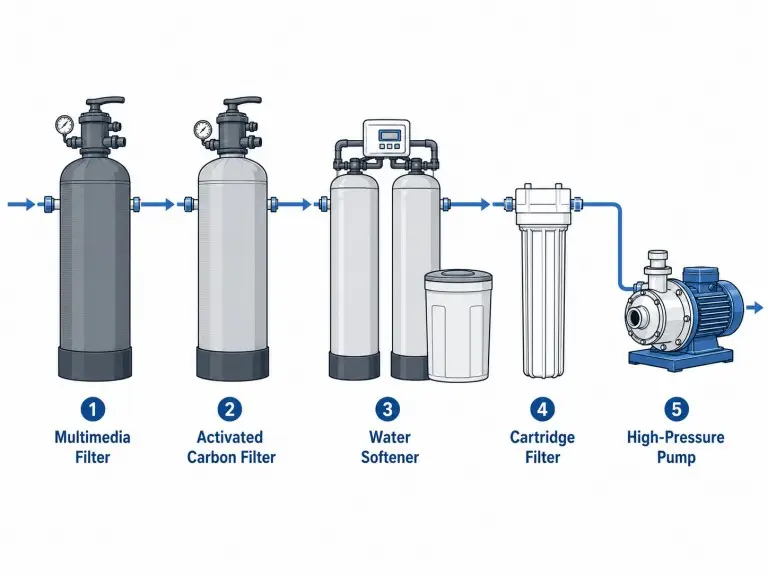
What the pretreatment review produces
The pretreatment sequence below is confirmed from water analysis, flow target, membrane inlet limits, and the required product-water quality. Each stage has a specific inlet threshold that triggers its inclusion.
Why pretreatment failures cause most RO problems. Systems reaching us for troubleshooting — premature fouling, short cleaning intervals, early flux decline — nearly always trace the cause to a pretreatment gap. In export projects across Southeast Asia and Africa, seasonal variation in municipal chloramine levels and blended-source iron content are the two most common mismatches we catch during design review.
1. Sediment and Turbidity Control
We include a multimedia filter when raw feed turbidity is above 1 NTU or when suspended particulate load is variable. Multimedia filtration targets suspended solids, sediment, rust particles, and visible turbidity, bringing the water to the SDI level required at the RO membrane inlet.
2. Chlorine Removal
Municipal water carries free chlorine or chloramine as disinfectant. We specify activated carbon filtration sized to the chlorine concentration and flow rate. Chloramine removal is more design-sensitive than free chlorine — catalytic or extended-contact carbon is required rather than standard granular carbon. Final carbon bed sizing is confirmed from the water analysis.
3. Hardness and Scaling Control
Calcium and magnesium ions in tap water form carbonate and sulfate scale on the membrane surface. We evaluate water softener sizing versus antiscalant injection based on hardness level, target recovery rate, and system capacity. High-silica water requires specific antiscalant chemistry selected during design.
4. Iron and Manganese Removal
Tap water from systems that blend treated surface water with groundwater can carry residual iron or manganese above the membrane inlet limit. In export project reviews, especially in Southeast Asia and parts of Africa where blended municipal networks are common, we have seen iron levels shift between seasons as the surface-to-ground blend ratio changes.
5. Final Particle Guard
A 5-micron or finer cartridge filter sits immediately upstream of the high-pressure pump as the last prefiltration stage. This protects the membrane array from particles that pass through upstream stages.
Standard Process Flow from Raw Tap Water to Treated Product Water
We follow a defined sequential process to convert raw tap or municipal feed water into treated permeate. Whether the best commercial reverse osmosis system for your project is a single-rack skid or a multi-train containerized plant, the process stages below remain the same — what changes is component sizing, membrane count, and post-treatment scope.
Process review boundary. The sequence below is the standard process carrier for tap-water-fed RO. For a 500 ppm municipal feed targeting 65% recovery, a single-stage 4-element array with 8–12 bar operating pressure is a typical starting configuration — final figures come from your water analysis.
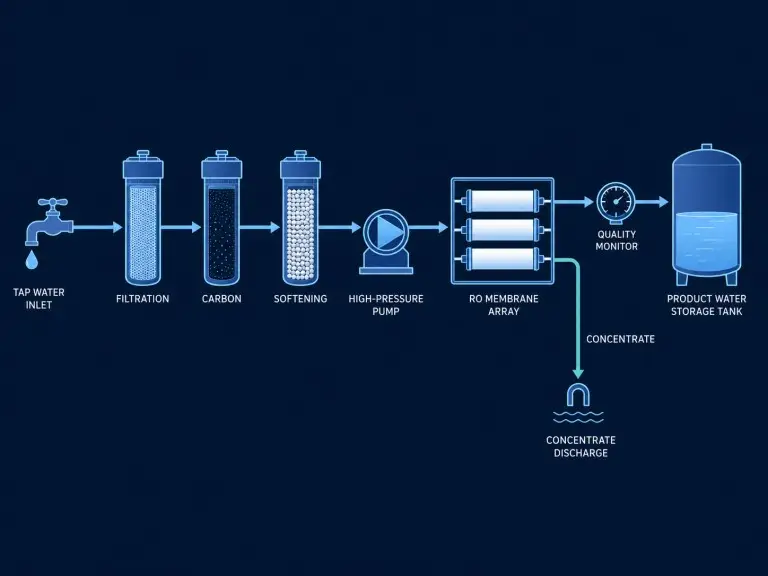
Raw Feed Water Intake
Feed water enters from the municipal supply or tap water source. Inlet pressure and available flow are checked against design requirements.
Multimedia Filtration
The raw feed passes through multimedia filtration when specified to reduce suspended solids and turbidity.
Activated Carbon Filtration
Free chlorine, chloramine, organic compounds, and taste-and-odor compounds are treated before membrane contact.
Softening or Antiscalant Dosing
Hardness ions are removed by softener or controlled by metered antiscalant injection according to water analysis.
5-Micron Cartridge Filter
The treated feed passes through the final cartridge filter before the high-pressure pump.
High-Pressure Pump
The pump is sized to the design recovery target and operating pressure determined by feed TDS and temperature.
RO Membrane Array
Dissolved salts, hardness, silica, and trace organics are rejected at the membrane surface while permeate passes through.
Quality Monitoring
Product water is collected and passed through inline conductivity or TDS monitoring instrumentation.
Concentrate Discharge
Concentrate is discharged according to local effluent requirements. Reuse options are reviewed when water conservation is a constraint.
Post-Treatment
Product water may require UV sterilization, pH adjustment, carbon dioxide stripping, or re-mineralization by application.
Specification and Operating Variables for Tap Water RO
All values in this table are configurable engineering variables for a commercial RO water filter system sized to your feed water. None represent a fixed product specification — final figures are determined after reviewing your water analysis report, required flow rate, application, and installation environment.
| Parameter | Engineering Variable | How It Is Determined |
|---|---|---|
| Feed water TDS | ≤ approximately 1,000 ppm for tap water route | Confirmed from water analysis report. |
| Required product flow rate | Defined by buyer in m³/day or GPD | Primary sizing input; peak and average flow are both requested. |
| Operating pressure | Typically 8–15 bar for tap water feed (150–500 ppm TDS) | Calculated from feed TDS, target recovery rate (typically 65–75% for tap water), and membrane manufacturer flux tables at the design temperature. |
| Target recovery rate | Typically 65–75% for tap water feed | Recovery above 75% increases scaling risk exponentially; exact limit is set by antiscalant dosing capacity and concentrate disposal constraints. |
| Salt rejection rate | 95–99.5% depending on membrane element and operating conditions | New membranes typically reject 98–99.5% at rated conditions; rejection declines with membrane age, higher temperature, and lower pressure. Product water conductivity for 300 ppm feed is typically 3–15 µS/cm. |
| Turbidity at membrane inlet | Target < 1 NTU | Achieved through pretreatment design and confirmed before the membrane stage. |
| SDI at membrane inlet | Target SDI ≤ 3 | Pretreatment is sized to achieve this target from raw feed conditions. |
| Free chlorine at membrane inlet | Non-detectable (design target < 0.1 ppm) | Achieved through carbon filtration or chemical reduction; verified by ORP or inline free-chlorine monitoring. |
| Iron at membrane inlet | < 0.05 ppm recommended | Upstream treatment added when raw water iron exceeds threshold. |
| pH range | Monitored; adjusted as needed | pH outside range affects scaling tendency, compatibility, and upstream adjustment requirements. |
| Water temperature range | Typical design range 10°C-35°C | Design accounts for seasonal temperature variation at the installation site. |
| Post-treatment options | UV, pH adjustment, CO₂ stripping, re-mineralization | Added based on end-use specification and regulatory requirements. |
| Control system | Standard panel or PLC touch-screen | Configuration option confirmed at quotation. |
| Frame / skid type | Skid-mounted or containerized | Configuration option reviewed and confirmed per project. |
| Power supply | Voltage, phase, and frequency | Confirmed by installation country and site condition. |
All values are Hiju preliminary design references, not fixed product specifications or universal industry standards. Final parameters are confirmed after engineering review of your feed-water analysis, membrane selection, and project requirements.
How to use this table
Share your feed water analysis report and required product flow rate when you contact us. Our engineering team works through each row and returns a sized proposal with component selection, pretreatment scope, and a configuration recommendation.
Skid-Mounted, Containerized, Control, and OEM Options
A tap-water-fed commercial reverse osmosis system can be configured as skid-mounted, containerized, or hybrid depending on installation environment and project logistics. Configuration is confirmed at quotation after reviewing your site conditions.
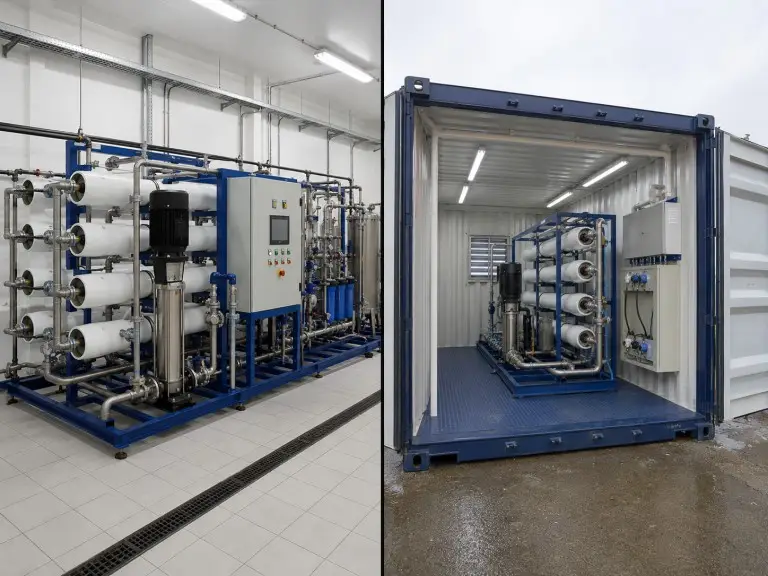
Skid-Mounted Systems
We supply skid-mounted commercial RO systems for installation inside plant rooms or treatment buildings. The skid integrates pretreatment, high-pressure pump, membrane vessels (typically 2–6 per rack at 4-inch or 8-inch diameter), instrumentation, and PLC control onto a single base. Standard skid footprint for a 5 m³/h system is approximately 3.5 m × 1.2 m.
Containerized Systems
Where indoor installation is not available — remote sites, construction projects, or export locations with limited civil infrastructure — we engineer the system inside a 20-ft or 40-ft shipping container. Containerized units include internal lighting, ventilation, chemical dosing cabinet, and membrane flushing provisions. Typical lead time is 8–12 weeks from order confirmation.
Control System Options
We offer standard electrical panel control and PLC-based touch-screen control. Selection is confirmed based on operator skill level, required automation, and whether remote monitoring integration is part of the project scope.
OEM and Custom Label
OEM and ODM configurations are available — custom frame color, labeling, documentation language, and component selection are discussed during the initial project review.
Post-Treatment Module Integration
We integrate UV sterilization, pH adjustment, carbon dioxide stripping or degassing, and re-mineralization when specified by the application. Post-treatment scope is finalized based on your application and local regulatory requirements.
Where a Commercial RO Water Filter System Is Specified
Tap-water-fed commercial RO systems serve multiple industries wherever a municipal or treated surface water supply needs further reduction of dissolved solids, hardness, or general quality improvement for downstream use.
Food and Beverage Production
Process water quality directly affects taste, shelf life, microbial stability, and regulatory compliance. Boiler feed, rinse water for CIP circuits, ingredient water, and cooking water benefit from RO-treated municipal feed. We cover this application on our bottled water plants page.
Pharmaceutical and Laboratory First Pass
In pharmaceutical and electronics manufacturing, tap water RO functions as the first stage that reduces TDS, hardness, and organics before a DI water system polishes product water to final purity. Final compliance must be confirmed against the user’s process specification, validation protocol, and applicable local standard.
Hospitality and Commercial Buildings
Hotels, resorts, and large commercial buildings in regions with hard or high-TDS municipal water use tap water RO for drinking water, kitchen preparation water, laundry conditioning, cooling tower makeup, and boiler feed.
Industrial Boiler Feed and Cooling Tower Makeup
RO-treated water reduces scaling and corrosion in steam boilers and heat exchangers. Recovery rate design and pretreatment selection are driven by boiler operating pressure and blowdown management requirements.
Municipal Drinking Water and Community Supply
Municipal authorities and project developers use tap-water-fed RO systems to improve distributed water quality when incoming municipal supply exceeds drinking water TDS or hardness standards.
Electronics and Semiconductor Pretreatment
Rinse water preparation, ultra-pure water feed, and process cooling begin with feed TDS reduction that allows downstream ion exchange or EDI polishing to work efficiently. Final water quality compliance must be confirmed against the specific semiconductor process specification and facility requirements.
What Our Engineering Team Needs to Prepare Your Proposal
To prepare an accurate system proposal, our engineering team needs the following information about your project. A water analysis report and your flow rate target are the two most important inputs.
- — Feed Water Data —
- Feed water source — municipal tap water, treated surface water, or blended source.
- Feed water TDS — ppm or mg/L from water test report.
- Feed turbidity — NTU from water test report.
- Free chlorine or chloramine level — ppm from water test report.
- Total hardness — ppm as CaCO₃ or mg/L from water test report.
- Iron content — ppm from water test report.
- Manganese content — ppm from water test report.
- Silica content — ppm from water test report, if available.
- pH — from water test report.
- Water temperature range at inlet — minimum and maximum, °C or °F.
- Full water analysis report — attach directly when available.
- — Flow Rate and Sizing —
- Required product water flow rate — m³/day, m³/hour, or GPD.
- Peak flow rate — if different from average, such as shift production or batch processing.
- Required product water TDS or conductivity — if a specific quality target applies.
- Operating hours per day — to confirm system sizing and duty/standby configuration.
- Storage tank volume available — affects sizing if flow can be accumulated over time.
- — Application and End Use —
- Application industry — food and beverage, pharmaceutical, hospitality, industrial, municipal, or other.
- End use for product water — boiler feed, process water, drinking water, rinse water, ingredient water, or other.
- Post-treatment requirements — UV sterilization, pH adjustment, re-mineralization, CO₂ stripping, or known constraints.
- Local regulatory requirements — product water quality requirements if applicable.
- — Installation and Configuration —
- Installation format — indoor, outdoor, or containerized.
- Available power supply — voltage, phase, and frequency.
- Feed water inlet pressure — pressure available at the connection point.
- Drain limitations — constraints on concentrate discharge volume or quality.
- Ambient conditions — temperature range, humidity, dust level, or corrosive atmosphere.
- — Commercial Requirements —
- Custom label or frame color — specify if your project requires non-standard branding.
- Destination country and port — for export logistics and certification documentation.
- Project timeline — known installation or commissioning date, if any.
- Quantity — one unit, multiple units, or ongoing supply arrangement.
Manufacturing, Engineering, and Export Credentials
When you submit a water analysis and flow rate requirement, an engineer from our permanent in-house team reviews it and prepares the system configuration directly from our 70,500 m² Qingdao facility — the same production base that builds every unit in the industrial reverse osmosis system family.
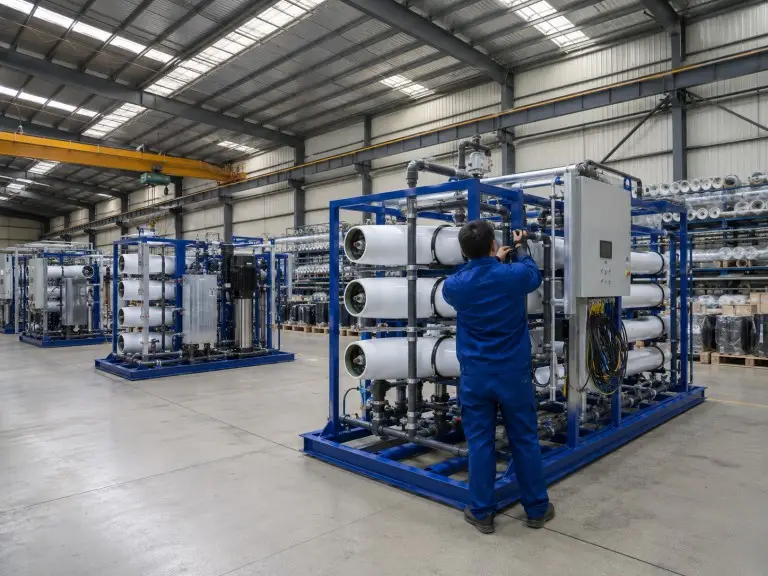
Full in-house production
Membrane vessel mounting, piping, wiring, PLC programming, and factory pressure testing — no outsourced assembly.
Water analysis → sized proposal
Every system is engineered from your water report — not selected from a catalog or price list.
Factory acceptance test
Each unit undergoes pressure test, electrical inspection, and conductivity verification before shipment.
Export documentation
Packing list, test report, wiring diagram, P&ID, and operation manual included with every shipment.
8–12 week lead time
Standard production cycle from order confirmation to ready-for-shipment, including containerized builds.
Remote commissioning support
Video-guided startup assistance, parameter setting, and membrane flush procedure for international installations.