
Pipeline Fittings for Water Treatment Systems
Every connection point in a water treatment system carries a different chemical and mechanical load. We specify pipeline fittings as engineering components, not catalog items, because the wrong material at the wrong stage degrades, leaches, or fails in ways that compromise the entire system downstream.
Hiju · CE · ISO 9001 · Exporting to 20+ countries since 2016.
Pipeline Fitting Material Selection by Application Stage
The most common specification error we see is treating pipeline fitting material as an aesthetic or cost preference rather than an engineering boundary condition. The table below is the selection logic we apply when reviewing a project, not a general industry reference.
We specify SS 316L at dosing injection points and boiler feed headers, where chloride exposure or elevated temperature would degrade UPVC over time. We specify virgin PP or PVDF at the post-RO permeate stage and through ultrapure loops, because treated water becomes chemically aggressive and will extract ions from PVC or CPVC. UPVC is our default recommendation for pre-treatment feed, softener bypass, and RO feed piping where temperature stays below 60 deg C and the line is not exposed to sustained outdoor UV.
| Material | Application Stage | Working Pressure | Max Continuous Temp | Typical Fitting Types | Not Recommended For |
|---|---|---|---|---|---|
| UPVC | Pre-treatment feed, RO feed, softener bypass, chlorinated raw water lines | Up to 1.6 MPa (PN16) | About 60 deg C | Elbows, tees, reducers, true union ball valves, unions, couplings | Sustained UV exposure without pigmentation; high-vibration dosing loops; concentrated acids or ketones |
| CPVC | Hot process water lines, RO permeate with mild temperature elevation, warm chemical feed | Up to PN16 | About 93 deg C | Elbows, tees, reducers, unions, couplings | Strong solvents, concentrated oxidizing acids, or lines where PVC solvent cement would soften joints |
| PP / PPR | Ultrapure or DI water loops, pharmaceutical loop piping, aggressive chemical drainage | PN10-PN16 | About 95 deg C | Elbows, tees, reducers, couplings, unions, butt-fusion and socket-fusion jointing | Aromatic solvents, oxidizing acids above dilute concentration, or solvent-bonded high-purity sections |
| PVDF | High-purity pharmaceutical, electronics cleanroom, UV-resistant outdoor lines, ultrapure recirculation loops | Up to PN16 | About 135 deg C | Elbows, tees, reducers, unions, couplings, fusion-welded joints | Strong caustic lines at elevated concentration and temperature; some ketone and ester solvents |
| SS 304 | General industrial piping, chemical-neutral process water, filter backwash headers | SCH 40-80 / PN40+ | High temperature, consult for steam | Elbows, tees, reducers, flanges, unions, couplings | Chloride-rich process water, seawater, brine service, or elevated-temperature chloride exposure |
| SS 316 / 316L | Chemical dosing injection, boiler feed water headers, seawater desalination, ultrapure pharmaceutical and electronics piping | SCH 40-80 / PN40-100 | High temperature and aggressive chemical service | Elbows, tees, reducers, flanges, compression fittings, unions, couplings | Stronger chloride resistance than SS 304; final selection still depends on chloride concentration, temperature, pH, oxidants, crevice risk, weld condition, and operating pressure. No stainless grade is immune to chloride stress corrosion cracking. |
Pressure ratings for thermoplastic fittings must be derated as operating temperature rises. PN16 at 20–23°C does not remain PN16 at maximum rated temperature; consult the manufacturer’s pressure-temperature derating chart for the selected pipe and fitting series.
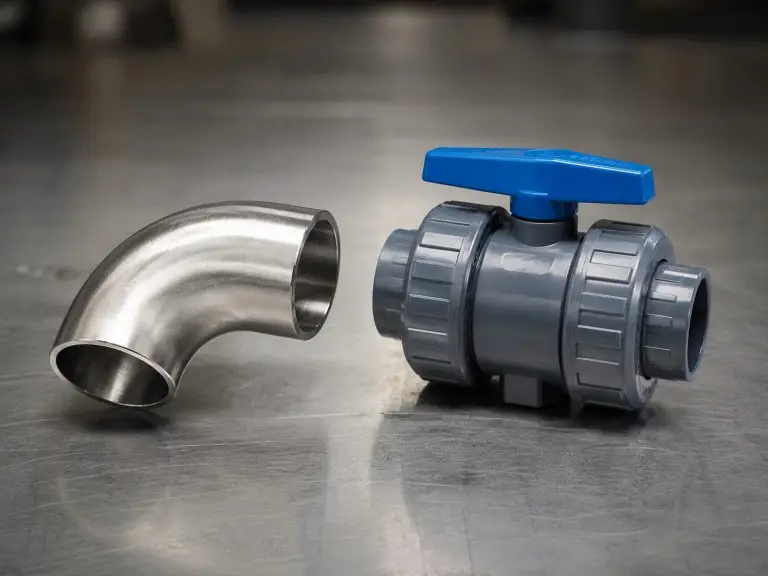
We treat the “not recommended for” column as a design boundary, not as a disclaimer. For example, SS 304 can look adequate if the buyer checks only pressure class, but chloride-rich concentrate or brine service changes the corrosion risk completely. UPVC can look economical at the same DN size, but dosing vibration, UV exposure, or elevated temperature can make that same fitting class unsuitable. This is why our quotation review starts with fluid chemistry and system stage before price or catalog availability.
Water Treatment Pipeline Fitting Types and Failure Risks
Selecting the right type is separate from selecting the right material. A wrong type choice creates maintenance access problems, vibration failure, or dead-leg contamination risk that is difficult to correct after commissioning.
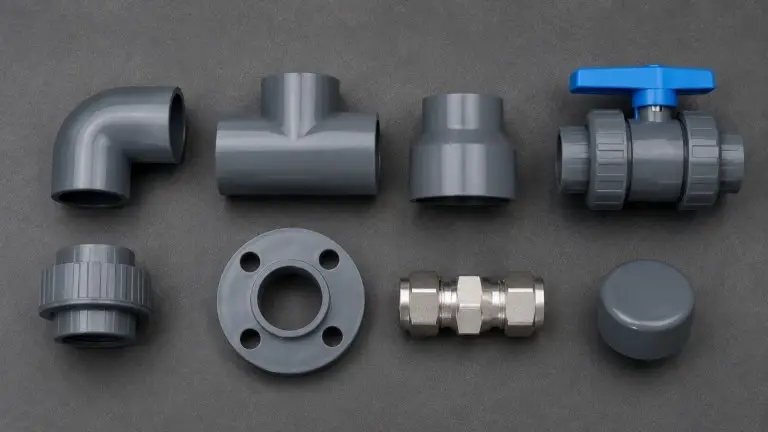
Elbows (45 / 90 Degree)
We route piping direction changes with elbows at equipment frames, vessel bases, and skid edges. UPVC fits pre-treatment and RO feed sections; SS 316L is used at high-pressure pump outlet headers and high-salinity concentrate headers.
Failure risk: Short-radius elbows where long-radius elbows are specified create higher pressure drop and turbulent zones that accelerate erosion in SCH 40 thermoplastic above DN50 flowrates.
Tees (Equal / Reducing)
We position tees at bypass loops, sampling ports, parallel filter connections, and softener regenerant branch circuits. Reducing tees handle branch diameter transitions without a separate reducer fitting.
Failure risk: Dead-leg tee branches are a biofilm risk in ultrapure systems; stagnant water colonizes within days above 20 deg C unless flush-tee or bleed valve designs are used.
Reducers (Concentric / Eccentric)
We specify reducers at pump inlet and outlet connections, between filter outlet and RO feed piping, and at dosing injection take-off points. Concentric and eccentric designs solve different orientation problems.
Failure risk: Concentric reducers at horizontal pump suction lines trap air at the pipe crown, causing air entrainment, cavitation, and accelerated pump seal wear.
True Union Ball Valves
We specify true union ball valves at cartridge filter housing inlets and outlets, dosing pump isolation points, and RO bypass circuits. They provide manual isolation at each vessel, while control valves handle sequencing. In a multi-vessel installation, standard valves without union ends require pipe cutting for each replacement, multiplying downtime across the system.
Failure risk: Standard ball valves without union ends require pipe cutting during replacement, multiplying downtime across multi-vessel systems.
Unions (In-Line Disassembly)
We install unions at cartridge filter housing connections, dosing pump discharge tees, and instrument ports where calibration or cleaning requires periodic removal.
Failure risk: A system built without unions forces maintenance teams to cut pipe when removing equipment, creating leak risk at every repair point.
Flanges (Slip-On / Threaded / Blind)
We specify flanges at high-pressure interfaces and break-open maintenance points. PN40 SS 316L flanges are specified at high-pressure pump outlets and RO membrane housing connections above 0.8 MPa.
Failure risk: UPVC flanges above PN16 or above 60 deg C continuous service deform at the flange face, and gasket seating fails under cyclic pressure load.
Compression Fittings
We use compression fittings at instrument connections, sample taps, and dosing injection quills. SS 316L is standard at acid and oxidant dosing points; PVDF is reviewed for caustic or solvent compatibility.
Failure risk: Threaded NPT connections in dosing loops can loosen under continuous pump cycling — typically within months in high-frequency service — causing micro-drip contamination at the injection quill.
Caps and Plugs
We cap future expansion tees during Phase 1, so the branch can be activated in Phase 2 without cutting or modifying the piping run.
Failure risk: A capped dead-end in an ultrapure or DI loop without a bleed port creates zero-velocity stagnation, biofilm growth, and rising conductivity at the distribution point.
Pipeline Fitting Specifications: Pressure, Temperature, and Standards
The negative boundaries below are the most consequential variables on this page. A fitting material can be inside pressure and temperature limits and still fail if it is placed in chemically incompatible service.
| Material | Working Pressure | Max Temp | Chemical Compatibility | Connection Standards | Size Range | Joint Method |
|---|---|---|---|---|---|---|
| UPVC | Up to PN16 (1.6 MPa) | About 60 deg C | Neutral to mildly acidic or alkaline; not for ketones, esters, concentrated nitric acid | NPT, BSP, DIN, ANSI, JIS | DN15-DN150 | Solvent cement, threaded, flanged |
| CPVC | Up to PN16 | About 93 deg C | Broader acid and alkali range than UPVC; not for chlorinated solvents | NPT, BSP | DN15-DN100 | Solvent cement, threaded |
| PP / PPR | PN10-PN16 | About 95 deg C | Excellent broad chemical resistance; not for aromatics or strong oxidizing acids | DIN, ISO | DN15-DN110 | Heat fusion, no solvent bonding in high-purity service |
| PVDF | Up to PN16 | About 135 deg C | Excellent UV and chemical resistance; not for strong caustics at elevated temperature | DIN, ANSI | DN15-DN100 | Heat fusion, mechanical union |
| SS 304 | SCH 40-80 / PN40+ | Service-dependent | Good general chemical service; avoid high-chloride and brine | NPT, BSP, DIN, ANSI, JIS | DN15-DN200+ | Butt weld, socket weld, threaded, flanged |
| SS 316 / 316L | SCH 40-80 / PN40-100 | Service-dependent | Excellent chloride, acid, caustic, seawater, and pharmaceutical-grade service | NPT, BSP, DIN, ANSI, JIS | DN15-DN200+ | Butt weld, socket weld, threaded, flanged, compression |
Pressure ratings for thermoplastic fittings must be derated as operating temperature rises. PN16 at 20–23°C does not remain PN16 at maximum rated temperature; consult the manufacturer’s pressure-temperature derating chart for the selected pipe and fitting series.
We can match pipeline fittings to NPT, BSP including BSPP and BSPT, DIN, ANSI, and JIS standards per project requirement. The connection standard we specify depends on downstream equipment: pump outlet flange standard, membrane housing end-cap thread standard, or control valve body port standard. When an inquiry specifies mixed equipment from multiple suppliers, we confirm each interface before quoting so adapter flanges are specified as part of the package rather than left as a site-resolution problem.
A mixed-standard project is not rare in EPC skid assemblies. A pump may arrive with ANSI flanges, a filter vessel may use DIN nozzles, a membrane housing may use manufacturer-specific end-cap threads, and instrument ports may be NPT or BSP depending on the supplier. If fittings are purchased only by nominal size, the mismatch is discovered during assembly, when the solution becomes field adapters, extra threaded joints, and additional leak points. We check those interfaces before quoting.
What Each Stage Demands from Pipeline Fittings
Pre-Treatment Loop
The pre-treatment stage handles raw or partially treated source water containing chlorine residual, suspended solids, iron, and manganese. UPVC is our standard recommendation because it is chlorine-resistant across the pre-treatment pressure range, available from DN15 to DN150, and suitable for PN16 pressure conditions typical of feed pumps.
The bypass circuit on a filter requires true union ball valves at the inlet and outlet of each vessel so one vessel can be isolated for backwash while an adjacent vessel remains in service.
RO Feed and Concentrate Piping
Working pressure typically ranges from 0.6 MPa to 1.6 MPa for brackish water and higher for seawater. We specify SS 316L elbows, tees, and flanges at the high-pressure pump outlet and at the inlet ports of the membrane housings, where pressure peaks and impulse loads make thermoplastic fittings unsuitable.
The concentrate header still carries a concentrated salt load. SS 316L remains correct for seawater or high-salinity brackish concentrate lines. For low-salinity RO, UPVC concentrate piping within PN16 can be acceptable after we confirm concentrate TDS and chloride content. See the connected membrane in reverse osmosis.
Chemical Dosing Injection Points
Chemical dosing injection is the highest corrosion-risk and highest vibration-risk position in a water treatment system. We specify SS 316L compression fittings at all acid and oxidant dosing take-offs. At caustic and coagulant injection points, we evaluate whether PVDF compression fittings are preferred based on concentration and temperature.
Threaded NPT injection tees can loosen under continuous dosing pump cycling — typically within months in high-frequency service — resulting in micro-drip contamination at the injection quill. Our standard routing eliminates NPT threads at vibration-exposed positions and substitutes compression fittings with lock-nut retention.
Boiler Feed Water Circuit and Ultrapure Loop
Boiler feed water treatment demands fittings that perform under elevated temperature and pressure beyond the thermoplastic class envelope. We specify SS 316L flanges and elbows at boiler feed pump outlet connections; SS 304 is incompatible if any chloride residual remains in feed water.
For deionized water filtration system applications, post-RO permeate piping requires virgin PP/PPR or PVDF with heat-fusion joints. Below the minimum flow velocity, stagnant zones create biofilm colonization risk within days at typical process temperatures; 48–72 hours is a commonly cited threshold in ultrapure water system design guidance. Final compliance must be confirmed against the user’s process specification, validation protocol, and applicable local standard.
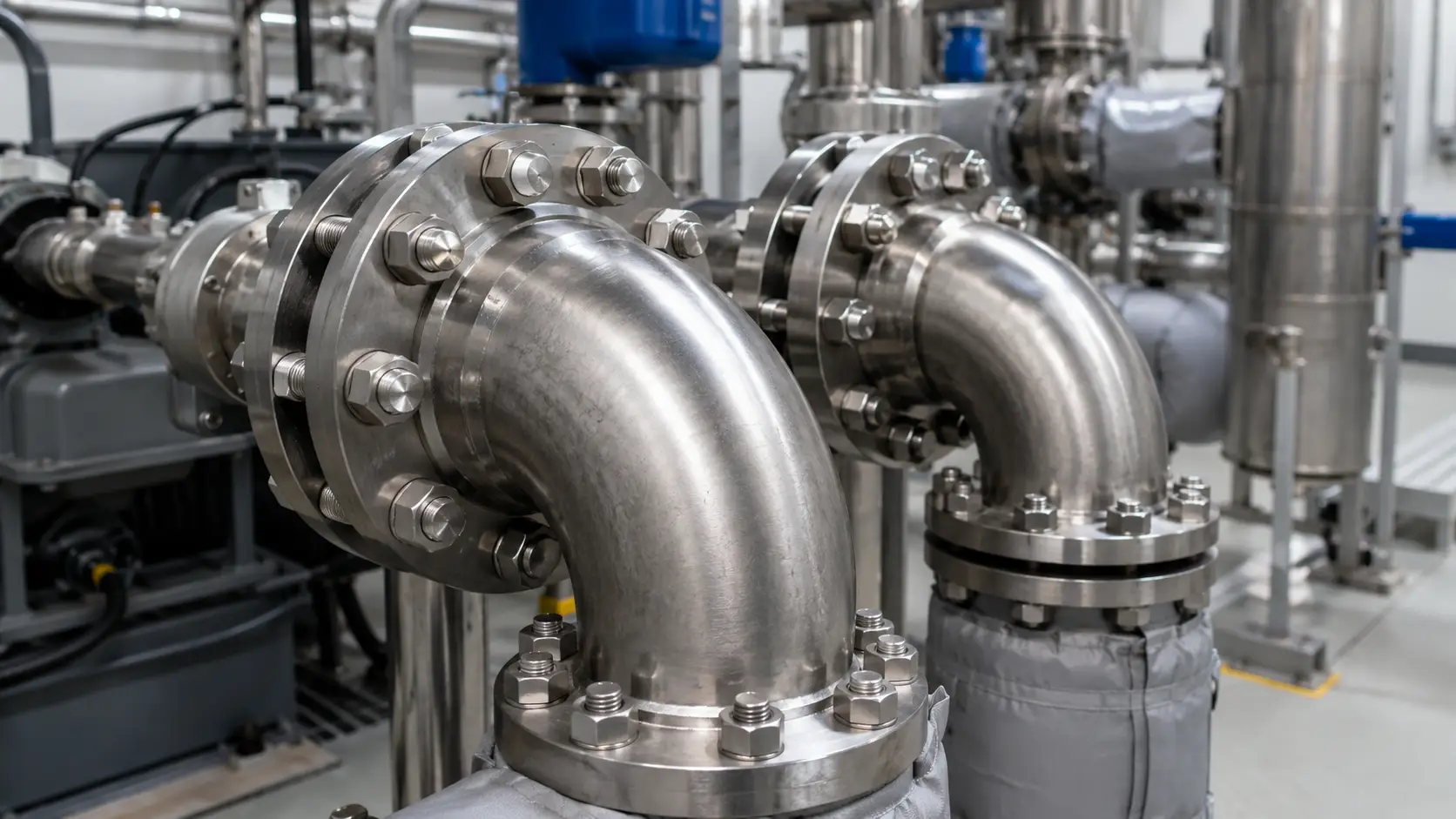
Undersized ultrapure loop piping is a commissioning design error, not a product defect. If velocity falls below the lower bound, upgrading the fitting material does not remove stagnant pockets; the pipe diameter and loop hydraulics must be corrected. We flag this during project review because biofilm, dead legs, and conductivity rise are system-design consequences that appear downstream from a small fitting decision.
OEM Pipeline Fittings and Skid Integration
Established in 2016, Qingdao Hiju Thermal Power Co., Ltd operates from a 70,500 sqm facility with a 21,000 sqm dedicated workshop. Our engineering team of 28 engineers and 78 technicians covers the full scope of water treatment system design, fabrication, and component specification, which is why we supply pipeline fittings as system-matched accessories rather than isolated catalog items.
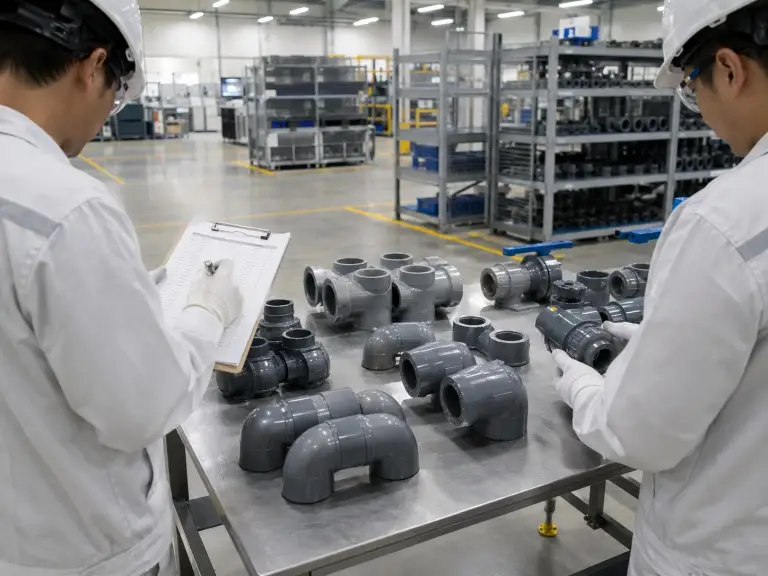
When a buyer sources pipeline fittings alongside other water treatment parts from separate suppliers, connection standard conflicts, end-to-end pressure class mismatches, and incompatible flange face ratings are common project risk points that delay commissioning. We mitigate this by reviewing the complete system configuration before specifying any fittings.
We hold CE documentation and ISO 9001 quality management certification and export to 20+ countries and regions, with active project experience in Southeast Asia, the Middle East, Africa, South America, and Central Asia. OEM and ODM production is available for system integrators and skid fabricators who require custom-labeled components or modified configurations. To discuss project volume requirements or OEM arrangements, contact our team.
For integrated skid packages, we review whether the same assembly also includes membrane housings, control valves, high-pressure pumps, UV or cartridge filter housings, and instrumentation ports. That lets us confirm thread family, flange face, PN class, and maintenance clearance together rather than shipping fittings that look correct individually but create conflicts when the skid is assembled.
CE Documentation · ISO 9001 QMS
Documentation ships with every order to support EPC compliance review.
OEM / ODM Programs
Custom labeling, modified configurations, and skid-matched fitting schedules.
Qingdao Manufacturing Base
Qingdao manufacturing base exporting to 20+ countries since 2016.
Compliance & Documentation Scope
| Item | Scope |
|---|---|
| CE documentation | Available where applicable by product and assembly scope; confirm model and destination market before order |
| ISO 9001 | Quality management system certification; applies to manufacturing and inspection processes, not individual fitting performance |
| Material certificate | Available for SS304, SS316L, PVDF, PP, and UPVC by batch on request |
| Pressure rating | PN class, Schedule, or flange class confirmed by fitting model; pressure-temperature derating data available for thermoplastic series |
| Drinking water contact | NSF/ANSI 61 only where specifically requested; confirm application and jurisdiction before specifying |
| Factory documents | Packing list, fitting schedule, material list, pressure class confirmation included with each order |
Sample Fitting Schedule
Material certificate, pressure rating confirmation, and fitting schedule are included with each order. The schedule below is the format we use when reviewing a multi-stage system:
| System Stage | Medium | Material | Connection Standard | Pressure Class | Selection Basis |
|---|---|---|---|---|---|
| Pre-treatment feed | Chlorinated raw water | UPVC | DIN / BSP | PN16 | Chlorine-resistant; temperature <60°C |
| RO feed / high-pressure | Brackish water | SS 316L | ANSI / DIN flanged | PN40 | Pressure >1.0 MPa; impulse load at pump outlet |
| Chemical dosing injection | HCl / NaOCl solution | SS 316L | NPT compression | SCH 40 | Acid and oxidant compatibility; vibration lock-nut |
| Permeate / ultrapure loop | RO permeate / DI water | PP/PPR | DIN heat-fusion | PN16 | No leachables; velocity 0.9–1.8 m/s maintained |
Inputs Required to Confirm Your Fitting Specification
Send these ten inputs and we return a fitting schedule that matches your fluid chemistry, pressure class, and connection standard across each system stage.
- Fluid / medium composition — chlorinated raw water, RO permeate, deionized water, chemical dosing solution, steam condensate, or brine is the single most important selection input. The same UPVC 90-degree elbow that is correct at a pre-treatment vessel bypass can be the wrong material at a boiler feed outlet or ultrapure loop.
- Working pressure — continuous and peak — we need both values. A system at 0.6 MPa with hydraulic hammer peaks at 1.4 MPa needs PN16-rated fittings, not PN10.
- Operating temperature — continuous and peak — UPVC at 60 deg C, CPVC at 93 deg C, and PVDF at 135 deg C are continuous-service boundaries.
- Connection standard required — NPT, BSP, DIN, ANSI, JIS, or ISO must match the connected equipment. If you provide pump model, membrane housing make, or control valve port standard, we can confirm the connection family independently.
- Pipe schedule or PN class — required to confirm wall thickness compatibility at threaded, flanged, solvent-socket, or fusion-welded connections.
- DN size range for each fitting position — provide per-section sizes if the system uses different pipe diameters across stages. DN range can change between raw-water feed, RO feed, concentrate discharge, permeate, and chemical injection lines.
- Application stage — pre-treatment, RO feed, concentrate, permeate, chemical dosing, boiler feed, ultrapure loop, softener bypass, or other. If the project covers multiple stages, list each section separately so material selection is not generalized across the whole system.
- Downstream equipment list — membrane housing model, pump outlet flange spec, control valve body port standard, and UV or cartridge housing thread standard help us verify compatibility.
- Project location and destination country — required for CE compliance confirmation and export documentation.
- Order quantity — required to confirm lead time and whether OEM or ODM production applies to the volume.