
Sand Filter Tank: First Physical Barrier in Your Pretreatment Train
We position quartz sand filtration as the first physical barrier in any pretreatment train because it is the most cost-effective way to strip turbidity and suspended solids before finer downstream equipment sees the water. A sand filter tank charges an inlet stream that is typically stable at 5-20 NTU – with inlets approaching 50 NTU treated as a reviewed upper bound that depends on grain size, bed depth, filtration velocity, coagulation and backwash capacity – through a pressurized bed of graded quartz media, and intercepts particles in the 10-50 µm range. A correctly sized sand filtration tank returns clarified water to a reviewed project target, matched to your inlet profile and downstream equipment before the outlet figure is confirmed.
Our industrial water treatment equipment range covers quartz sand filters, multi-media filters, activated carbon filters, and cartridge filter housings. We manufacture CE- and ISO 9001-certified pressure filter vessels, with ASME construction available on request, for export to Southeast Asia, the Middle East, Africa, South America, and Central Asia, with OEM and ODM configurations available.
Is a Quartz Sand Filter Right for Your Application?
A quartz sand filter is the appropriate first-stage unit when suspended solids and turbidity are the treatment objective, inlet turbidity is consistently stable in the 5-20 NTU range with inlets approaching 50 NTU treated as a reviewed upper bound, and downstream equipment requires particulate protection rather than dissolved-contaminant removal.
RO / UF Pretreatment – First-Stage Clarification
Inlet condition: Turbidity 5-20 NTU with downstream RO membrane bank or UF module.
Fit verdict: Fit only as one stage of a complete pretreatment train.
Operating boundary: Fine grain at 8-12 m/h filtration velocity. Sand filtration must be followed by cartridge filtration, with SDI, turbidity and membrane-supplier requirements confirmed before RO.
High-Volume Industrial Operation
Inlet condition: TSS above 10 mg/L before a cooling circuit, boiler, or softener.
Fit verdict: Standard fit.
Operating boundary: Coarser grain with semi-automatic or manual backwash where outlet turbidity of 3-5 NTU is acceptable.
Food-Grade or Municipal-Scale Installation
Inlet condition: Low-turbidity hygienic process water or large-diameter municipal installation.
Fit verdict: Fit with stainless vessel review.
Operating boundary: Vessel material, nozzles, and interior finish are confirmed during engineering review.
When a quartz sand filter is not the correct first stage:
- Inlet turbidity consistently exceeds 50 NTU; a layered multi media filter handles that suspended-solids load with better depth-filtration efficiency.
- Fine colloidal particles below 2 µm dominate the inlet; quartz sand alone cannot capture sub-2 µm colloids reliably, so UF or upstream coagulation-flocculation is required. A sand filter tank is not an absolute micron barrier, and colloid capture depends on particle chemistry, coagulation, hydraulic loading, media grading, and downstream fine filtration.
- TDS reduction or hardness removal is the treatment goal; quartz sand passes dissolved salts and hardness unchanged.
Dissolved organics, chlorine residuals, and taste/odor compounds that survive the sand bed are removed downstream by activated carbon water filter systems.
How Quartz Sand Filtration Works – and What Backwash Does
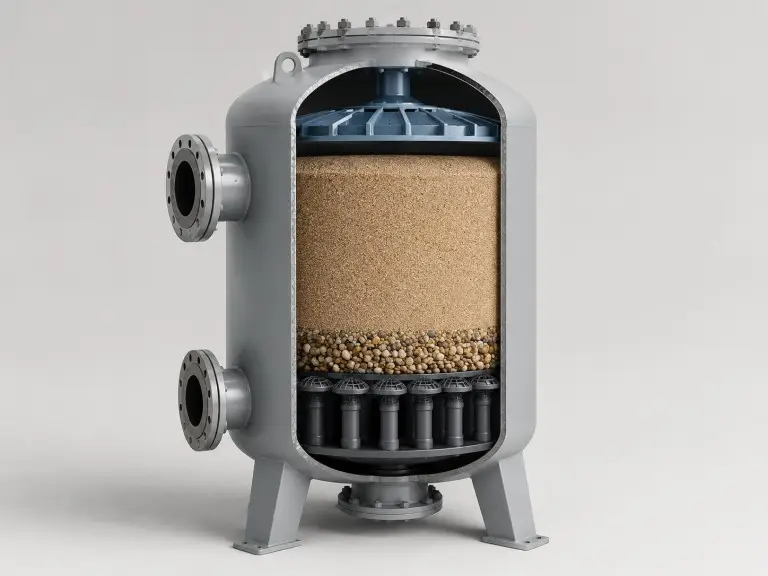
A sand filter tank removes suspended solids through physical sieving at grain contact points, gravitational sedimentation inside the pore structure, and surface adsorption of fine colloids onto grain surfaces. Water enters from the top through a distribution dome or perforated manifold, passes downward through the quartz sand bed and gravel support above an ABS mushroom-cap nozzle underdrain, and exits as clarified effluent.
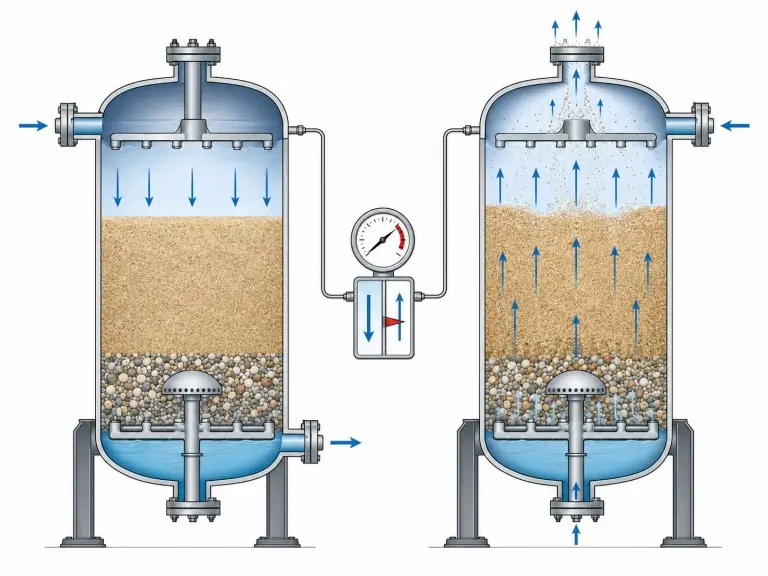
Commissioning note: Cycle duration is set after we verify inlet quality, bed fouling rate, drain capacity, and the vessel’s actual expansion behavior.
Backwash Operating Sequence
ΔP Trigger — Differential pressure
Backwash starts when differential pressure across the vessel reaches ΔP ≥0.05 MPa (0.5 bar).
Time Fallback — Time-cycle backup
A time-cycle fallback, typically 24-72 hours, is confirmed per project as a backup trigger.
Upflow Wash — Reviewed backwash rate
Water enters from below at a reviewed 28-48 m/h (12-20 gpm/ft²), set against grain grading, water temperature, target bed expansion, distributor design, and media-loss risk.
Bed Reset — Expansion and resettle
The media bed expands 30-50%, releases captured fines, resettles by gravity, and returns to service.
What Happens When Backwash Is Delayed
Missed backwash cycles
If backwash cycles are missed, differential pressure climbs, effective throughput drops below design rate, and captured fine particles can break through the compacted bed. For systems feeding RO membranes, that turbidity breakthrough accelerates fouling on the membrane surface.
Downstream scope
Quartz sand filtration does not remove dissolved organics, chlorine residuals, or taste/odor compounds; activated carbon filters address those contaminants downstream.
Media Grain Selection – Why the Wrong Grade Has Consequences
The media grain size we specify is not an interchangeable default. We select it based on inlet turbidity, required outlet quality, filtration velocity, and downstream equipment type, then confirm it during our pre-order configuration review.
Fine Grade (0.35-0.60 mm) for Pre-RO and Pre-UF Applications
For pre-RO and pre-UF applications, fine-grade quartz produces the dense grain-to-grain contact surface needed to reduce 5-20 NTU inlet turbidity toward the reviewed project target that membrane pretreatment requires. If a coarser grade is substituted, turbidity slips through the bed, SDI rises at the membrane feed, and RO fouling intervals compress.
Coarse Grade (0.8-1.2 mm) for High-Turbidity Pre-Filter Applications
For 10-50 NTU inlet water feeding a softener, cooling circuit, or boiler, coarse media operates at higher filtration velocity with lower pressure drop and shorter backwash intervals where an outlet target of 3-5 NTU is acceptable.
| Grain Grade | Effective Size | Inlet Condition | Outlet Target | Consequence If Wrong |
|---|---|---|---|---|
| Fine (pre-RO / pre-UF) | 0.35-0.60 mm | Inlet turbidity 5-20 NTU; downstream RO or UF | Reviewed project target, typically 1-5 NTU; SDI confirmed by testing | Coarser substitution → turbidity slip → SDI rise → membrane fouling acceleration |
| Coarse (high-turbidity pre-filter) | 0.8-1.2 mm | Inlet turbidity 10-50 NTU; downstream softener, boiler, cooling circuit | 3-5 NTU | Excess fine grade → unnecessary pressure drop, shortened backwash cycles |
Media bed depth is configured at 0.6-1.5 m. Deep-bed designs at 1.0-1.5 m are specified for high-inlet-load applications where extending the interval between backwash cycles is an operations priority. Achieving SDI <3 from source water above 30 NTU with high colloidal content requires upstream coagulant injection; we do not confirm that target from sand filtration alone.
Vessel Material and Configuration Options – Selected Per Project
We fabricate quartz sand filter pressure vessels in five standard material options, with selection determined by water chemistry, operating pressure, regulatory requirements, and downstream equipment compatibility. For food-grade applications, we default to SS304 unless SS316L is specified or required by process chemistry; food- and pharmaceutical-grade selection is subject to confirmation of surface roughness, weld finish, cleaning procedure, material certificates, and buyer validation requirements.
| Vessel Material | Water Chemistry Fit | Typical Working Pressure | Food-Grade | Notes |
|---|---|---|---|---|
| Carbon steel, epoxy-lined | General industrial; neutral to mildly acidic or alkaline | ≤0.6 MPa | No | Chemistry review required for pH <6 or >9, or elevated chloride |
| Carbon steel, rubber-lined | High-TSS, abrasive inlet; moderate process temperature | ≤0.6 MPa | No | Superior abrasion resistance; not suited to elevated-temperature streams |
| SS304 | Low-chloride, food-process, pharmaceutical | ≤0.6 MPa typical; higher on review | Yes – default | Standard food-grade selection |
| SS316L | Chloride-containing, seawater RO pretreatment, aggressive chemistry | ≤0.6 MPa typical; higher on review | Yes | Specified when SS304 does not meet chloride resistance requirements |
| FRP / GRE | Corrosive chemical media, coastal or outdoor installation, weight-sensitive | ≤0.6 MPa typical | No | Non-metallic; confirm pressure rating for project |
Final compliance for food-process and pharmaceutical applications must be confirmed against the user’s process specification, validation protocol, and applicable local standard.
Vessel orientation
Vertical is standard; horizontal is used for large-diameter high-flow installations where headroom is constrained.
Control mode
Manual multiport valve, semi-automatic time-cycle, or fully automatic PLC + ΔP sensor.
Water distribution system
ABS mushroom-cap nozzle underdrain, flared nozzle, dome plate, or perforated pipe manifold selected by velocity and grain size.
Media variants
Manganese sand, anthracite/quartz dual-layer, and gravel underbed support are configured when the project requires them.
Technical Specifications – Configured to Project Requirements
Flow rate and vessel diameter are sized to project requirements and are not fixed catalog parameters.
| Parameter | Standard Range |
|---|---|
| Filtration velocity | 5-15 m/h; standard industrial operating range 8-12 m/h |
| Working pressure | ≤0.6 MPa typical; higher-pressure designs available subject to project review |
| Media bed depth | 0.6-1.5 m; 1.0-1.5 m for deep-bed configurations |
| Media grain size | 0.35-0.60 mm (fine, pre-RO / pre-UF) or 0.8-1.2 mm (high-turbidity pre-filter) |
| Inlet turbidity | 5-20 NTU stable design range; inlets approaching 50 NTU treated as a reviewed upper bound subject to grain size, bed depth, filtration velocity, coagulation and backwash capacity |
| Outlet turbidity target | Reviewed project target, typically 1-5 NTU; lower values testing-confirmed with fine grain and upstream coagulation |
| Backwash trigger | ΔP ≥0.05 MPa across bed; OR time-cycle (24-72 h); OR effluent turbidity rise |
| Backwash flow rate | Reviewed range 28-48 m/h (12-20 gpm/ft²), bound to grain grading, water temperature and a 30-50% target bed expansion |
| Control mode | Manual; semi-automatic (timer); fully automatic (PLC + ΔP sensor) |
| Vessel orientation | Vertical (standard); horizontal (large-diameter industrial) |
| Certifications | CE, ISO 9001; ASME available on request |
Application Matrix – Where Quartz Sand Filters Are Specified
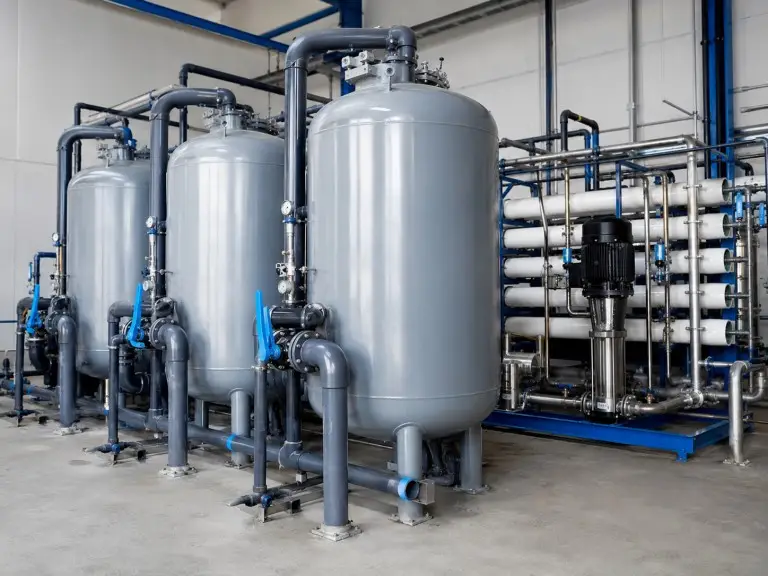
Sand filter tank vessels are configured for six recurring scenarios. The matrix lets you locate your application by inlet condition, primary contaminant, fit verdict, and downstream equipment chain.
| Scenario | Inlet Turbidity | Primary Contaminant | Fit Verdict | Downstream Pairing |
|---|---|---|---|---|
| RO membrane pretreatment | 5-50 NTU | TSS, suspended solids | Core fit; protects RO membranes from particle fouling | Security cartridge filter → RO membrane bank |
| UF module pretreatment | 10-100 NTU | TSS, colloids | Fit; reduces particulate load on UF modules | UF module bank |
| Cooling tower side-stream | Variable; circulating TSS | TSS, scale-forming particles | Standard fit; coarser grain and auto backwash typical | Return to cooling circuit |
| Boiler feedwater | River or well water; TSS >10 mg/L | TSS, sediment | Fit as first stage before softener | Ion-exchange softener or deaerator |
| drinking water bottling plant | Low turbidity; hygienic vessel requirements | TSS, fine particles | Fit with SS304/316L vessel | Activated carbon or UV downstream |
| Industrial process water reuse | High TSS recycled streams | TSS, carried-over solids | Fit with planned backwash cycle and drain sizing | Carbon polishing or secondary security filtration |
Projects routing sand-filtered water to municipal supply networks should reference our water filtration system for drinking solutions page for full system context and large-diameter vessel options.
For projects pairing sand filtration with precision downstream polishing before RO membranes or ultra-pure water systems, stainless steel cartridge filter housing units are the standard final security stage.
Five Common Configuration Mistakes in Incoming Specifications
These are the most frequent misconfigurations we see in RFQs and incoming specifications. We treat them as pre-sales engineering checks because each one can change vessel sizing, media selection, control mode, or civil scope.
Grain size selected by availability rather than outlet requirement
A 1.0-1.2 mm grain bed at 12 m/h is appropriate for cooling tower or boiler service where 3-5 NTU outlet turbidity is acceptable. The same bed will not reliably serve an RO membrane train that requires effluent turbidity below 2 NTU.
Assuming SDI <3 is achievable from high-TSS feed without coagulant dosing
A sand filter reduces SDI, but achieving SDI <3 from source water carrying above 30 NTU with high colloidal content requires upstream coagulant injection or another pretreatment configuration.
Ignoring backwash drain load in the civil scope
Backwash water volume depends on vessel diameter, bed depth, and backwash velocity. An undersized drain forces reduced backwash frequency, leading to media compaction, rising ΔP, and particle breakthrough.
Carbon steel vessel selected without water chemistry review
Epoxy-lined carbon steel is appropriate for neutral-pH, moderate-TDS industrial water. For pH below 6, elevated chloride, or dissolved CO₂ above ambient levels, epoxy lining at welds and fittings carries elevated corrosion risk.
Manual backwash systems operated without an inspection schedule
A manual-backwash unit without regular pressure differential monitoring will not be backwashed on time. We recommend semi-automatic or fully automatic backwash control for systems running more than 8 hours per day or fed from variable-turbidity surface water.
Certified Pressure Vessel Manufacturing – CE and ISO 9001
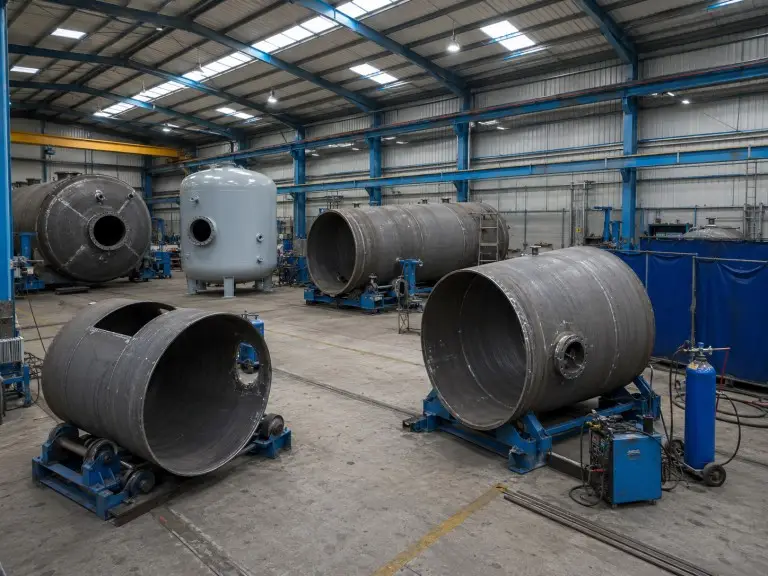
Our Qingdao facility houses a dedicated fabrication workshop for pressure filter vessels. We manufacture under CE and ISO 9001 quality frameworks, with ASME-code construction available on request – relevant for buyers on tenders referencing pressure vessel compliance codes in North America, the Middle East, and international pressure vessel standard projects.
OEM and ODM production is available for system integrators and project engineering firms sourcing filter vessels for resale or private-label system packaging.
70,500 m²
Total facility area
21,000 m²
Fabrication workshop
28 + 78
Engineers and technicians
20+
Export countries
Project Inputs for Sand Filter Tank Configuration
Send any combination of these inputs. Partial specifications are accepted, and we will identify which variables need confirmation before fabrication begins.
- Inlet water source — Well, surface river, municipal supply, reclaimed water, or seawater.
- Inlet turbidity (NTU) and TSS (mg/L) — Measured values or best available estimate.
- Design flow rate (m³/h) — Peak and average if they differ.
- Operating pressure (bar / MPa) — System supply pressure and allowable pressure drop.
- Target outlet quality — Turbidity NTU, and SDI target if RO membranes are downstream.
- Downstream equipment type — RO membrane bank, UF, softener, boiler, cooling circuit, or process storage.
- Preferred vessel material — Carbon steel, SS304, SS316L, FRP, or our recommendation.
- Control mode preference — Manual, semi-automatic timer, or fully automatic PLC + ΔP sensor.
- Site constraints — Backwash drain capacity, floor area, headroom, and power supply.
- Installation location and project destination — Shipping country, climate zone, and applicable pressure vessel standard.