
FRP Water Tanks
SMC Panel Tanks Designed for Mid-to-Large Industrial and Commercial Projects. When a project requires corrosion-resistant water storage above 10 m³ and the structural load or capital cost of stainless steel is prohibitive, FRP panel tanks are our standard recommendation within Hiju’s broader range of water storage equipment.
When FRP Is the Right Tank
FRP (fiberglass-reinforced plastic), GRP (glass-reinforced plastic), and SMC panel tanks all describe the same product in building and industrial water storage. SMC is the panel manufacturing process: glass fiber mat and thermosetting resin consolidated under heat and pressure to produce panels that are dimensionally stable, uniformly dense, and self-finished on both faces without painting.
| Selection Criteria | FRP / GRP Panel Tank | Stainless Steel Tank | PE Plastic Tank | Concrete Cistern |
|---|---|---|---|---|
| Corrosion resistance | Excellent: glass fiber and resin composite; no metallic rust risk; gasket, sealant, and gelcoat condition should be verified during periodic inspection. | Excellent with 316L or good with 304; pitting risk remains in high-chloride environments. | Good for most water types; UV embrittlement risk on exposed units over time. | Moderate; surface spalling and mineral leaching are common without lining. |
| Weight and structural load | Light, approximately one-quarter the weight of an equivalent steel panel, accessible for rooftop and restricted-floor plant rooms. | Heavy; structural slab upgrades are typically required above 2 m³. | Very light with minimal structural requirement. | Heaviest; requires reinforced slab or in-ground construction. |
| Modular scalability | High: panel grid allows incremental sizing from 1 m³ to 200 m³+ without custom moulding. | Limited; fabricated in fixed dimensions and large tanks require field welding. | Low; single-piece units in fixed sizes, with parallel units needed for large volumes. | High only at initial construction; cannot be resized post-build. |
| Installation complexity | Moderate bolted panel assembly; accessible through standard door openings without cranes or hot-work permits. | High; certified welding, passivation, and pressure testing required. | Low; no field assembly. | Very high; formwork, reinforcement, curing, and permanent civil works. |
| Operating temperature range | -10 °C to +70 °C with standard grade resin. | -196 °C to +300 °C, grade-dependent. | -40 °C to +60 °C for HDPE. | Effectively ambient; lining determines upper service limit. |
| Typical cost tier at 10-50 m³ | Mid-range; lower installed cost than stainless steel and higher than PE. | Highest. | Lowest. | Variable and high in labour-cost markets. |
| Certification posture | CE + ISO 9001 from Hiju; EN 13280 sectional tank design reference. | CE + ISO 9001 from Hiju. | CE + ISO 9001 from Hiju. | No modular certification pathway; depends on liner specification. |
| Best fit when… | Mid-to-large industrial or building storage, corrosion resistance is the priority, and rooftop or restricted-access installation matters. | Stainless steel water tanks are better for hygiene-critical, high-pressure, food, pharma, or premium specifications. | PE plastic water tanks fit volumes below 5 m³, cost-driven residential or agricultural storage, and simple installation. | Permanent civil structures above 500 m³ where an existing reinforced structure is available. |
FRP is our default recommendation when a project combines volume above 10 m³ with a site condition where concrete is impractical and stainless steel is over-specified on structural or cost grounds. The table above is a starting point; the engineering decision turns on installed cost, access route, corrosion exposure, and maintenance expectation together — not any single column.
When FRP Is Not the Right Route
Water temperature above 70 °C
Standard SMC resin begins to lose dimensional stability above 70 °C. If stored water enters the tank above this temperature from a heat exchanger return, a solar-heated rooftop loop, or a hot process water source, the material specification must shift to stainless steel or a high-temperature-rated composite. Above 70 °C, resin grade and panel configuration must be reviewed before a standard SMC specification is accepted.
Strongly aggressive chemical environments
FRP/SMC panel tanks are resistant to clean water, cooling water, dilute process water, and non-aggressive aqueous solutions. Concentrated acid, caustic soda above 5% concentration, and organic solvents are incompatible with standard SMC resin systems. Storage of these fluids requires an HDPE-lined or polypropylene vessel, a separate product class.
Very small volumes below 1 m³
The modular panel assembly process has a minimum economic volume threshold. For storage requirements below 1 m³, a single-piece rotomoulded PE plastic water tanks is simpler to install, lower in total cost, and the appropriate recommendation. We manufacture PE plastic tanks for these applications.
How FRP Panel Tanks Are Sized and Assembled
Panel Module Grid
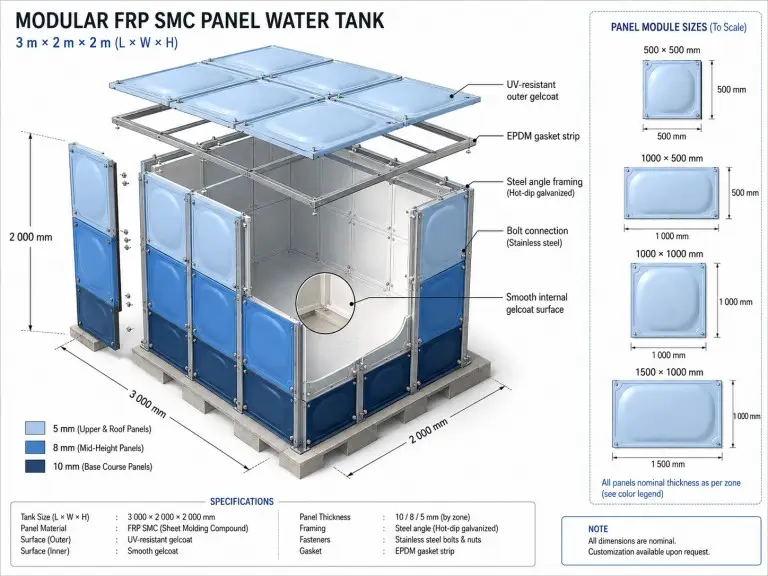
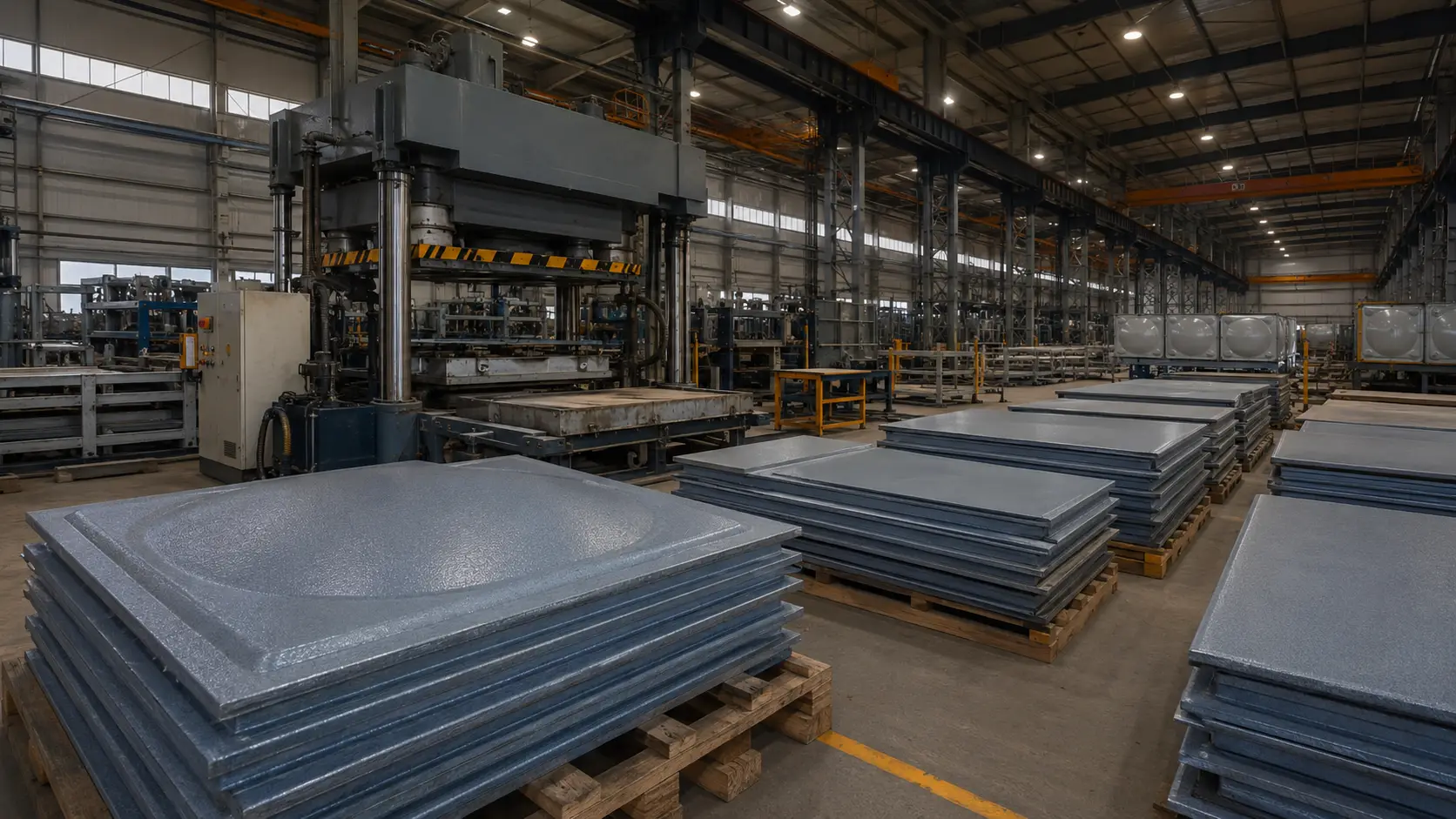
SMC panels are produced by high-pressure compression moulding — glass fibre mat and thermosetting resin consolidated under heat and pressure. Four module sizes cover the standard range: 500×500, 1000×500, 1000×1000, and 1500×1000 mm. Tank footprint advances in module steps; tank height builds in tier increments from 1 m to 4 m. Non-standard plant room dimensions are accommodated by mixing module sizes. For export projects, panels ship flat in standard containers and assemble on site — making FRP practical for retrofit plant rooms where single-piece tanks cannot pass through finished building openings.
Height, Load, and Panel Thickness
In a 4 m-tall tank, base panels carry approximately 40 kN/m² of hydrostatic pressure — nearly eight times the load on upper panels. Zone-graduated thickness is the correct approach: 10 mm at base courses, 8 mm mid-height, 5 mm upper and roof. Specifying a uniform 5 mm throughout leaves the base structurally underdesigned. Heights above 4 m require a separate structural review.
Capacity Reference
3 m × 2 m × 2.5 m: approx. 13.5 m³ gross volume — indicative of a fire reserve buffer for an 8-storey commercial building under light hazard occupancy. Usable volume is lower after nozzle geometry and outlet residual level are deducted.
4 m × 3 m × 3 m: approx. 33 m³ gross volume — around 4 hours of autonomous operation for a process water system drawing 7–8 m³/h. Final capacity is calculated on usable depth, not gross height.
Compartment Configuration
Standard tanks are single open compartments. Where fire protection codes require physical segregation of fire reserve from domestic supply within the same footprint, a dual-compartment tank is built with a central divider panel in L-shape or E-shape geometry. The divider is integral to the structural frame and must be declared at order stage — it cannot be retrofitted. All compartment assignments and nozzle positions must be confirmed before production.
Nozzle planning rule: All penetration positions — including reserved future ports — must be confirmed before production begins, together with pipe sizes and nozzle material (stainless steel or UPVC). Field drilling of assembled SMC panels creates edge stress concentrations and falls outside the manufacturing specification.
Technical Specifications
| Parameter | Range or Value | Engineering Note |
|---|---|---|
| Panel module sizes | 500×500 mm, 1000×500 mm, 1000×1000 mm, 1500×1000 mm | Module combination determines footprint increment steps and whether a non-standard plant room constraint can be used efficiently. |
| Panel thickness | 5 mm-12 mm, height-zone dependent | Base panels in 4 m-tall tanks carry about 40 kN/m²; 10 mm minimum at the bottom two courses prevents a uniform 5 mm under-specification. |
| Tank height tiers | 1 m, 1.5 m, 2 m, 2.5 m, 3 m, 3.5 m, 4 m | Heights above 4 m require custom structural review because hydrostatic load and bracing geometry change materially. |
| Usable capacity | 1 m³ to 200 m³+; custom larger | Usable volume is less than gross footprint x height due to internal fitting geometry and minimum outlet residual level. |
| Operating temperature | -10 °C to +70 °C standard grade resin | Exceeding +70 °C requires material specification change; this is a hard design limit, not a service margin. |
| Design pressure | Atmospheric service, open-vented. Standard SMC panel tanks are not rated for positive internal pressure; pressurised applications require a separately engineered closed vessel with applicable pressure-vessel standard. | Most building and fire reserve applications are atmospheric; pressurised circuits require engineering review before connection. |
| Tensile strength | ≥60 MPa standard grade; reference up to ≥109 MPa high grade | Higher-grade panels are warranted for seismic zones or high-load industrial installations under ASTM D4097 / EN 13280 references. |
| Flexural strength | ≥100 MPa reference per ASTM D4097 | Relevant for roof panels under maintenance foot traffic or eccentric loading during service access. |
| Glass fiber content | ≥25% minimum; structural panels typically ≥30-35% | Glass content below 25% reduces mechanical performance; specify at least 30% for structural-grade industrial applications. |
| Water absorption | ≤1.0% standard; premium grade ≤0.10% | Lower water absorption is critical for potable water hygiene and food-grade or clean-water storage positions. |
| Joint sealing | EPDM gaskets + food-safe sealant | Dual-seal system uses EPDM as the primary seal and food-safe sealant as the secondary seal, not a single material. |
| Internal surface | Smooth food-grade gelcoat, mirror finish | No internal painting or coating is required; the smooth internal surface reduces adhesion risk and supports effective cleaning. |
| External surface | UV-resistant outer gelcoat | No external repainting is required for normal outdoor or rooftop installation under standard maintenance. |
| Insulation | Optional polyurethane foam panels or external wrap | Specify when diurnal ambient swing exceeds 20 °C or when stored water must remain below 25 °C for chlorine efficacy. |
| Compartment configuration | Single; dual L-shape / E-shape with central divider panel | Dual compartment must be declared at order stage because the divider is part of the structural frame. |
| Design safety factor | ≥6x maximum hydrostatic load, EN 13280 reference | Panel assembly is engineered with a safety margin against maximum anticipated hydrostatic pressure. |
| Roof live load | ≥2.4 kN/m² for walkable roof panels | Roof panels subject to maintenance access require reinforced geometry and should not be treated as decorative covers. |
| Applicable design standards | EN 13280 primary; ASTM D4097 reference | Primary design reference for SMC sectional cold-water storage tanks: EN 13280. ASTM D4097 applies to contact-molded cylindrical FRP tanks; confirm applicable standard per configuration during engineering review. |
| Connection nozzles | Project-specified position, pipe size, material: SS or UPVC | All penetrations must be declared before production; factory-fabricated flanges only. |
The values above are Hiju preliminary design targets for SMC panel FRP water tanks. Final limits depend on panel grade, resin specification, tank configuration, and project-specific engineering review.
Where FRP Panel Tanks Are Specified
Four application types account for the majority of FRP panel tank projects we supply. Each has distinct configuration requirements that affect compartment geometry, nozzle layout, insulation, and connection material.
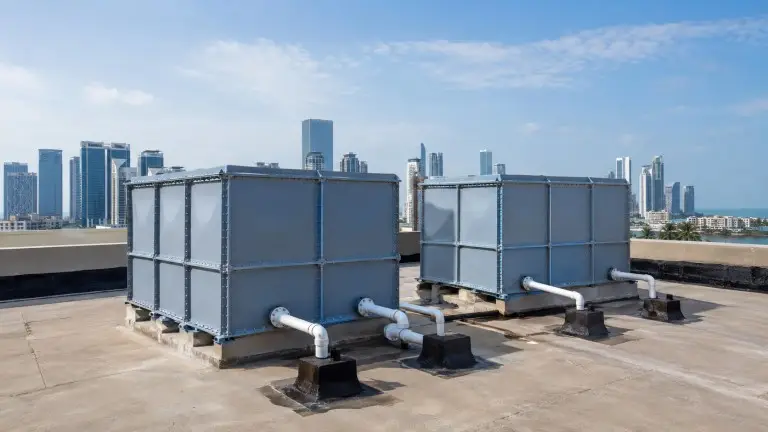
Commercial Building and Hotel Rooftop Water Supply
High-rise hotels and commercial buildings use elevated FRP panel tanks to feed domestic cold water by gravity, removing the energy cost and mechanical complexity of continuous booster pumps. Standard configuration for a 200-room hotel is 30–50 m³ fed by a transfer pump from a ground-level break tank. In tropical or arid climates, specify polyurethane foam insulation as part of the standard build — elevated ambient temperature accelerates chlorine decay and creates bacteriological compliance risk at the building supply point.
water filtration systems for commercial use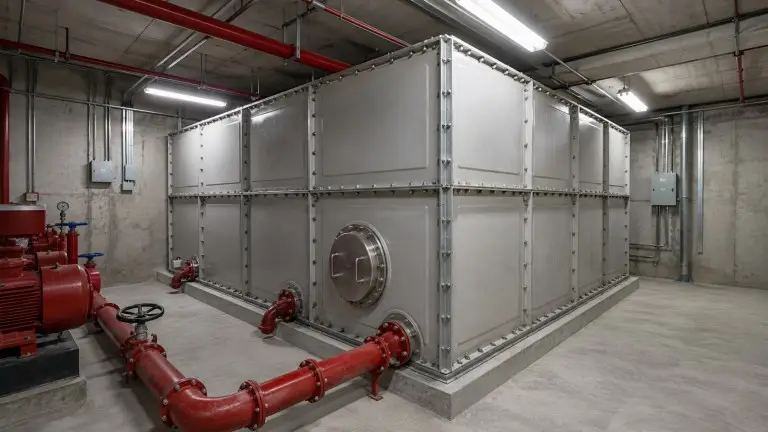
Fire Reserve Storage
Fire codes across Southeast Asia, the Middle East, and Africa require a physically segregated fire reserve that cannot be consumed during normal domestic demand. Dual-compartment FRP tanks provide structural-level isolation in a single footprint, assembled through standard building access openings without hot-work permits. Sizing follows the fire engineering report — 750 L/min × 60 min requires 45 m³; 2,500 L/min × 60 min requires 150 m³. Verify against NFPA 13, EN 12845, or the applicable authority before confirming capacity.
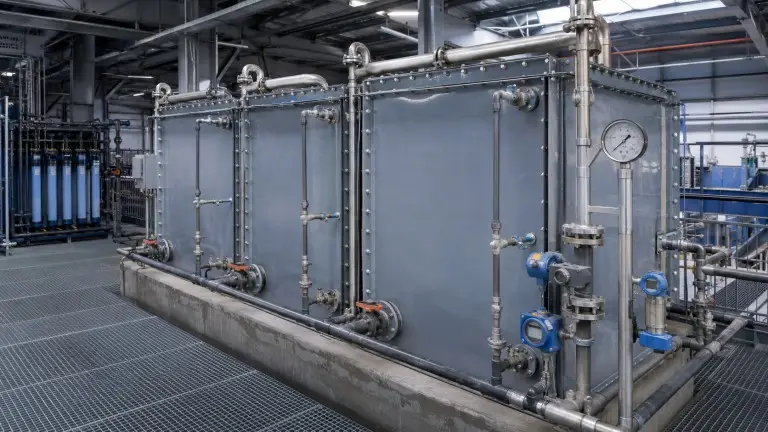
Industrial Process Buffer
FRP buffer tanks decouple intermittent water supply from continuous downstream process demand. A 50 m³ tank upstream of a 10 m³/h process line provides approximately 5 hours of autonomous operation. Connection layout must be factory-fabricated from the panel drawing — undefined nozzle positions create field modifications, dead-leg piping, and biological load on downstream equipment.
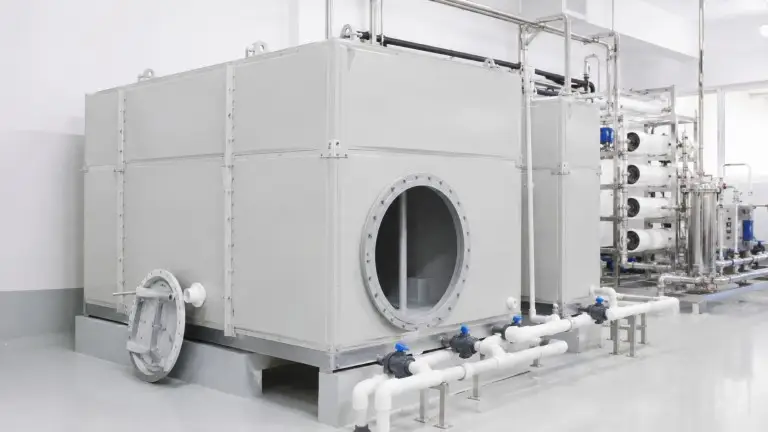
Food and Beverage Pre-Treatment Storage
FRP tanks with food-grade resin and smooth internal gelcoat serve as pre-treatment buffer upstream of RO membranes, UV sterilizers, and ultrafiltration systems. The compression-moulded SMC surface requires no internal coating and is visually inspectable. Size to 2–4 hours of downstream demand; extended retention in warm ambient conditions increases biological load on downstream treatment equipment. Potable contact documentation available on request; NSF/WRAS/BS 6920 applicability confirmed per destination.
bottled water plantsFive Specification Errors That Cause Problems in the Field
Specifying uniform panel thickness throughout a tall tank
Base panels in a 4 m-tall tank carry approximately 40 kN/m² at full capacity, nearly eight times the load acting on upper panels. A uniform 5 mm specification satisfies a form but leaves the base structurally underdesigned. Zone-graduated thickness, 10 mm at base courses, 8 mm at mid-height, and 5 mm at upper courses and roof, reflects actual load distribution.
Omitting insulation in hot-climate rooftop installations
Solar heat gain on an uninsulated rooftop tank in tropical or arid climates can drive stored water above 35 °C. Chlorine residual then degrades within hours, creating a bacteriological compliance failure at the building supply level. The FRP tank performed correctly; the system design failed to account for thermal environment.
Connecting a pressurised circuit to an atmospheric panel tank
Standard SMC panel tanks are rated for atmospheric or open-vented service. Above approximately 0.1 MPa gauge pressure differential, the panel design envelope is exceeded. Applications above this boundary require a closed, pressure-rated vessel rather than an atmospheric storage panel tank.
Leaving nozzle positions undefined until after delivery
Factory drilling and flanging of panel penetrations before shipment is the manufacturing standard. Field drilling, cutting, or grinding completed panels creates edge stress concentrations, compromises the resin seal around the penetration, and falls outside the manufacturing specification. All connection positions, including future instrumentation provisions, must be confirmed before production starts.
Treating service life figures as guaranteed specifications
Claims of 30-year or 50-year lifespan for FRP tanks often appear without qualification. Actual durability depends on water chemistry, UV exposure, operating temperature history, and maintenance frequency. We design for long-term service under normal conditions and provide project-specific maintenance guidance, but we do not state a fixed lifespan that ignores environment and maintenance practice.
Manufacturing Scale and Export Capability
70,500 sqm
Total facility in Qingdao, China, established in 2016.
21,000 sqm
Dedicated production workshop for water storage and treatment equipment.
78 + 28
78 production technicians and 28 engineers covering design, fabrication, QC, and export logistics.
CE / ISO 9001 / ASME
CE and ISO 9001 apply to manufacturing quality; ASME reflects broader pressure vessel capability and must be confirmed by configuration.
OEM / ODM
Custom footprint, compartment geometry, non-standard connections, and OEM labelling are available through drawing approval.
20+ countries
Export track record across Southeast Asia, Middle East, Africa, South America, and Central Asia.
Certification Scope
CE and ISO 9001 are the directly relevant manufacturing quality references for standard atmospheric FRP storage tanks. ASME reflects Hiju’s pressure vessel manufacturing capability within our broader equipment range — buyers procuring atmospheric FRP panel storage tanks should confirm which certification applies to their configuration during engineering review. We accept project-specific panel configurations, custom compartment geometries, non-standard connection positions, and custom labelling; all custom configurations proceed through dimensional drawing approval before production.
Export Track Record
Hiju has supplied equipment to more than 20 countries and regions, with primary markets in Southeast Asia, the Middle East, and Africa — the same climates where mid-scale FRP storage tanks are a common specification for commercial building water supply and industrial pre-treatment systems. Established supply chain relationships in these markets mean buyers are not navigating the export process for the first time.
Inputs Required to Configure Your Tank
Our engineering team reviews project requirements and returns a configuration drawing, including panel layout, height tiers, and nozzle positions, together with a cost estimate. To prepare this, send us the following:
- Required usable capacity in m³, or as flow rate x autonomy duration if final capacity is still being calculated.
- Site footprint constraint including maximum available floor area, ceiling height, door openings, and structural obstacles.
- Water type such as potable domestic supply, fire reserve, industrial process water, cooling water, food-grade pre-treatment, or other.
- Ambient and inlet water temperature range for climate conditions and process inlet conditions.
- Connection nozzle requirements including inlet, outlet, overflow, drain, instrument tap positions, pipe sizes, and SS or UPVC flange preference.
- Compartment configuration as single open compartment or dual potable + fire reserve with central divider panel, including L-shape or E-shape if required.
- Insulation requirement as yes, no, or unsure, with maximum expected ambient temperature if relevant.
- Downstream equipment such as gravity distribution, pump suction, RO pre-treatment train, fire sprinkler manifold, or other equipment.
- Project certification or standards requirements including local building code references, authority approvals, or water quality documentation.
- Delivery destination and project timeline including country, port of destination, and required on-site delivery date.