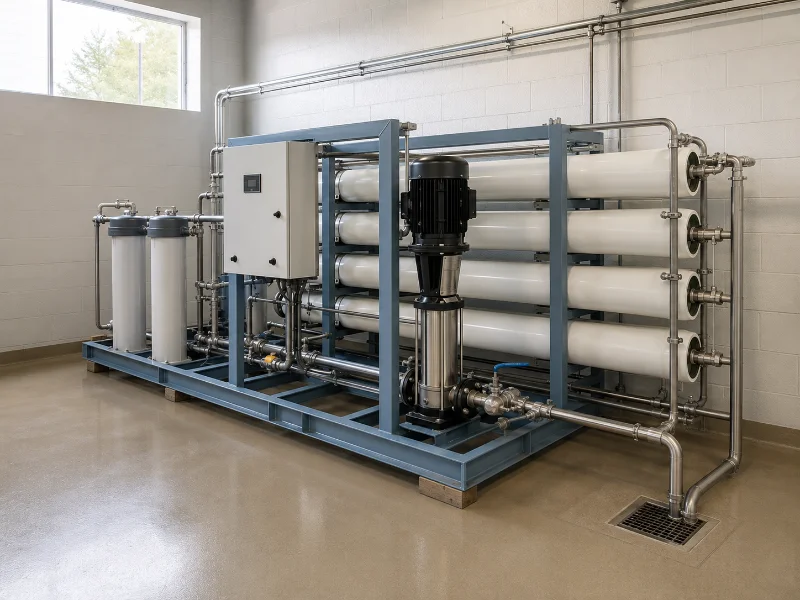
The best commercial reverse osmosis system for a site is the one sized to that site’s peak draw, feed water chemistry, and lowest seasonal feed temperature, not the largest nameplate capacity available. Commercial RO sits between point-of-use units and full industrial trains, and no single capacity marks the boundary. Two skids carrying the same GPD label can deliver different flows once feed temperature and dissolved solids are applied, because the label is a rated figure tied to reference test conditions. Your water analysis, your draw profile, and the permeate quality your process requires are what settle the specification.
Commercial RO Datasheets and Certification Scope
Commercial reverse osmosis is a catalog market band with no fixed lower edge, and where the band begins depends on each supplier’s own product range. One catalog’s commercial line starts where its residential units stop. Another’s ends where its industrial skids begin. Comparing “commercial systems” across two catalogs therefore often compares two different types of reverse osmosis system.
Certification marks carry the same ambiguity. NSF/ANSI 58 covers point-of-use reverse osmosis drinking water treatment systems. It addresses material safety, structural integrity under cyclic and hydrostatic pressure, and TDS reduction claims. A floor-mounted skid producing thousands of gallons a day falls outside that scope. An “NSF certified” claim attached to such a system is therefore describing something else: wetted components, a sub-assembly, or a different standard entirely.
The claim becomes checkable once the supplier states four things. The standard number. The certified product or component. The model as listed. The claims the listing covers. Certification bodies publish searchable listings, so the entry takes minutes to confirm.
Where a system is chosen on the strength of a certification mark, the mismatch surfaces at the membranes, months after the label was checked. Feed water outside the range the unit was built around shortens element life, and the correction is a feed analysis and a pretreatment review that warranty terms will not cover.
Commercial RO Capacity Bands by Application
Commercial RO catalogs segment into roughly four permeate capacity bands, and the band a site falls into decides which question dominates its specification. Suppliers draw the dividing lines at different points, so treat the bands below as observed segmentation.
| Permeate capacity | Sites that commonly land here | The decision that dominates at this band |
|---|---|---|
| Under ~1,000 GPD | Single cafés, small laboratories, clinic points of use, light hydroponics | Whether storage and a delivery pump sit inside the scope, since instantaneous flow is small against any draw peak |
| ~1,000–5,000 GPD | Restaurant groups, coffee roasters, small breweries, car washes, greenhouses | Pretreatment scope, as softening and carbon become a material share of cost and floor area |
| ~5,000–20,000 GPD | Hotels, hospitals excluding dialysis water systems, food and beverage lines, bottling | Recovery rate and concentrate discharge, as reject volume grows enough to meet sewer limits |
| Above ~20,000 GPD | Manufacturing plants, boiler feed, larger process water duties | Instrumentation, controls, and the acceptance test, as supply moves from catalog to engineered project |
Dialysis water is selected against a separate medical-water framework and does not follow from capacity.
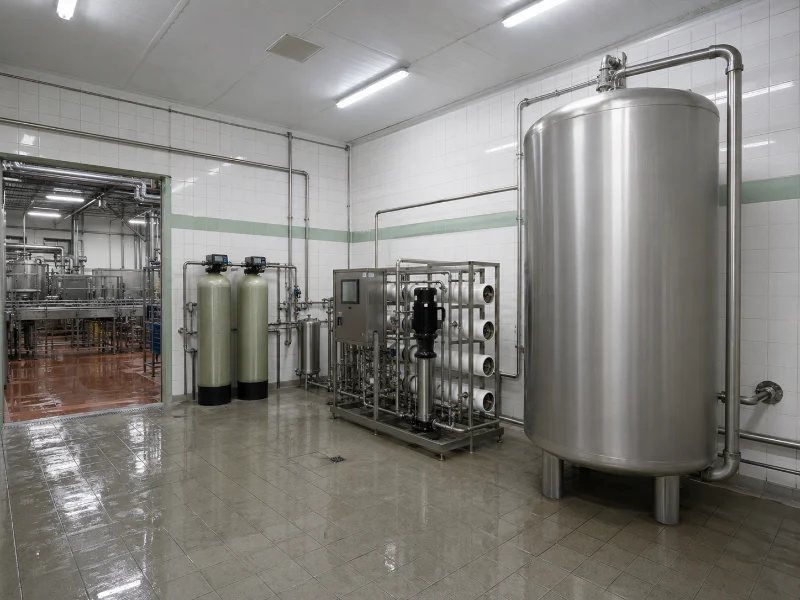
The dominant decision moves between bands for a mechanical reason. Reject volume scales with permeate flow at a given recovery, so a system producing ten times the permeate sends roughly ten times the concentrate to drain. At a few hundred gallons a day that stream barely affects total water cost, though discharge requirements still depend on the receiving sewer, any septic system, and local permits. Somewhere in the mid thousands the volume stops being marginal on either count, which is why recovery rate and discharge limits arrive as design constraints together.
Best Commercial Reverse Osmosis System Sizing
Sizing a commercial RO system starts from two numbers no catalog can supply: the volume the site draws in its busiest hour, and the volume it draws in a day. Those two diverge whenever production runs in batches. Treat them as one number and the usual result is a system that meets its daily total while the point of use runs dry at the peak.
Storage is what separates them. A site drawing 1,200 gallons a day needs 150 gallons per hour of permeate if the system may only run during an eight-hour shift, which is 2.5 GPM. Allow that same system to produce into a storage tank across sixteen hours and the requirement falls to 75 gallons per hour, or 1.25 GPM. Converted at GPM × 1,440, those are minimum continuous-production equivalents of roughly 3,600 GPD and 1,800 GPD for identical demand. They are not equipment ratings. Each still has to be derated against the site’s coldest feed temperature, actual feed TDS, a fouling allowance, and the downtime that flushing and cleaning impose. The tank, not the membrane, is often the cheaper half of that difference.
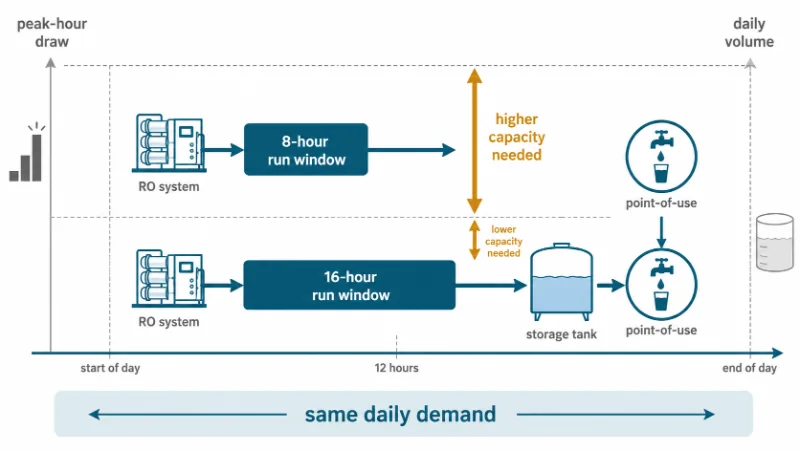
Two variables lock before the others. Permeate quality comes first. It decides whether one pass is enough or whether a second pass and polishing are needed, which changes the machine itself. The available run window comes next, because it sets capacity and storage together. Feed chemistry, footprint, and materials all have to converge before the design closes. These two lead because they set the boundaries the rest are sized inside.
There is also a case for not buying one at all. Where feed TDS is already low and the complaint is limited to chlorine, taste, odor, or particulate, sediment and activated-carbon filtration may resolve it for a fraction of the capital and with no concentrate to handle. Softening belongs in that answer only where hardness or scale control is part of the requirement. Reverse osmosis earns its cost when a dissolved-solids or specific-ion limit drives the specification.
FFeed Water Analysis and Pretreatment Scope
Feed water chemistry shapes a commercial RO specification more than capacity does, because the same permeate flow can require entirely different pretreatment depending on hardness, silica, iron, and the disinfectant the utility uses. A capacity figure quoted without an analysis behind it is a quotation for hardware alone.
| Feed variable | What it changes in the specification | How to establish it |
|---|---|---|
| Total dissolved solids and conductivity | Membrane family, and whether a single pass reaches the required permeate quality | Laboratory analysis of the actual feed point, drawn on site |
| pH | Carbonate equilibrium, silica solubility, and which scale-control chemistry applies | Reported on the same analysis and confirmed in the field |
| Total hardness and alkalinity | Whether softening or antiscalant dosing goes ahead of the membranes, and the recovery the design can hold | Full ion analysis including calcium, magnesium, and bicarbonate |
| Sulfate with barium and strontium | Sulfate scaling risk, which can cap recovery at trace ion concentrations | Requested explicitly, as these are routinely omitted from standard panels |
| Reactive silica | The upper recovery limit the design can run without scaling the tail element | Reported explicitly on the same analysis |
| Iron and manganese | Whether oxidizing filtration is required upstream of the cartridge filters | Sample drawn and preserved so it does not oxidize in transit |
| Disinfectant type and residual | Whether dechlorination is mandatory, and what has to be monitored to prove it works | Utility’s disinfectant confirmed, then free and total chlorine measured in the field |
| Feed temperature range | Permeate flow at a given pressure, and the capacity available in winter | Site measurement in the coldest month, plus the annual range |
| Turbidity and SDI | Prefiltration duty at the raw feed; membrane feed acceptance after pretreatment | Turbidity and SDI on raw water for pretreatment design, then SDI at the RO feed |
Many utilities dose chloramine, so a free-chlorine test can read low while an oxidant capable of damaging polyamide membranes is still present.
Where hard feed water runs without adequate scale control, mineral scale develops first toward the concentrate end. DuPont’s FilmTec troubleshooting guidance on high pressure drop (Form 45-D01652-en) attributes rising tail-end differential pressure to scaling, and points to scale control and system recovery as the design questions behind it. Rising differential pressure at the front end more often indicates particulate, colloidal, or biological fouling. The two symptoms point at different parts of the design, so diagnose from stage-level normalized flow, salt passage, and pressure drop before pulling any element.
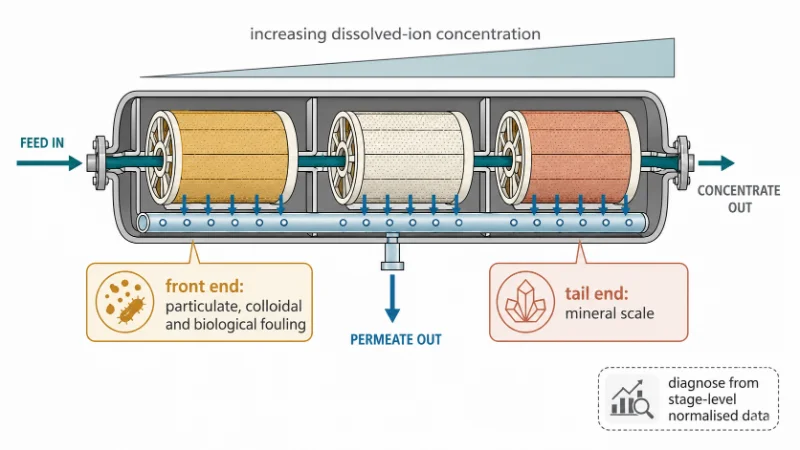
We verify a commercial RO design against a current analysis of the actual feed point and the site’s coldest expected feed temperature before committing to a permeate flow figure.
Nameplate GPD Versus Site Output
Rated capacity on a commercial RO datasheet is measured at reference conditions, so the GPD figure describes a test result. The flow you get on site depends on the feed temperature, feed TDS, and feed pressure the machine actually sees. Most capacity tables carry a footnote naming those reference conditions. Two systems can carry identical labels on different rating bases, which makes them non-comparable until someone reads the footnotes.
The same effect shows up from the operating side. Permeate flux falls when feed water temperature drops, so a system commissioned in August and judged in January is being judged against a different feed condition. It is not evidence of fouling.
Ask each supplier to restate capacity at your measured feed TDS and your coldest expected feed temperature, and to say which element data the restatement uses. Temperature correction is element-specific and published by the membrane manufacturer, so it belongs in the supplier’s calculation. A rule of thumb applied afterward will not survive a technical review.
Recovery rate moves for related reasons. At a fixed permeate flow, higher recovery reduces feed flow and concentrate volume. It does not automatically reduce pump size. Required pressure rises as the concentrate stream becomes more concentrated, and stage hydraulics and minimum crossflow have to be checked alongside flow. Higher recovery also raises scaling risk at the tail element. Softening, antiscalant dosing, and reducing recovery are not three competing options. They can be used singly or in combination, depending on the hardness, alkalinity, sulfate, and silica present, and on the discharge limit the concentrate has to meet.
Commercial RO Quote Comparison Basis
Two quotes for a commercial RO system of equal capacity are comparable only when both state the same rating basis and the same scope of supply. Most of the price gap between them sits in items that are easy to leave off a line-item total.
Published figures show how wide that gap runs. Equipment retailers list packaged skids at catalog prices: a 2,000 GPD AXEON unit sits near $4,400 at reverseosmosis.com, a 6,000 GPD unit near $9,000 at ESP Water Products. AMPAC USA’s 2026 commercial RO cost guide puts 2,000 GPD at $8,000 to $15,000. Roughly twice the figure, same nameplate. Neither is wrong. One quotes a skid on a pallet, the other an engineered package carrying pretreatment, storage, controls, and commissioning inside the number. Which line items move an industrial RO system price is the more useful question.
| Quote line | What a low number often means | What to ask before comparing |
|---|---|---|
| Pretreatment | Carried as an allowance, or excluded pending a water analysis | Which steps are included, and sized against which analysis |
| Membrane elements | Element count, model, and array left unstated | How many elements, in how many vessels, in what array |
| High-pressure pump | Selected against the rating condition alone | Which feed temperature and feed pressure the selection assumes |
| Instrumentation | Conductivity and flow indication only, with no logging | Which parameters are measured, displayed, and recorded |
| Controls | Manual start and stop, with no automatic flush | Whether flush cycle, low-pressure cut-out, and tank level control are included |
| Storage and repressurization | Tank and delivery pump left in the buyer’s scope | Whether tank, delivery pump, and interlocks are covered |
| Commissioning and performance test | Delivery only, with no demonstration | What performance is proven on site, at what conditions, against what acceptance criterion |
Align competing quotes to one rating basis and one scope list before comparing totals. The cheapest quote is frequently the one that left the most out.
From Feed Analysis to a Comparable Commercial RO Quote
The best commercial reverse osmosis system for a site is settled by two answers: the permeate quality the process must hit, and the window the system is permitted to run in. The capacity band narrows the The best commercial reverse osmosis system for a site is settled by two answers: the permeate quality the process must hit, and the window the system is permitted to run in. The capacity band narrows the shortlist. Those two answers close it.
Systems that disappoint after commissioning usually do so because the design was fixed against an assumed feed, which means pretreatment retrofitted around an already-built skid. Whether that risk applies to your site depends on the feed source, the seasonal temperature swing, and the concentrate discharge limit, all project-level confirmations that we clarify before specifying a commercial RO water filter system.
The list below pins down the two things no datasheet can tell a supplier: what your water is, and when you need the water.
- A current laboratory analysis of the actual feed point, covering pH, conductivity, TDS, calcium, magnesium, total hardness, alkalinity, chloride, sulfate, reactive silica, iron, and manganese, with the sample date noted
- Barium and strontium on the same analysis where recovery above roughly 60 percent is intended, since sulfate scaling can cap recovery at trace concentrations
- The utility’s disinfectant type, with free and total chlorine measured at the connection point
- The lowest feed water temperature the site sees, the month it occurs, and the annual range
- Static and dynamic feed pressure measured at the proposed skid position
- Peak-hour draw and daily volume, stated as two separate figures
- Required permeate quality expressed as a number and a unit, whether TDS, conductivity, or a process specification
- Hours per day the system is allowed to run, and whether overnight production into storage is permitted
- Pretreatment already installed on site, with capacities and the date it was last serviced
- Where the concentrate discharges, and any limit that applies at that point
- Whether production must continue during membrane cleaning
- Drain elevation relative to the skid, since concentrate runs to it continuously in operation
With those answered, a capacity figure stops being a guess and becomes a specification a supplier can be held to.
FAQ
Fixed costs decide this more than the water does. Pretreatment, storage, and service visits cost about the same at one site as at five, so a single location carries the whole overhead. Groups justify RO at a lower TDS threshold than a standalone store.
Fouling and cleaning history decide it, and no calendar interval substitutes. Track normalized permeate flow, salt passage, and differential pressure, and replace when cleaning stops restoring them to the commissioning range.
Partly. Recovery set points and dosing rates stay adjustable after commissioning. Element count, vessel count, pump selection, frame size, and electrical supply are physical decisions, often costly or impractical to change after fabrication. Ask which array the skid accepts as built, and treat any larger capacity as a separate purchase.
Often, though a standard municipal-style panel is the wrong test to start from. A well needs hydrogen sulfide, microbiological activity, and turbidity added to the analysis. Hydrogen sulfide in particular depends on its form, concentration, pH, the oxidation approach chosen, and the final water specification.
Ask the utility that owns the receiving sewer, in writing, before sizing. The answer may come back as a permit condition, a surcharge schedule, or a site-specific limit. It can cap the recovery rate the design is allowed to use.
Related Posts
Brackish Water RO Design: Recovery Limits, Staging, and What to Verify — continues the recovery and tail-end scaling limits described in the feed water section.
Top Industrial RO Manufacturers: 15 Suppliers by Role, Ownership, and Fit — the step before quote alignment: narrowing the supplier list to a comparable set.
Industrial Pure Water Process: Stages, Key Technologies, and Specification — takes up what happens when permeate quality calls for a second pass and polishing.
Reverse Osmosis Application: Which Water Problems It Actually Solves — expands the case for when a simpler treatment train is enough.
Distillation vs Reverse Osmosis: What Decides Between Them at Plant Scale — the alternative worth pricing before committing to membranes.