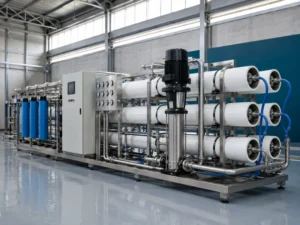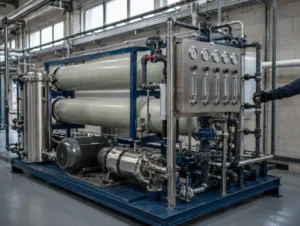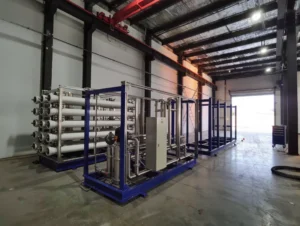
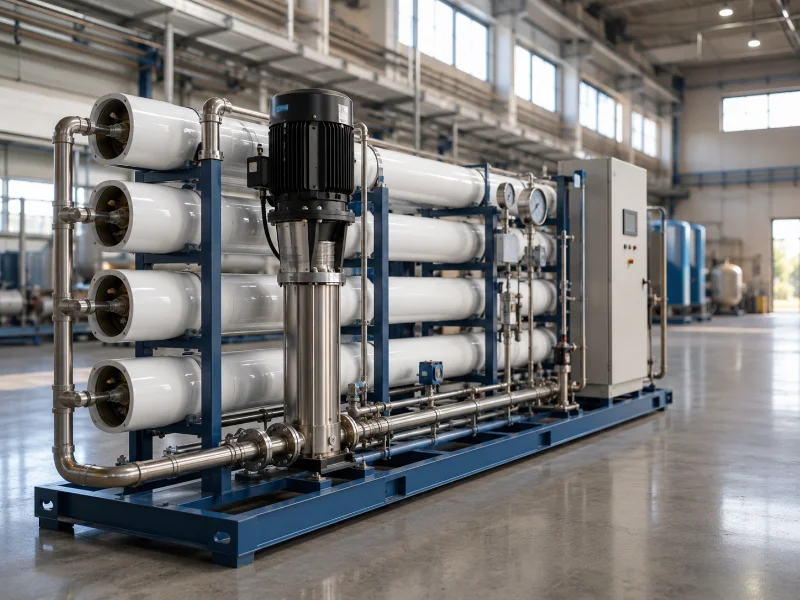
The best filter for brackish water is reverse osmosis in most industrial applications, though the choice depends on feed TDS, the ion split behind it, and how low the permeate must go. Brackish sources run roughly 1,000–10,000 mg/L TDS, where no sediment, carbon, or softening stage removes dissolved salt. Nanofiltration and electrodialysis remain candidates under specific ion and target-quality conditions. Pretreatment and concentrate chemistry then decide whether the selected process holds up in service. Commissioning day proves much less than the first summer does.
Why “Filter” Is the Wrong Word for a Brackish Water Problem
Conventional filtration removes suspended solids and not dissolved salt, which is why any source above roughly 1,000 mg/L TDS needs a desalination process, not a finer cartridge. This guide is written for commercial and industrial supply, where the permeate has to meet a written specification, not a taste preference. Sediment filters, multimedia beds, and activated carbon filters work on particles, turbidity, chlorine, and organics. Salt ions pass straight through all three.
Water softeners produce the most expensive version of this mistake. Softening exchanges calcium and magnesium for sodium, so hardness drops while TDS holds steady or edges upward. A softened brackish supply can still taste salty, still drive chloride corrosion, and still fail a conductivity specification.
A brackish source diagnosed from a taste complaint instead of a laboratory analysis often ends with a softener installed first and a desalination system purchased second. The correction is a full ion panel before any equipment is specified, not a larger softener.
The Best Filter for Brackish Water Depends on Feed TDS and Ion Profile
Three desalination processes compete inside the brackish band, and the deciding variables are feed salinity, the ratio of monovalent to divalent ions, and how far the permeate must fall. Reverse osmosis is the most widely applied general-purpose option across the range because it rejects both monovalent and divalent species and can reach relatively low product-water salinity. That breadth explains why RO is the default. It does not make RO the cheapest.
| Process | What it rejects | Typical competitive conditions | Where it loses ground |
|---|---|---|---|
| Reverse osmosis (BWRO) | Monovalent and divalent ions, organics, microbes | Across the brackish band and above, particularly where a low product salinity is required | Energy tracks feed osmotic pressure, so partial desalination costs nearly as much as full |
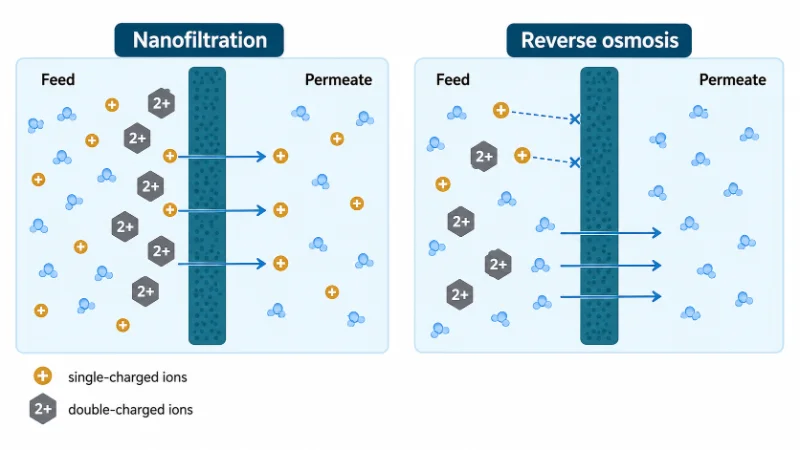
| Nanofiltration (NF) | Divalent ions strongly; monovalent ions largely pass | Feeds where hardness and sulfate carry the TDS, and partial demineralisation is acceptable | Sodium-chloride-dominant feeds, where the rejection advantage largely disappears |
| Electrodialysis (ED/EDR) | Ionic species only; no removal of neutral organics or particles | Lower feed salinity combined with a modest required salt-removal ratio | Rising feed salinity combined with a demand for deep desalination |
These are screening conditions, not design limits. Final selection needs process modelling against the actual analysis, and a pilot run where the water chemistry is unusual.
Nanofiltration lives or dies on the ion split. NF membranes reject divalent ions far more strongly than monovalent ones. Many brackish aquifers carry their load as sodium and chloride, though hard, sulfate-rich, bicarbonate-rich and mixed-ion waters are also common, and the type varies with lithology and local water chemistry. In a sodium-chloride-dominant feed, NF passes the bulk of what the buyer is trying to remove, and the TDS reduction stays modest however low the feed reads. Where the analysis shows calcium, magnesium and sulfate carrying the load, NF becomes a real candidate. The total cannot tell you which case you are in. Only the ion breakdown can.
With electrodialysis, what matters is the gap between feed and target, not the feed alone. ED consumes energy in proportion to the ionic equivalents it moves across the membrane stack, while RO must overcome the osmotic pressure of the whole feed stream regardless of how much salt is taken out. Trimming a moderately saline feed to a moderately saline product is a small ionic load and a plausible ED duty. Drive the same feed to a low product salinity and the load is large, and RO’s position strengthens. A peer-reviewed comparison in ACS ES&T Engineering reported that any practical ED advantage disappeared once feed salinity reached about 10 g/L, given the salt removal needed for drinking water quality. The same study found RO ahead at lower salinity too, where deep removal and energy recovery were involved. The crossover in a given project depends on stack resistance, electricity price, recovery, and the required removal ratio. Establish it by comparative modelling; do not assume it from a threshold.
Confirm the Ion Analysis First; Scale and Duty Come Second
A complete ion analysis is the input to confirm before anything else on a brackish project, because feed chemistry determines which processes remain technically viable at all. Two wells reading identical TDS can require different membranes, different antiscalant chemistry, and different recovery ceilings. Ordering equipment before the analysis is one of the few errors that resizing cannot correct.
The second input is the product-water target, named as the specific limit that drives it, not as a general wish for clean water. A boiler conductivity specification, a beverage recipe, and the US EPA secondary drinking water guideline of 500 mg/L TDS will yield three different designs from the same well.
Where the product is intended for potable use, that guideline needs reading carefully. The 500 mg/L value is a non-enforceable secondary standard covering taste, colour, and similar aesthetic and technical effects. Meeting a TDS target does not on its own confirm the permeate is safe to drink. A potable design must also clear the microbiological and chemical limits applicable at the project location, and disinfection, pH adjustment, or remineralisation may still be needed downstream. Which of those apply is a compliance question for the responsible authority, not something a conductivity reading can answer.
Flow rate, duty cycle, redundancy, footprint and power availability then decide which of the technically viable options stays practical and economical at the required scale. At large capacity they can shift the economics between processes in their own right.
Before we compare processes, we verify that the analysis covers barium, strontium, sulfate and silica, since sparingly soluble species may set the recovery ceiling even when sodium accounts for most of the feed TDS.
Reverse osmosis is not always the right answer. Where hardness dominates the TDS and the objective is scale control in a cooling or process loop instead of a low-TDS product, softening or nanofiltration will often meet the requirement at a fraction of the operating cost. A full RO train would be money spent on a problem that was not there.
Pretreatment and Concentrate Chemistry Decide Membrane Life
Pretreatment for brackish water reverse osmosis systems follows from three feed measurements, not from a standard equipment list: particulate fouling potential, dissolved iron and manganese, and the scaling ion set. ASTM D4189 defines the silt density index test used for the first of these, an empirical indicator of how strongly a feed tends to foul membrane systems with particulates. A tighter SDI target changes the media and cartridge stages ahead of the array, not the membranes.
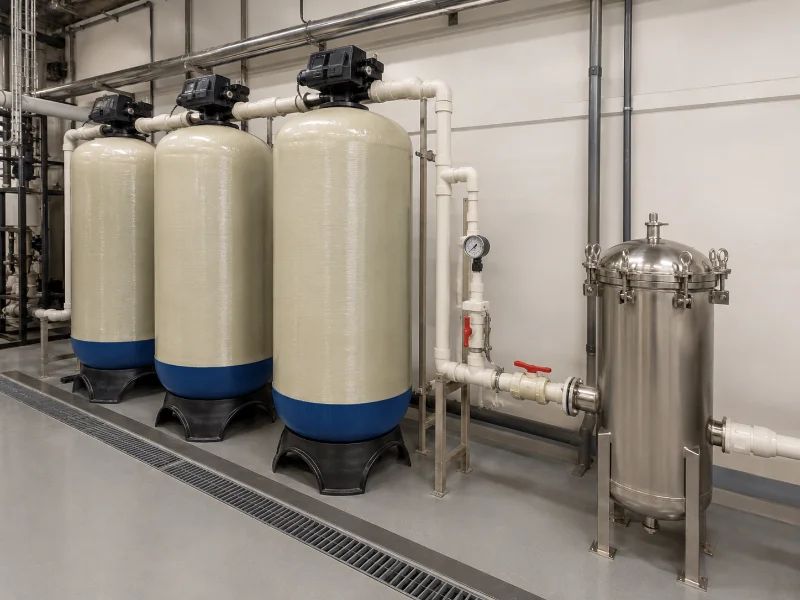
Where dissolved iron or manganese is present, the pretreatment design should establish how those species get oxidised and removed upstream of the RO cartridge filter. The choice of iron and manganese removal filters follows from that decision, not the other way round. The cartridge filter is a final guard, not the iron-removal stage. Rapid cartridge loading in service is normally a sign that upstream oxidation or solids removal needs review.
Recovery concentrates whatever is not removed. At a recovery R, an ideal bulk mass balance gives a final concentrate factor of about 1/(1−R), so a system run at 85% recovery reaches roughly 6.7 times the feed concentration in the bulk concentrate. Element-by-element and membrane-surface concentrations differ from that figure, because salt passage, staging, concentration polarisation and any precipitation all shift it. Take those numbers from a membrane projection. The direction of the conclusion holds either way: a feed analysis showing a comfortable Langelier index is not the number that governs. ASTM D3739 exists for this reason, covering calculation of the Langelier saturation index for the RO concentrate stream from the feed analysis and operating parameters. Sulfate scaling by calcium, barium and strontium salts is calculated separately, under different published practices listed below. Those limits frequently cap achievable recovery before calcium carbonate does.
We compare the projected concentrate saturation against the target recovery before selecting an antiscalant, because the alternative is a chemical chosen for a water the membranes never see.
How to Verify a Brackish Water System Before It Ships
Acceptance verification for a brackish RO system rests on normalized performance data, not on a single startup reading, since permeate flow and salt passage both move with temperature, pressure and recovery. ASTM D4516 sets out the procedure for converting operating data to a fixed reference condition, so that two readings taken weeks apart can be compared at all. A supplier who cannot produce normalized figures is offering a snapshot.
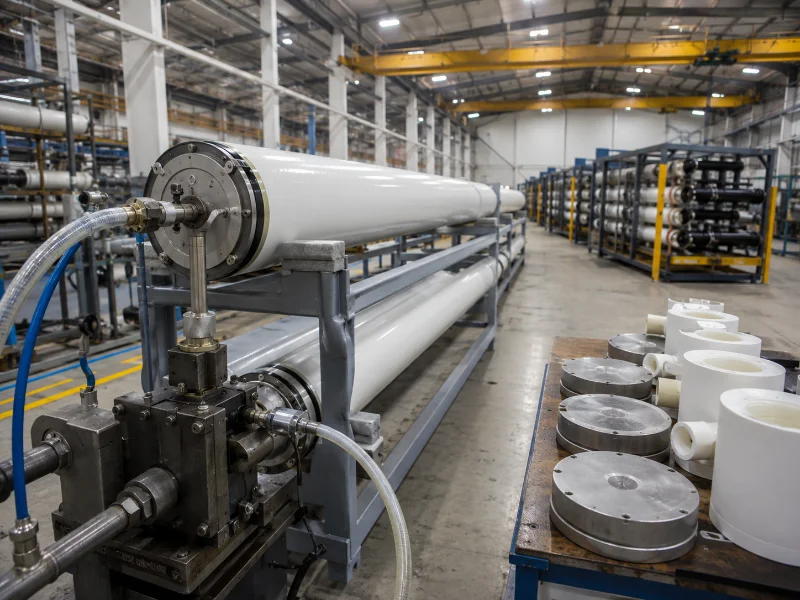
Three checks are worth insisting on before signing. Ask for a projection run at your actual feed analysis and your worst-case cold-season temperature, since low feed temperature reduces flux and is the condition most often omitted. Ask what recovery the projection assumes and what caps it, scaling or hydraulics. Ask how the plant behaves at turndown if your duty cycle is intermittent, because a system that starts and stops daily fouls differently from one that runs continuously.
Concentrate handling belongs in this conversation earlier than most buyers expect. The available disposal route caps achievable recovery from the outset: a sewer discharge consent, a surface water permit, an evaporation pond area, and a deep well injection option each impose a different ceiling. A recovery target fixed before that route is known can turn out to be undeliverable. Selecting and permitting the route itself sits outside this article. That is a separate exercise, and it belongs with the relevant authority in parallel with process selection, not after it.
Where to Start with Brackish Water Selection
The best filter for brackish water is settled by two numbers: the ion breakdown behind the TDS, and the specific limit the permeate has to meet. Once both are on paper the process choice usually narrows quickly, and the remaining work shifts from selection to sizing.
Where a source is specified from a TDS reading alone, the problem often surfaces in the concentrate, not the permeate, and the correction tends to be a recovery reduction or an antiscalant change instead of new membranes. Recovery itself stays a project-level variable. It depends on the scaling ion set, the feed temperature range and the disposal route available at the site, and it should be confirmed against a projection run on your own analysis, not borrowed from a typical figure. We align membrane count, staging and recovery to that analysis, not to a catalogue capacity.
Suppliers cannot size a brackish system from a salinity figure and a flow rate, and any who offer to are quoting a guess. With the eight items below, sizing becomes arithmetic:
- A full ion panel: sodium, calcium, magnesium, barium, strontium, potassium, chloride, sulfate, bicarbonate, nitrate and silica, with pH
- Feed temperature range, including the cold-season minimum that sets the worst-case flux
- Silt density index or turbidity, sampled after the pump has run long enough to draw formation water instead of standing water
- Dissolved iron and manganese, on a field-preserved sample
- The permeate limit and what drives it: a boiler specification, a product requirement, or a regulatory value
- Required permeate flow with the daily duty cycle, and whether operation is continuous or intermittent, since intermittent service changes both the staging and the flush arrangement
- Available feed pressure and electrical supply, which set whether the high-pressure pump duty is achievable without a booster stage
- The intended concentrate disposal route, since the permitted option caps achievable recovery
FAQ
No. Boiling drives off water and leaves the salt behind, so what remains is saltier than what went in. Salt removal needs a membrane or a condensing still.
Yes, as pretreatment rather than as treatment. Where calcium carbonate scaling is what caps recovery, softening the RO feed can lift that ceiling and allow the system to run tighter. The softener does not lower TDS. It changes what the concentrate stream can tolerate.
A seawater element can operate on brackish feed, but it should not be selected for its higher nominal rejection alone. Permeability, test conditions, projected flux, salt passage and pump duty all need comparing against a purpose-designed brackish element at your actual feed analysis before the swap makes sense.
There is no calendar answer. The trigger is normalized data: a defined fall in normalized permeate flow, a rise in normalized salt passage, or a rise in differential pressure across a stage. Feeds with high organic or biological activity reach those triggers sooner than clean groundwater.
A single pass is often sufficient for a TDS target. Check species-specific limits separately against the feed concentration and the membrane projection, since boron and, in some waters, nitrate may control the design instead of bulk TDS.
Related Posts
- What Is Brackish Water Reverse Osmosis? — the process itself, for readers who reached the selection question before the definition
- What Is the Difference Between a Cation and an Anion? — the ion classes behind the analysis this guide keeps returning to
- Aeration in Water Treatment — how dissolved iron and manganese get oxidised before they reach the membranes
- Industrial Reverse Osmosis System Maintenance — the daily and periodic checks behind the cleaning triggers in this guide
- Does Reverse Osmosis Remove Fluoride? — the same species-by-species rejection question that decides whether one pass is enough