Yes, a reverse osmosis system removes fluoride, and a well-selected RO membrane rejects most of it, commonly about 80% to 95% depending on the membrane type and the water. How much you get depends on the feed fluoride concentration, pH, total dissolved solids, temperature, pressure, and recovery rate. A single-pass unit on municipal tap water behaves very differently from a high-recovery industrial system on high-fluoride groundwater. RO reduces fluoride rather than eliminating it, so whether it meets a target is a question of margin, not a plain yes or no.
Fluoride is present for one of two reasons: it is deliberately added to public water at a recommended level, 0.7 mg/L in the United States, or it occurs naturally in groundwater, sometimes well above regulatory limits. That recommended fluoridation level is not a safety ceiling. The U.S. EPA sets an enforceable maximum contaminant level of 4.0 mg/L and a non-enforceable secondary standard of 2.0 mg/L, and the World Health Organization guideline value is 1.5 mg/L. A treatment target is set by the applicable regulation, process specification, or customer requirement, not fixed at 0.7 mg/L. What follows covers whether and how well RO removes fluoride, and how to confirm it on your water.
How a Reverse Osmosis Membrane Removes Fluoride
A reverse osmosis membrane removes fluoride by rejecting the dissolved fluoride ion at the polyamide active layer, and how completely it does so is governed by the ion’s charge and hydration, not by pore size in any simple sieving sense. Most explanations get the mechanism wrong. A common version says RO works because fluoride is larger than a water molecule, caught by pores too small to pass it.
Fluoride is one of the smaller ions in drinking water. If separation were size-sieving, a small ion would be among the easiest things to pass, yet fluoride is held back by 80% to 95%. High rejection of a small ion is the clue that sieving is not the mechanism. Rejection comes from two effects instead. The membrane surface carries a negative charge that repels the fluoride anion, and the ion holds a tightly bound shell of water that must be stripped before it can cross the film.
How water and ions move through the active layer is an open question in membrane science. The long-standing solution-diffusion model still drives engineering projections, while newer research describes transport through interconnected nanoscale free volume rather than diffusion through a fully dense solid. For system selection, the conclusion holds either way: fluoride rejection is specific to the membrane and the operating conditions, and no nominal pore size predicts it. Choose a system on a headline percentage without checking feed fluoride against the target, and the permeate often lands above the target anyway, forcing a second pass or a blending correction later.
How Much Fluoride a Reverse Osmosis System Removes
How much fluoride an RO system removes is membrane- and condition-specific rather than a single number, so published figures vary with the membrane type and the water chemistry behind them. In a Water Quality Association technical review, cellulose-acetate membranes are cited at roughly 80–90% fluoride rejection across pH 4–8.5, and thin-film composite membranes at up to about 95% across pH 3–11. Residential performance sheets often report high-90s reductions under their own test conditions. No figure here is universal: acidic, high-fluoride, or high-recovery water can fall well below them.
A percentage alone is not enough because rejection is a share of what leaves the feed, not an absolute amount. Take a fixed 90% rejection at two starting points: feed at 1.0 mg/L leaves about 0.1 mg/L, while feed at 6 mg/L leaves about 0.6 mg/L. Same membrane, very different result. One case clears a low target with wide margin; the other barely meets it. Starting concentration decides whether you pass.
That margin can be stated exactly. The rejection you need follows directly from your feed and target:
Required rejection = 1 − (target concentration ÷ feed concentration)
Using a project target of 0.7 mg/L as an illustration:
| Feed fluoride | Required rejection to reach 0.7 mg/L |
| 1.5 mg/L | ~53% |
| 3.0 mg/L | ~77% |
| 5.0 mg/L | ~86% |
| 6.0 mg/L | ~88% |
Residential and industrial systems land at different points on that range. A residential under-sink unit runs at low recovery on low-TDS municipal water, so it tends to sit near the top. An industrial or commercial system runs at higher recovery on tougher feed, which shifts the arithmetic in ways a catalog percentage never captures. High-fluoride wells are often brackish, so brackish water reverse osmosis is the usual starting point at that end of the range.
What Determines Fluoride Rejection, and Which Variables to Confirm First
Fluoride rejection in a working RO system is set by a handful of variables, but two of them decide whether RO is the right tool before the rest matter: the feed fluoride concentration and the target level. Together they set the rejection margin you need. At 1.2 mg/L against a 0.7 mg/L target, almost any functioning RO clears it. Feed at 5 to 6 mg/L needs better than roughly 86 to 88% just to reach that target, which leaves little room for temperature swings, membrane aging, or higher recovery, and may point to a second pass. Both numbers come from your water, not your equipment, so establish them first; everything else only adjusts the margin around them. Choosing among the types of reverse osmosis systems, from single-pass to double-pass configurations, starts from those same two numbers.
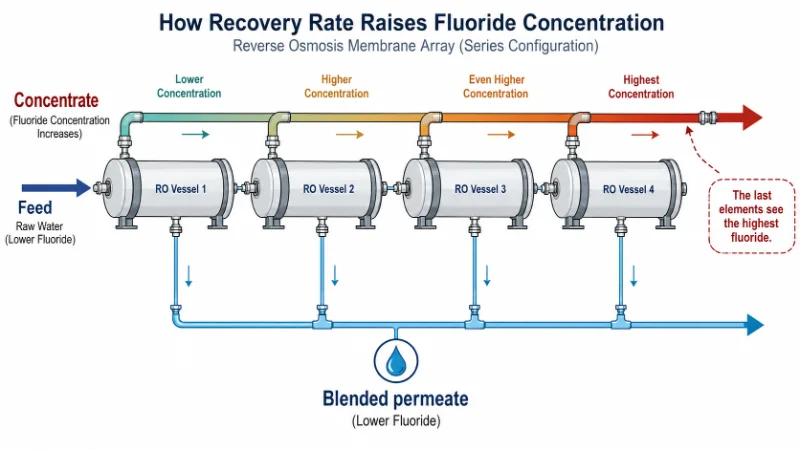
Recovery rate is the one most often underestimated. Recovery is the share of feed converted to permeate; as it climbs, the water left behind concentrates, so the last membranes in the array see more fluoride than the raw feed. Because rejection is a percentage, those elements pass more fluoride in absolute terms, and the blended permeate carries it. Mass balance makes this unavoidable: pushed to high recovery on high-fluoride feed, a system can miss the target while every element still rejects at its rated percentage. Check blended permeate fluoride at the design recovery, not a single-element rating.
| Variable | Direction of effect on fluoride rejection | What to check |
| Feed pH | Rejection can fall sharply as pH drops toward the HF region (around pH 3–4), where fluoride is less ionized; near-neutral to mildly alkaline feed favors the charged ion | Fluoride speciation; the membrane’s allowable pH; scaling |
| Temperature | Warmer feed generally increases salt passage, lowering rejection slightly | Coldest and warmest feed expected |
| Net driving pressure | Higher pressure generally improves rejection, up to membrane limits | Adequate pressure; stay within limits |
| Recovery | Higher recovery concentrates the feed side and raises system-level permeate fluoride | Blended permeate at design recovery |
| Membrane condition | Fouling, scaling, oxidation, or seal leakage can change rejection; direction and magnitude are not set by age alone | Normalized flow, normalized salt passage, differential pressure, direct fluoride test |
When a fluoride target drives the design, we size against the projected blended-permeate fluoride at the design recovery and temperature range.
Reverse Osmosis vs Other Fluoride-Removal Methods
Reverse osmosis is the broadest fluoride-removal method for most water, but activated alumina, bone char, strong-base anion exchange, and distillation each remove fluoride too, and the right choice depends on how much other treatment the water needs.
| Method | How it removes fluoride | Best suited to | Main limitation |
|---|---|---|---|
| Reverse osmosis | Rejects the fluoride ion at the membrane | Water needing broad contaminant reduction, or high-TDS and high-fluoride feed at volume | Higher capital and energy cost; produces a concentrate stream to manage |
| Activated alumina | Adsorbs fluoride onto the media | Fluoride as the main objective, on feed at or near pH 5.5 to 6 | Usually needs pH adjustment ahead of it; finite capacity |
| Bone char | Adsorbs fluoride onto a carbon-mineral medium | Niche and legacy installations | Finite capacity; limited modern supply and specification |
| Strong-base anion exchange (chloride form) | Exchanges fluoride for chloride on the resin | Fluoride-selective polishing where the rest of the water is already suitable | Competing anions consume capacity; resin needs regeneration |
| Distillation | Boils water to steam and leaves fluoride behind | Small volumes where energy cost is acceptable | Energy-intensive and slow; rarely suits volume work |
If your feed fluoride sits only slightly above target and the water is otherwise clean, a targeted adsorption method like activated alumina may be simpler or cheaper, and RO would be over-specified. That holds when fluoride is the main objective and the feed chemistry suits it. RO earns its cost when you also need broad contaminant reduction, or when you treat high-TDS or high-fluoride water at volume, where adsorption media exhaust and need frequent replacement or regeneration. Adsorption capacity is finite and runs on a replacement schedule; RO rejection is continuous for the life of the membrane.
How to Verify a System Removes the Fluoride You Need
Verifying fluoride removal means checking a specific system against your actual feed and target, and the evidence that counts differs between a point-of-use unit and an industrial plant. For a point-of-use or residential system, look for certification to NSF/ANSI Standard 58, the standard for point-of-use reverse osmosis drinking water systems, then read the listing closely. TDS reduction is the baseline requirement under Standard 58; fluoride reduction is a separate, optional claim. A system can be certified without carrying a fluoride claim, so confirm that the specific model’s performance data sheet states a tested fluoride reduction.
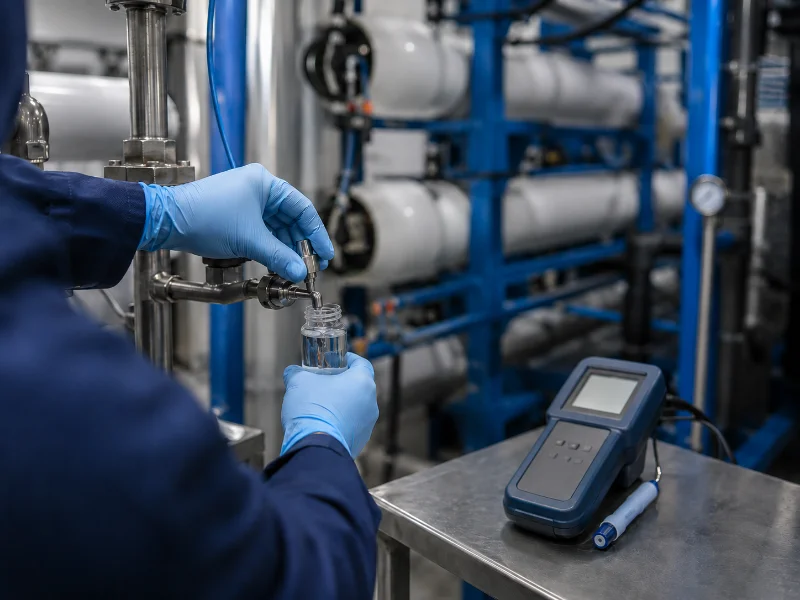
For an industrial or commercial system, certifying a membrane element is not the same as proving system performance on your water. Performance is verified in two steps: a membrane projection at your design conditions before purchase, and grab samples of feed and permeate fluoride at commissioning under normal operating recovery. What governs acceptance is the measured permeate fluoride at design recovery, not a datasheet rejection rate.
Confirming that RO can hit your fluoride target is a separate job from sizing and selecting the system for your flow and site. Both start from the same feed-water analysis, but they are distinct engineering steps.
Where to Start When You Need RO to Hit a Fluoride Target
Whether a reverse osmosis system removes fluoride is settled: it does. What decides success is whether it removes enough on your specific water, and that comes down to two numbers you fix before looking at equipment: your feed fluoride concentration and your target. Those set the rejection margin you need and decide whether a single pass is enough or a second pass is warranted. On high-TDS or high-fluoride groundwater, the recovery setting and the last membranes in the array are the first places to look when permeate fluoride drifts above target. We match an industrial reverse osmosis water system to the feed analysis and the target rather than to a headline rejection number, because the same membrane performs differently on different water. Final performance also depends on site conditions like feed temperature range, recovery, and pretreatment, confirmed at commissioning.
The next step is a feed-water analysis. A fluoride projection is only as good as the feed data behind it, and the measurements that let a supplier size a system to a target are:
- Fluoride concentration in the feed (mg/L)
- Target fluoride level, set by regulation, process, or specification
- Total dissolved solids (TDS)
- Feed water temperature range, minimum to maximum
- Feed pH
- Silica and hardness (calcium and magnesium), which cap how high recovery can go before scaling
- Required permeate flow rate
- Water source, and any known seasonal variation in fluoride or TDS
With those in hand, a supplier can project permeate fluoride at your design conditions and size the membranes and passes to hit the target, instead of quoting a rejection percentage that may not apply to your water.
FAQ
No — a small residual always remains, so a system is matched to a target level rather than to complete removal.
Usually, though well water often carries higher natural fluoride and higher TDS than municipal supply, so the same system works from a smaller margin. Test the well for fluoride and TDS before assuming a single pass is enough.
Yes. Reverse osmosis removes minerals along with fluoride: the same rejection also reduces calcium, magnesium, and alkalinity, which is why many drinking-water systems add a remineralization stage afterward to adjust taste, alkalinity, corrosion tendency, or a defined product-water specification.
An intact RO membrane physically rejects bacteria and many microorganisms, but a standard residential RO system is not validated disinfection unless the complete unit carries the appropriate microbiological certification. Membrane defects, seal leakage, storage tanks, and post-filters can all compromise microbial safety, so UV or another validated step may still be needed. Manufacturers also specify that RO be fed biologically safe water.
There is no fixed schedule to quote. A membrane can hold its fluoride number for years or drift up sooner, driven by fouling, oxidation, and cleaning history rather than age. The practical answer is to track it: normalized salt passage and an occasional permeate fluoride test flag a real decline before it crosses the target.
Related Posts
- Distillation vs Reverse Osmosis — how the two methods compare when distillation is on the table as a fluoride option
- Does Reverse Osmosis Remove Nanoplastics? — the same “what does RO actually reject” question for another contaminant
- Reverse Osmosis Applications — where RO fits beyond fluoride, and which water problems it solves
- Industrial Reverse Osmosis Pros and Cons — the trade-offs to weigh before committing to RO
- How Long Do Reverse Osmosis Filters Last? — membrane life, the variable behind rejection drifting over time