A reverse osmosis application is any process whose separation objective needs broad reduction of dissolved solutes: seawater and brackish desalination, boiler and process-water pretreatment, ultrapure water, food and process-liquid concentration, and wastewater reuse. Those five sort into four separation tasks, and the task you are in decides the feedwater analysis you need, the permeate target you design to, and the variable that caps the design. RO earns its place when the objective needs broad solute reduction. It is rarely the cheapest instrument when one parameter is out of spec and nothing else is.
What Does a Reverse Osmosis Application Actually Have to Do?
Every reverse osmosis application asks the membrane for the same thing, broad reduction of dissolved solutes under applied pressure, and how completely it delivers depends on which solutes are present rather than on how dirty the water looks. Pressure above the feed’s osmotic pressure drives water through a semipermeable membrane while most dissolved matter stays behind and leaves as concentrate. That is how reverse osmosis works at the level a specifier needs. What it does not hand you is a rule for predicting any particular solute.
Charge is the rule people reach for, and it breaks quickly. Boric acid and silicic acid are both weak acids that stay largely undissociated at neutral pH, yet a membrane treats them very differently. Silica is held well enough to become the scalant that caps recovery. Boron passes in significant proportion, which is why seawater plants raise pH above boric acid’s pKa of roughly 9.2 to convert it to borate, or add a second pass, instead of switching to a looser membrane. Two uncharged weak acids, opposite outcomes.
The difference is structural. A commercial RO layer is a dense polyamide film, not a screen with a pore diameter, so rejection follows how each solute partitions into that film and diffuses across it. Nominal pore figures quoted on application pages are analogies borrowed from filtration, and they predict nothing about a solute you care about; that has to come from tested data at stated conditions. Dissolved gases are the clearest case: carbon dioxide is small, uncharged, poorly held by the film, and it crosses to the permeate side.
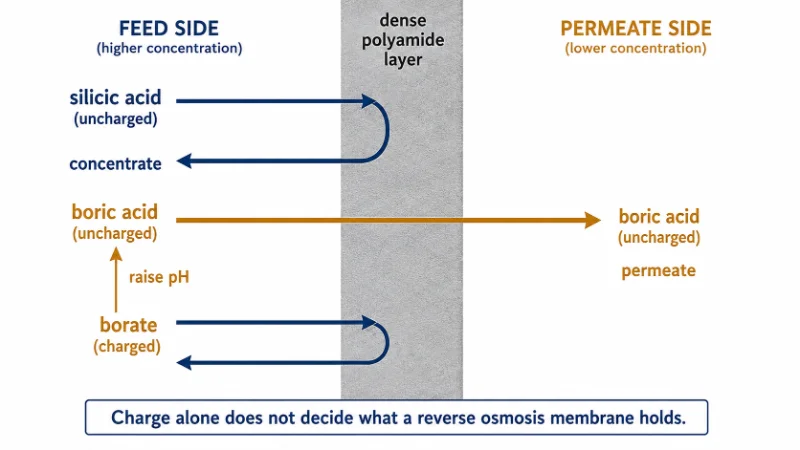
So the first question in scoping an application is not which industry you are in. It is whether the objective needs broad solute reduction, and whether the solutes that matter to you are ones the membrane holds. A semiconductor rinse line and a car wash sit in different industry rows and ask for the same job: the dissolved load taken down far enough that nothing is left behind when the water dries.
Why Is “99% Removal” the Wrong Basis for an RO Decision?
The rejection percentages quoted for reverse osmosis are scoped claims rather than universal ones, and the scope decides whether they mean anything for your feedwater. NSF/ANSI 58 covers point-of-use RO drinking water treatment systems. Its scope assumes supplies already considered microbiologically safe and of known quality, and it addresses total dissolved solids reduction plus a defined list of contaminants. A percentage validated inside that scope carries the scope with it: a known feed, and a drinking-water endpoint. Industrial verification runs on the element datasheet and a projection against your own analysis.
The same problem attaches to the number people reach for as a target. The 500 mg/L TDS figure comes from the US EPA’s National Secondary Drinking Water Regulations under 40 CFR Part 143. Those cover nuisance characteristics such as taste, staining, and scale, and they are not federally enforced, though individual states may adopt them.
The figure was never a process specification. Design a permeate target around it and you import an aesthetic guideline for public drinking water into a boiler house or a rinse line. The real requirement sits with the equipment or the product: a boiler’s pressure class, a resistivity spec for electronics rinse, batch-to-batch consistency in a beverage.
When a permeate target gets copied from a drinking-water table instead of read off the point of use, the system typically meets its stated number and still fails the process. What needs revisiting then is the specification.
A rejection figure also means little without its conditions attached. Test solution, pressure, temperature, and recovery all move the number, and an element quoted at test conditions will not repeat that figure on a colder, saltier feed run at higher recovery. Ask which conditions produced a percentage before you compare two of them.
Which RO Applications Map to Which Separation Task?
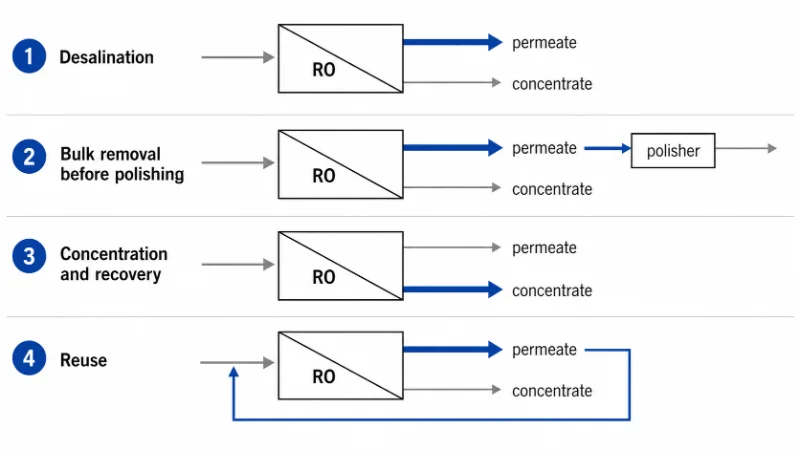
Industrial reverse osmosis applications sort usefully into four separation tasks, and the task you are in decides which variable caps the design long before element selection matters.
Desalination
Desalination asks the membrane to remove the bulk of the dissolved salt in the feed. Osmotic pressure scales with dissolved salt content, so salinity sets the pressure the pump must beat before the first litre of permeate appears. That is why brackish water reverse osmosis and seawater desalination are not one machine at two sizes: different elements, different pressures, different energy recovery.
Bulk Removal Before Polishing
Ultrapure and process water applications use RO as the bulk removal stage ahead of a polisher. The membrane strips most of the ionic load, then EDI or mixed-bed ion exchange finishes it, so what the RO hands to the next unit is what sizes it. Boiler feed water treatment follows the same logic even where no polisher exists, because the boiler’s pressure class sets the endpoint, not the water.
Concentration and Recovery
Concentration inverts the purpose, because the concentrate is the product. Osmotic pressure climbs as the solute concentrates and the pump has to stay ahead of it, so membrane area alone does not move the ceiling: more vessels in parallel add throughput, not concentration.
Lifting the ceiling means more pressure, which runs into the element’s pressure rating, and pressure is one limit among several. Viscosity, concentration polarisation, fouling, and in food duties product damage and hygienic design can cap the concentration factor first. That combination is why concentration duties eventually hand off to evaporation.
Reuse and Discharge Reduction
Reuse puts RO downstream of a treated effluent, where the salt is usually the tractable part and the biology is the problem. Pretreatment carries the design. Concentrate handling becomes a separate engineering question with its own permit and cost consequences, and it sits outside the scope of this article.
| Separation task | Typical applications | Confirm first | When RO is not the primary answer |
|---|---|---|---|
| Desalination | Brackish well water, seawater desalination, municipal potable supply | Feed salinity across the year | Only hardness is out of spec |
| Bulk removal before polishing | Boiler feed water, electronics rinse, pharmaceutical process water | Residual load the polisher will accept | Low-TDS feed reaches spec on ion exchange alone |
| Concentration and recovery | Juice and dairy pre-concentration, process liquid and metals recovery | Osmotic pressure at the target concentration | Target sits above the pressure or viscosity ceiling |
| Reuse and discharge reduction | Textile effluent, cooling blowdown, municipal reclaim | Fouling potential of the treated effluent | Reuse target is non-potable and turbidity-limited |
Which Variable Decides an RO Application, and Which Ones Can Wait?
Two inputs establish whether a reverse osmosis application is feasible at all: representative feedwater data, and a permeate target traced to the point of use. Confirm those before anything else, because they decide whether RO can meet the objective. Flow, temperature range, recovery, operating profile, and concentrate constraints then decide the configuration, and a configuration is cheaper to revisit than a feasibility call made on a TDS reading.
Representative data means more than TDS. Each parameter below answers a question TDS cannot, and each has a way of being reported that hides the answer.
| Parameter | What it decides | What it cannot be read off |
|---|---|---|
| Ca, Mg, Ba, Sr, sulfate, carbonate | Achievable recovery and antiscalant strategy | Total hardness; barium and strontium set limits at concentrations a hardness figure conceals |
| Silica | Recovery ceiling and cleaning strategy | Standard hardness panels, which often omit it unless asked |
| Alkalinity and pH | Carbonate balance and CO₂ carryover into permeate | pH by itself |
| TOC or COD | Organic fouling risk | SDI, which reflects particulate and colloidal plugging only |
| Turbidity and SDI | Particulate and colloidal fouling tendency | A single figure without its temperature and test filter |
| Temperature range | Flux, pressure, and projection at the winter low | Annual average temperature |
Fouling potential usually arrives as a silt density index measured under ASTM D4189, a test method scoped to relatively low-turbidity waters such as well water, filtered water, or clarified effluent. The standard states that SDI is empirically correlated with the fouling tendency of RO devices, not an absolute measurement of it. Values also vary with water temperature and with the manufacturer of the test filter, so results from different filters or temperatures are not comparable.
An SDI number without its test conditions cannot be checked against a supplier’s acceptance limit. Ask for the temperature and the filter manufacturer, and treat the figure as what it measures: particulate plugging.
Recovery is where a full analysis pays for itself. At recovery R, whatever the membrane holds concentrates in the reject stream by roughly 1/(1−R), ignoring salt passage. A design at 75% recovery therefore leaves the scaling ions about four times more concentrated than the feed, and silica or barium that looked negligible in the analysis is what sets the ceiling.
The permeate target has to come from the point of use. A boiler’s pressure class, a resistivity requirement on a rinse line, or a product consistency spec each name a number. “As pure as possible” names none, and it prices the system accordingly. On seasonal surface water, one sample describes one quarter, and a design built on a single analysis is the one that struggles at the turn of the season.
If hardness is the only parameter out of spec and sodium in exchange for calcium is acceptable at the point of use, water softening reaches the target for a fraction of the capital and running cost, and RO is the wrong purchase. That condition is narrower than it sounds: softening swaps hardness for sodium and leaves TDS, alkalinity, chloride, and silica where they were.
We verify the feedwater analysis and the point-of-use specification before comparing any configuration. Which type of reverse osmosis system follows, single or double pass, element type, recovery, belongs to the selection review that comes after those two inputs are fixed.
When Should Reverse Osmosis Not Be the Primary Unit?
Reverse osmosis is the wrong primary unit whenever a cheaper process reaches the same endpoint, or whenever the load in question should never have arrived at the membrane. The water analysis says which case you are in before a supplier does.
Three questions get run together in these conversations. A membrane’s capability to reject something is one. Whether that something should reach the membrane at all is a second, and it is a process question with a different answer. The third is regulatory: what counts as a validated barrier. RO scores well on the first far more often than on the second.
Turbidity and colloids show the gap. A membrane will hold them; letting significant turbidity, colloidal load, or biological growth reach the RO stage is a pretreatment failure rather than an RO design strategy. Ultrafiltration sits ahead of the membrane for exactly that reason.
A single problem ion may or may not be RO’s job, and boron shows why the answer comes out of the chemistry. Selective ion exchange handles nitrate well at low concentrations. Boron at neutral pH is undissociated boric acid and only partially rejected, so the fixes are raising pH so it becomes borate, adding a second pass, or using a boron-selective resin. A looser membrane makes it worse.
Microbial control is a compliance question. RO can provide a strong physical barrier to microorganisms, but a membrane element on its own should not be assumed to be a validated disinfection process. Validation depends on system integrity, monitoring method, the regulatory framework, and what disinfection sits downstream. NSF/ANSI 58 sidesteps the question by presuming a feed already considered microbiologically safe, which is why its numbers cannot settle it for an industrial stream.
Dissolved gases are the quiet failure. Carbon dioxide crosses to the permeate side and re-forms carbonic acid there, so an RO stage can hit full rejection on its salt numbers and still miss a conductivity target. Low-conductivity applications pair the membrane with degassing or a downstream polisher.
Where Should Your Reverse Osmosis Application Assessment Start?
A reverse osmosis application assessment starts with the separation task, then settles feasibility before configuration, because the task decides which analysis and which permeate target you need. If the objective needs broad solute reduction, RO is on the table. A representative analysis plus a point-of-use permeate target will then tell you which of the four tasks you are in and which trace ion caps your recovery. If one parameter is out of spec and nothing else is, the analysis usually says so before a supplier does.
Two things stay project-specific however clearly the task is named. Recovery depends on the scaling ions and silica in your particular feed. Fouling behaviour on a treated effluent tends to reveal itself after commissioning rather than during sizing, which is why pretreatment deserves the same scrutiny as the membrane. We align the permeate target with the point of use before pricing anything, because a target nobody can trace is a target nobody can verify.
Two documents make a supplier conversation productive. One is a full ionic analysis rather than a TDS reading, with barium, strontium, silica, and alkalinity on it. The other is the paper your permeate target comes from, whether an equipment manual, a product spec, or a limit that applies to your site.
Flow, temperature range, available feed pressure, and the concentrate’s destination shape the configuration and are worth bringing too. But a supplier holding the first two can already tell you whether industrial RO water systems are the right purchase, and that is the answer worth having first.
FAQ
Repeat frequency is set by events, not by an interval on the calendar. A new well, a switched utility source, a drought supply brought online, or a change at the utility’s own plant all reset it, and the last of those usually happens without notice to industrial customers. Ask what your utility plans to blend.
Household units do not scale up, because the constraints change with the duty. A domestic unit runs intermittently against a storage tank that absorbs any mismatch between what the membrane makes and what the tap draws. An industrial application has no tank to hide behind, which is what the pretreatment, instrumentation, and cleaning provisions are for.
The disposal route should be chosen before the recovery rate is fixed, because recovery decides the volume and strength of what you then have to place. Routes run from permitted discharge through further concentration to zero liquid discharge, and local limits decide which is open. Fix recovery first and the route search can send you back to redesign it.
A pilot earns its cost when the feed has no reliable analysis history, or when the stream is a treated effluent whose fouling cannot be predicted from a spot sample. Well-characterised municipal and brackish well feeds are normally projected from the analysis and the datasheet without one. The test is how much of the design rests on assumptions.