Reverse osmosis (RO) is a pressure-driven process that forces water through a semi-permeable membrane, leaving dissolved salts and many contaminants behind in a reject stream. The mechanics of how reverse osmosis works stay the same across every category. But the contaminants a given system reduces depend on the membrane, the design, and third-party testing for each one. So “types of reverse osmosis” is really several overlapping classifications. Which one matters depends on the water source, the output volume, and where the system runs.
Why RO Types Go Beyond Under-Sink vs Whole-House
Reverse osmosis systems are classified along several independent axes, and installation location (under-sink, countertop, whole-house) is only the most visible one. For residential drinking water, form factor is often enough to decide. For commercial and industrial use, performance depends on the mix of membrane type, module configuration, feed-water salinity, and pass architecture.
Specifying a system on form factor alone skips two variables: feed-water salinity and target recovery. The result is often an undersized or fouling-prone unit that misses its rejection targets and needs a redesign after commissioning. The category label tells you where a system sits, not whether the membrane and configuration match the water chemistry.
Feed-water total dissolved solids (TDS) is the variable that most often reshapes the type decision. Higher TDS raises osmotic pressure. That shifts the operating pressure, membrane selection, and staging, so one “commercial system” label can cover two very different machines. Confirm the TDS of the source water before you treat any single classification as enough.
Main Types of RO Systems and Their Uses
Reverse osmosis systems fall into four broad categories by scale and application. Each is defined by output volume, feed-water assumptions, and the engineering the installation needs. The categories share membrane chemistry but split sharply on capacity, pretreatment, and monitoring. The table below maps common needs to the category to start from:
| If you need to treat… | Start with… |
|---|---|
| Drinking water at one faucet | Under-sink or countertop point-of-use RO |
| Water at every fixture in a building | Whole-house / point-of-entry RO |
| A restaurant, café, lab, or hotel supply | Commercial RO |
| Manufacturing, boiler feed, or process water | Industrial RO |
| A high-salinity source (brackish or seawater) | BWRO or SWRO, set by measured salinity |
| High-purity output | Double-pass RO or RO plus polishing |
Point-of-Use Residential RO
Point-of-use residential RO systems treat water at a single fixture, usually an under-sink unit feeding a dedicated faucet. They are sized for drinking and cooking, not whole-home supply, and countertop and tankless variants trade storage capacity for space or flow rate. In the United States, NSF/ANSI 58 is the core certification standard for these systems. It covers material safety, structural integrity, and performance, and it requires at least 75% TDS reduction, with other contaminant claims verified as options. The EPA’s WaterSense specification, released in 2024, adds a water-efficiency layer. A labeled unit must send no more than 2.3 gallons to drain per gallon of treated water, against 5 gallons or more for a typical unlabeled system.
Whole-House (Point-of-Entry) RO
Whole-house RO systems treat water where it enters a building, supplying every fixture rather than one tap. They suit properties with elevated TDS, sodium, or contaminants that affect bathing and appliances. This class is not the default fix for ordinary hard water. It wastes far more water than a point-of-use unit, adds storage and repressurization, and usually needs professional design. For hardness alone, a softener or a lower-waste filter is often the better fit. RO earns its place when the contaminant profile needs membrane separation across the whole supply.
Commercial RO
Commercial RO systems serve businesses that need steady water quality at moderate volume: restaurants, cafés, hotels, labs, and healthcare sites. They add components that point-of-use units skip, such as booster pumps, flow monitoring, and multi-stage prefiltration. The filtration principle matches residential RO. The sizing, duty cycle, and monitoring do not.
Industrial RO
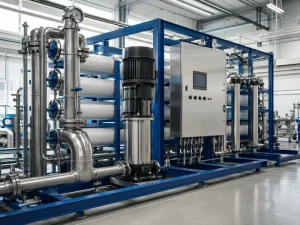
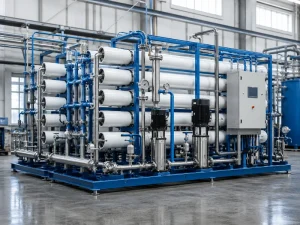
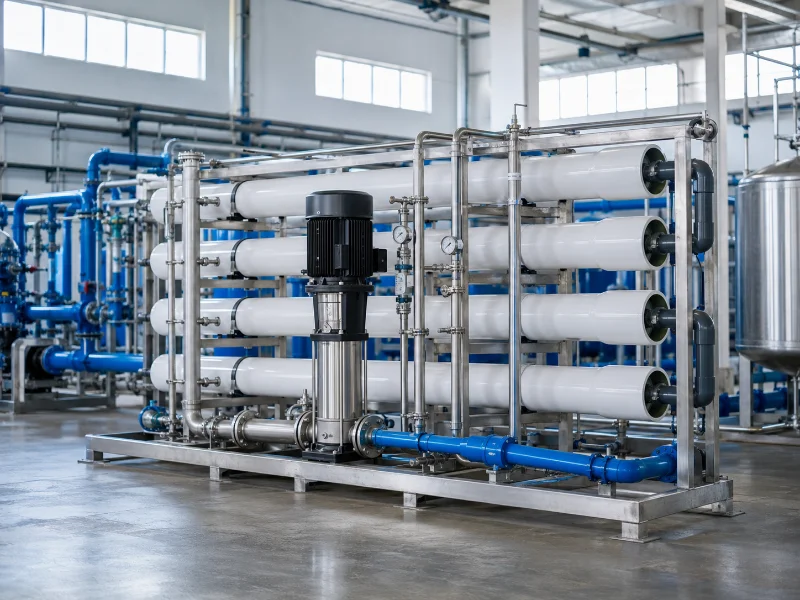
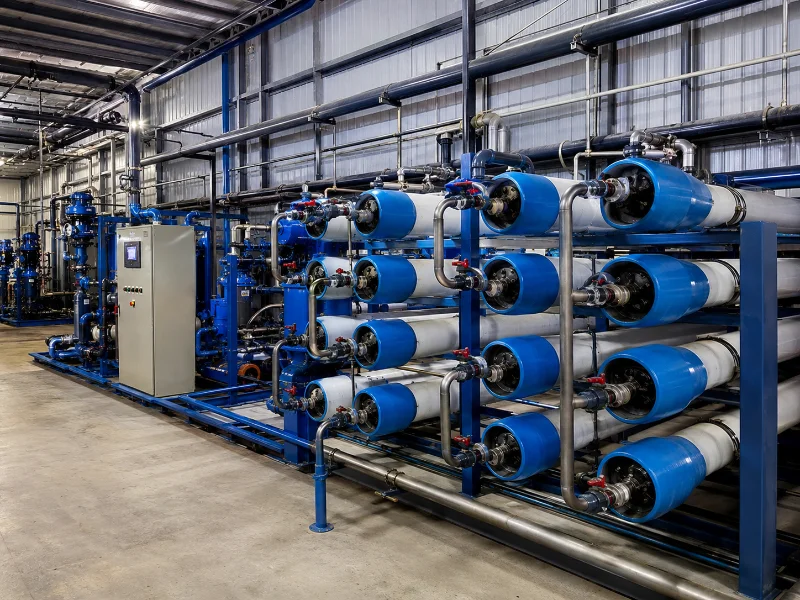
Industrial RO systems produce process water at high volume, and the process drives the design rather than a generic “clean water” goal. Applications include boiler feed for power plants, ultrapure water for semiconductor fabrication, food and beverage processing, and wastewater recovery. Against commercial units, industrial systems are built for continuous duty, higher flow, higher recovery, tighter monitoring, and project-specific pretreatment. At this scale, membrane configuration, array staging, and recovery strategy become engineering decisions, not catalog picks. The system is specified around the feed water, not the other way around.
RO Membrane Types: CTA vs TFC
Membrane classification is the axis that most directly affects rejection rate and feed-water compatibility. It splits into two questions: what the membrane is made of, and how it is packaged into a module. Both answers are constrained by the chemistry of the incoming water.
The two materials used in reverse osmosis membranes define the field, though the market has mostly settled on one. Cellulose triacetate (CTA) membranes tolerate chlorine and suit chlorinated feed water, but they reject less and now fill a niche. Thin-film composite (TFC) polyamide membranes are the modern default for residential and industrial systems alike. They reject more, often 95–99% for common dissolved salts under test conditions, but they are not built for continuous free-chlorine exposure. Membrane data sheets usually list a free-chlorine tolerance below 0.1 ppm, and residual oxidants must be removed upstream before the membrane, since oxidation damage is usually outside warranty. Actual rejection depends on the data sheet, feed chemistry, pressure, temperature, and recovery target, so verify it there rather than trusting the headline number. For food and beverage projects, the membrane material may also need to meet FDA 21 CFR 177.2550 or an equivalent local food-contact rule, which covers the material rather than the whole system.
Once the material is set, the membrane is packaged into a module. The four common configurations are:
- Spiral-wound — the dominant configuration for water treatment, with lower replacement cost and simpler plumbing for most commercial and industrial systems.
- Hollow-fiber — high surface area in a compact footprint, used where packing density matters.
- Tubular — tolerant of high-solids, fouling-prone feed, common in tough wastewater streams.
- Plate-and-frame — used in specialized separations where the other formats do not fit.
For most drinking-water and industrial process work, spiral-wound thin-film composite elements are the default. The configuration choice only opens up when the feed water is unusually high in solids or fouling potential.
Industrial RO: Brackish, Seawater, and Pass Types
Industrial reverse osmosis is classified mainly by feed-water salinity and by how many times water crosses the membranes. Both variables set operating pressure, recovery, and final water quality. These distinctions rarely show up in residential guides, but they form the core of any industrial spec.
Feed-water salinity separates brackish water RO (BWRO) from seawater RO (SWRO). Osmotic pressure rises with salinity. So seawater systems, the domain of seawater desalination, run at much higher pressure than brackish systems to push water across the membrane. That pressure drives different membrane grades, energy use, and materials of construction. The right class follows the measured salinity of the source, not a loose label like “salty water.” A BWRO or SWRO tag names the salinity class only. It does not prove the system will hit a target recovery without scaling or fouling on the real feed.
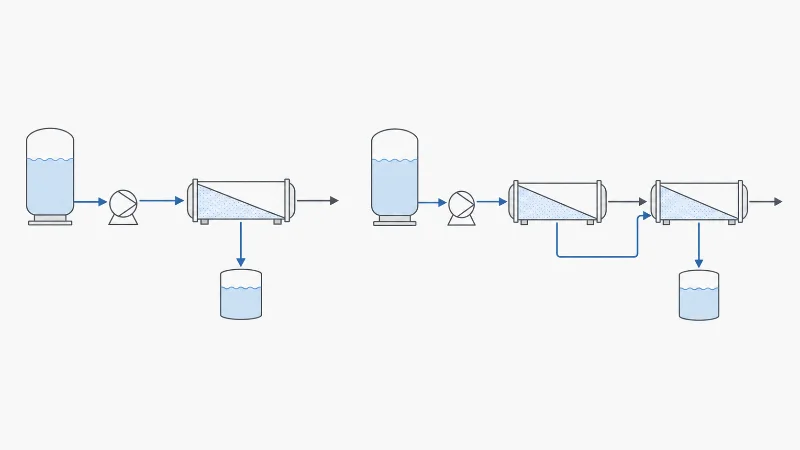
Pass architecture is the second industrial axis. A single-pass system sends feed water through the membranes once. A double-pass system treats the first pass’s permeate a second time to reach higher purity, as ultrapure or boiler-feed water needs. Whether a second pass is worth it depends on the target quality and the cost of missing it. Over-specifying passes wastes energy; under-specifying them fails the downstream process.
Recovery rate is the share of feed water turned into permeate. It ties these choices together, and scaling potential in the concentrate stream caps how high it can go. Pushing recovery too high without accounting for the specific scaling ions is a frequent field failure. It shows up as scale on the tail-end elements, which shortens membrane life. The pretreatment and antiscalant design that make a target recovery achievable are a separate engineering step, project-specific and outside a general classification. Confirm it against the actual feed-water analysis, not the system type.
How to Choose the Right RO Type
Choosing an RO type comes down to matching a few feed-and-demand variables to the classifications above. Work through them in order to narrow the field before any specific product enters the conversation.
| Variable to confirm | Why it drives the type | What to verify |
|---|---|---|
| Feed-water TDS / salinity | Separates brackish from seawater class and sets operating pressure | Lab analysis of the actual source water |
| Required capacity (volume/day) | Separates point-of-use from commercial and industrial scale | Peak demand, not just average |
| Target water quality | Determines single- vs double-pass and membrane grade | The downstream process spec (e.g. boiler, ultrapure) |
| Feed chlorination / oxidants | Determines CTA vs TFC and dechlorination need | Whether the source is chlorinated |
| Hardness / silica (scaling ions) | Caps achievable recovery, drives antiscalant or softening | Scaling-ion levels in the feed analysis |
No single classification answers the question on its own; the type falls out of the combination. A high-TDS, high-volume, high-purity job points to a multi-stage system with double-pass architecture and TFC membranes. A chlorinated municipal feed for a café points somewhere else. Confirm each variable against measured data before you commit to a category.
Conclusion
Choosing among the types of reverse osmosis comes down to three linked variables: feed-water salinity, required capacity, and target purity. Form factor tells you where a system lives. Those three tell you what it has to be.
In our work specifying industrial RO systems, a classification only holds up once we check it against a real feed-water analysis. The tail-end scaling and rejection shortfalls we see in the field almost always trace back to a category chosen before the water was measured. We treat feed salinity, target recovery, and pass architecture as project-level variables to confirm, not assumptions to inherit from a label.
If you are specifying process water for a plant or facility, start by gathering a current feed-water analysis with your target output quality and volume. With those in hand, our team can align membrane type, configuration, and recovery for an industrial RO system matched to your source water. Contact us to submit your feed-water data and application requirements for review.
FAQ
RO systems sort first by scale: point-of-use residential, whole-house, commercial, and industrial. Within those, they sort again by membrane material, module configuration, feed salinity, and pass architecture. For a home tap, scale is usually enough. For process water, the second set of axes decides the design.
TFC polyamide is the right choice for most systems, because it rejects more dissolved salts. CTA earns its place only when the feed water is chlorinated and you cannot dechlorinate ahead of the membrane, since CTA tolerates chlorine and TFC does not. The trade-off is rejection: CTA gives some up to survive the chlorine.
You need double-pass RO when a single pass cannot hit the target purity, typically for ultrapure or boiler-feed water. A single pass handles most brackish and municipal duties. A second pass raises both purity and cost, so the process spec justifies it, not habit.
Measure the feed-water salinity, or TDS, and let the number decide. Higher salinity means higher osmotic pressure, which pushes you toward a seawater-grade system with stronger membranes and pumps. A rough description like “salty water” is not enough; the class follows the tested value, not the impression.
Start from a current feed-water analysis and the process water spec, not from a product category. Those two inputs set the membrane grade, pass count, and recovery target that a catalog listing cannot. Match the classification to the water first, then compare specific systems.