Industrial reverse osmosis cleaning is triggered by normalized data rather than a calendar: clean when normalized permeate flow falls about 10%, normalized permeate quality declines about 10%, or normalized pressure drop rises about 15% against the reference baseline. Those are Hydranautics’ Typical thresholds. DuPont’s FilmTec figures differ, and high-fouling wastewater feeds carry a wider set of their own. Sequence is the second decision. Both element makers put the high-pH step ahead of the acid step for mixed fouling, because acid meeting organics or biofilm congeals them onto the surface. pH, temperature and exposure time then act as one coupled limit that narrows by element family. Sizing a CIP cleaning system is a separate engineering review.
Reverse Osmosis Cleaning Triggers in Normalized Data
hree normalized parameters decide when an industrial RO train needs cleaning: permeate flow, permeate quality and pressure drop, each read against a reference baseline. Raw readings are not enough. Feed temperature, pressure, recovery and feed TDS drift on their own schedule, and a cold morning alone can pull raw permeate flow down with nothing on the membrane. DuPont’s cleaning guidance points operators to its FTNORM program for the correction. Hydranautics offers one called ROData and describes it as free.
ASTM D4516, the standard practice for standardizing reverse osmosis performance data, covers permeate flow, salt passage and coefficient of performance for RO systems. Read its scope statement before leaning on it: the practice applies to brackish and seawater, and states it is not necessarily applicable to wastewaters. Standardize brine-staged systems one stage at a time.
Hydranautics publishes two columns. The Typical one asks for a clean at a 10% decrease in normalized permeate flow, a 10% decline in normalized permeate quality, or a 15% increase in normalized pressure drop. The High Fouling column, written for industrial and municipal wastewater, allows 20%, 20% and 30%, and measures deviation against stabilized performance that may take a week of operation to appear. DuPont’s FilmTec guidance uses different numbers again: a 10% flow drop, a 5–10% rise in normalized salt passage, a 10–15% pressure drop increase. Its second parameter is a different measurement from Hydranautics’ permeate quality figure, so program the trigger in the units your element’s maker uses.
The second column exists because some feeds behave differently from day one. In wastewaters carrying high concentrations of soluble organic compounds, Hydranautics describes an initial normalized flow drop of 10% to 20% across the first two to four weeks. Organic adsorption onto the membrane surface drives it. The decline then flattens to a marginal slope over the next six to twelve months. Aggressive cleaning recovers much of that early loss, but the bulletin notes the gain is short-lived and the train settles back where it was. Its advice is to base cleaning decisions on the decline rate after stabilization.
That pattern has a signature, and month-one flux loss qualifies only if it matches. Hydranautics describes the adsorption case as a sharp drop in normalized flow accompanied by a decrease in salt passage. Flow falling while salt passage climbs is a different problem. Flow falling while first-stage pressure drop spikes is another. Both point at pretreatment, dechlorination or dosing before they point at the membrane. Check the stage-by-stage trend and the direction of salt passage first. Then choose between a reset reference and a CIP.
The Acid-First Default and the Signature That Should Override It
On feeds carrying organics or biofilm, starting a clean at low pH leaves the fouling harder to remove than it was before the pump started. Acid coagulates organic matter and bioslime instead of dissolving them. The compacted layer then sits in the feed spacer, where the alkaline step that follows can no longer reach it.
Both membrane manufacturers say so in their own documents, though with different force. Hydranautics states that oil- and biologically-fouled membranes should not receive a low-pH clean first, because that matter congeals. Its typical pattern runs high pH, then low pH, and it publishes a specific sequence for complex fouling. DuPont goes further for FilmTec elements. It recommends alkaline cleaning as the first step by default, reserving acid-first for deposits known to be nothing but calcium carbonate or iron oxide and hydroxide. The reasoning is mechanical. Acid reacts with silica, humic acids and biofilm in ways that drive performance further down, and recovery can demand conditions outside the manufacturer’s own guidelines.
The opposite order is in wide circulation. Kurita America’s membrane CIP guide describes running the low-pH clean before the high-pH clean as often the most effective, and several supplier guides present pre-rinse, low pH, high pH, rinse as the standard sequence. That order has one case behind it, and Hydranautics names it: iron deposits and scaling commonly associated with well waters, where a simple low-pH clean may be the entire job. Everywhere else, acid-first risks congealing a foulant nobody has identified.
On surface-water and reuse trains that have run dechlorinated through a warm season, the lead elements take the organic load first. A mis-sequenced clean shows up there too, as a pressure drop that will not come back down. Before we specify a sequence, we trace which stage the pressure drop moved in and what the feed has been carrying since the last clean.
Reading the signature before mixing
In a multi-stage train, pressure drop and salt passage move in different combinations depending on the foulant, and the pattern names both the family and where it settled.
| Foulant family (where it settles) | Pressure drop / salt passage | Route published in TSB107: gentle → harsher | Confirm before mixing |
|---|---|---|---|
| Metal oxides: Fe, Mn, Cu, Ni, Zn (lead elements) | Rapid rise / rapid rise | Low pH citric acid → sodium hydrosulfite, a reducing agent at its natural pH 4–6 | Upstream aeration, unlined pipe, oxidised well water |
| Inorganic colloids: silt, iron, alumina (lead elements) | Gradual rise / slight rise | Low pH citric acid → HCl near pH 2.5 | SDI and coagulant carryover |
| Mixed inorganic/organic colloids (lead elements) | Gradual rise / slight rise | High pH STPP + Na-EDTA near pH 10 → NaOH + SDS near pH 11.5 | Whether organics or biofilm are in the feed at all |
| Carbonate scale: CaCO₃ (tail elements) | Moderate rise / marked rise | Low pH citric acid → HCl | Acid injection and antiscalant dosing |
| Sulfate scale: Ca, Ba, Sr (tail elements) | Moderate rise / marked rise | High pH STPP + Na-EDTA → HCl; Ba and Sr sulfate resist almost every cleaning solution | Feed sulfate and the antiscalant’s coverage of it |
| Biological: bioslime, algae, mould (any stage, usually lead) | Marked rise / normal to rising | High pH STPP with chelant or anionic detergent → NaOH + SDS, followed by a membrane-compatible non-oxidising biocide | Dechlorination, dead legs, standby practice |
| Dissolved NOM: humic, fulvic (all stages) | Gradual rise / falling | High pH STPP + Na-EDTA near pH 10 → NaOH + SDS near pH 11.5 | Whether this is early adsorption on a new train |
Signatures follow the RO troubleshooting matrix in Hydranautics TSB107 (Rev. .28, April 2025); chemistry follows the recommended cleaning-solution table in the same bulletin, for 4- to 16-inch composite polyamide elements. Damage reads the opposite way: oxidation, hydrolysis and abrasion all show feed pressure falling while salt passage rises, and no chemistry reverses them.
The bulletin indexes its two tables differently. Reading them against each other shows something neither table states on its own: two pairs of foulants share a signature but need different chemistry. That split is the most useful thing in the table. Inorganic colloids and mixed inorganic/organic colloids both appear as a gradual pressure-drop rise on the lead elements. Yet the bulletin routes the first to citric acid and the second to an alkaline chelant. Carbonate and sulfate scale both appear in the tail with salt passage climbing. Yet carbonate goes to acid, while sulfate scale gets an alkaline chelant as its gentle route. DuPont’s chemistry table agrees on that second point, listing sulfate scales under its caustic-plus-EDTA column.
So the trend gives you the foulant family and the stage. For colloids and for scale, the trend stops there. The feed analysis decides the rest: sulfate and silica levels, coagulant and antiscalant history, and whether organics are in the water at all. Reading the signature without a feed analysis answers half the question. The other half is a guess.
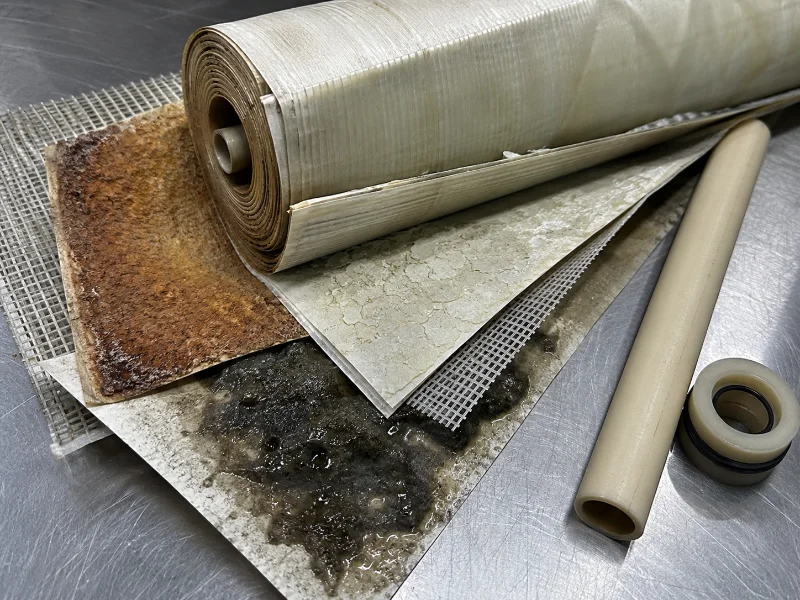
Two more foulants do not follow that pattern. For polymerized silica, the bulletin lists no gentle route at all. Its only option is caustic near pH 11.5, which the bulletin rates a harsh regimen, and Hydranautics asks to be contacted when traditional methods fail. Antiscalant fouling looks much the same and is worst in the second stage, so check the dosing system before you treat it as silica.
Starting gentle has a cost. DuPont rates citric acid as the less effective alternative for metal oxides and carbonate, and warns it can feed biofouling if it is not rinsed out properly. Removal efficiency does climb toward the extremes of pH, but the exposure limits are tightest there.
The order for mixed fouling
Where more than one foulant is present, Hydranautics publishes a recommended sequence. Flush with permeate, adding a non-oxidising biocide such as DBNPA at the end of the flush. Run the high-pH CIP. Flush again until the brine side reads below pH 8.5. Run the low-pH CIP, then finish with an acid flush carrying the same non-oxidising biocide. The supplier has to qualify every biocide in that sequence against your element, and free chlorine is never one of them. Composite polyamide may not meet chlorinated water at any point. That is why residual chlorine gets neutralised with sodium bisulfite, dosed at 1.8 to 3.0 ppm per 1.0 ppm of free chlorine, before it reaches the elements. The bulletin excludes cationic surfactants on the same grounds, warning they can foul an element irreversibly.
The rinse between the two chemistries matters as much as either chemical does. A caustic meeting an acid inside the vessel neutralises both and can drop the foulant straight back onto the membrane, which is why the bulletin gates that rinse on pH instead of a clock.
One line in that bulletin is rarely quoted with the rest. Hydranautics recommends coordinating cleaning operations with them during the element warranty period, and it puts responsibility for proprietary chemical compatibility on the chemical vendor. Worth knowing before a contractor picks your chemistry for you.
The Envelope an RO Clean Has to Stay Inside
Cleaning limits for a polyamide RO membrane element are published as a pH range at a stated temperature with a stated exposure time, and all three tighten together as the chemistry gets more aggressive.
How the pH window moves with temperature
A pH range of 1 to 13 and a 45 °C ceiling are both real numbers from these tables. They do not appear on the same row.
| Element family (Hydranautics standard series) | Cleaning pH at ≤45 °C | at ≤35 °C | at ≤25 °C |
|---|---|---|---|
| CPA (brackish) | 2–11.5 | 1–12 | 1–13 |
| SWC (seawater) | 2–11 | 1–12 | 1–13 |
| ESPA (low energy) | 2–10.5 | 1–11 | 1–12 |
| ESNA / LFC | 2–10.5 | 1–11 | 1–12 |
| NANO-SW | Contact manufacturer | 1–10.5 | 1–11.5 |
Selected rows from the standard-membrane cleaning limits in Hydranautics TSB107 (Rev. .28), which also covers ESPAB and carries a separate table for the PRO series. DuPont publishes its own table for FilmTec elements. The current datasheet and cleaning bulletin for the exact element in your vessels govern. At 50 °C every row says contact the manufacturer.
The pH 13 figure in circulation is a 25 °C figure, and only for the two families that reach it. DuPont’s table has the same shape for FilmTec BWRO and SWRO elements: pH 1–10.5 at 45 °C, 1–12 at 35 °C, 1–13 at 25 °C. Its NF elements get a tighter table again, and DuPont bars them from 50 °C entirely. An ESPA element never reaches pH 12 at any cleaning temperature, while a CPA element does at 35 °C. Same polymer family, different row. Neither maker publishes the other’s table, so this comparison only exists where someone has to work to whichever element is already in the vessel.
Hydranautics adds a limit that is rarely quoted alongside the pH numbers. At those pH limits, cleaning exposure is capped at 60 minutes below 40 °C and 30 minutes above it, and extended soaking is available only at gentler pH. Set that against an overnight soak and the two instructions belong to different rows. DuPont allows the long soak, 10 to 15 hours for difficult fouling, and there is no contradiction: long contact goes with gentle chemistry, short contact with harsh. Hydranautics names both ends, calling pH 4 to 10 the gentle range and pH 2 to 12 the harshest. A procedure that takes the harsh pH from one row and the long soak from another is outside both.
Temperature has a floor as well. Hydranautics suggests a minimum of 21 °C; DuPont advises against cleaning below 20 °C, where chemical kinetics fall away and some surfactants precipitate. And pH drifting more than half a unit during a clean means the chemistry is being consumed. Both makers answer that by topping it up.
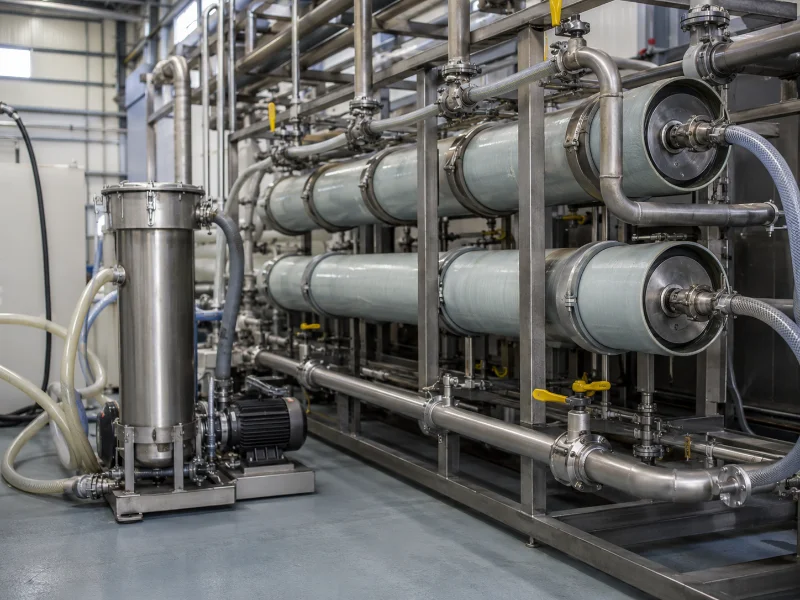
The hydraulic side of the same envelope
Cleaning pressure and flow carry their own ceilings, and breaching them damages elements the chemistry never touched.
- Hold the pressure vessel inlet at or below 60 psi (4 bar) and leave the high-pressure pump out of it. Permeate made during a clean carries foulant back into the membrane.
- Keep the permeate valve open throughout. Hydranautics caps permeate back-pressure at 0.35 bar (5 psig), above which tail-element glue lines can let go. The bulletin lists a closed permeate valve during cleaning as its own failure mode.
- Clean in the same direction as service flow. Reverse-direction cleaning is a separate procedure with its own precautions.
- Start at a third of normal cleaning flow when pressure drop is already high, then step up. Full flow into a plugged spacer will telescope the element.
- Clean one stage at a time, or foulant leaving the first stage arrives at the second.
- Read DuPont’s 15 psi per element and 50 psi per vessel as damage limits. The manual states explicitly that they are not cleaning criteria.
Verification Steps That Confirm a Clean Worked
A clean is verified when the normalized parameters return to the reference baseline the triggers were measured against. That means startup performance on conventional feeds, or the post-stabilization reference Hydranautics allows for qualifying high-fouling wastewater. Decide which baseline applies at commissioning, not on the day someone wants to call a clean successful.
Take data twice, immediately before the chemistry goes in and immediately after the rinse comes out. Hydranautics adds a step worth building into the procedure: restart after the first chemistry, alkaline or acid, and take normalization data before running the second. That tells you which step did the work. After two or three cycles, the record tells you what your feed actually deposits.
Permeate quality lags. Following a high-pH clean, RO permeate quality can take hours or even days to stabilize, so the conductivity an hour after startup is not the verdict. DuPont sends permeate to drain for at least 30 minutes at restart. Hydranautics runs the final flush until the water reaching drain is within 10% to 20% of feed conductivity, typically 15 to 60 minutes. Cleaning solution that turns turbid or discoloured is spent, and it gets replaced.
Of everything on the cleaning worksheet, confirm two variables before the rest. The reason is dependency, not danger. First is the baseline: whether it is normalized at all, and which reference it is. Every threshold here is a percentage of it, so a wrong baseline makes every downstream decision wrong in the same direction. Second is the foulant’s identity and stage. You choose the chemistry, the sequence and the flow ramp given that answer.
The rest are constrained, not free. Chemistry compatibility, the pH–temperature–time envelope, permeate back-pressure and the hydraulic limits are safety-critical, and several of them fail permanently. They come second in one specific sense. You select them once the diagnosis is in, and the element maker’s table governs them, not your trend chart.
The Point Where More Cleaning Stops Paying
Cleaning frequency is a measure of your pretreatment. On an industrial RO train that needs chemistry more often than once a month, the problem sits upstream of the membrane. Hydranautics puts numbers on it. Once every three to twelve months is a reasonable interval. Above once a month, the bulletin says the capital case for better pretreatment or an RO redesign should be easy to make. Improved pretreatment here means industrial water treatment equipment sized to your actual feed: media filtration, carbon, softening or UF, chosen from the water analysis. Between one and three months, the money is better spent on how the existing equipment is run, since the capex argument gets harder to defend.
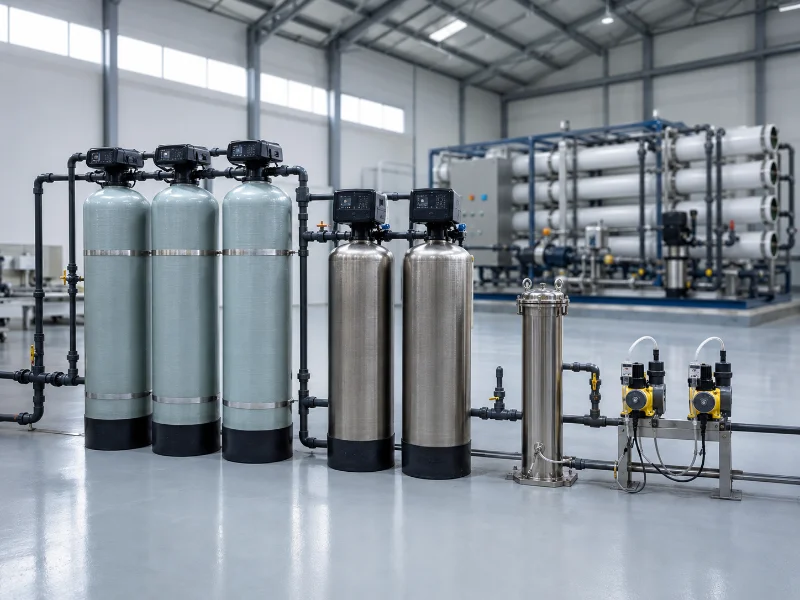
That threshold is worth stating against our own interest. If your interval has collapsed to monthly, a bigger cleaning skid and a stronger cleaner are the wrong purchase. The same money spent upstream removes the reason to clean at all.
There is also a point where cleaning recovers nothing. Once normalized performance has dropped 30% to 50%, Hydranautics notes that full restoration to baseline may no longer be possible. Heavy fouling blocks the chemical from penetrating the deposit, and blocks the flush from carrying it out. Waiting costs you recovery: the longer you leave it, the less a clean can restore.
Some deposits never had a cleaning route at all. Barium and strontium sulfate scale is close to insoluble in nearly every cleaning solution. DuPont rates the odds on sulfate scale older than about a week as doubtful. Those are antiscalant and recovery decisions made at design. When an interval starts drifting shorter, we compare the last two cleaning records against a current feed analysis before touching the chemistry.
And when the trend runs the other way, with feed pressure and pressure drop falling while salt passage rises, no chemistry applies. That signature belongs to oxidation, hydrolysis or abrasion, which sit among the reverse osmosis system problems a CIP cannot touch. The decision is replacement.
Two Risks to Close Before Your Next Reverse Osmosis Cleaning
Risk one is chemistry chosen for a foulant nobody identified. The check is cheap. Pull the stage-by-stage pressure-drop trend and the feed analysis since the last clean, then name the signature and the feed chemistry behind it before anything gets mixed. Risk two is an envelope breach that looks like nothing on the day it happens. A pH taken from the 25 °C row while the tank runs at 40 °C. A cleaning-strength pH left to soak overnight. A permeate valve closed during a flush. The check there is the datasheet and cleaning bulletin for the element in your vessels, read as one coupled envelope.
Both risks trace back to two questions. Which reference baseline is this train measured against? Does the foulant have a name, a stage and a feed analysis behind it? Reverse osmosis cleaning gets cheaper once you can answer both. Every cycle you cannot, it costs more.
In practice, though, on trains where the interval has been drifting shorter across two or three cycles, the cleaning record usually says less than the feed analysis does. How much of any of this transfers to your train depends on the element family, the feed and how the baseline was set.
If you would rather have that read than guessed at, send the normalized trend from the last two cleans, a current feed analysis, and the element model in your vessels. That is enough for our engineers to separate a cleaning problem from a pretreatment one, and to size a CIP circuit against the industrial RO systems already on your floor. We build both, and that is why we read the two makers’ tables against each other.
FAQ
Industrial CIP procedures do not cover residential elements. Hydranautics’ cleaning bulletin applies to 4-, 6-, 8-, 8.5- and 16-inch elements, and the smallest diameter in DuPont’s cleaning flow table is 2.5 inches. A 1812 or 2012 element has no CIP port, no cross-flow control and no practical way to hold pH and temperature for an hour. Its replacement cost usually sits below the cost of the chemistry plus the risk. In most point-of-use systems replacement is the economical call, unless your system manufacturer publishes a procedure for that specific unit, in which case that procedure governs. Sanitising a housing and tank is a different operation from cleaning a membrane.
A flush moves water; a CIP moves chemistry. Hydranautics’ procedure opens with a low-pressure flush at 60 psi (4 bar) or less, running permeate or DI-quality water through the vessels for several minutes at roughly half the cleaning flow rate. Its only job is displacing feed and brine before chemicals arrive. The CIP then circulates a cleaning solution at controlled pH and temperature for an hour or more. The bulletin also notes a use for permeate with nothing to do with cleaning day. Soaking elements with permeate during standby helps dissolve scale and loosen precipitates, which reduces how often the chemistry has to come out at all.
Four to eight hours per stage, by Hydranautics’ estimate. Because each stage takes that window on its own, a three-stage train needs three of them plus the flushes in between. That makes the outage a production decision as much as a maintenance one. Inside each window, Hydranautics describes a typical cycle as 30 minutes of circulation, 30 minutes of soaking, then another 30 minutes of circulation. A two-chemistry clean, with a rinse to below pH 8.5 between them, runs longer again.
RO permeate or DI water, to a published specification. Hydranautics sets it at hardness below 30 ppm as CaCO₃, calcium below 5 ppm, iron below 0.05 ppm, manganese below 0.02 ppm, reactive silica below 10 ppm, turbidity below 0.5 NTU and SDI15 below 1, with zero free chlorine. Mixing chemistry into feed water precipitates the hardness you were trying to remove straight back into the element. The same specification covers flush and rinse water, which is the part sites miss: a rinse drawn from raw feed can undo the clean that just finished.
No. DuPont’s cleaning guidance excludes sulfuric acid because of the risk of precipitating calcium sulfate, a harder scale than the calcium carbonate being cleaned off. The trap is proximity. Sulfuric acid already sits on many sites for feed pH adjustment, which puts a drum of it within reach of the CIP tank. Hydranautics lists an overfeed of sulfuric acid during pH adjustment as one of the ways sulfate scale arrives in the first place.