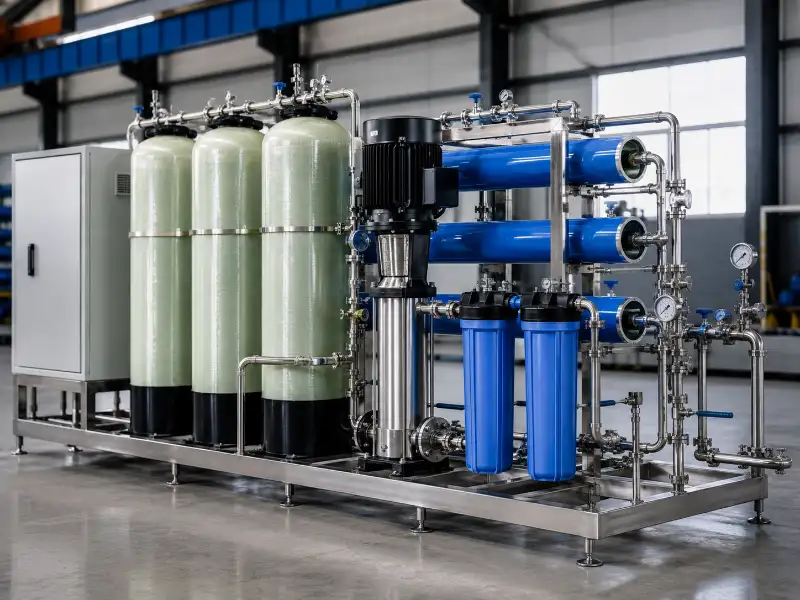
Water treatment system components are the individual units that combine into one treatment train—filters, membranes, pumps, dosing systems, valves, and controls. The right set for a project depends on source water chemistry, flow demand, and the finished-water standard. Buyers often ask us for a component list first, but a list says nothing about whether the units will work together once installed. As a water treatment equipment manufacturer, we design and fabricate these stages as integrated systems rather than parts in isolation. This article covers what each component does, what decides which ones you need, and where specifications most often go wrong.
What Counts as a Water Treatment Component
A water treatment component is any discrete unit that performs one defined function inside a treatment train, with its role set by the system’s end-use. A sediment filter, an RO membrane, a UV sterilizer, and a control panel are all components. But they sit at different stages and solve different problems.
Grouping components into four roles lets a buyer reason about a system, not a parts bin. Pretreatment conditions the raw water and protects what follows. Core treatment removes the target contaminants. Post-treatment polishes the water to its final use. Auxiliary units—tanks, pumps, valves, and controls—keep the train inside its design window. A component that looks optional on a quote is often the one protecting an expensive downstream stage.
Why a Component List Is Not a Working System
A component list does not guarantee a working system, because performance depends on how the units are sequenced, sized for peak flow, and matched to the feed water. Two plants with the same bill of materials can perform very differently. The gap shows up when the pretreatment is undersized or the membrane stage sees water it was never specified for.
When the membrane stage is specified before pretreatment is checked against the feed water’s silt density and hardness, the membranes usually foul first and need early replacement. That failure mode is common because the component list looked complete. We check the feed water’s scaling and fouling indices against each stage’s tolerance before issuing a specification. The variable is feed water quality; the impact is membrane fouling rate; the check is a source water analysis read against each component’s rated limits.
Core Component Categories and What Each Actually Removes
Core water treatment components fall into four categories: pretreatment, primary treatment, post-treatment, and monitoring/control. Which ones a project needs depends on the gap between raw water quality and the target specification. The table below maps each category to its function and to the variable that decides whether you need it.
| Category | Typical components | Primary function | What decides inclusion |
|---|---|---|---|
| Pretreatment | Multimedia filters, activated carbon, antiscalant dosing, softeners | Remove sediment, chlorine, and scaling ions before core treatment | Turbidity, hardness, free chlorine, silt density index |
| Primary treatment | RO units, ultrafiltration, ion exchange, EDI, desalination skids | Remove dissolved salts, colloids, organics, or specific ions | Feed TDS, target purity, organic load |
| Post-treatment | UV, remineralization, pH adjustment, final cartridge filters | Polish water to its final-use standard | End-use (potable, process, boiler feed) |
| Monitoring & control | Conductivity meters, pressure sensors, flow controls, PLC panels | Hold the train within its design window and flag drift | Automation level, regulatory monitoring |
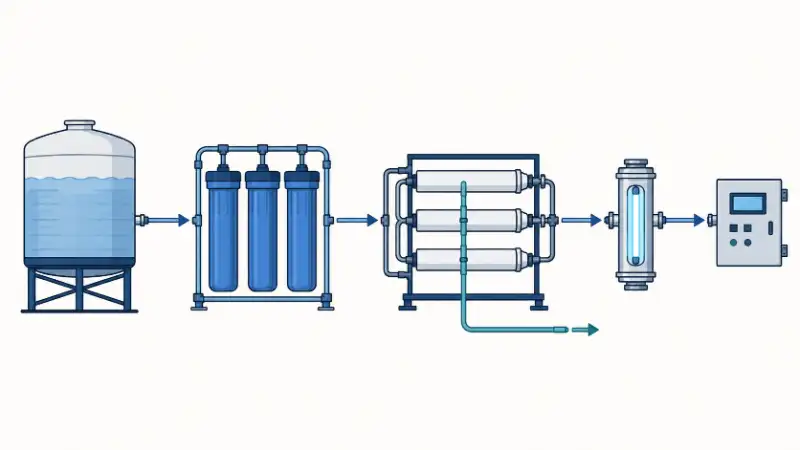
Primary-treatment technologies are not interchangeable, and treating them as one category is a common cause of misspecification. Each removes a different class of contaminant, and the differences between the four membrane filtration methods explain why one cannot stand in for another:
| Core technology | What it actually removes | What it does not remove |
|---|---|---|
| Reverse osmosis (RO) | Dissolved salts (TDS), most inorganics, many organics | Needs pretreatment; sensitive to free chlorine and fouling |
| Nanofiltration (NF) | Hardness, divalent ions, some organics | Passes most monovalent salts |
| Ultrafiltration (UF) | Colloids, suspended solids, bacteria, some viruses | Does not remove dissolved salts |
| Ion exchange (IX) | Specific ions—hardness, nitrate, boron—per resin type | Not a general-purpose contaminant remover |
| UV sterilizer | Inactivates microorganisms | Does not remove TDS, hardness, or particles |
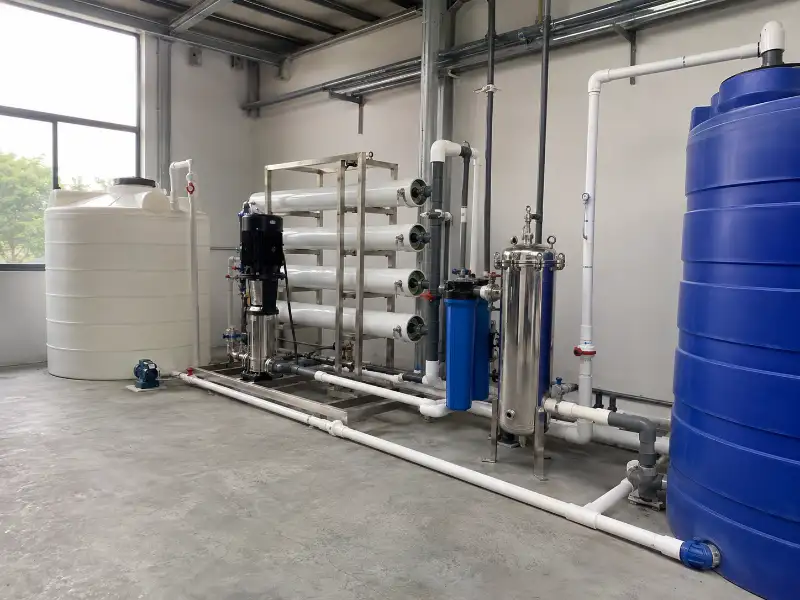
We design and fabricate these stages as integrated skids under direct engineering oversight, so the components are sized and sequenced as one system. The category a project skips matters as much as the ones it includes. A low-TDS source may need no desalination stage, while a high-hardness source can fail without enough softening upstream of the membranes.
Components Often Left Off a Basic Quote
The components most often missing from a basic list are the supporting units that stabilize flow, protect the core stage, and handle waste. These omissions tend to surface only during commissioning. A quote built around the headline equipment can still leave out the parts that keep that equipment running:
- Raw water / feed tank — buffers flow and absorbs source-water variation before treatment.
- Feed or booster pump — sets the inlet pressure and flow the core stage was sized for.
- Cartridge (security) filter — the last particle barrier directly ahead of RO membranes.
- Backwash provision — lets multimedia and activated carbon filters recover capacity.
- CIP (clean-in-place) system — restores membrane performance during scheduled cleaning.
- Concentrate / brine discharge — RO and NF reject a concentrate stream that needs a defined route.
- Product water tank — buffers finished water and stabilizes supply to the point of use.
- Chemical storage and dosing — tanks and metering pumps for antiscalant, acid/caustic, or dechlorination reagent.
We confirm which of these a project needs when we review the application. The absence of any one of them causes field problems more often than the choice of the core membrane itself.
Source Water Variables That Decide Which Components You Need
Component selection follows a defined set of source water parameters, not a fixed equipment template. Each parameter changes the configuration in a specific way. A full water analysis—not a single nominal figure—is what turns a component list into a specification:
| Source water parameter | What it decides |
|---|---|
| TDS / conductivity | Whether RO, NF, IX, or EDI is needed |
| Hardness / alkalinity | Need for a water softener, antiscalant, or pH adjustment |
| Turbidity / TSS | Need for multimedia filtration, UF, or cartridge protection |
| SDI / MFI | RO and NF fouling risk, read against the membrane’s rated limit |
| Iron / manganese | Need for oxidation and filtration ahead of membranes |
| Silica | Scaling risk at high recovery |
| Free chlorine / ORP | Need for carbon or reducing-agent dosing to protect RO membranes |
| TOC / COD | Organic load, and the case for carbon, UF, or advanced oxidation |
| pH / temperature | Membrane flux, scaling tendency, and dosing rates |
| Microbiology | Need for UV, ozone, or hygienic design |
| Target standard | Post-treatment depth and required certifications |
The same parameters explain why an identical flow rate can call for different components. The matrix below shows how a few common source conditions change the right configuration:
| Source water condition | Weak choice | Better configuration |
|---|---|---|
| High hardness + high alkalinity | RO alone | Softening or antiscalant + pH control, then RO |
| High turbidity / high SDI | Cartridge filter + RO | Multimedia filtration or UF + cartridge, then RO |
| Free chlorine present | RO alone | Activated carbon or reducing-agent dosing before RO |
| High iron / manganese | RO alone | Oxidation + filtration + cartridge, then RO |
| Bottled drinking water | RO alone | RO + UV + remineralization / pH adjustment |
Protection limits—maximum feed SDI, free chlorine tolerance, and recovery rate—are set by the membrane manufacturer’s specification and the project’s water chemistry. We verify the source water against those rated limits, not against a generic threshold.
Standards and Certifications That Constrain Component Selection
The standards that govern component selection depend on the end-use and the destination market. They apply to materials, treatment chemicals, electrical assemblies, and pressure parts—not just the finished water. Specifying components without checking the right standard is a frequent cause of rejected shipments:
| Scope | Common reference | Note on applicability |
|---|---|---|
| Drinking water contact materials | NSF/ANSI/CAN 61 | Health-effects standard for wetted components; not a performance or microbiological standard |
| Treatment chemicals | NSF/ANSI/CAN 60 | Covers chemicals added to drinking water |
| RO drinking water systems | NSF/ANSI 58 | Product-level certification for point-of-use RO |
| Finished-water limits | WHO Guidelines for Drinking-water Quality | National standards may be stricter |
| Control panels / electrical | IEC, UL, or CE | Depends on destination market |
| Pressure vessels / piping | ASME or PED | Depends on operating pressure and jurisdiction |
We align proposed components to the destination market’s certification and electrical rules before confirming a configuration. A system that performs technically can still arrive non-compliant when the standard was not checked at the specification stage.
Common Mistakes When Specifying Water Treatment Components
The most costly errors in specifying water treatment components come from three things: skipping the source water analysis, undersizing for peak demand, and overlooking destination-market certification. Each one surfaces only after installation. A system that performs in testing can still fail in service when the feed water differs from the assumption used to size it.
Component selection is separate from on-site installation piping and civil works, which depend on the site layout and local mechanical codes. We confirm the system configuration, and the installation contractor aligns the piping and foundations to the site. Keeping that line clear prevents two recurring problems: buyers paying for installation scope a manufacturer cannot verify remotely, and configurations altered on site in ways that void the original engineering basis.
To prevent the most frequent specification errors, prepare these inputs before requesting a component quote:
| Input | Why it matters |
|---|---|
| Raw water source | Well, river, seawater, municipal, or reuse changes the whole train |
| Full water analysis | Determines pretreatment and core technology |
| Required product flow | Sizes pumps, vessels, and membrane trains |
| Peak flow and operating hours | Prevents undersizing |
| Final water standard | Potable, process, boiler, bottled, or irrigation |
| Destination country | Affects voltage, certification, and materials |
| Concentrate discharge route | Affects RO recovery and brine handling |
| Automation level | Affects PLC, sensors, alarms, and remote monitoring |
Specify Components Against Your Water, Not a Template
Choosing water treatment components comes down to three decision variables: the source water you start with, the flow you need to deliver, and the finished-water standard. A complete component list means little until those three are fixed and the units are sequenced to work together.
As a manufacturer, we review the water report and application for each project against those variables before we design or fabricate a system. We also flag the conditions that still need project-level confirmation: peak flow, seasonal water variation, concentrate discharge, and destination certification. The source water analysis is the starting point of every specification, not a formality after the quote.
If you are scoping a system, the most useful next step is to send us your source water analysis and a short application brief covering flow, end-use, and destination market. Our engineering team will review it against the variables above and confirm a component configuration matched to your conditions.
FAQ
The minimum components ahead of an RO membrane are a pretreatment stage and a cartridge (security) filter, sequenced so the membrane only ever sees water within its rated feed limits. How deep the pretreatment goes is driven by the feed water rather than by a fixed package—a clean municipal supply needs little, while a turbid or high-hardness source needs more upstream protection.
A cartridge filter ahead of RO is the final particle barrier before the membranes, catching anything that slips past the upstream pretreatment. The cartridge is a guard stage rather than a substitute for proper pretreatment, and its micron rating is matched to the membrane’s feed requirement.
Activated carbon is needed only when the feed water carries free chlorine, chloramine, or organic compounds that would damage RO membranes or affect taste and odor. A dechlorinated or low-organic source can skip carbon entirely, while a municipal supply with a chlorine residual usually requires it ahead of the membranes.
Water treatment systems do not share a fixed component set, because the configuration follows feed water quality and end-use. A low-TDS municipal source and a high-salinity brackish source need different core technologies, even at the same flow rate.
Choosing the right components starts with a lab water analysis, read against the standard the finished water must meet. Send that analysis together with your target flow and end-use, and the component list follows from the data rather than from a generic template.
Certifications for drinking water components depend on the destination market. Materials in contact with potable water commonly reference NSF/ANSI/CAN 61, treatment chemicals reference NSF/ANSI/CAN 60, and packaged RO products may carry NSF/ANSI 58. Electrical and pressure parts follow the destination market’s own electrical and pressure-equipment codes.