The right type of water treatment plant depends on three inputs: the source water you start with, the quality the treated water must reach, and the conditions at the site. Two plants can carry the same label and still share little design logic once the water is measured. This guide maps the main plant types to the problems they solve, the standards that define their output, and the variables that decide which type fits your project.
Why Source Water Comes Before Plant Type
Source water chemistry and the required output quality decide the plant type, which is why naming a category before the water is tested often produces a mis-staged system. A plant that turns river water into safe drinking water and one that recovers industrial effluent may share some unit processes — filtration, disinfection, sometimes membranes — but their design drivers differ. One starts from public-health risk and potable standards; the other from pollutant load, discharge limits, and reuse targets.
In our experience reviewing inquiries from importers and EPC contractors, the most common avoidable error is specifying a plant category before a source water report exists. When feed TDS, hardness, or organic load is assumed rather than measured, the system is usually mis-staged — a polishing step is missing, or the pretreatment cannot protect the membranes downstream — and the gap surfaces at commissioning, when the plant fails acceptance testing. We verify source water data against the destination-market standard before aligning on a plant type, because correcting a category on paper costs far less than correcting it on site. The detailed hydraulic and unit-process design of a specific plant — pipe sizing, pump curves, membrane array layout — follows from that project analysis and sits outside a type-level overview.
The Main Types of Water Treatment Plants and Their Typical Uses
Water treatment plants fall into a handful of categories defined by feed water and end use, and the right category depends on whether the goal is potable water, compliant discharge, or process-grade purity. The table summarizes how the main types differ on the dimensions that drive a buying decision.
| Plant type | Typical feed water | Primary goal | Key design parameters |
|---|---|---|---|
| Drinking water plant | Surface or ground water | Meet potable standards | Turbidity, pathogens, TDS, specific contaminants |
| Sewage treatment plant (STP) | Domestic sewage | Safe discharge or reuse | BOD, COD, TSS, NH₃-N |
| Effluent / industrial WWTP (ETP) | Industrial wastewater | Remove process contaminants | pH, COD, oil & grease, heavy metals |
| RO / desalination plant | Brackish or seawater | Reduce dissolved salts | Feed TDS, SDI, recovery, brine handling |
| Demineralization (DM) plant | Pre-filtered fresh water | Remove dissolved minerals | Conductivity, silica, resistivity |
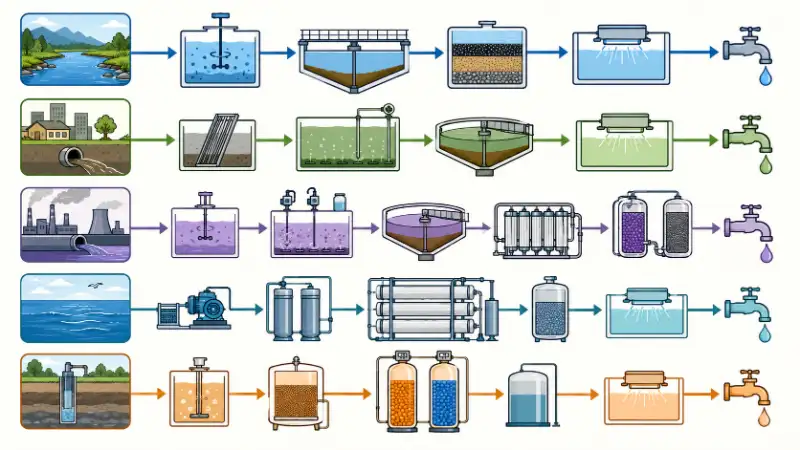
We design and fabricate equipment across all of these categories, so we treat the choice between them as a verification step rather than a menu selection.
Drinking Water (Potable) Treatment Plants
Drinking water plants treat natural surface or ground water to a potable standard, and the process depth depends on the raw water’s turbidity, microbial load, and dissolved content. A typical line runs coagulation, flocculation, sedimentation, filtration, and disinfection. Where the source carries higher salinity or specific contaminants such as arsenic or fluoride, membrane or adsorption stages are added rather than assumed. Our drinking water plants for municipal and community supply are configured around the measured raw-water profile rather than a fixed template.
Sewage Treatment Plants (STP)
Sewage treatment plants process domestic wastewater from households and commercial buildings, and the required discharge quality determines how far treatment must go. Most STPs run primary settling, secondary biological treatment, and a tertiary polishing stage. The reuse target — irrigation versus surface discharge — changes the tertiary design more than the plant size does.
Effluent and Industrial Wastewater Treatment Plants (ETP / WWTP)
Effluent treatment plants handle industrial wastewater whose contaminant profile varies sharply by industry, so two ETPs for different sectors rarely share the same process train. Chemical, pharmaceutical, and textile streams each demand specific stages — physical-chemical pretreatment, neutralization, or heavy-metal precipitation — ahead of any biological step. The contaminant load, not the plant label, sets the design.
Reverse Osmosis and Seawater Desalination Plants
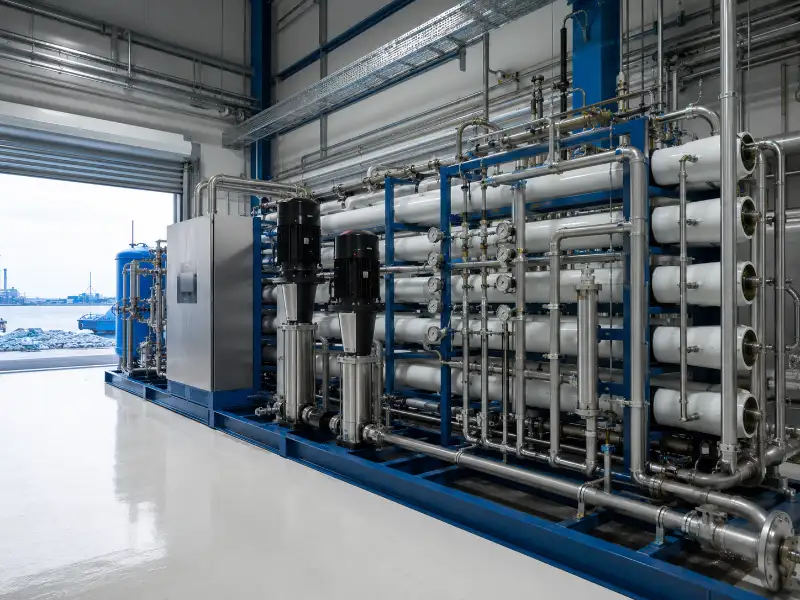
Reverse osmosis plants drive feed water through a semipermeable membrane under pressure to reduce dissolved salts, and the feed salinity decides the membrane array, pump pressure class, and pretreatment. Seawater systems run at far higher pressures than brackish-water systems, though the working figures are indicative until confirmed against the feed analysis. Pretreatment to protect the membranes scales with the fouling potential measured as SDI and suspended solids. We build reverse osmosis desalination plants sized to the intake salinity and fouling load rather than a nominal capacity alone.
Demineralization (DM) and High-Purity Plants
Demineralization plants remove dissolved minerals to reach high-purity water, and the target conductivity decides whether ion exchange, RO, mixed bed, or EDI is used. DM water serves high-pressure boiler feed, electronics manufacturing, and other process streams where minerals cause scaling or defects. The purity specification — stated as conductivity or resistivity, not “pure water” — drives the configuration.
Plants Defined by Core Technology or Installation Form
Some plants are named by their core technology or how they are delivered rather than by feed water, and the choice depends on the contaminant target and the site. Ultrafiltration (UF) suits suspended-solids and microbial reduction as pretreatment or polishing; UV suits chemical-free disinfection; ion exchange suits hardness and mineral removal; and activated sludge, MBR, SBR, or MBBR variants suit biological treatment where footprint, load, and effluent target differ. By installation form, skid-mounted, containerized, and package plants suit constrained sites or fast deployment, while built-up plants suit large fixed capacities.
Standards and Output Quality Targets by Plant Type
The output standard a plant must meet defines its acceptance criteria, and that standard depends on whether the water is destined for drinking, discharge, reuse, or process use. The references below name the standard families that typically apply; the specific limits depend on the destination market and local regulations.
| Plant type | Standard families to confirm | Parameters they govern |
|---|---|---|
| Drinking water | WHO GDWQ, EPA NPDWR, EU Drinking Water Directive, local potable codes | Turbidity, pathogens, TDS, nitrate, arsenic, residual disinfectant |
| STP | Local sewage discharge / reuse limits | BOD, COD, TSS, NH₃-N, TN, TP, coliform |
| ETP / industrial | Sector discharge limits, local permits, EPA Effluent Guidelines (US) | pH, COD, oil & grease, heavy metals, toxic organics |
| RO / desalination | Potable, process, or reuse target plus brine rules | Feed and product TDS, recovery, brine discharge |
| DM / high-purity | ASTM D1193, ISO 3696, or the boiler/process spec | Conductivity, resistivity, silica, sodium, TOC |
We verify the applicable destination-market standard before confirming a configuration, because the acceptance test is written against that standard, not against the plant category.
How to Match Source Water to the Right Plant Type
Matching a plant type to a project depends on a short set of source water and site variables, and skipping any one of them is where most mismatched systems start. The parameters below decide the category before any equipment is sized.
- TDS / conductivity: fresh, brackish, and seawater require different membrane pressure classes, and high TDS points toward RO or DM.
- Turbidity / SDI: RO feed should be evaluated for SDI and suspended solids before membrane selection.
- Hardness / silica: high values limit recovery and may require softening or antiscalant.
- BOD / COD: organic load decides biological tank volume and aeration demand in STP and ETP.
- Oil & grease / heavy metals: industrial streams may need DAF, precipitation, or neutralization before biological treatment.
- Output conductivity / resistivity: high-purity applications must specify a numeric target, not “pure water.”
Read against those variables, the source water usually points to one category.
| Source water condition | Likely plant type | Why |
|---|---|---|
| River/lake water with turbidity and pathogens | Drinking water plant | Suspended solids and microbial risk dominate |
| Domestic sewage | STP with biological treatment | Organic load is the main design driver |
| Textile/chemical/pharma wastewater | ETP, physical-chemical + biological | Contaminants vary by process |
| Brackish well water | BWRO plant | Dissolved salts are the main issue |
| Seawater | SWRO desalination plant | High salinity requires high-pressure RO |
| Boiler feed / electronics process water | DM or RO + mixed bed/EDI | Low conductivity and silica control required |
We review these variables against your water report before recommending a type. To prepare an inquiry, the useful data set is straightforward: source water analysis; required treated-water standard; flow rate in m³/h and m³/day; peak flow and operating hours; site voltage, frequency, and available power; space and installation form; and discharge or brine disposal conditions.
Common Mistakes When Specifying a Water Treatment Plant
Most specification errors trace back to choosing a plant category before the water is characterized, and each one surfaces later as a failed acceptance test or a compliance gap. The patterns below recur across inquiries:
- Selecting RO before checking SDI and hardness, then facing early membrane fouling.
- Treating STP and ETP as interchangeable when the contaminant profiles differ.
- Requesting “DM water” without a conductivity or resistivity target.
- Sizing by daily volume while ignoring peak flow.
- Applying drinking-water logic to industrial wastewater.
- Overlooking brine or sludge disposal until after the layout is fixed.
We prevent these by reviewing feed data and acceptance targets before issuing a specification, so the configuration matches the water the plant will actually receive.
Conclusion
Choosing among the types of water treatment plants reduces to three questions: what is in the source water, what quality the output must reach, and what the site allows. The category names — drinking water, STP, ETP, RO, DM — are shorthand for combinations of those answers, and they map to standards and parameters rather than serving as a starting point on their own.
In practice, the plants that pass acceptance testing and stay compliant are specified after the water is measured. As water filtration equipment manufacturers with an in-house engineering team, we review each inquiry against source water conditions, site electrical standards, and destination-market requirements, and several design decisions still depend on project-level variables that only a water report can confirm.
If you are scoping a system, the most useful next step is to send your source water analysis and application requirements — flow, target quality, and site conditions. Our engineering team will review the data and confirm which plant type and configuration fit your project.
FAQ
The four most commonly grouped types are drinking water plants, sewage treatment plants, effluent or industrial wastewater plants, and desalination or demineralization plants. The grouping reflects feed water and end use rather than a fixed industry list.
A water treatment plant (WTP) produces usable or potable water from a raw source, while WWTP, STP, and ETP all treat used water — WWTP is the general wastewater category, STP handles domestic sewage, and ETP handles industrial effluent. The feed water separates them.
Effluent treatment plants handle industrial wastewater with variable chemical contamination, while sewage treatment plants handle domestic sewage with a mostly organic load. The contaminant source and profile, not the plant size, separate the two.
A DM plant and an RO plant are not the same, though they overlap — DM targets near-complete mineral removal using ion exchange, RO, or both, while RO is a membrane process that reduces dissolved salts but may not reach DM-grade purity alone. The conductivity target decides which is specified.
Seawater is treated by reverse osmosis desalination plants built for high salinity and high operating pressure. The membrane array and pretreatment are sized for the specific salinity and fouling potential of the intake.
Sizing requires a source water analysis, the required treated-water standard, flow rate and peak flow, site electrical conditions, available footprint, and the discharge or brine disposal route. We use exactly this data set to confirm the plant type and configuration.