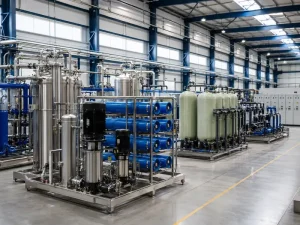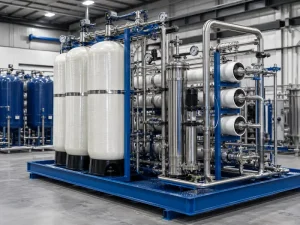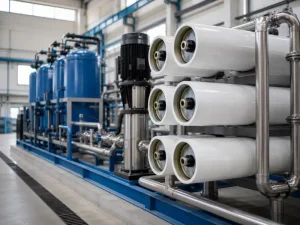
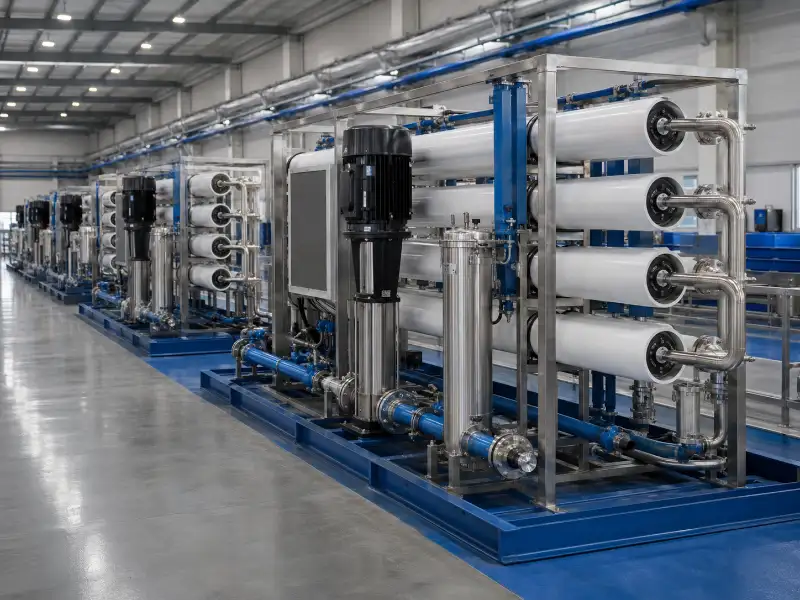
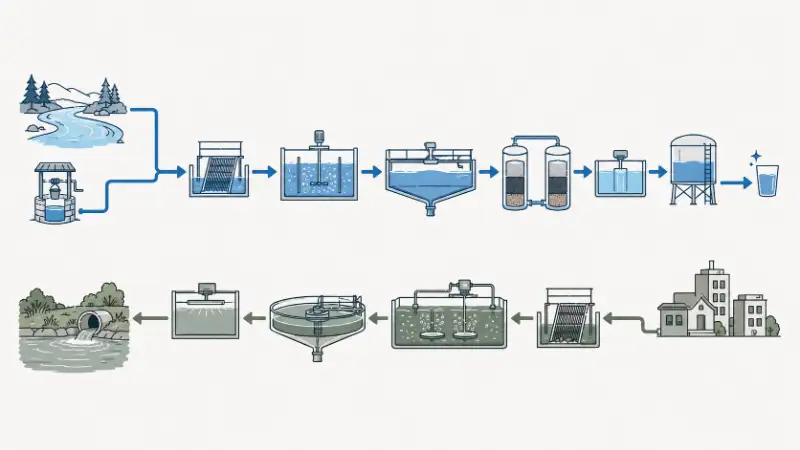
WTP and WWTP sit at opposite ends of the same water cycle. The two acronyms differ by a single letter, so buyers often swap them on procurement documents. A water treatment plant (WTP) prepares raw source water for use. A wastewater treatment plant (WWTP) cleans spent water before it is discharged or reused. If you write specifications as an importer, EPC contractor, or municipal buyer, telling the two apart matters. It decides whether you order equipment matched to the water on site, or a plant that cannot do the job. We clarify which category an inquiry actually needs before any configuration is confirmed.
What a Water Treatment Plant (WTP) Does With Raw Source Water
A water treatment plant treats raw water from rivers, wells, lakes, or boreholes, and the source quality sets the process train it needs. The goal is to raise incoming water to a defined quality: potable, process, or boiler-feed grade. A WTP does not clean used water; that is a different job.
Typical WTP stages move water through coagulation, flocculation, sedimentation, filtration, and disinfection. When the end use demands tighter limits, we add softening, reverse osmosis, or UV. Each added stage answers a measured variable. High hardness drives softening or RO. Pathogen risk drives disinfection. Dissolved salts in the feedwater drive membrane selection. Skip that variable-by-variable logic, and the plant ends up over-built for a clean borehole or under-built for a high-turbidity river.
In an industrial setting, the treated output protects boilers, cooling towers, and production lines from corrosion, scaling, and fouling. We design the pretreatment and membrane stages against the source-water analysis. The same nameplate capacity can need very different equipment, depending on what the raw water carries.
What a Wastewater Treatment Plant (WWTP) Does With Spent Effluent
A wastewater treatment plant treats spent effluent from homes, industries, or commercial sites, and the effluent’s load sets the stages it needs. The goal is to lower contaminants to a level fit for discharge or controlled reuse. That is the reverse of a WTP’s job.
WWTP treatment usually runs through preliminary screening, primary sedimentation, and secondary biological treatment. Where discharge limits are strict, a tertiary stage follows: tertiary polishing such as filtration or membrane separation. The biological stage is the core of most municipal and industrial plants. Its size follows the organic strength of the influent, not a generic flow figure. Regulators commonly define secondary-treatment performance around organic load (BOD5), suspended solids (TSS), and pH. An effluent heavy in oils, nitrogen, or industrial chemicals shifts which stages carry the load, and how large each one must be.
The treated effluent is then disinfected. From there it is either released to a receiving water body or recovered for non-potable reuse. We fabricate WWTP skids against the effluent analysis and the local discharge consent. Before a skid ships, we verify that the configuration can hold those limits.
Why WTP, WWTP, STP, and ETP Get Confused on Procurement Specifications
The terms WTP, WWTP, STP, and ETP describe different water streams, yet buyers often use them interchangeably. Which one fits depends on a single question: is the stream incoming source water, or outgoing waste? A WTP (and its drinking-water variant, DWTP) sits on the supply side. A WWTP sits on the discharge side. Under it sit two common subsets. An STP (sewage treatment plant) handles domestic sewage. An ETP (effluent treatment plant) handles industrial wastewater. Both are types of wastewater treatment, not separate fields.
The confusion is not academic. Suppose a facility specifies the wrong stream. It asks for a clarification-and-disinfection train, when the real need is biological treatment of a sewage-strength load. The equipment that arrives cannot reach the required outcome, and the fix usually means a retrofit after commissioning. We clarify the stream direction first on every inquiry. Getting the category right prevents a specification error that no downstream tuning can fix.
Six Variables That Separate a WTP From a WWTP
A WTP and a WWTP differ across six practical variables: input stream, output destination, primary goal, dominant process, scale, and governing limits. Each one changes which equipment a specification should call for. We compare an inquiry against all six before recommending a category.
| Variable | Water Treatment Plant (WTP) | Wastewater Treatment Plant (WWTP) |
|---|---|---|
| Input stream | Raw water from rivers, wells, lakes, reservoirs | Spent effluent from homes, industry, commerce |
| Output destination | Potable, process, or boiler-feed supply | Discharge to environment or controlled reuse |
| Primary goal | Raise quality for use | Lower contaminants for safe release |
| Dominant process | Coagulation, filtration, membranes, disinfection | Biological treatment plus physico-chemical stages |
| Typical scale | Often smaller; depends on demand and source quality | Often larger; depends on pollutant load |
| Governing limits | Drinking-water or process-quality standards | Discharge consent and reuse limits |
The table holds at a category level. The numbers behind each row come from the project, not the acronym. A WWTP for a clean rinse-water stream can be smaller than a WTP feeding a large desalination demand. So scale is a tendency, not a rule. For a closer look at how systems split by duty and capacity, see our guide to the types of water treatment plants.
Common Specification Errors When Buyers Confuse WTP and WWTP
Specification errors between a WTP and a WWTP usually trace to one of four mismatches. Each one fails for the same reason: the equipment is matched to the wrong stream, or the wrong load. We flag these mismatches when an inquiry’s stated plant type does not match the contaminants in the water profile.
| Mismatched specification | Why the duty is not met | Correct category |
|---|---|---|
| WTP requested for sewage-strength influent | No biological stage sized for organic load and ammonia | STP / WWTP |
| WWTP requested when the need is boiler-feed or process water | Output target is wrong; no softening, RO, or polishing | WTP with softening / RO / EDI |
| ETP treated as a discipline separate from wastewater treatment | An ETP is the industrial wastewater category, not a different field | Industrial WWTP / ETP |
| Selection made on design flow alone | Pollutant load, not flow, sizes the treatment stages | Flow plus contaminant load together |
Each row points back to the same root cause. The category was chosen from the label, instead of from the water stream and its tested load. The second row is a common one: a process line that actually needs boiler-feed water treatment gets specified as a wastewater plant. We verify both stream and load before issuing a configuration.
How to Decide Which Plant Your Facility Actually Needs
Choosing between a WTP and a WWTP starts with the direction of the water stream. The final configuration then depends on a tested source-water or effluent analysis. If water enters the site clean and must be made usable, the answer is a WTP. If water leaves a process dirty and must be made safe to release, the answer is a WWTP. Many sites run both at once. They treat their intake water and the wastewater they generate, as two separate but complementary systems.
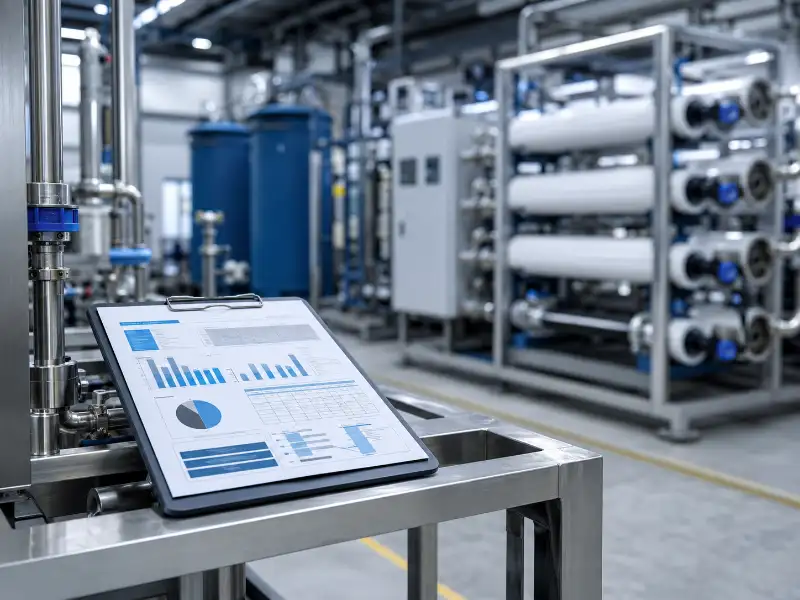
Before we confirm a category and configuration, a defined set of data decides the outcome. For sources high in dissolved salts, that data also determines whether reverse osmosis belongs in the train. We review the following against your output target and the destination-market limits:
| Category | WTP data needed | WWTP data needed |
|---|---|---|
| Basic water quality | pH, turbidity, TDS, hardness, alkalinity | pH, COD, BOD5, TSS, temperature |
| Specific contaminants | Iron, manganese, nitrate, fluoride, microbiology | Ammonia, total nitrogen, total phosphorus, oil & grease, metals |
| Process design inputs | Design flow, pressure, SDI (if RO), end use | Average and peak flow, organic load, equalization need |
| Compliance target | Potable, process, or boiler-feed standard | Discharge or reuse permit limit |
This guide clarifies which plant category fits a given water stream. It does not replace project-specific stage selection or equipment sizing. Those follow from a certified laboratory analysis, which we carry out per project against site electrical standards and destination-market requirements.
Conclusion
The decision between a WTP and a WWTP rests on three variables, not on the acronyms: which way the water stream runs, what a lab analysis finds in it, and which limits the output must hold. Read those three together, and the right category is usually clear—even when the terminology on a quote is not.
We are a manufacturer, not a trading company. As one of the few water treatment equipment suppliers that reviews each inquiry in-house, our engineering team checks three things before confirming any configuration: the source-water or effluent profile, the destination-market limits, and the site’s electrical and capacity constraints. Sometimes the stated plant type and the described contaminants do not match. That review is where the mismatch surfaces and gets corrected—before fabrication, not after commissioning. Several factors stay project-specific: stage selection, equipment sizing, and the exact discharge or potable limits that apply.
The practical next step is simple. Send us the source-water or effluent analysis, along with the intended use and design flow. With that, we can confirm whether a WTP, a WWTP, or both fit the site. Then we align a configuration to the limits you need to meet.
FAQ
A WTP cleans water on the way in, and a WWTP cleans water on the way out. The quickest way to tell which one you need is the direction of the stream: incoming supply points to a WTP, outgoing waste points to a WWTP.
An STP is a type of WWTP built for domestic sewage. So every STP is a wastewater plant, but not every WWTP is limited to sewage. Industrial effluent plants (ETPs) are the other common subset.
A WTP treats incoming raw water for use. An ETP treats outgoing industrial effluent before disposal, which places it on the wastewater side. In procurement terms, an ETP handles industrial effluent, just as an STP handles domestic sewage.
A standard WWTP is built to meet discharge or non-potable reuse limits, not drinking-water certification. Potable output is possible only with advanced polishing, disinfection, validation against potable standards, and local approval. Whether it is achievable depends on the effluent quality and the rules of the destination market.
The starting data follows the stream: a WTP specification keys off the source-water profile, while a WWTP specification keys off the effluent’s organic and pollutant load. A source report missing a value such as hardness, or an effluent report missing BOD5 and ammonia, usually holds up the configuration until the gap is filled.
Often yes, because the two solve opposite problems: making intake water usable, and making process wastewater dischargeable. Whether you need one or both comes down to your source-water quality and your discharge obligations. Some sites only treat their intake, some only treat their discharge, and many treat both.