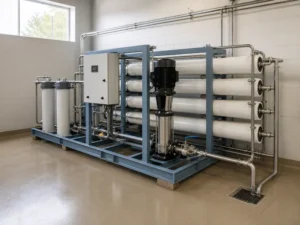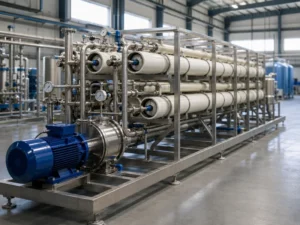
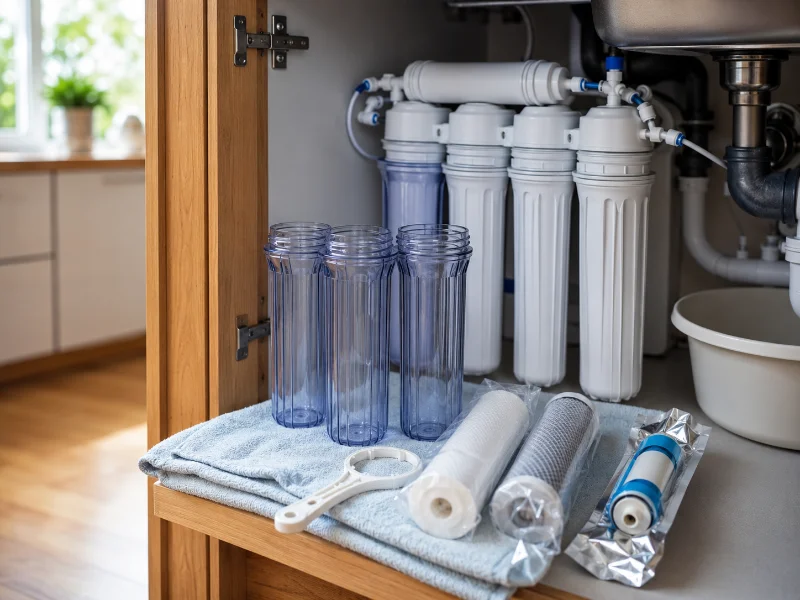
Filters for a reverse osmosis system cost roughly $15 to $100 per cartridge at point-of-use scale. Most under-sink systems land between about $60 and $300 a year once you count every stage. The membrane element carries the highest single price, commonly $50 to $100. Because it lasts two to five years, it usually accounts for a smaller share of the annual figure than the pre-filters do. Reverse osmosis filter cost moves inside that band with cartridge format, chlorine and sediment load, and total throughput.
What Filters for a Reverse Osmosis System Cost, Stage by Stage
Replacement cartridge prices for point-of-use RO systems sit in a narrow band per stage, and the spread inside each band follows cartridge format, micron rating, and rated capacity. The table below gives published ranges for a standard under-sink configuration.
| Stage | Typical unit price | Published change interval | What moves it |
|---|---|---|---|
| Sediment pre-filter | $15–$25 | 6–12 months | Turbidity, iron, seasonal source changes |
| Carbon block pre-filter | $20–$30 | 6–12 months | Chlorine or chloramine concentration, total feed volume |
| RO membrane element | $50–$100 | 24 months to 5 years | Pre-filter discipline, feed TDS, operating pressure |
| Post-carbon polishing filter | $15–$25 | 6–12 months | Taste requirements, storage tank residence time |
| Remineralization cartridge (where fitted) | $30–$40 | 12–24 months | Target hardness and alkalinity, daily draw |
Ranges compiled from published U.S. cost data (HomeGuide) and a retailer’s per-stage maintenance table (Crystal Quest). Intervals follow published manufacturer change schedules (ESP Water). Figures checked July 2026; labour, shipping, and tax excluded.
Annualizing the table shows where the yearly band comes from. A membrane at $50 to $100, replaced every two to five years, works out to roughly $10 to $50 a year. Three pre- and post-filters at $15 to $30 each cost about $45 to $90 per change. That change happens once or twice a year. Add the two together and the low end sits near $55. At the high end, twice-yearly changes plus a remineralization stage push the total close to $300. The membrane carries the highest sticker price and the smallest annual share.
Change Frequency Costs More Than Cartridge Price
Annual filter spend on an RO system is the product of two numbers, unit price and change frequency, and only one of them is settled at checkout.
A three-cartridge under-sink system at roughly $20 per cartridge costs about $60 for a full change. On an annual schedule that is about $60 a year. On a six-month schedule, about $120. Cutting the cartridge price by 20 percent saves about $12 across the year. Moving from a six-month to a twelve-month interval saves about $60. Frequency is worth roughly five times as much as unit price on the same hardware.
Frequency itself is bounded by whichever limit arrives first: rated throughput, an unacceptable pressure drop or decline in output, or the manufacturer’s maximum service interval. Low household draw does not stretch a cartridge indefinitely. Wetted media ages, and the time limit exists partly for hygiene.
On feed water carrying seasonal turbidity, the sediment pre-filter reaches the end of its useful life first, usually well before the date printed on the carton. A surface intake after heavy rain and a shallow well drawing fine sand both produce that pattern. Reduced flow at the faucet is the symptom.
The reading that confirms it is differential pressure across the pre-filter housings, compared against a documented clean-cartridge baseline. A single membrane-inlet gauge tells you less. Its reading only means something when feed pressure is stable and nothing else is drawing water.
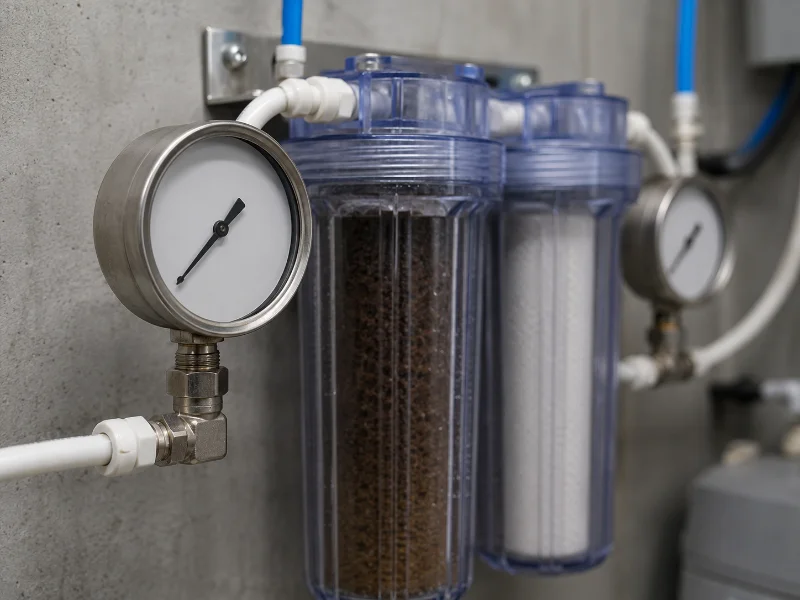
Pressure is a poor proxy for the carbon stage. Chlorine can exhaust a carbon block while its pressure drop still reads normal, so carbon is tracked against rated throughput instead. Leave a carbon pre-filter in service past its chlorine capacity because the calendar shows months remaining, and chlorine reaches the polyamide membrane. Rejection then falls permanently. The correction is a membrane replacement, not another cartridge.
Universal Cartridges vs Proprietary Quick-Change
Cartridge format shapes the annual cost of an RO system as much as any other single variable, and the gap between universal and proprietary formats widens over the life of the unit. Three formats cover almost every installation.
| Format | What it fits | Typical annual cartridge spend | Sourcing |
|---|---|---|---|
| Universal 10-inch (2.5″ × 10″) | Most tank-type under-sink systems with screw-on housings | $30–$50 | Many manufacturers, wide retail availability |
| Proprietary quick-change | Twist-and-click manifolds, most tankless units | $80–$150 | Original brand only |
| Large-format commercial (20-inch housings, spiral-wound elements) | Light-commercial and industrial skids | Set by element count and format | Membrane and cartridge suppliers, lead time applies |
In one published five-year ownership example, Filter United budgeted universal cartridge upkeep at about $40 a year against roughly $120 for proprietary quick-change cartridges. That is a single vendor’s scenario rather than a market average. Current prices vary widely by brand, by whether the set includes a membrane, and by replacement interval. The mechanism behind the gap travels further than the number does: dozens of manufacturers make a standard 10-inch cartridge, while one makes a quick-change cartridge.
The distinction that matters at purchase is between what can be revised in service and what cannot. You can change service interval, micron rating, and rated flow later. The housing manifold cannot. A quick-change system will not accept universal cartridges without new hardware, so the format carries its operating cost for the life of the unit.
What Actually Moves an RO Filter Budget
Five variables move an RO filter budget, and they act on it unequally: chlorine load, sediment and turbidity load, the system’s recovery rating, cartridge format, and membrane area. The first three drive frequency. The last two drive unit cost.
Recovery rating deserves more attention than cost discussions usually give it, because pre-filters see the entire feed stream, permeate and concentrate together. The EPA’s WaterSense program reports that a typical point-of-use RO system sends five gallons or more to drain per gallon of treated water. Labeled systems must demonstrate 2.3 gallons or less. Total feed per gallon of drinking water can therefore be approximated as about 6 gallons on a typical system, against about 3.3 on a labeled one. That approximation assumes both draw the same permeate volume and ignores membrane flush cycles. A carbon block rated for a fixed number of gallons of chlorine reduction then covers roughly 1.8 times more drinking water on the efficient system.
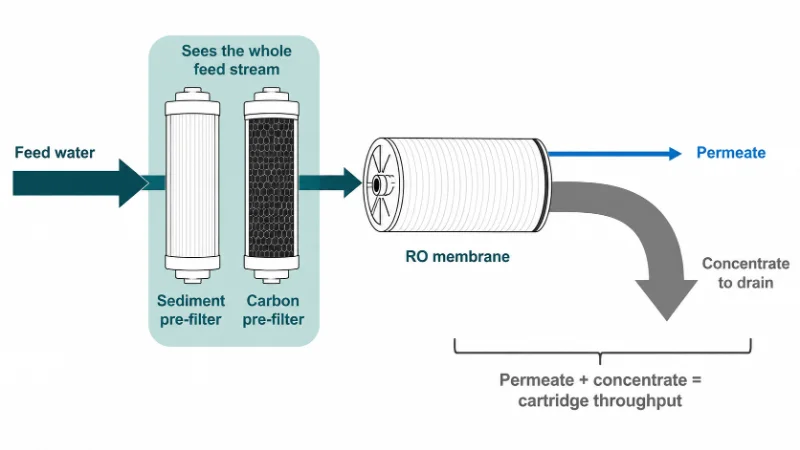
The efficiency rating is therefore a filter cost variable, not only a water bill variable, provided the cartridge’s rating is throughput-limited rather than time-limited. One caveat on the label itself: WaterSense covers complete point-of-use systems, so there is no WaterSense-labeled replacement cartridge or membrane to shop for.
Two of these variables need settling first, and they settle together. Cartridge format locks because it is irreversible once the housings are installed. Chlorine and sediment load lock alongside it, because they feed every frequency estimate that follows. Membrane area, certification tier, and brand can wait, since none of them changes what the earlier two already fixed.
For a single under-sink unit on chlorinated municipal water, a universal-cartridge system stocked with generic 10-inch cartridges is usually the lowest-cost correct answer. Larger or more specified equipment adds cost without adding anything that application needs.
Where Under-Sink RO Filter Prices Stop Applying
Under-sink cartridge pricing stops describing a system once the housings move past the 10-inch standard, and above that point the cost structure changes shape rather than scaling proportionally.
Certification scope breaks first. NSF/ANSI 58 covers materials safety, structural integrity, and TDS reduction performance for point-of-use reverse osmosis systems. Its scope stops there, well short of large-scale systems serving community or process water. Certification, proprietary geometry, distribution, and brand pricing all feed into what a residential cartridge costs. At industrial scale, buyers verify element performance against the element datasheet and their own permeate readings.
The second break is element geometry. An 8040 element commonly provides about four to five times the active membrane area of a 4040. The exact ratio has to come from the two datasheets, because leaf count, feed-spacer thickness, glue lines, and packing density all differ between products. External diameter alone will not give it.
Conclusion
Filters for a reverse osmosis system are priced per cartridge and paid for per year. The yearly figure follows mostly from two things that have to converge: the cartridge format the housings accept, and how long the filters last on the feed water you have. Format locks first, because housings cannot be economically converted once installed. Interval follows from measurement, using differential pressure across the pre-filter housings and throughput against the carbon block’s rated capacity.
Every range here shifts with feed water quality, duty cycle, and local pricing. That is why we verify the change interval against a specific water analysis before it enters a budget.
If your feed is chlorinated municipal water and the unit is a single under-sink system, buy universal 10-inch cartridges and set a differential-pressure check at six months. If you are budgeting cartridges and elements for a commercial RO water filter system on well or brackish feed, start with a current feed analysis and the element datasheets. At that scale the interval carries far more of the budget than the cartridge price.
FAQ
Generic 10-inch cartridges can suit a system when dimensions, end-seal configuration, micron rating, rated flow, and chlorine or chloramine capacity match the original specification. Chlorine reduction and chloramine reduction are separate claims, so a chloraminated supply needs a cartridge rated for chloramine. On a certified system, check whether aftermarket parts affect the warranty.
Membrane replacement makes sense while the housings, faucet, and tank remain sound, since the element is typically half or less of a new under-sink system’s price. Replacing the whole unit becomes reasonable when housings leak, the format is out of production, or the recovery rating is poor enough that water waste outweighs the saving.
Measure the old cartridge and read the model number on the housing. Several standardized sizes are in use besides 2.5 × 10 inches, so confirm dimensions before ordering.
Shelf life depends on how the element was supplied. Elements ship either dry or wet-preserved in a storage solution. Wet-preserved ones need intact packaging and periodic preservative checks, and an element that has already been wetted must never dry out. Those limits cap how far ahead a bulk discount is worth buying.
A TDS meter reads membrane rejection only. Sediment and carbon cartridges load up and exhaust without moving the TDS number, and by the time TDS climbs the membrane has usually already taken damage. Treat a rising TDS reading as a membrane finding, not a maintenance alarm for the earlier stages.
Related Posts
Types of Commercial Water Filters — takes the stage table above up a scale, showing which equipment each filtration stage becomes in a commercial plant.
What Is the Best Filter for Brackish Water? — covers the selection judgment behind the well and brackish feed branch in the closing section.
How Much Does a New Water Treatment System Cost? — picks up the boundary drawn above, pricing the equipment that this article deliberately leaves out.
Reverse Osmosis System Problems — reads the symptoms behind rising pressure drop and falling output flow.
Industrial RO System Maintenance — the plant-scale version of the interval judgment that sets the cost here.