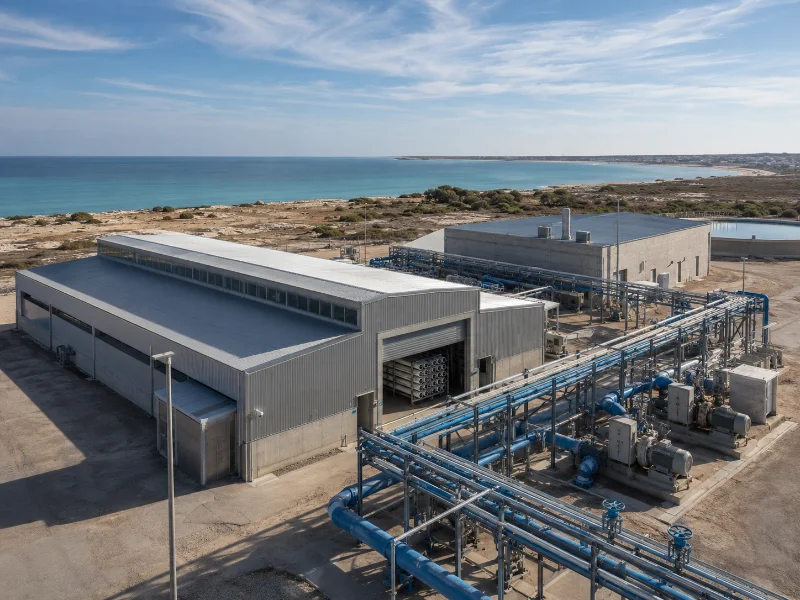
Desalination plants are treatment facilities that strip dissolved salt from seawater or brackish water to produce water fit for drinking, irrigation, or industrial process use, and the feed source governs almost every design choice downstream. Capacity sits outside the definition. The term covers a containerized skid serving one island resort and a municipal works producing tens of millions of gallons a day. Most modern facilities run reverse osmosis, which drives feed water through semi-permeable membranes under pressure. Thermal plants that evaporate and recondense water still hold ground where heat is cheap. Feed salinity sets operating pressure, so identical output can mean very different machines.
| Dimension | Value |
|---|---|
| Feed salinity bands | Brackish 1,000–10,000 mg/L TDS; seawater near 35,000 mg/L (Texas Water Development Board) |
| Leading feed source | Seawater, near 57% of global installed capacity (peer-reviewed global fleet assessment) |
| Dominant process | Reverse osmosis; about 72% of US municipal brackish plants (TWDB, 2024) |
| SWRO energy use | About 2.5–4.0 kWh/m³ for the SWRO process with modern energy recovery; whole-plant figures higher |
| Seawater osmotic pressure | About 30 bar at 35 g/L; roughly 60 bar in the concentrate at 50% recovery (van ‘t Hoff estimate, approximate) |
| Recovery ceiling | Set by tail-end osmotic pressure, membrane and vessel pressure rating, and concentrate scaling potential |
| Pretreatment yardstick | Silt density index per ASTM D4189-23; report edition and test conditions with the value |
What Counts as a Desalination Plant
A desalination plant is any facility that separates most of the dissolved salt from a saline feed and discharges two streams, product water and concentrate, at whatever scale the demand and available source require. The definition is silent on size. The category stretches from a 5 m³/h skid to a works supplying a city.
The two-stream structure carries the downstream consequences. A plant concentrates salt; it never destroys any. Every site therefore needs somewhere to send the reject stream, and the receiving environment has to tolerate what arrives.
Sizing begins from a volume target, which sets membrane area, vessel count, and pump duty. The figure worth verifying is peak-day demand. Average demand misleads. A system sized on the annual average will carry most of the year and fall short in the weeks it was built for.
Not Every Desalination Plant Is a Seawater Plant
Desalination plants divide by feed source into seawater and brackish systems, and that division governs pressure class, pretreatment, recovery, and concentrate handling before any other choice is made.
The two feed types lead on different measures. Seawater dominates by installed capacity. A peer-reviewed assessment of the world fleet puts it near 57% of global installed capacity. Count individual plants inside one country and the picture inverts. The Texas Water Development Board’s 2024 biennial report identifies 406 municipal brackish groundwater plants in the United States. Roughly 40% of them sit in Florida, 14% in California, and 13% in Texas, and about 72% use reverse osmosis.
The salinity gap behind that split drives the hardware. Brackish water carries roughly 1,000 to 10,000 mg/L of total dissolved solids. Seawater sits near 35,000 mg/L. The gap is large. Osmotic pressure rises with dissolved ion concentration, so a brackish feed demands a fraction of the pressure seawater does. Pump duty, vessel pressure rating, piping class, and the case for energy recovery hardware all follow from it.
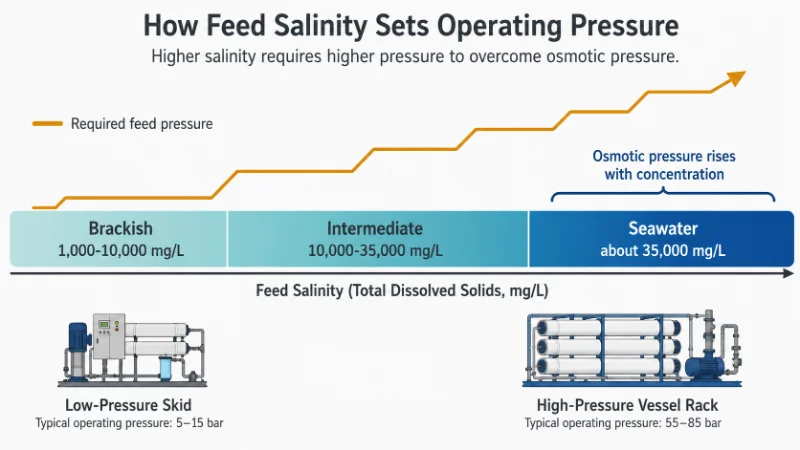
The failure mode is consistent. A project fixes its budget from an output target, leaves the feed analysis until afterwards, and ends up with a system rated for the wrong pressure class. Pressure class is a fabrication decision, not a set point. Correcting it means new pumps and new vessels.
The Six Main Blocks in a Typical Reverse-Osmosis Desalination Plant
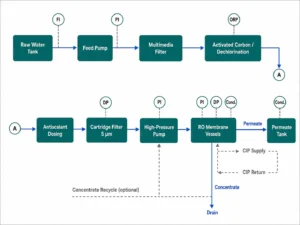
A typical reverse-osmosis plant runs six blocks in sequence, from intake to concentrate discharge, and each block answers to a different variable than the plant’s headline capacity. Thermal and electrodialysis systems share the intake, pretreatment, and concentrate ends of that sequence, and they replace the middle.
| Block | What it does | What decides its design |
|---|---|---|
| Intake | Draws raw feed water | Solids and organic load at the site; open intake, beach well, or production well |
| Pretreatment | Removes solids, organics, and biology ahead of the membranes | Feed SDI and turbidity; seasonal algal bloom risk |
| Membrane separation | Splits the feed into product water and concentrate | Feed TDS, temperature, ion composition, target recovery |
| Energy recovery (optional) | Returns pressure from the concentrate to the incoming feed | Pressure differential, flow, recovery rate, power tariff, annual running hours |
| Post-treatment | Remineralizes, adjusts pH, disinfects | Product quality standard and downstream pipe material |
| Concentrate handling | Discharges or disposes of the reject stream | Local permit conditions and the receiving environment |
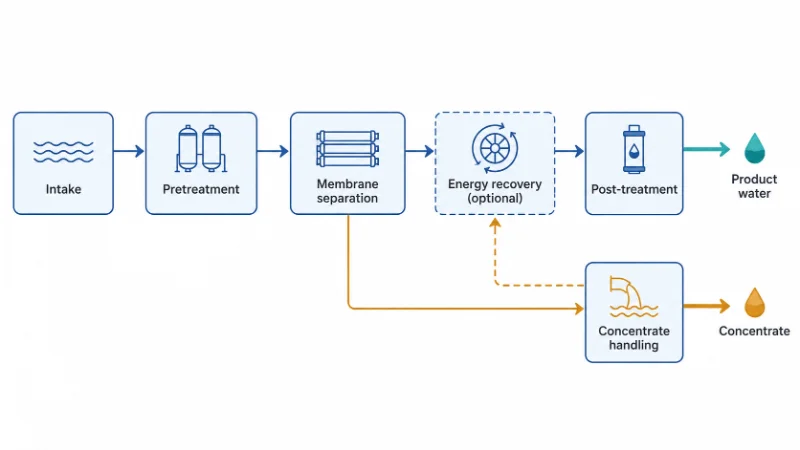
Pretreatment is where sites diverge most. Seawater salinity varies within a fairly narrow band worldwide. Suspended and organic load varies by orders of magnitude between an open intake on a bloom-prone coast and a beach well. Two plants with identical membranes and identical output can therefore differ substantially in footprint and capital cost, and the difference sits upstream of the membranes.
Silt density index is the usual pretreatment yardstick, and its standard has moved. ASTM D4189-23 is the current edition of the SDI test method. ASTM withdrew the earlier D4189-07(2014) in 2023, and specifications drafted before then may still cite the old designation. SDI indicates comparative fouling potential in relatively low-turbidity water; it does not measure particulate concentration absolutely. Report the edition, test duration, membrane type, temperature, and sampling conditions alongside any SDI figure. We ask for those conditions with the analysis before fixing a pretreatment train, because a headline capacity figure says nothing about this block.
Energy recovery deserves its own check. High-pressure seawater duty usually justifies it. Researchers have also studied isobaric devices on high-recovery brackish systems, so the case turns on pressure differential, flow, recovery rate, power tariff, and annual running hours. The seawater-or-brackish label settles nothing on its own.
Thermal, Membrane, and Electrodialysis Plants Compared
Desalination separates salt by pressure, by evaporation, or by an electric field, and the choice among the three turns on what energy costs at the site and what the feed contains.
| Technology | Separation driver | Feed it suits | Still specified when |
|---|---|---|---|
| Seawater RO (SWRO) | Pressure across a semi-permeable membrane | Seawater, roughly 30,000–45,000 mg/L | Electricity is the available energy and no low-cost heat exists |
| Brackish RO (BWRO) | Pressure, at a fraction of seawater duty | Brackish water, 1,000–10,000 mg/L | An inland aquifer is the source and capital cost is tight |
| Multi-stage flash (MSF) | Evaporation across staged pressure drops | Seawater, including feeds that foul membranes quickly | Co-located generation supplies low-cost, consistently available heat of limited alternative value |
| Multi-effect distillation (MED) | Evaporation across successive effects at reduced pressure | Seawater | Low-grade heat is available at moderate temperature |
| Electrodialysis (ED/EDR) | Ion transport under an applied voltage | Low to moderate TDS brackish water | Selective ion removal matters more than bulk salt rejection |
Reverse osmosis takes most new capacity, and brackish water reverse osmosis dominates the inland fleets as well. Thermal systems keep their role where a power station supplies steam of limited alternative value, and they tolerate feed water that would foul a membrane train quickly. One site can also run both families together, so a hybrid arrangement is a normal outcome where heat and power are both available.
Feeds between roughly 10,000 and 35,000 mg/L fall outside both standard categories. High-salinity groundwater, estuarine water, and concentrated process streams land in that band. Each needs project-specific evaluation against a full ion analysis, a scaling model, temperature, and the product specification. Total dissolved solids indicate the approximate pressure and membrane category. The complete process depends on more: ion composition and saturation indices, boron and silica, organic and biological load, recovery target, concentrate disposal limits, and the available power or heat.
What Drives the Energy Use and Cost of Desalinated Water
Energy is the largest recurring cost at most desalination plants, and its size follows from feed salinity, recovery rate, and whether energy recovery hardware is fitted. Published surveys put the electrical specific energy consumption of the SWRO process itself near 2.5 to 4.0 kWh per cubic metre where modern energy recovery devices are used. Whole-plant figures run higher, because they also carry intake, pretreatment, post-treatment, concentrate pumping, and product conveyance.
A physical floor sits under that figure, and anyone can estimate it without vendor data. Treat seawater at about 35 g/L as sodium chloride and apply the van ‘t Hoff relation, π ≈ iMRT. With i = 2, M ≈ 35 ÷ 58.44 ≈ 0.6 mol/L, R = 0.0831 L·bar/(mol·K), and T = 298 K, osmotic pressure comes out at about 30 bar.
Now recover half the feed as product. The concentrate leaves roughly twice as concentrated, so its osmotic pressure roughly doubles, to about 60 bar. Feed pressure has to clear that before product crosses the membrane at the tail end. Physics sets the floor. Seawater trains therefore run at pressures a brackish system never approaches, and pushing recovery higher on seawater costs energy. At least two limits cap seawater recovery: this pressure relationship and the pressure rating of the reverse osmosis membranes and their vessels. Scaling potential in the concentrate deserves a check alongside both.
The van ‘t Hoff estimate is illustrative only, and no one should treat it as a design value. Seawater is not a pure sodium chloride solution. Osmotic pressure also stops tracking concentration linearly at high strength, and concentration polarization at the membrane surface lifts local osmotic pressure above the bulk figure. Design work uses membrane-supplier software or a validated thermodynamic model.
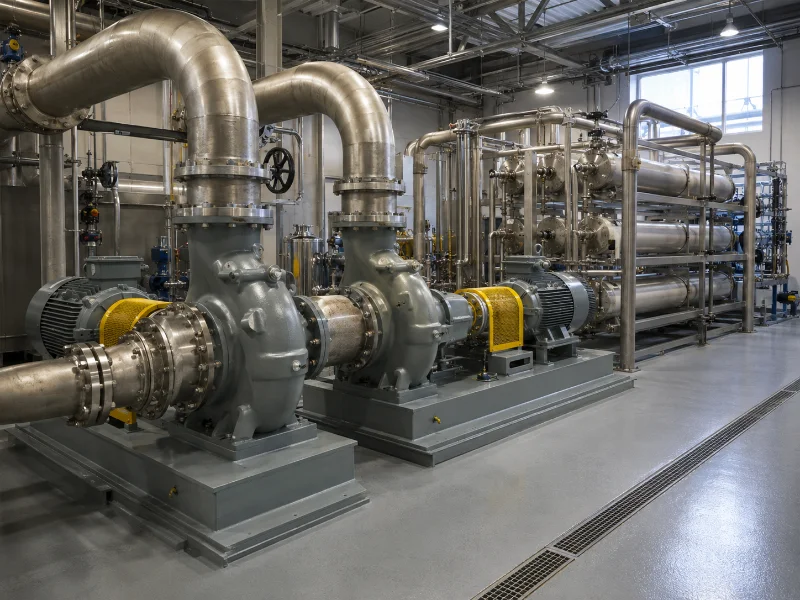
Unit cost splits along the same line. Texas planning ranges published by the state water agency put desalinated brackish water at $1.25 to $2.60 per thousand gallons, against $3.60 to $5.80 for seawater. Those figures are regional and historical, and they carry no inflation adjustment. They also leave financing, conveyance, and concentrate disposal unstated, so read them as an order of magnitude.
Four inputs converge before anyone can size a plant: the feed source with its full analysis, the product volume and quality target, the discharge route, and the site power supply. Feed source and discharge route settle earliest. Both rest on permissions a project cannot reverse once granted or refused, and the feed analysis feeds every block downstream of it. Volume then sets membrane area and vessel count. Of those four, the feed analysis is the one worth paying to get right twice.
One judgement runs against our own interest. Where a lower-salinity source sits within economic pumping distance, or an existing supply can meet demand once losses are repaired, the plant rarely pays back its capital and its power bill.
In feeds with seasonal algal blooms, pretreatment is usually the first stage to need rechecking, because its design load changes more than anything else between commissioning and the first bloom season. Most reverse osmosis system problems that surface later trace back to that stage.
Concentrate Discharge and Its Effect on Siting
Concentrate handling constrains where a desalination plant can be built, and the routes available depend on whether the site is coastal or inland far more than on plant size. The Texas Water Development Board treats concentrate management as one of the factors that can decide a project’s feasibility outright.
Coastal sites generally return concentrate to the sea under controlled discharge conditions, or inject it into deep formations. Inland sites work from a different list: discharge to surface water, evaporation ponds, transfer to a wastewater treatment works, or beneficial reuse in an industrial process. One state agency lists those routes. A given site may have fewer of them available, since local permit conditions decide which survive.
Recovery rate interacts with all of it. Taking more product from the same feed concentrates approximately the same mass of salt into less water. Discharge volume falls and salinity rises. Jurisdictions differ on whether a permit governs concentration at a mixing zone boundary or total load, and that wording decides which direction helps. Obtain the discharge limit for the receiving water in writing, from the authority that issues it, early enough to shape the configuration.
Choosing Between Seawater and Brackish Desalination Routes
Four inputs shape a desalination plant, and the feed source settles earliest. It feeds every block downstream, and intake and discharge permissions cannot be un-granted. A plant sized from an output figure alone tends to be right about capacity and wrong about pressure class, which is the expensive half to correct.
We confirm the feed analysis and the discharge conditions against the site before selecting a configuration. We treat both as site data, because carry-over assumptions from a similar job are exactly where pressure class goes wrong.
If a full ion analysis puts the feed near open-ocean salinity, and no low-cost heat source exists at the site, the usual route is a reverse osmosis desalination machine built for seawater pressure class. Gather that analysis next, with the SDI edition and measurement conditions stated alongside it. If the feed lands in the brackish band below 10,000 mg/L, evaluate a low-pressure system instead, and let pressure differential and running hours decide whether energy recovery earns its place. Anything between those bands needs a scaling model and a product specification before either route is priced.
FAQ
Product water becomes safe and stable at the post-treatment stage, not at the membrane outlet. Permeate straight off a membrane holds very few dissolved minerals and attacks metal and cement pipework. Remineralization, pH adjustment, and disinfection are what make it potable and safe for the distribution network.
Yes, and several operate that way, usually with a grid connection or storage as backup. Membranes prefer steady conditions, so a purely intermittent supply forces either frequent start-stop cycling or extra capacity to catch up during daylight hours.
No. Membranes reject charged ions efficiently, while small uncharged molecules such as boric acid pass more readily at neutral pH. Some plants add a second pass at elevated pH, and double pass RO systems exist for exactly that reason.
Permitting and intake or outfall approvals can dominate the schedule, particularly on large coastal projects. One Texas brackish groundwater plant of 27.5 MGD moved from planning in 2001, to a draft environmental impact statement in 2004, to construction in 2005, and to completion in 2007. Equipment lead times, grid connection, and financing govern other projects.
Cost and power supply mostly, plus distance: an inland demand centre pays to move desalinated water as well as to make it.
Related Posts
Seawater Desalination Plants for Remote Sites — Configuration options across the size range this article describes, from island resorts to remote community supply.
Brackish Water RO Design — Recovery limits and staging for the low-pressure branch named in the closing section.
Distillation vs Reverse Osmosis — What decides between the thermal and membrane families at plant scale, expanding the comparison table above.
Industrial RO System Components — Pretreatment, membranes, and pumps taken block by block against source-water type.
Industrial Reverse Osmosis System Price — Equipment-side cost drivers and how to compare quotes, behind the order-of-magnitude figures given here.