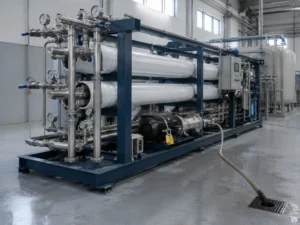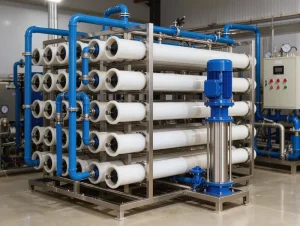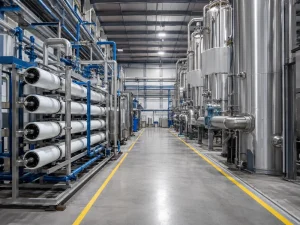
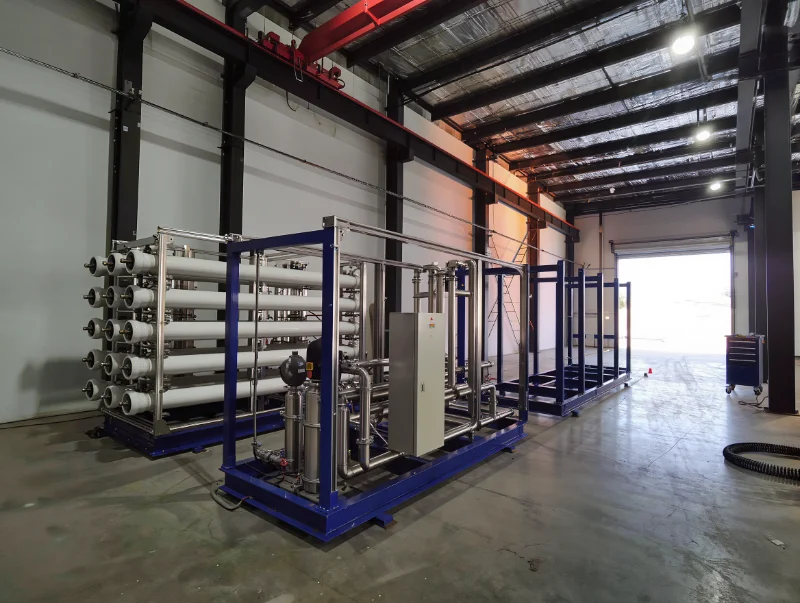
A top industrial RO manufacturer is one that can design to your verified feed water, build the pressure and electrical scope to the standards of the destination market, and still be the same legal entity when a warranty claim arrives. The 15 companies covered here do three different jobs. Some fabricate the skid you sign for, some make the membrane elements every fabricator designs around, and some sell process design, chemistry and long-term operation. They rarely bid the same scope, which is why a single ranked list tells a buyer so little about who should be quoting.
Four of the companies on this list changed hands or changed identity between 2023 and 2025. Evoqua was absorbed into Xylem in May 2023, Koch Separation Solutions became Kovalus in October 2023, and LG Water Solutions became NanoH2O in December 2025. A ranking written before those dates is recommending suppliers under names that no longer appear on a contract.
| Company | Role | Headquarters | Ownership status, July 2026 | Supplies | Typical fit |
|---|---|---|---|---|---|
| Hiju Water Treatment | System builder | Qingdao, China | Privately held | RO skids, pretreatment, softeners, storage; vessels and panels built in-house | Export projects needing a named fabricator |
| Aquatech International | System builder | Canonsburg, PA, US | Cerberus Capital invested April 2025 | High-recovery RO, ZLD, ultrapure water | Sites with hard concentrate or discharge limits |
| Kovalus Separation Solutions | System builder | Wilmington, MA, US | Sun Capital affiliate; renamed from Koch Separation Solutions in 2023 | Membrane filtration, ion exchange, evaporators | Food, beverage and life-science separation trains |
| Lenntech | System builder and integrator | Delft, Netherlands | Privately held | RO units with consultative process engineering | European projects needing process advice first |
| Pure Aqua | System builder | Santa Ana, CA, US | Privately held | Brackish, seawater and containerized skids, US-built | Standard configurations with light customization |
| DuPont Water Solutions | Element producer | United States | Retained by DuPont; spin-off reversed January 2025 | FilmTec RO elements, ion exchange resins, UF | Specifications written to a widely stocked element |
| Hydranautics | Element producer | United States | Nitto Denko subsidiary | ESPA and high-fouling RO elements | Feeds where fouling is the binding constraint |
| LANXESS | Element producer | Germany | Public, FSE: LXS | Lewabrane RO elements and ion exchange resins | One supplier for both resin and membrane |
| NanoH2O | Element producer | Seoul, South Korea | Glenwood PE and Mubadala; renamed from LG Water Solutions 1 December 2025 | High-flux seawater and brackish RO elements | Seawater desalination where flux drives array size |
| Toray Industries | Element producer | Japan | Public, TSE: 3402 | Spiral-wound RO and nanofiltration elements since 1968 | Large-diameter, high-capacity arrays |
| Toyobo | Element producer | Japan | Public, TSE: 3101 | Hollow-fibre seawater elements | Seawater duties specifying hollow fibre |
| Vontron | Element producer | Guiyang, China | CRRC-affiliated | Spiral-wound RO, NF and UF elements | Projects led by ten-year replacement cost |
| Ecolab | Service and chemistry | United States | Public, NYSE: ECL | Antiscalant and cleaning programs, monitoring, some equipment | Chemistry and membrane performance under one contract |
| Veolia Water Technologies & Solutions | Service and engineering | Trevose, PA, US | Veolia Group; formerly Suez WTS, formerly GE Water | Equipment, chemistry and digital services | Multi-technology plants and long-term operating contracts |
| Xylem | Service and engineering | Washington, DC, US | Public, NYSE: XYL; absorbed Evoqua May 2023 | RO skids, instrumentation, service network | US sites wanting equipment and service from one party |
Alphabetical within each group, publisher first. No paid placements. Ownership status re-checked July 2026.
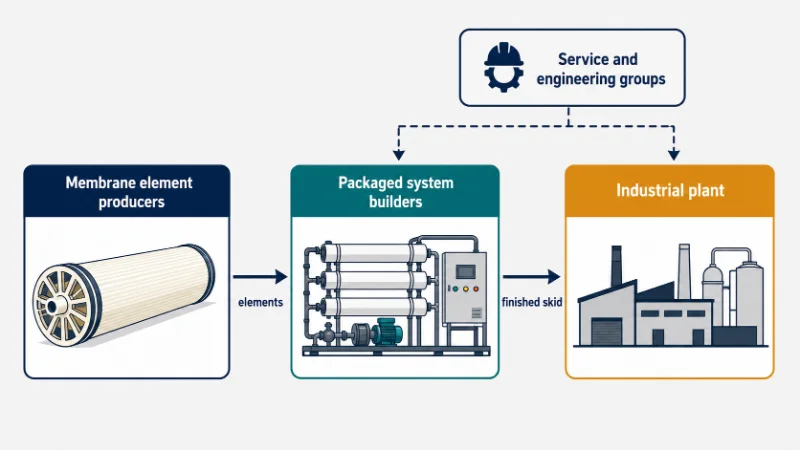
Packaged System Builders
Packaged system builders design and fabricate the skid a buyer contracts for, and whether one is the right counterparty depends on how far the specification departs from a catalogue configuration. Most buyers of a single plant belong in this group.
1. Hiju Water Treatment
Headquarters and manufacturing: Qingdao, China | Founded: 2016 | Ownership: Privately held
Company-reported: a 70,500 m² site including a 21,000 m² enclosed workshop, with pressure vessels, membrane housings, skids and electrical panels fabricated in-house; 28 engineers and 78 technicians; export to more than 20 countries. Holds ISO 9001, ISO 14001 and ISO 45001 management-system certificates and CE conformity under Machinery Directive 2006/42/EC, with ASME pressure-vessel documentation available on request. Certificate numbers and validity dates are published and can be checked with the issuing body.
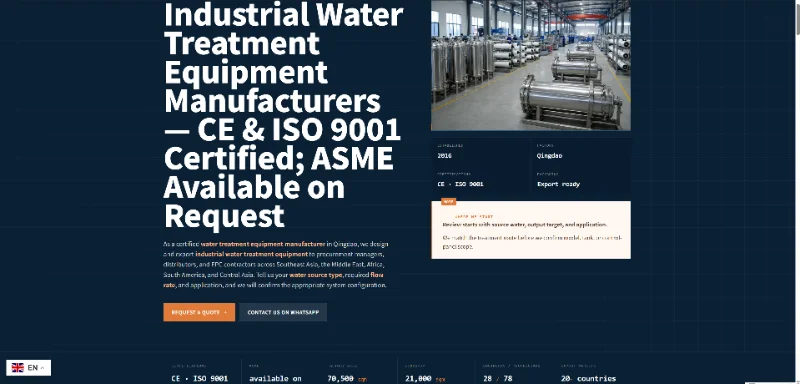
Typical fit: export projects where the buyer wants a named fabricator behind the pressure housing and the panel, with destination-market documentation inside the supply scope.
2. Aquatech International
Headquarters: Canonsburg, Pennsylvania, US | Founded: 1981 | Ownership: Cerberus Capital Management invested in April 2025
High-recovery reverse osmosis, zero liquid discharge, ultrapure water trains and mobile treatment, with more than 2,000 site solutions in over 60 countries .
Typical fit: power, mining and chemical sites where concentrate volume or discharge limits drive the design.
3. Kovalus Separation Solutions
Headquarters: Wilmington, Massachusetts, US | Founded: 1963 | Ownership: Sun Capital Partners affiliate
Formerly Koch Separation Solutions, renamed following acquisition by a Sun Capital Partners affiliate and operating as a standalone business with over 700 employees and four manufacturing sites. Membrane filtration, ion exchange, evaporators and dryers.
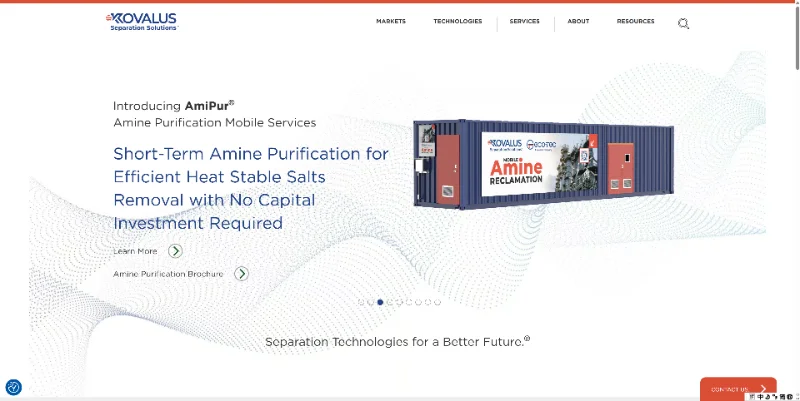
Typical fit: food, beverage and life-science plants where RO sits inside a wider separation train.
4. Lenntech
Headquarters: Delft, Netherlands | Ownership: Privately held
Consultative integrator supplying RO units for laboratory, pharmaceutical, commercial and industrial duties, with pre-sales process engineering as the principal offering rather than volume fabrication.
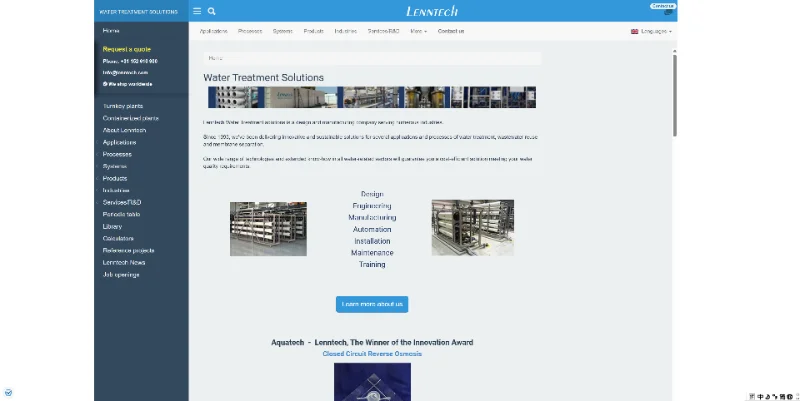
Typical fit: European projects that need the process settled before equipment selection.
5. Pure Aqua
Headquarters and manufacturing: Santa Ana, California, US | Founded: 2001 | Ownership: Privately held
Brackish, seawater, containerized and membrane-cleaning skids, engineered and built in the United States around bought-in elements.
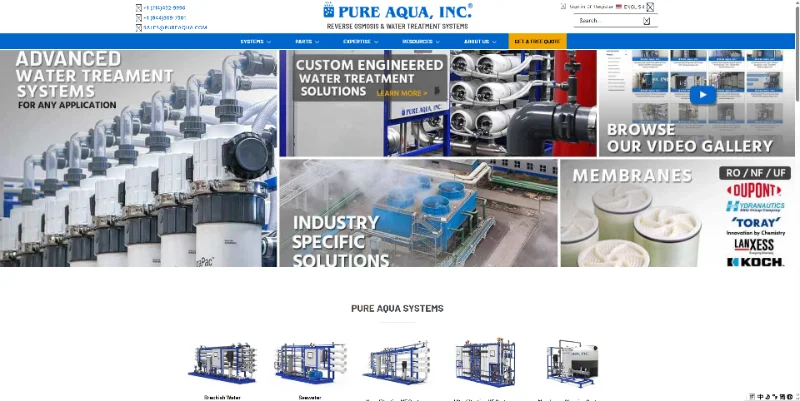
Typical fit: North American projects wanting domestic fabrication with moderate customization.
Membrane Element Producers
Membrane element producers manufacture the spiral-wound elements that every skid builder designs around, and their published envelopes set the ceiling on what any quotation can promise, subject to the test conditions those figures were measured under. Sales normally run through system builders rather than to plant owners.
6. DuPont Water Solutions (FilmTec)
Base: United States | Ownership: Retained by DuPont
Announced in May 2024 as one of three separated companies, then reversed in January 2025, with Water remaining in the DuPont portfolio. Around $1.5bn in sales across the FilmTec, Amberlite, Fortilife, IntegraFlux and TapTec brands, roughly half from industrial and energy customers.
Typical fit: specifications written against a widely stocked element with published performance curves.
7. Hydranautics
Base: United States | Ownership: Nitto Denko subsidiary
Broad element range including the ESPA brackish series and dedicated high-fouling options. Launched an energy-efficient industrial RO membrane in December 2023.
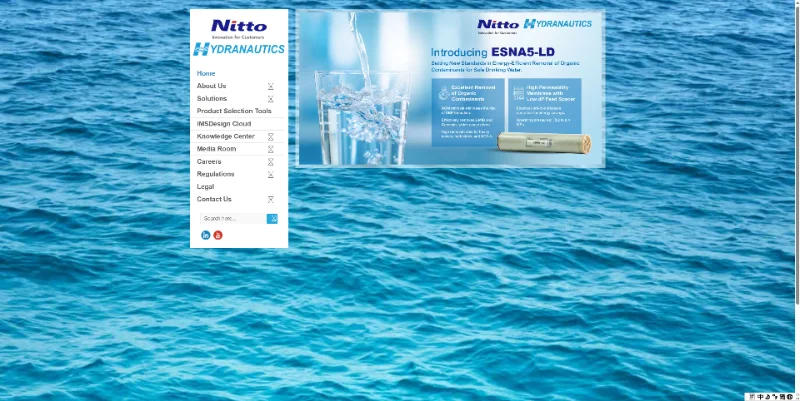
Typical fit: feeds where fouling potential, rather than skid design, is the binding constraint.
8. LANXESS (Lewabrane)
Base: Germany | Ownership: Public (FSE: LXS)
Listed among the principal element producers in market surveys, supplying spiral-wound elements alongside its ion exchange resin range.
Typical fit: duties where a single supplier for resin and membrane simplifies procurement.
9. NanoH2O (formerly LG Water Solutions)
Headquarters: Seoul, South Korea | Ownership: Glenwood Private Equity and Mubadala
LG Chem’s Water Solutions business began operating as NanoH2O Co., Ltd. effective 1 December 2025, and Glenwood PE, Mubadala and co-investors announced the closing of their investment on 3 December 2025 with all regulatory approvals met. The business was reported at roughly 21% of the global market, second to Toray. Long-lead projects specifying these elements should confirm that quotations, supply agreements and warranty documents name the current entity.
Typical fit: seawater desalination where flux per element drives array size.
10. Toray Industries
Base: Japan | Ownership: Public (TSE: 3402)
Producing spiral-wound RO and nanofiltration elements since 1968, with manufacturing across Japan, Korea and China. A joint venture with Saudi-Abunayyan targets Saudi Arabia’s first RO membrane plant at 254,000 elements a year.
Typical fit: large-diameter, high-capacity arrays and desalination duties.
11. Toyobo
Base: Japan | Ownership: Public (TSE: 3101)
Listed among the principal element producers, associated with hollow-fibre geometry for seawater duties rather than spiral-wound elements.
Typical fit: seawater applications where a hollow-fibre configuration is specified.
12. Vontron
Headquarters and manufacturing: Guiyang, Guizhou, China | Ownership: CRRC-affiliated
One of China’s largest domestic RO element producers, with membrane sheet capacity reported near 30 million m² a year and distribution across China, Brazil, Egypt, India, Indonesia and Turkey (company-reported). Positioned as a cost-competitive alternative at comparable rejection specifications.
Typical fit: projects where ten-year element replacement cost outweighs brand familiarity, provided datasheet test conditions are compared rather than headline rejection figures.
Service, Chemistry and Engineering Groups
Service and engineering groups lead with process design, chemistry and long-term operation rather than skid fabrication, and they become the right first call when a project spans several treatment technologies. Several also supply packaged equipment, so the grouping describes emphasis rather than a limit.
13. Ecolab (Nalco Water)
Base: United States | Ownership: Public (NYSE: ECL)
Reaches industrial RO through antiscalant and cleaning programs, monitoring and service, and also supplies equipment and rental units for some duties.
Typical fit: plants managing chemical program and membrane performance under one contract.
14. Veolia Water Technologies & Solutions
Headquarters: Trevose, Pennsylvania, US | Ownership: Veolia Group
Carries the former GE Water & Process Technologies business, bought by Suez in 2017 and absorbed when Veolia acquired Suez in 2022; now operating in 130 countries with over 10,000 employees.
Typical fit: multi-technology plants and long-term operating contracts.
15. Xylem
Headquarters: Washington, DC, US | Ownership: Public (NYSE: XYL)
Completed its all-stock acquisition of Evoqua Water Technologies on 24 May 2023 at about $7.5bn, creating a company with roughly $7.3bn pro forma revenue and more than 22,000 employees. Evoqua’s industrial RO skids and service network now sit inside Xylem, so any list still naming Evoqua as an independent supplier predates May 2023.
Typical fit: North American industrial sites wanting equipment and a service network from one counterparty.
What Separates a Top Industrial RO Manufacturer from the Rest
Four inputs decide which suppliers can realistically bid an RO project: feed water composition, product water target, capacity with duty cycle, and the code and hygiene regime at the site. Most of a vendor questionnaire is downstream of these four.
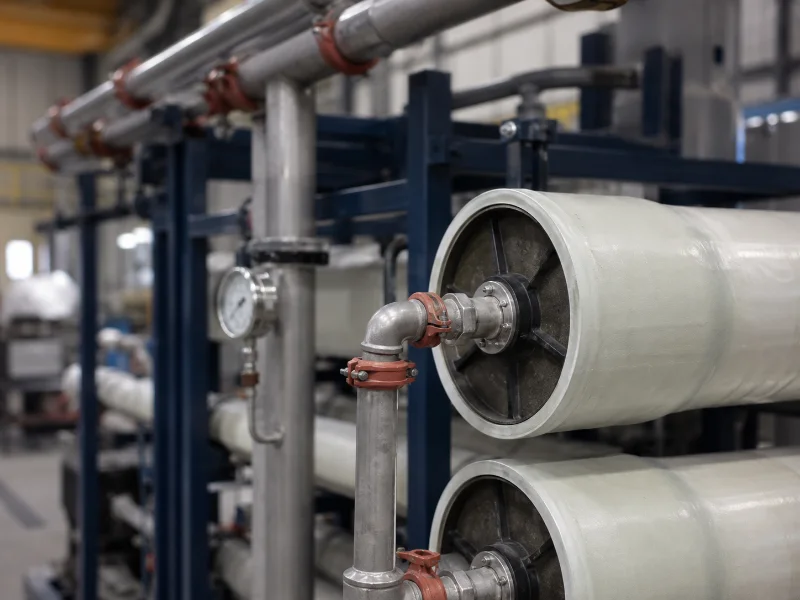
Two belong before the first call. The feed analysis and the product water target set the membrane configuration and the design flux, and an error in either is expensive to reverse, because correcting it means a different array and sometimes a different skid. Automation level, frame material and instrument preference can be revised late without touching the hydraulics.
Feed quality also propagates further than buyers expect. High fouling potential forces a lower design flux, since pushing more water through a given membrane area accelerates membrane fouling and its energy penalty. A lower flux requires more membrane area for the same permeate flow, which means more elements and longer vessels. A different design flux is one common reason two proposals for the same output show different element counts. It is not the only one. Element active area, feed temperature, system recovery, staging and array layout, per-element recovery limits, maximum feed flow per vessel, permeate quality target, fouling allowance and any N+1 redundancy all move the count, and each should be aligned before the two designs are compared.
Price differences deserve the same treatment. A lower quotation may reflect fewer elements, lighter instrumentation, different pump or material selections, reduced documentation, or omitted commissioning and pretreatment scope. The cause should be identified item by item rather than inferred from the total.
When the assumption “same as the last plant” is carried over without a fresh analysis, the design flux ends up set too high for the actual water, RO membrane cleaning intervals shorten within the first months, and the site is left choosing between a pretreatment retrofit and a permanent de-rate.
There is also a point below which this becomes over-specification. If the feed is municipal tap water at modest capacity with no hygienic or ultrapure requirement, a pre-engineered standard skid is usually sufficient, and commissioning a custom design for that duty buys engineering hours rather than performance.
How to Verify a Manufacturer Before You Shortlist
Verification works on documents that exist before an order is placed, and which of them matter depends on where the skid will run and what it will treat.
A design projection for your water, not a generic one. Design flux, recovery, element model and count, staging, and the temperature basis, produced from your analysis.
Pressure containment requirements. Identify the material and function of each pressure-containing component before naming a code. Metallic vessels may be designed to ASME BPVC Section VIII, while fibre-reinforced plastic membrane housings may fall under Section X. Stamping, registration and inspection requirements depend on the destination jurisdiction and the equipment configuration.
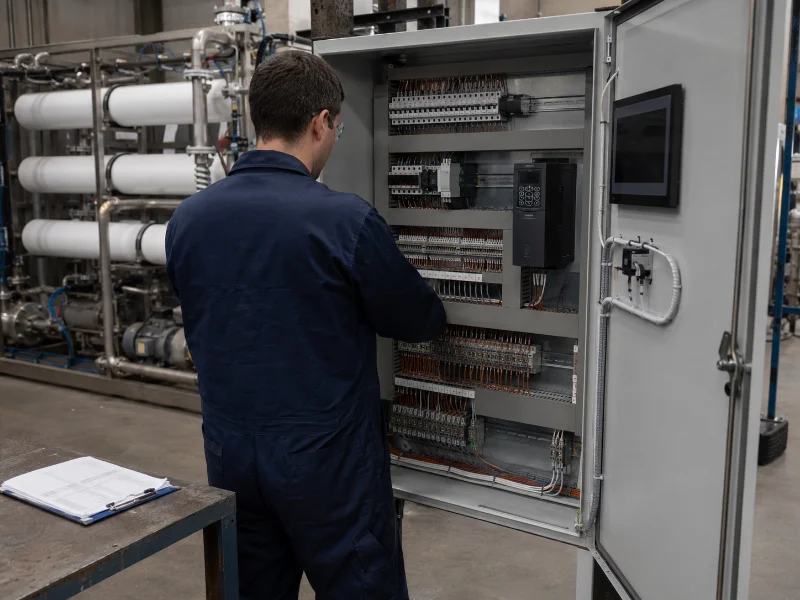
Electrical and control-panel requirements. Some North American owners, specifiers and authorities having jurisdiction require or prefer a UL 508A panel carrying the applicable shop mark, together with project-specific NEC, SCCR and machinery-electrical requirements. In IEC-based markets, IEC/EN 61439 may govern the low-voltage assembly, while IEC/EN 60204-1 may apply to the electrical equipment of the skid as machinery. These standards cover different scopes and should not be treated as one-for-one substitutes.
EU machinery status, if the destination is Europe. Regulation (EU) 2023/1230 applies from 20 January 2027 and replaces Directive 2006/42/EC, with no period in which both apply. Equipment placed on the EU market before that date rests on 2006/42/EC; from 20 January 2027 the assessment must be against the Regulation. A CE mark does not settle compliance on its own. Machinery, pressure, EMC and low-voltage legislation may each apply, and what should be checked is the technical file, the risk assessment, the harmonized standards used, and the EU Declaration of Conformity.
Material traceability. For stainless wetted parts, an EN 10204 type 3.1 inspection certificate ties a delivered material batch to a mill test report. It evidences the material, not the welding or the finished assembly.
Certificate numbers and expiry dates, not logos. A certificate quotable by number and validity date can be checked with the issuing body, and scope matters as much as existence. ISO 9001 certifies a quality management system and makes no claim about any given skid. NSF/ANSI 58 covers residential point-of-use RO and applies to specific certified models. NSF/ANSI/CAN 61 addresses the health effects of wetted materials in drinking water system components, not RO performance.
The contracting entity. Given how much of this list has changed hands, confirm that the legal entity on the quotation is the one that built the reference plants and the one that will carry the warranty.
On well water and reclaimed feeds, the part of an industrial RO plant that most often needs re-checking first is the pretreatment allowance, not the membrane. When we clarify whether a proposed skid can be commissioned at a given site, the panel standard and the pressure-containment basis get checked before the pump curve. Neither is a service-visit fix. Site piping layout, drain routing for concentrate and civil work sit outside supplier selection; they belong to the installation review that follows, and the same document logic extends to vetting any water treatment equipment manufacturer across a wider equipment scope.
Making Two Industrial RO Quotes Comparable
Two quotations for the same output become comparable only once the design assumptions behind them are aligned, and the design basis has to be fixed before award rather than discovered later. We align the feed water basis, design flux, recovery target and temperature reference before comparing any two proposals.
Scope is the second source of false savings. Pretreatment, storage, the CIP arrangement, instrumentation, panel, freight and commissioning move in and out of quotations without any version being wrong, so a line-by-line inclusion list is worth more than a discount. Cost drivers themselves are a separate question, better handled against a breakdown of what drives industrial reverse osmosis system price.
Where to Start with Your Industrial RO Shortlist
Two documents do most of the shortlisting work for an industrial RO water system: a current feed water analysis and a written product water target. With those in hand the field narrows on its own, because an industrial RO manufacturer that responds with a design projection rather than a catalogue page has already demonstrated the capability this evaluation is trying to detect.
Design recovery, permeate flow and water-quality guarantees should be stated before award, with the feed and temperature conditions they are guaranteed against. Commissioning verifies those values; it does not set them. Cleaning frequency and membrane life remain operating expectations rather than fixed commissioning outcomes, and they depend on the feed you actually run. We verify the guaranteed values against site data at start-up.
Sending every candidate the same package removes the assumptions they would otherwise have to invent:
- Feed water analysis with sampling date, location and method: TDS, pH, hardness, silica, barium, strontium, sulfate, chloride, alkalinity, iron and manganese, TOC, turbidity, free chlorine and other residual oxidants, microbiological activity, minimum and maximum temperature, seasonal variation, and SDI with its test conditions
- Product water target: conductivity limit at 25 °C, plus any application-specific limits for silica, boron, sodium, chloride, TOC or microorganisms, and whether a polishing step such as electrodeionization (EDI) or DI will follow
- Required permeate flow at peak and average, with operating hours per day
- Feed pressure and available feed flow at the tie-in point
- Site code regime: pressure-containment basis accepted, control panel standard required, destination-market machinery legislation, and any sanitary design requirement
- Utilities and access: voltage, phase and frequency, drain capacity for concentrate, footprint, and delivery clearance
- Status of any existing pretreatment that will remain in service
- The contracting entity and the entity carrying the warranty, named on the quotation
A supplier that answers that package with a projection, an itemized scope and a code declaration has done in a week the work that separates a shortlist from a ranking.
FAQ
Specify performance and operating conditions, then require the builder to name the element model its projection used. A brand name alone constrains procurement without constraining the design.
Not automatically. How obligations travel depends on how the business was sold: a share purchase usually leaves existing contracts with the same company, while an asset purchase may not carry them across. Ask for written confirmation naming your contract and the entity now standing behind it.
No. What matters is where replacement elements and control components are stocked and how quickly a stocked part reaches site. A distant builder with regional inventory can outperform a local one without it.
Element life is governed by the feed, the pretreatment and how the plant is run, which makes how long RO membrane elements last a weak signal about who built the skid. The supplier-related question is narrower: whether the warranty covers manufacturing defects or a stated performance level, and what voids it.
Related Posts
- How to Install an RO System — the installation review that begins once the supplier is chosen and the skid is specified
- Industrial Pure Water Process — the stages and specification variables behind the product water target you send candidates
- How to Remove a Reverse Osmosis System — isolation and element unloading scope when a new skid is replacing an existing plant
- How Much Water Do RO Systems Waste? — recovery rate in detail, the guarantee that has to be fixed before award
- Choosing a Water Treatment Equipment Supplier — the same verification logic applied across softeners, filtration and disinfection rather than RO alone