The right water treatment equipment supplier can specify, build, and document a system around your actual source water. A reseller only ships a catalog item. For importers, distributors, EPC contractors, and municipal teams, this choice sets system performance, lead time, and compliance. It does so long before the first membrane goes in.
We founded Hiju as a manufacturer in Qingdao for one reason. Buyers across Southeast Asia, the Middle East, and Africa kept getting matched with trading companies. What they needed was a factory that could review their water chemistry first.
This guide shows what a complete supplier should handle. It explains how to tell a manufacturer from a reseller, which standards and water-report values to check, and how to confirm capability before you buy. It does not cover destination-site installation or piping design. That work belongs to a separate engineering review against your site drawings.
What a complete water treatment equipment supplier should cover
A complete water treatment equipment supplier covers every stage your water moves through: pretreatment, membrane separation, disinfection, and storage. A single product line forces you to source the rest elsewhere. A split supply chain also leaves no one accountable for how the stages work together. Before going further, confirm which categories the supplier builds in-house and which it buys from third parties.
We design and fabricate the core categories most projects need under one roof:
- Industrial reverse osmosis systems for demineralizing brackish, tap, or seawater feeds, sized to a target output quality.
- Filtration equipment for pretreatment, which removes suspended solids and turbidity before the membranes.
- UV sterilizers for chemical-free disinfection, matched to flow rate and water transmittance.
- Desalination plants for high-salinity or seawater sources that need multi-stage treatment.
- Water storage tanks sized to match system output and demand.
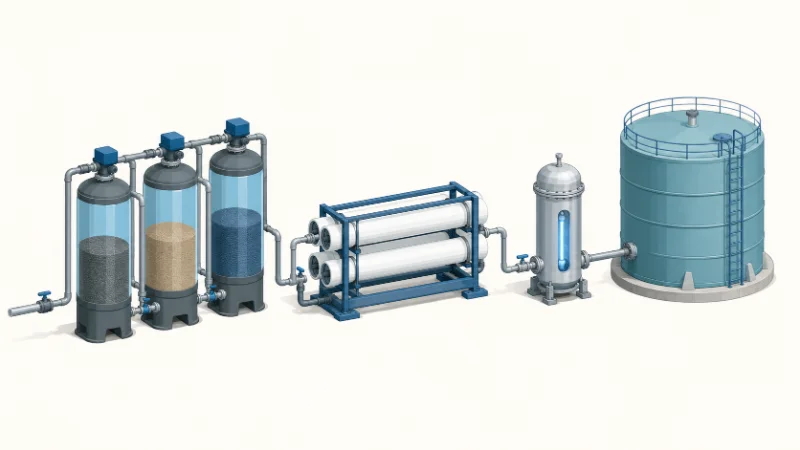
For industrial systems, “complete” means more than the five categories above. The supplier also handles chemical dosing, instrumentation and control, pumps, pressure vessels, and pre-shipment testing. That way the stages are matched under one accountability, not assembled from parts that do not fit.
Manufacturer or trading company: the distinction that changes your project
The word “supplier” hides two very different businesses: a factory that builds equipment and a trading company that resells it. That difference decides who is accountable when a system underperforms. A trading company can quote quickly. But it usually cannot revise a pressure vessel rating or a membrane housing design, because the engineers who can sit at a factory it does not control.
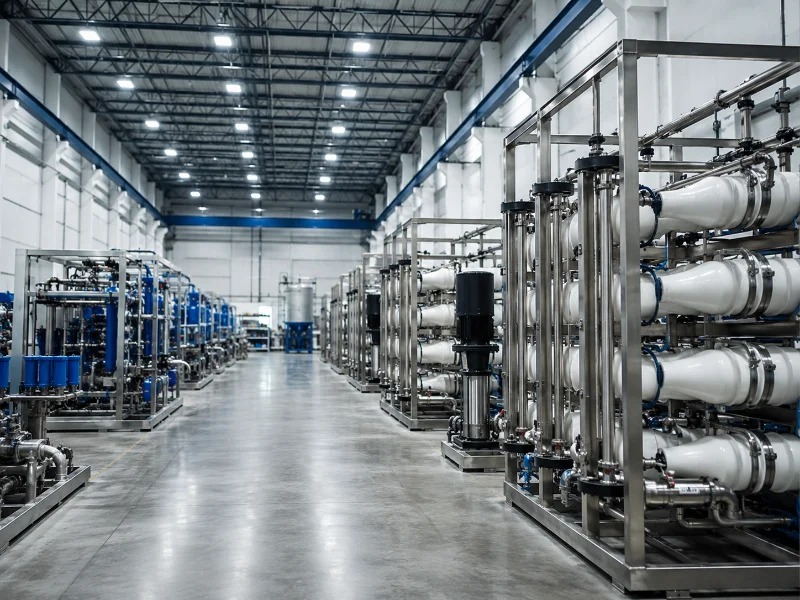
Buyers who assume the company quoting them also built the equipment often find the gap after delivery. By then a specification needs changing, and no one on the selling side can authorize it. We fabricate pressure vessels, membrane housings, system skids, and electrical panels in our own enclosed workshop. So the engineer who reviews your inquiry works in the same operation that can adjust the build.
The three sourcing models compare as follows:
| Factor | Manufacturer / OEM | Trading company | Distributor |
|---|---|---|---|
| Engineering control | In-house specification review | Relies on an external factory | Limited to stocked range |
| Customization to feedwater | Direct | Routed through factory | Constrained by inventory |
| Accountability for performance | Single point | Split across parties | Shared with brands carried |
| Documentation access | Production and test records | Re-passed from factory | Brand-level only |
Find out which model you are dealing with before you compare prices. A cheaper quote from a reseller can hide a slower revision loop and a thinner paper trail.
Selection criteria that survive past the quote
The supplier criteria that matter are the ones still in play after the quote is signed: production scale, certification scope, lifecycle cost, and service reach. Headline price is not one of them. Production scale shows whether a supplier can hold lead times under load. Our 70,500 m² Qingdao site includes a 21,000 m² enclosed workshop, with 28 engineers and 78 technicians covering each project from specification to final testing. Ask for facts like these, and verify them rather than take them on trust.
Certification is where buyers most often over-trust a logo. Confirm the scope each standard actually covers against your project:
| Standard / document | Applies to | What to verify |
|---|---|---|
| ISO 9001 | Quality management system | Process consistency, not product performance |
| NSF/ANSI 61 | Materials in contact with drinking water | Whether it applies to your potable-water components |
| NSF/ANSI 58 | Point-of-use RO drinking-water systems | Do not extend the claim to all industrial RO skids |
| PED 2014/68/EU | Pressure equipment for the EU market | Applies when maximum allowable pressure exceeds 0.5 bar |
| WHO / EPA NPDWR / EU Directive 2020/2184 | Drinking-water target quality | Which set the destination market enforces |
| ISO 5667 | Water sampling | Whether the source-water report followed reliable sampling |
Lifecycle cost is where the cheapest quote often loses. Total cost depends on energy tariffs, feedwater quality, and membrane replacement far more than on the purchase price. We compare configurations on operating cost when energy or consumables drive a project’s economics. Service reach is the last filter. Confirm spare-parts availability and lead times for membranes and high-pressure pumps in writing before you shortlist.
Matching equipment to your source water and site conditions
Equipment selection depends first on your source water and site conditions: feedwater chemistry, target output, available power, and destination-market standards. A standard product pulled from a list rarely fits all four. A system that works on municipal feed can fail on brackish or seawater sources. Salinity and scaling potential change both the pretreatment and the membrane technology. Tap-water RO runs at lower pressure with simpler pretreatment. Brackish-water RO puts antiscalant and scaling control at the center. Seawater RO adds high-pressure pumping, energy recovery, corrosion-resistant materials, and deeper pretreatment.
Any supplier that sizes a system without a water analysis is guessing. A reliable source-water report should carry at least these values:
| Parameter | Why it matters for sizing |
|---|---|
| TDS / conductivity | RO vs NF vs EDI vs softening selection and operating pressure |
| Turbidity / TSS | Depth of pretreatment (media, UF, coagulation) |
| SDI | RO membrane fouling risk |
| Hardness | Scaling risk, antiscalant or softening need, recovery rate |
| pH | Corrosion, scaling, and dosing strategy |
| Iron / manganese | Fouling of membranes and media |
| Silica | Scaling limit at high recovery |
| Chlorine / ORP | Membrane oxidation risk, carbon or dosing strategy |
| Microbiology | UV, chlorination, ozone, or CIP strategy |
| Temperature | Membrane flux and output correction |
| Target output quality | System staging and post-treatment |
UV disinfection shows why these values matter. It kills microorganisms without chemicals. But its sizing still depends on flow rate, UV transmittance, target dose, lamp aging, and upstream turbidity. On its own, UV will not hold a residual through a distribution network.
Take a 50 m³/day brackish-water RO inquiry quoted without TDS, hardness, silica, SDI, and temperature. Treat that quote as preliminary. Those values drive membrane selection, pretreatment depth, recovery rate, and antiscalant dosing.
In high-turbidity or high-salinity feed, the pretreatment stage is usually the first thing to recheck when an RO system underperforms. The membranes get blamed, but the cause often sits upstream. We review each inquiry against source water, site power standards, and destination requirements before confirming a configuration. Where a value cannot be set without test data, the answer stays conditional: the membrane array and pretreatment depth follow your verified feed analysis.
How to verify a supplier before issuing a purchase order
Verification before a purchase order rests on evidence you can check: production records, certification scope, and a willingness to review your water report. Marketing language is not evidence. This check protects you at the moment the deal is hardest to reverse, after payment and before delivery. Run these checks before you commit:
| Check | What to ask | Red flag |
|---|---|---|
| Water-analysis review | Which parameters do you need before sizing? | Quotes a system without water data |
| Manufacturing evidence | Can you show workshop, skid assembly, panel wiring, and QC? | Only catalog photos |
| Certification scope | Which certificate covers which product? | Certificate covers the company, not the product |
| Pre-shipment testing | What is tested before shipment, and is there a record? | No factory test report |
| Spare parts and service | Lead time for membranes, pumps, lamps, and cartridges? | No written spare-parts policy |
| Export documentation | Which documents come with the shipment? | Buyer must arrange everything alone |
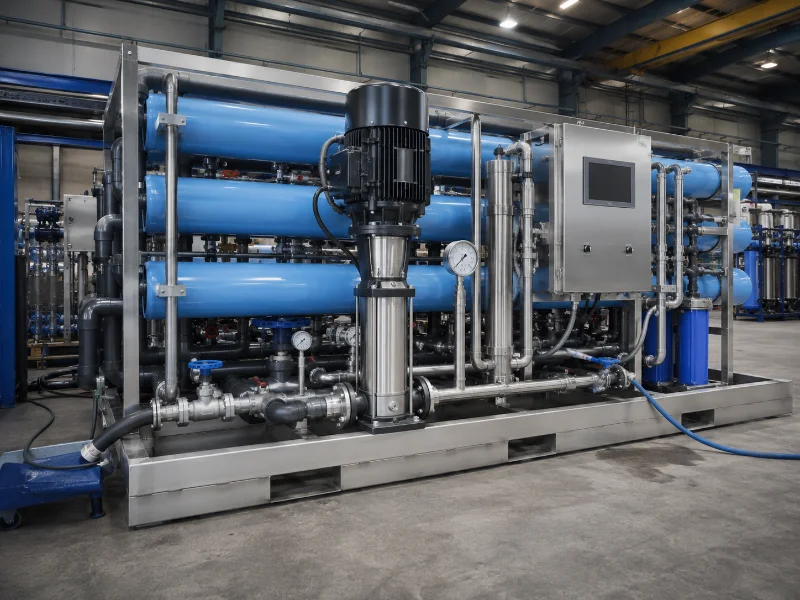
We design, fabricate, and test each system from specification through final hydraulic pressure testing and export documentation, under direct engineering and QC oversight. So every stage leaves a record you can ask to see. Buyers comparing wastewater treatment equipment manufacturers and other water-technology suppliers can run the same checks to tell factories from intermediaries.
Confirming the right supplier for your project
The supplier decision comes down to three checks: a manufacturer you can hold accountable, equipment matched to your verified source water, and capability that is documented rather than described. Headline price is the weakest signal of the three. It misleads most when the paper trail is thinnest.
Across our export markets in Southeast Asia, the Middle East, Africa, South America, and Central Asia, the projects that run smoothly share one trait. Source water, site power standards, and destination requirements get reviewed before the configuration is fixed. A few variables still need project-level sign-off: feed chemistry, target output, available power, and applicable standards. These decide the specification rather than follow it, so we ask buyers to put them on the table early.
For the next step, send us your source water analysis, target water quality, required capacity, power standard, installation country, and application. Our engineering team reviews whether you need RO, pretreatment, UV, storage, or desalination stages. Then we confirm the configuration against your project, not from a catalog.
FAQ
A supplier set up for export gives you a factory test record, certificate copies with their scope stated, and the shipping documents the order needs. Ask what the pre-shipment test measured, such as flow, pressure, conductivity, and leak checks. Then ask for the record itself, not a verbal promise.
A real manufacturer can show you its workshop, name its welding and assembly steps, and revise a specification on request. A trading company routes those questions back to a factory it does not control. Ask to see production and test records tied to the exact product you are buying.
A water report turns a quote into a real specification instead of a guess. Each value in the parameter table above shifts membrane choice, pretreatment, or recovery rate. A supplier that quotes without one is pricing a standard product, not a system for your water.
Capacity starts from your peak and average demand, plus a safety margin. Match daily output in m³/day to verified demand, not to a round number. Then ask the supplier to confirm that output under your specified feed conditions.
Membrane life depends on feedwater quality, pretreatment, and how the system is run. Under good conditions it falls in a multi-year range rather than at a fixed number. Controlling fouling through proper pretreatment is what extends it.
Operating cost runs on four things: energy, membrane and filter replacement, chemical dosing, and maintenance labor. Each one moves with your feedwater and local tariffs. Compare suppliers on lifecycle cost, since the gap between two quotes usually shows up here over time.