Distillation versus reverse osmosis is settled at plant scale by two questions before any other: whether the water-quality target is written as a process or as a number, and whether the heat a still would burn is heat the site already generates. Purity usually ranks lower than buyers expect. Both processes reach low-conductivity water on typical industrial feed, and each handles one class of contaminant worse than the other, so the separation turns on energy and continuity rather than on which is cleaner. RO’s energy demand climbs with feed salinity, while a thermal system’s is set by its heat source, so the comparison is site-specific rather than general.
Distillation vs Reverse Osmosis: What Does Each Process Actually Separate?
Distillation and reverse osmosis remove dissolved solids by opposite principles, and which principle costs less on a given site depends on where the energy comes from more than on how clean the water needs to be.
Distillation changes the water’s phase. Heat drives water into vapour. The dissolved solids stay behind in the boiling chamber, because they do not vaporise at the same temperature, and the condenser returns the vapour to liquid. Reverse osmosis leaves the phase alone. A pump raises feed pressure above the solution’s osmotic pressure, and water crosses a membrane the dissolved ions cannot follow.
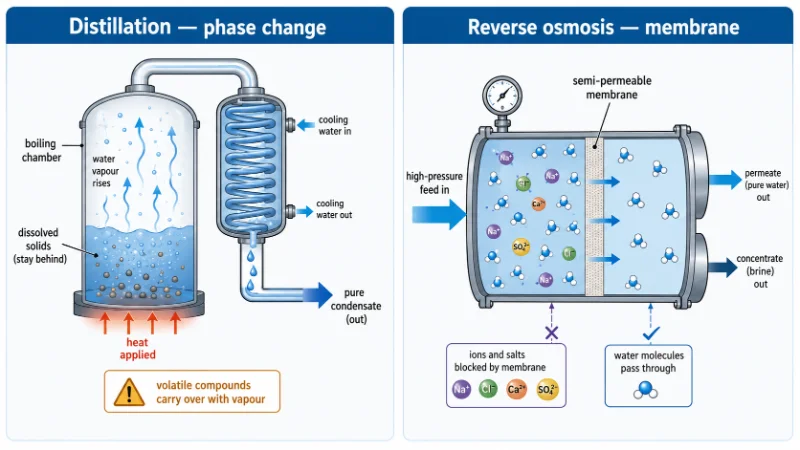
The arithmetic here is worth running. Water’s latent heat of vaporisation is roughly 2,257 kJ per kilogram at 100 °C, a property of water rather than a design choice. Evaporating one cubic metre therefore needs on the order of 2,257,000 kJ, about 627 kWh at 3,600 kJ per kWh. That figure is the unrecovered latent-heat duty for a cubic metre: the heat a single-effect still with no heat recovery would draw, before feed preheating or condenser recovery shift the system total.
Large installations rarely work that way. Multiple-effect and vapour-compression designs exist precisely to make the same latent heat do the job several times over, and most sizeable plants use them. Single-effect and single-stage stills still appear where capacity is small, simplicity matters, or genuinely spare heat is on hand. So the real question in any distillation vs reverse osmosis comparison at plant scale is not thermodynamic efficiency. It is whether the heat a still would consume is heat the site already produces and cannot put to higher-value use, which the steam balance answers and the specification sheet does not.
Is Distilled Water Always Purer Than RO Water?
Distilled water is not uniformly purer than RO permeate, and the exception depends on how much of the feed water’s contaminant load is volatile.
Phase-change separation leaves behind whatever does not vaporise, so anything that vaporises more readily than water need not stay behind. Acetone boils near 56 °C, chloroform near 61 °C, benzene near 80 °C, all under water’s 100 °C, so a still can pass them to the condenser instead of rejecting them. How much actually carries over is a question of vapour–liquid equilibrium, how the compound splits between water and vapour, entrainment control and any upstream degassing. Boiling point alone only says the potential is there.
Reverse osmosis has the mirror weakness. Small, uncharged organic molecules are the ones a membrane rejects least reliably, because rejection tracks size and charge more than volatility. What handles them sits upstream or downstream of the membrane, not in it. Often that is an activated-carbon stage, but depending on the compound it can take air stripping, advanced oxidation or a compound-specific resin, and not every RO train carries any of these by default.
Take “distillation is the purest option” as a rule without a feed-water analysis, and the volatile fraction can reach the point of use. The fix is then a carbon or membrane stage bolted downstream of a still bought to avoid needing one. On feed carrying volatile organics, condensate TOC is usually the first number worth re-checking, since conductivity can pass while the organic load moves through untouched.
Neither weakness rules a process out. Both are a reason to know the volatile and non-volatile split before comparing anything else, and a general water analysis will not report that split unless volatile organics were named on the request.
Which Variables Decide Between the Two Processes?
Four variables decide a distillation-or-RO selection for industrial process water: how the quality target is written, where the heat comes from, feed salinity, and how demand is shaped over time.
Two of the four outrank the rest, and the order is structural, not stylistic. The format of the quality target decides whether the comparison happens at all. The heat source decides whether a still’s operating cost is a real number or an allocated one. Salinity and demand shape are real variables, but they stay useful only after the first two are settled, which the first two can foreclose entirely.
Quality targets take two forms, and they behave differently. A specification sets a number, a conductivity ceiling, a TOC limit, an endotoxin figure, and any train that holds the number qualifies. A process names the equipment, and no engineering argument substitutes for it. In regulated settings the line blurs, since meeting the number also means running a validated, monitored system rather than hitting a reading once. Even so, the first question is which of the two forms the governing document uses.
Pharmaceutical water is where that line has actually moved. The European Pharmacopoeia monograph 0169, covering Water for Injections, required distillation until a revision effective 1 April 2017 admitted non-distillation routes that produce water equivalent or superior to distillation at removing chemicals and microorganisms. The United States Pharmacopeia has framed the requirement as an equivalence test for longer. What qualifies under either is a complete validated system, not an RO unit on its own, and the governing pharmacopoeia is only the starting point, because market access and local GMP sit on top of it. Pharmacopoeias do not move in step, so the destination market changes the answer. Read the document; do not estimate it.
The heat question is narrower than it first looks. A still’s operating cost is dominated by the latent heat above, so a site venting low-pressure steam it already generates allocates that heat very differently from a site that would fire a boiler to raise it. Vented steam is not free even so, since it still carries generation chemicals, make-up water and condensate-return costs. But its marginal cost can sit well below the figure behind a vendor’s kWh estimate. Where a specification names distillation, or spare steam already exists and demand runs to a few hundred litres an hour, a membrane train just adds a system to maintain for a gain the site cannot bank.
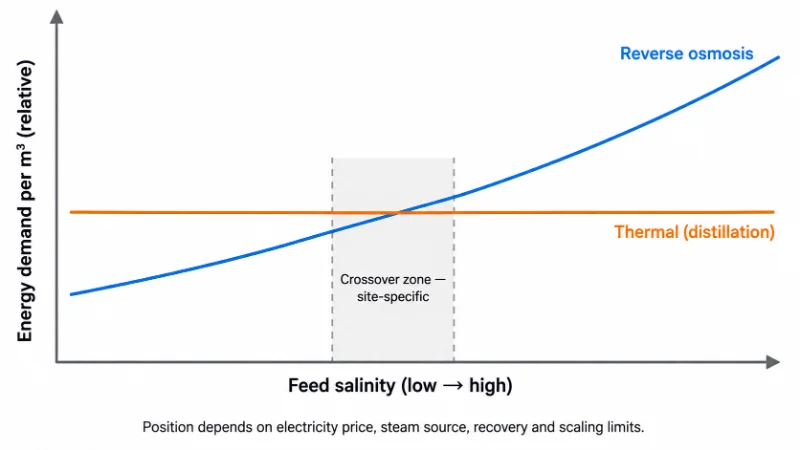
Salinity is where the two energy profiles diverge, and the reason is mechanism, not market data. Latent heat is a property of water: evaporating a cubic metre costs about the same at 500 mg/L or at 50,000 mg/L. Osmotic pressure is a property of the solution: it climbs with the concentration of dissolved species, and the RO pump has to beat it. So RO’s energy demand rises as the feed gets saltier, while a thermal system’s is set instead by heat integration and concentration limits. Whether that yields a cost crossover on a given site, and where it falls, depends on electricity price, steam source, boiling-point elevation, scaling limits and the target recovery. That is a project-specific mass-and-energy balance, not a number to quote.
Demand shape is the quickest of the four to read. Both RO and industrial distillation can run continuously; large thermal plants, multiple-effect and vapour-compression stills among them, are built to. So the real question is not batch versus continuous, but whether peak hourly draw, turndown, start-up time, storage volume and cleaning cycles favour a membrane skid or a buffered thermal train. Where a line pulls water steadily and the volume runs to cubic metres an hour rather than litres, the comparison usually resolves fast.
| Variable | What settles it | Where to look |
|---|---|---|
| Format of the quality target | Whether the governing document names a process or states a number | The monograph, client specification, or offtake contract in the destination market |
| Heat source | Whether spare steam already exists with no higher-value use, and its marginal cost | The site’s steam balance, not the vendor’s kWh figure |
| Feed salinity | Whether, and where, a cost crossover falls, given electricity price, recovery target and concentration limits | A full ionic analysis plus a project-specific energy balance |
| Demand shape | Whether peak draw, turndown and storage favour continuous membrane flow or buffered batch output | The line’s hourly peak, not the daily total |
If those first two variables point to thermal, the next question is which thermal: multiple-effect, mechanical vapour recompression and thermal vapour recompression are different machines with different steam economies, and choosing among them is a separate exercise this comparison does not resolve.
When Do Plants Run Both Instead of Choosing One?
Running both processes in series is common wherever the quality target sits below what either reaches alone, and the sequence usually, though not always, puts reverse osmosis first.
Reverse osmosis is normally the cheaper stage to feed the bulk load to. It strips most of the dissolved solids with pressure, so whatever follows, a still, an EDI stack, a mixed-bed resin, sees a fraction of the load it would otherwise carry. The exception is feed a membrane cannot safely take. Heavy fouling, oil, high temperature or very high salinity can route water to different pretreatment, or occasionally to a thermal stage, before it reaches a membrane at all. The ordering principle holds; what changes is which stage can accept the raw feed.
The pharmaceutical membrane route runs the same way. Where a non-distillation train makes Water for Injections, the common build is reverse osmosis first, then electrodeionisation, then ultrafiltration as the final barrier, each stage seeing water the one before it has already reduced.
Series operation does not retire the earlier variables. It turns “which process” into “how much of each,” and sizing an industrial reverse osmosis system ahead of a thermal or polishing stage rests on the same feed analysis that would size it standing alone. Configuration choices below that, double-pass RO systems and EDI polishing among them, answer to that same analysis.
Where Should Your Distillation or RO Decision Start?
A distillation-or-RO decision starts with two documents, not a technology comparison: the one that governs the water-quality target, and the site’s steam balance.
Read the first to see whether it names a process or states a number. Pull the second to separate steam that is genuinely spare from steam a current or future line already claims. Those two answers settle most of the distillation-versus-reverse-osmosis question before salinity, footprint or capital cost enters, which is why the sections above put them first.
In boiler feed water treatment and similar cases, “we already have steam” is the assumption most worth re-checking. Steam with a claim on it is not spare, and steam a future line will claim is spare with an expiry date.
Once those two are settled, the rest becomes measurable. The table below is what a comparison needs before it can return anything useful.
| Input | For reverse osmosis | For distillation |
|---|---|---|
| Throughput | Average and peak m³/h | Average and peak m³/h (or kg/h steam-side) |
| Feed salinity | TDS, full ionic split, temperature | TDS, boiling-point elevation, concentration limit |
| Recovery / concentration | Target recovery, reject flow | Concentration ratio, blowdown |
| Water-quality target | Conductivity, TOC, boron, silica, CO₂ | Conductivity, TOC, volatile fraction, entrainment risk |
| Energy basis | kWh electric per m³ | Steam duty and grade, plus pump kWh |
| Operation | Cleaning and membrane-replacement intervals | Descaling, cleaning, start-up time |
None of these is a performance figure. The latent-heat number earlier is textbook physics; everything that turns these inputs into kWh, recovery or steam duty is project-specific and belongs in a balance run against your data, not a comparison chart.
What can be settled without guessing is the second half of the decision. Send the hourly demand and peak, a full feed-water analysis with the volatile fraction separated out, the target conductivity or TOC, and the steam conditions on site. A preliminary comparison then returns RO recovery and membrane staging, an estimated electrical demand, and the steam duty of the thermal alternative. Those numbers fall out of the analysis, not out of a table.
FAQ
No. Both are purified water made by different separations, and neither name fixes a purity figure.
Not on its own. It removes what does not vaporise, most of the dissolved load, and a well-run still is a strong barrier to microbes and endotoxin. But anything more volatile than water can travel with the steam, and final quality still rides on entrainment control, feed condition and the storage system downstream.
No, and that is the whole point of the distinction. A named process is a condition of the document, not a performance target other equipment can meet by being clean enough. The way out is to find which pharmacopoeia or contract actually applies, or to have the specification changed, not to demonstrate equivalent water.
Both processes strip dissolved minerals, so remineralisation is a product decision, not a process comparison. Bottled and beverage lines routinely blend or dose after RO, because taste and, in some markets, label category depend on mineral content. A still leaves the same gap with fewer ways to close it.