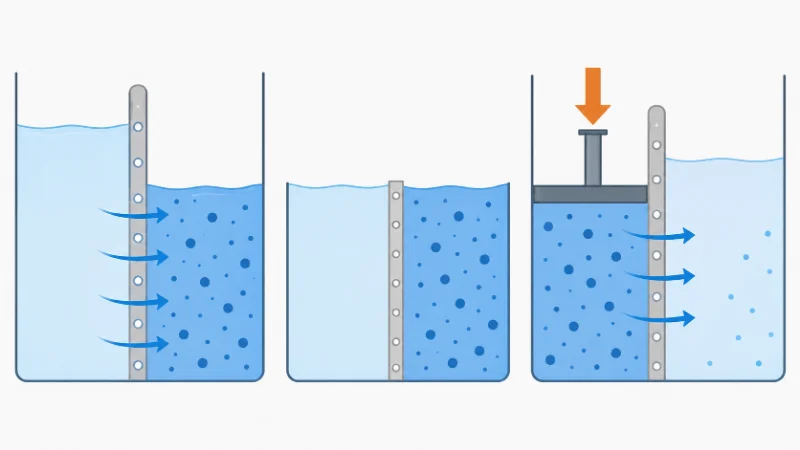
Osmosis and reverse osmosis are opposite processes. Both use a semi-permeable membrane, but reverse osmosis drives water the opposite way under pressure. In osmosis, water moves on its own toward the side with more dissolved solids, and it needs no outside energy. Reverse osmosis (RO) applies enough pressure to push past the feed’s osmotic pressure. Water moves the other way, and most dissolved salts stay behind in a concentrated reject stream. The two also differ in purpose: osmosis moves toward osmotic equilibrium, while RO separates a lower-salinity permeate from the feed. The pressure RO needs rises with the feed’s salinity. That is why seawater takes far more energy to treat than tap water.
Osmosis: The Natural Movement of Water Across a Membrane
Osmosis is the passive movement of water across a semi-permeable membrane, driven only by the difference in solute concentration between the two sides. Water moves from the more dilute side toward the more concentrated one, and the process needs no outside energy. The membrane passes water more easily than it passes the dissolved solutes, so water builds up on the concentrated side. Net flow continues until the resulting pressure difference offsets the osmotic pressure, the point we call equilibrium. At that point the two concentrations are not necessarily equal; the net movement of water has simply stopped.
You can watch osmosis work with a raisin dropped in water. It swells as water moves inward toward the higher sugar concentration under its skin. The same pull keeps plant cells firm and lets roots draw water from soil. In the body, the kidneys use it to reabsorb water and keep electrolytes in balance. None of this needs a pump or a power source. The concentration gradient does the work.
The force behind that movement has a name: osmotic pressure. It is the pressure you would need to apply to the concentrated side to stop water from flowing in. Osmotic pressure matters far beyond biology, because it sets the whole challenge reverse osmosis has to overcome.
Reverse Osmosis Adds Pressure to Reverse the Flow
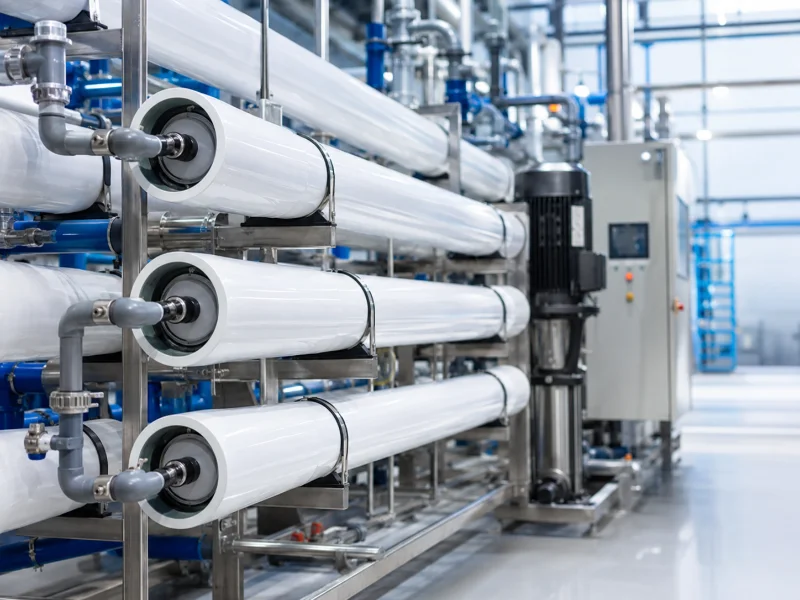
Reverse osmosis is an engineered process that uses applied pressure to force water through a semi-permeable membrane, against the natural direction of osmosis. The pressure has to be greater than the feed’s osmotic pressure, and that is what leaves dissolved salts behind. Instead of letting concentrations equalize, RO splits the feed into two streams: a lower-salinity permeate on one side, and a more concentrated reject stream that carries the salts away. Our overview of what reverse osmosis is covers that core idea and the parts of a system in more detail.
The membrane is the heart of the system, but its rejection is not simple pore-size sieving. What passes and what is held back depends on the membrane’s surface chemistry and on solute properties: molecular size, charge, polarity, and diffusivity, plus conditions like pH and temperature. Flow itself comes down to a balance between two pressures. Permeate is produced when the hydraulic pressure across the membrane (ΔP) is greater than the osmotic-pressure difference between the two sides (Δπ). The gap between them is the net driving pressure, and it sets how much water crosses. If ΔP falls below Δπ, permeate production falls away.
To keep the membrane from clogging, most systems use crossflow: feed water sweeps along the surface rather than dead-ending into it. That flow carries rejected salts away, limits concentration polarization at the surface, and keeps the concentrate side moving at the velocity the membrane needs.
Pressure is the part people underestimate. The saltier the feed, the higher its osmotic pressure, and the more the pump must supply before useful permeate appears. Seawater sits at the demanding end, running at far higher pressure than brackish or tap water. When an RO system underperforms, operators check several things together before naming a cause: normalized permeate flow and salt passage, feed pressure, temperature, conductivity, recovery, pressure drop, and fouling. Low net driving pressure is only one of them.
The Three Numbers That Describe RO Performance
Three terms turn the definition into something measurable, and they appear in every system specification:
- Net driving pressure (NDP): the effective pressure moving water across the membrane, NDP ≈ ΔP − Δπ.
- Salt rejection: the share of dissolved salts the membrane holds back, found from feed and permeate concentrations as (1 − Cp/Cf) × 100%.
- Recovery: the fraction of feed water that leaves as permeate, Qp/Qf × 100%. Higher recovery concentrates the reject stream and raises scaling risk, so more is not automatically better.
Where the “Osmosis in Reverse” Picture Breaks Down
Reverse osmosis names the direction water is forced to move. It is not a version of osmosis that runs backward on its own. Natural osmosis is spontaneous and one-directional: water always drifts toward the higher solute concentration to close the gap. It will not reverse on its own, any more than a ball rolls uphill without a push. Reverse osmosis is that push. Applied pressure above the osmotic pressure moves water against its natural gradient, and the moment that pressure drops below the threshold, separation stops.
The second half of the misreading is quieter but matters more: osmosis itself does not clean water. It only moves water toward equilibrium. A cell or a raisin using osmosis is not filtering anything. Purification happens only when the flow is forced and the membrane is set up to reject what the water leaves behind.
So the useful mental model is not “osmosis, backward.” It is a membrane plus enough pressure to separate. That is why an RO system is defined by its pressure, energy, and recovery, not by the membrane alone. And a clear definition is where sizing one has to start.
Osmosis and Reverse Osmosis, Side by Side
Osmosis and reverse osmosis differ across a handful of practical dimensions: the membrane, the direction water moves, the driving force, the energy needed, the effect on concentration, and where each one shows up. The table lines them up.
| Aspect | Osmosis | Reverse osmosis |
|---|---|---|
| Membrane | Biological or other selective barrier | Engineered, pressure-rated RO membrane |
| Water-flow direction | Dilute toward concentrated side | Concentrated toward permeate (dilute) side |
| Driving force | Natural solute gradient | Applied pressure above osmotic pressure (positive NDP: ΔP > Δπ) |
| Energy input | No external pumping energy | Pumping energy, rising with feed salinity |
| Effect on concentration | Moves toward osmotic equilibrium | Separates lower-salinity permeate from concentrate |
| Where it appears | Plant roots, kidneys, living cells | Desalination, drinking water, industrial process water |
Every row traces back to one difference: the driving force. Remove the applied pressure and reverse osmosis stops, sliding back toward ordinary osmosis. That one dependency is what makes RO an engineered system rather than a natural event.
Where Each Process Shows Up in Practice
Natural osmosis and engineered reverse osmosis serve almost opposite roles. Where you meet one usually signals which you actually need. Osmosis is a natural transport process throughout living systems: roots pulling moisture from soil, cells holding their shape, kidneys balancing fluid. It is also the principle behind salting or sugaring food, where water is pulled out to slow spoilage. None of these remove contaminants; they move water to balance concentration.
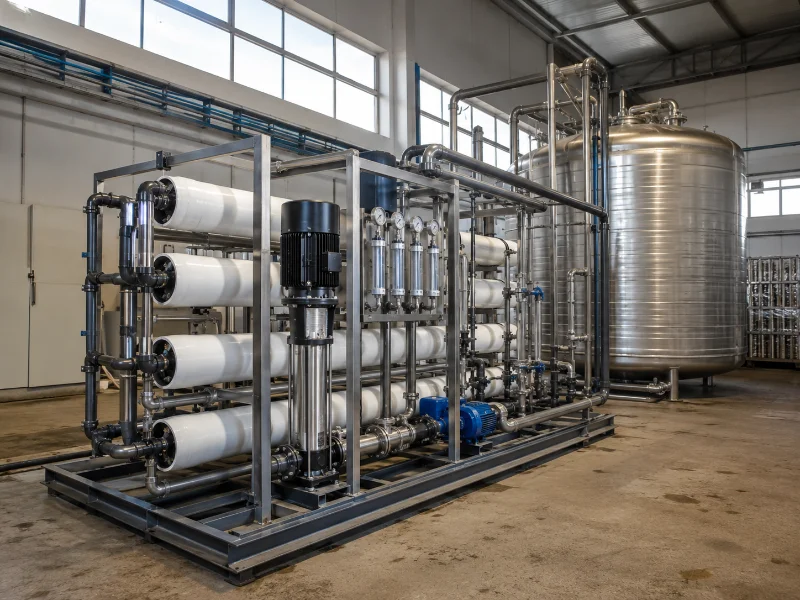
Reverse osmosis shows up wherever water has to be actively treated. Desalination plants turn seawater and brackish water into drinking water. Municipalities use RO to reduce contaminants that ordinary filtration leaves behind. In ultrapure-water systems for pharmaceutical and electronics manufacturing, RO is usually a major purification stage rather than the whole answer. It is followed by further polishing, such as electrodeionization (EDI) or ion exchange, and by microbiological controls. RO earns its cost when testing shows something has to come down to a set target: dissolved salts, or specific membrane-treatable contaminants like nitrate, arsenic, or fluoride.
The cost logic cuts both ways. For understanding household tap water, the biology of osmosis matters more than the engineering. A simpler filter may be enough when there is nothing dissolved to remove. In industrial service the opposite holds. Scope a system without accounting for the feed’s osmotic pressure, and it often cannot hold enough net driving pressure across the membrane to hit its design targets.
What the Difference Means, and Where to Go Next
What you do with the difference between osmosis and reverse osmosis depends on why you looked it up. If you are trying to understand the water from a home or office tap, the takeaway is short. Osmosis is the natural process at work in your body and your plants. Reverse osmosis is the engineering that removes dissolved solids when you want lower-salinity water. If you are specifying process water for a plant, the same definition is where design starts. The osmotic pressure of your feed sets the pressure, energy, and recovery the system has to reach.
The variable that carries the most weight going in is feed salinity. It drives the osmotic pressure and the energy the system needs. Salinity is not the only thing that decides achievable recovery, though. Scaling chemistry, membrane staging, pretreatment, and the product-water target all limit how far a system can be pushed. Which membrane, pressure, and pretreatment a given source actually needs is something we answer from a current feedwater analysis, not from the definition alone.
So the next step depends on where you sit. If you are still building intuition, our explainer on how reverse osmosis works covers the membrane and recovery rate a definition has to skip. If you are moving from understanding to specifying, that starting point feeds into system design. That is the stage where we match a commercial RO machine to a given feedwater and output target.
FAQ
Yes. Reverse osmosis produces water very low in dissolved minerals, and it is widely used for drinking water and in food and beverage production. Because RO also strips out beneficial minerals, some point-of-use systems add a remineralization stage to improve taste and raise the pH.
The pressure depends on the feed’s salinity, because the applied pressure has to exceed the osmotic pressure before any permeate is produced. Tap water and brackish water need relatively modest pressure, while seawater needs much higher pressure. The exact operating pressure comes from the membrane specification and a feedwater analysis, not from a single fixed number.
No. Reverse osmosis, distillation, and deionization all produce low-mineral water, but by different mechanisms, and they leave slightly different residual profiles. RO pushes water through a membrane, distillation evaporates and re-condenses it, and deionization uses ion-exchange resins to strip charged ions.
Not by itself. An intact RO membrane is a strong barrier to many microorganisms, but an RO system should not be treated as a stand-alone disinfection step. Membrane damage, seal leakage, storage tanks, and downstream piping can all reintroduce contamination. This is why the point-of-use RO standard NSF/ANSI 58, which covers residential RO drinking water systems, assumes the incoming supply is already microbiologically safe and of known quality.
System sizing and configuration depend on your feedwater quality, target output, and required recovery, which are specification decisions beyond the definition itself. Feed salinity drives the osmotic pressure and energy, but achievable recovery also depends on scaling chemistry, membrane staging, hydraulic limits, and pretreatment. Comparing the available types of reverse osmosis systems and matching one to a specific source water is a separate engineering step.
No. Reverse osmosis rejects most dissolved salts, larger molecules, and a large share of microorganisms, but small uncharged molecules and dissolved gases such as carbon dioxide can pass through. What gets rejected depends on molecular size and charge, so no single membrane removes every substance.