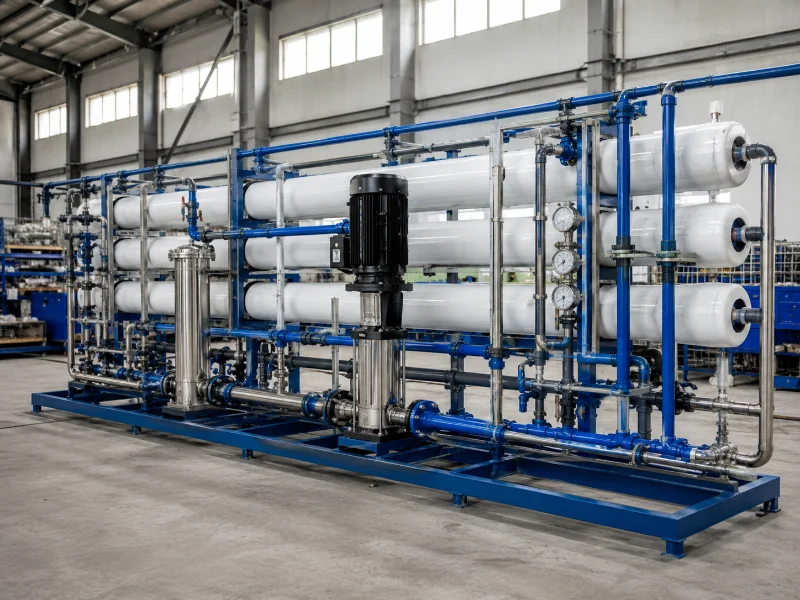
Reverse osmosis is a pressure-driven process that forces feed water through a semi-permeable membrane. The membrane separates water molecules from dissolved salts, organics, and microbial contaminants. The result is two streams. One is purified permeate. The other is a concentrated reject stream, called concentrate or brine. How much a system removes, and how much water it recovers, depends on the source water, the operating pressure, and the target recovery rate.
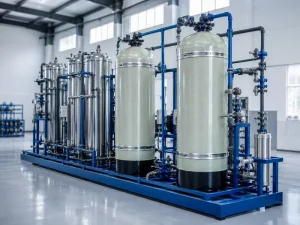
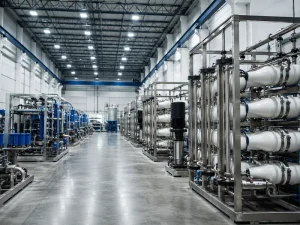
At Hiju, we design and fabricate reverse osmosis systems for importers, distributors, EPC contractors, and municipal buyers in more than 20 countries. We review each inquiry against its source water before confirming a configuration. This article explains what reverse osmosis is, how the separation works, what a system can and cannot remove, and the variables that decide whether RO fits your water source. <!– IMAGE: reverse-osmosis-membrane-system.jpg | alt: Industrial reverse osmosis system with membrane pressure vessels and a high-pressure pump inside a manufacturing workshop –>
Reverse Osmosis and Osmosis: The Core Difference
Reverse osmosis is the deliberate reversal of osmosis, driven by pressure applied above the feed’s natural osmotic pressure. In osmosis, water moves across a semi-permeable membrane from a weaker solution toward a stronger one, until both sides equalize. Reverse osmosis forces the flow the other way.
Osmosis happens without any external energy. Plant roots draw water from soil this way. Reversing it takes pressure greater than the feed’s osmotic pressure. That pressure pushes water molecules through the membrane and leaves most dissolved solids behind.
Osmotic pressure rises with the dissolved-solids load of the feed. A brackish source and a seawater source sit at very different pressures, so they call for different system designs. We verify the feed total dissolved solids (TDS) before specifying pump pressure for this reason.
Industrial RO Is Not the Same as a Household System
Industrial reverse osmosis and household RO share the same separation principle, but they answer to different scale, standards, and design criteria. Consumer standards such as NSF/ANSI 58 and the EPA WaterSense program govern a point-of-use system under a kitchen sink. An industrial system follows project-specific water analysis and membrane-manufacturer design data instead.
The difference is not only size. Point-of-use systems waste a lot of water. A typical residential unit sends five gallons or more of reject water down the drain for every gallon it treats. EPA WaterSense labels only models that stay at or below 2.3 gallons of reject per gallon treated. Industrial systems target higher recovery and route the concentrate to defined disposal or reuse. At industrial volumes, the reject stream is an engineering and cost variable, not a household nuisance.
We design industrial systems to the destination market’s source water and electrical standards, not to a residential certification. Consumer labels such as NSF/ANSI 58 cover materials safety and contaminant-reduction claims for drinking-water units. They do not cover the sizing of a process or municipal plant.
Why Reverse Osmosis Is Not Conventional Filtration
Reverse osmosis separates contaminants at the molecular level, using cross-flow across a membrane. That makes it different from the dead-end straining most people picture when they hear the word “filter.” A conventional filter traps particles by size in its media. An RO membrane works differently. It rejects dissolved ions and molecules, while a tangential flow sweeps the rejected material to the concentrate stream.
The distinction matters in practice. Among the membrane filtration methods (MF, UF, NF, and RO), RO is the tightest. That is why it removes dissolved salts that looser membranes, and ordinary sediment or carbon filters, let through. RO also always produces a reject stream, because the rejected contaminants have to go somewhere.
In our experience reviewing incoming feed-water reports, one misconception comes up often: buyers expect a finer cartridge filter to do RO’s job when dissolved solids are the real problem. We clarify the difference early. Left unverified against an actual TDS reading, that assumption leads to a system that polishes turbidity but never touches the salinity the buyer wanted to remove.
How a Reverse Osmosis System Separates Contaminants
A reverse osmosis system removes contaminants in three stages: pre-treatment, membrane separation, and post-treatment. The membrane does the molecular work, and the surrounding stages protect it. What the pre- and post-treatment include depends on what the source water carries.
Feed water first passes through pre-treatment filters, usually sediment and activated carbon stages. These remove particulates and chlorine before they reach the membrane. The water then enters the membrane array under pressure. Permeate passes through, and the concentrate carries the rejected salts and organics away. A high-pressure pump overcomes the osmotic pressure, and cross-flow slows the fouling that would clog a dead-end filter.
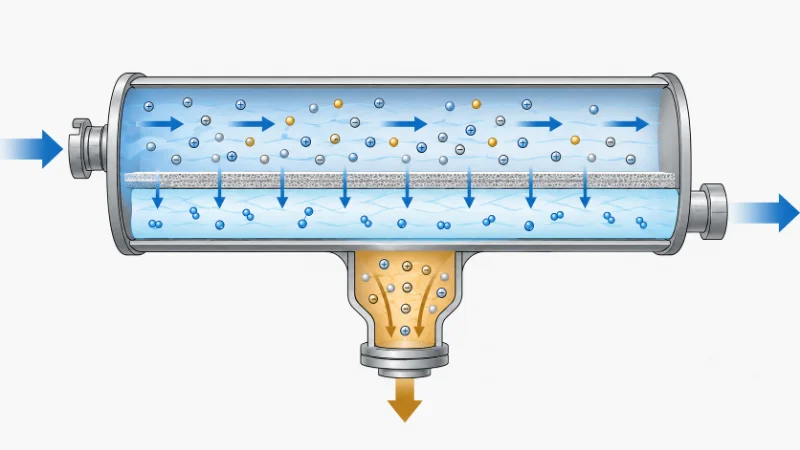
Pre-treatment is where most membrane life is won or lost. Chlorine oxidizes polyamide membranes, and suspended solids foul them. So we design the pre-treatment train around the measured oxidant and turbidity load, then check it against the membrane manufacturer’s limits. Sizing that train for a specific site, down to dosing rates and skid layout, is a project-level engineering job rather than something a general overview can settle.
What Reverse Osmosis Removes and What It Leaves Behind
A properly selected and tested reverse osmosis system reduces a wide range of dissolved salts, metals, and microbial contaminants. The reduction for any specific contaminant depends on the membrane type, recovery rate, and feed chemistry, not on RO as a category. Rejection is not simple pore-size filtering. It reflects membrane chemistry, ionic charge, hydrated molecular size, diffusion, feed concentration, pressure, and temperature.
The membrane rejects charged ions and larger molecules efficiently, including sodium, calcium, lead, and sulfate. Nitrate is less predictable, and its reduction varies with membrane type, recovery, and feed chemistry. Dissolved gases such as carbon dioxide pass through easily, because they carry little charge and weigh little. That is why RO permeate can read slightly acidic, as dissolved CO2 forms carbonic acid. An RO membrane is a barrier, not a disinfection step on its own. Potable applications still need a complete, validated treatment and integrity-control design.
| Contaminant group | RO performance | What it depends on |
|---|---|---|
| Dissolved salts and metals (sodium, calcium, lead) | High reduction | Membrane type, recovery, feed concentration |
| Suspended solids and microorganisms | High reduction, not a disinfection guarantee | Membrane integrity and downstream controls |
| Nitrate and many higher-MW organics | Variable to high | Membrane selection and operating point |
| Dissolved gases (CO2, low-MW organics) | Low | Charge and molecular weight |
Some applications cannot tolerate residual CO2 or a low permeate pH, such as boiler feed or certain process water. For these, we compare RO against or alongside complementary steps, based on the downstream water-quality target. Those steps include degasification, a second pass, or electrodeionization (EDI).
Performance Variables That Govern RO Output
Reverse osmosis output depends on a few measurable variables: feed pressure, feed water temperature, total dissolved solids, and the target recovery rate. Each one shifts permeate quality and quantity. No single number describes “RO performance,” because every variable moves with the source water and the operating point.
Salt rejection is the share of dissolved solids the membrane keeps out of the permeate. Recovery is the share of feed water turned into permeate rather than concentrate. Pushing recovery too high concentrates the reject stream and speeds up scaling. Temperature and pressure both change how fast water moves through the membrane. These variables interact, so we align the target recovery with the feed chemistry. We also verify the design against the scaling indices of the actual water, not a generic figure.
Before any system is sized, a few feed-water parameters need to be on the table. The values come from the project’s water analysis:
| Parameter to measure | Why it matters |
|---|---|
| Feed TDS / conductivity | Sets osmotic pressure, pump pressure, and membrane selection |
| Temperature | Affects flux and product volume; performance is normalized to a manufacturer basis |
| pH | Affects scaling, membrane compatibility, and cleaning strategy |
| Turbidity / SDI | Drives pre-treatment design and fouling risk |
| Free chlorine and oxidants | Must be removed before polyamide membranes to prevent oxidation |
| Hardness, alkalinity, silica, sulfate | Determine scaling risk and the safe recovery ceiling |
| Iron and manganese | Typically need oxidation or specific pre-treatment |
| Required permeate quality | Decides single vs double pass, EDI, or post-treatment |
Setting a recovery target without that analysis is where many underperforming systems begin. Industrial sizing leans on membrane-manufacturer design data, such as the DuPont, Toray, or Hydranautics technical manuals. It also leans on established water-analysis guidance for RO feed, not on residential certification.
Industrial Applications of Reverse Osmosis
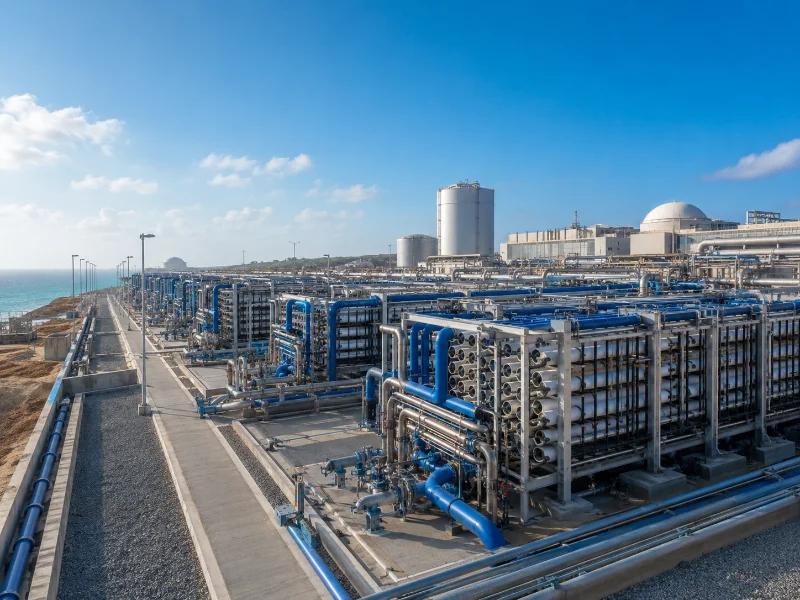
Industrial reverse osmosis serves any operation that needs large volumes of low-TDS water from a variable or saline source. The right configuration depends on both the feed source and the downstream purity target. The same core technology adapts across very different industries.
Common industrial applications include:
- Seawater desalination and brackish-water RO systems, producing potable or process water where the source is saline or scarce.
- Food and beverage, supplying consistent low-mineral water for ingredients and final products.
- Power generation, preparing boiler feed water that resists scaling.
- Pharmaceutical and electronics, feeding downstream polishing that demands ultrapure water.
- Municipal supply, treating contaminated groundwater or surface water to a compliant standard.
As a manufacturer, we design and fabricate industrial reverse osmosis systems for these applications under direct engineering oversight. We match the membrane configuration and pre-treatment to each project’s source water and electrical standards.
Choosing the Right Reverse Osmosis System
Choosing a reverse osmosis system comes down to a few decision variables, not a single specification. They are the source water’s dissolved-solids load, the recovery rate the design can safely sustain, and the downstream purity the application requires. Each one shifts the membrane configuration and pre-treatment a project needs.
In practice, we treat the feed-water analysis as the starting point for every specification. The same nominal flow rate behaves differently on brackish groundwater than on a chlorinated municipal supply. As a manufacturer rather than a trading company, our engineers review each inquiry against its source water chemistry, site electrical standards, and destination-market requirements. Every system then runs through hydraulic pressure testing and factory acceptance before it ships. Where a variable cannot be confirmed from a report, we flag it for project-level testing rather than assume it.
If you are evaluating reverse osmosis for a specific site, the most useful next step is simple. Share your source water report and application requirements, and our engineers can match an industrial reverse osmosis system to your conditions. We design and fabricate each system to the verified water analysis. Where a project-level test is needed, we will tell you before issuing a final specification.
FAQ
Single-pass RO sends feed water through the membrane array once, which suits most brackish and municipal sources. Double-pass RO runs the permeate through a second set of membranes for higher purity. The choice depends on the target permeate quality.
No. Reverse osmosis reduces most dissolved salts, metals, and microorganisms, but it is weak against dissolved gases such as carbon dioxide and some low-molecular-weight compounds. Reduction of any specific contaminant should be verified against membrane data, the system configuration, and the applicable testing standard.
A full feed-water analysis comes first. It covers TDS, temperature, pH, turbidity or SDI, free chlorine, hardness, silica, and iron or manganese. Recovery and membrane selection follow from that analysis, not from a default specification.
Reverse osmosis permeate can be safe to drink when the full system is designed, maintained, and tested for potable use. It usually needs a remineralization stage, because RO also removes beneficial minerals. Potable suitability depends on the complete system and the local drinking-water standard, not on the membrane alone.
RO membrane life depends on feed water quality, pre-treatment, and cleaning frequency rather than a fixed interval. Pre-treatment against chlorine and fouling is the main factor, which is why we design that stage around the measured feed water.