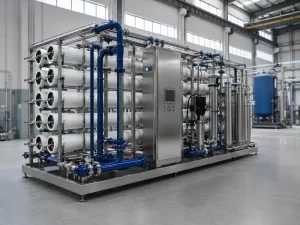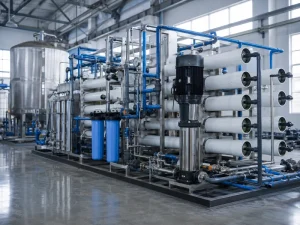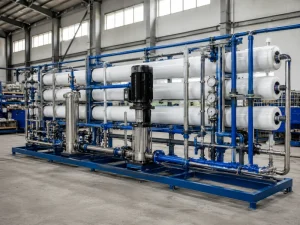
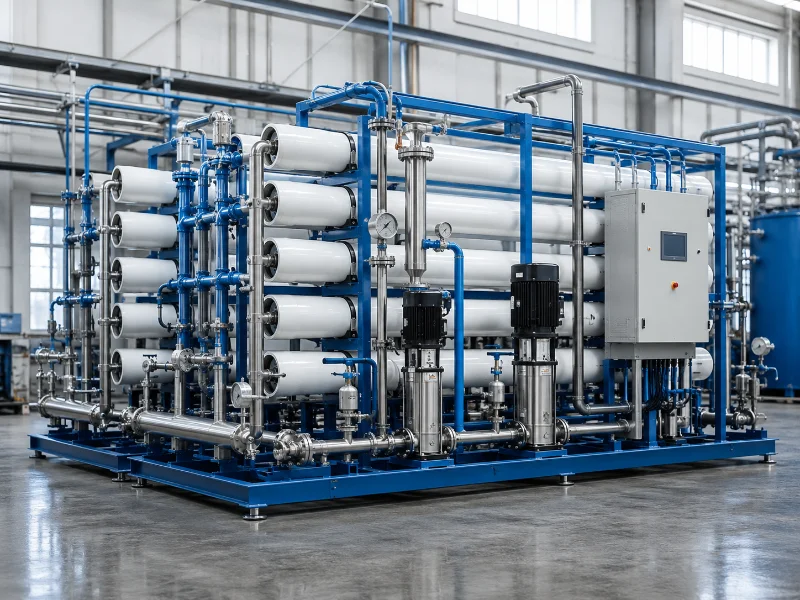
An industrial reverse osmosis system usually runs from around $15,000 for smaller configured skids (up to ~10,000 GPD) to $100,000–$300,000 for mid-scale 50,000–100,000 GPD systems. Large industrial or desalination plants can exceed $1 million. These are budgetary equipment ranges only. The real number depends on your feed water, recovery rate, pretreatment scope, membrane count, materials, controls, and whether installation is included. We confirm a figure only after reviewing your source water report.
Industrial reverse osmosis system price is set by engineered scope, not by the headline GPD figure. That is why two quotes for what looks like the same system can differ widely. Buyers want a budget anchor before committing capital. A meaningful number appears only once capacity, feed water, pretreatment, and build quality are defined. This guide explains what moves the price, what data a quote needs, and how to compare proposals on the same basis.
Why GPD Doesn’t Set the Price
Two industrial RO systems rated at the same GPD can differ in price by a wide margin. The rating describes permeate output, not the components, materials, or design margin behind it. Recovery rate, membrane brand and count, pump construction, vessel material, and controls all change independently of the GPD number. A low online product price usually means a standard skid or light-commercial package. A custom industrial quotation shifts once feed water, recovery, pretreatment, materials, and controls are fixed.
A system priced from a target GPD alone, with no feed water analysis, almost always has the pretreatment stage under-scoped. When pretreatment is too thin for the actual feed water, the membranes foul early and need replacement. The real cost of ownership then climbs well above the original quote. We design and fabricate each package to the specification your water requires, rather than shipping a generic unit. We also verify the build before export, so the figure reflects the components your conditions demand.
Site civil work, interconnecting piping, and installation labor sit outside the equipment price. They are quoted separately, because they depend on your facility layout and local trades. Reading a turnkey installed figure and an equipment price as the same number is the most common error when comparing suppliers. Confirm which one a quote represents before you compare anything else.
Price by Capacity (GPD to m³/day)
Industrial RO budget prices scale with capacity, but published bands serve only as orientation. Feed water and pretreatment shift them significantly. The ranges below are commonly cited across industry cost guides as equipment-budget estimates, not as quotes. Projects between tiers generally fall between the adjacent bands. Capacity is shown in the units international buyers actually use.
| Capacity (GPD) | ≈ GPM | ≈ m³/day | ≈ m³/h | Typical application | Budgetary equipment range* |
|---|---|---|---|---|---|
| Up to ~10,000 | 6.9 | 37.9 | 1.6 | Small plants, light manufacturing, water stores | $15,000 – $50,000 |
| ~50,000 | 34.7 | 189 | 7.9 | Mid-scale manufacturing, F&B | $100,000 – $200,000 |
| ~100,000 | 69.4 | 379 | 15.8 | Larger manufacturing, healthcare | $200,000 – $300,000 |
| 500,000+ | 347 | 1,893 | 78.9 | Heavy industry, desalination, municipal | $1,000,000+ |
*Budgetary equipment estimates for configured industrial RO packages. They do not include civil work, interconnecting piping, local installation labor, storage tanks, post-treatment, or project-specific compliance costs unless a quote states otherwise.
A capacity tier tells you which order of magnitude to budget for. It cannot tell you where inside the band your project lands. Feed water and component grade decide that position. So a published water treatment system cost band should be read as provisional until a water analysis confirms it.
Feed Water and Pretreatment Costs
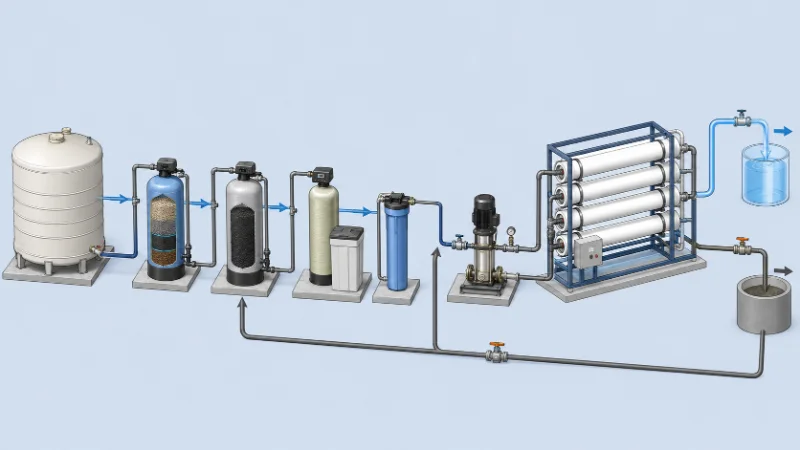
Feed water parameters set the pretreatment scope and the membrane count. Pretreatment is often the line item that separates a durable system from a cheap one. The same output target can require different equipment, depending on how aggressive the water is. So a quote written against a real analysis is the only one worth comparing. Below is the minimum data we review before pricing a configuration.
| Parameter | Why it changes the price |
|---|---|
| Feed / permeate flow (GPD, GPM, m³/h) | Sets membrane count, pump duty, pipe sizing, frame size |
| Feed TDS / conductivity | Drives membrane model, operating pressure, energy, recovery |
| Hardness, alkalinity, LSI/SDI | Determine softening, antiscalant dosing, cleaning frequency |
| Iron, manganese | Require dedicated iron/manganese removal pretreatment |
| Silica, barium, strontium | Raise scaling risk and cap achievable recovery |
| Turbidity, TSS, SDI | Determine media filtration or UF/MF pretreatment |
| Free chlorine / ORP | Require carbon or reducing-agent dechlorination to protect membranes |
| Oil & grease | Force additional pretreatment; major fouling risk |
| Required permeate quality | Decides single- vs double-pass RO, EDI, UV, or polishing |
| Voltage / phase / frequency | Set electrical panel, pump, and control configuration |
Aggressive water with high hardness, iron, or silica adds pretreatment stages and cost. A clean municipal feed needs less. We review this data against destination-market requirements and site electrical standards before confirming any configuration. That keeps a pretreatment gap from surfacing after commissioning.
Component and Build Quality
Component grade is where two similarly rated systems separate, on both price and service life. It covers membranes, pumps, pressure vessels, frame, and controls. A lower price often signals a centrifugal pump where a higher-duty unit is warranted. It can also mean PVC where stainless steel would last longer, or a thinner control package. Each choice trades upfront cost against reliability under your feed conditions.
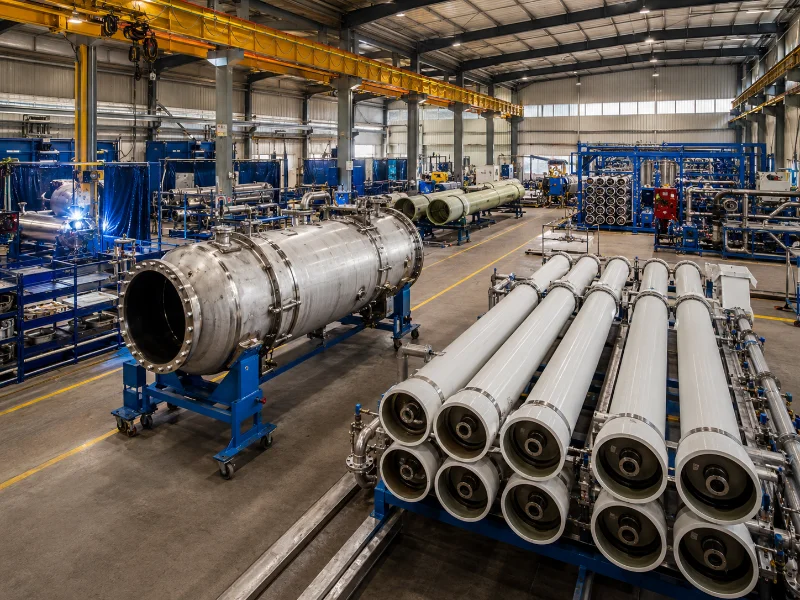
We fabricate pressure vessels, membrane housings, and system skids in our 21,000 m² enclosed workshop, under direct engineering and QC oversight. A team of 28 engineers and 78 technicians handles each stage. The work runs from specification through final hydraulic pressure testing and export documentation. Rather than asking buyers to trust a build, we specify and verify each industrial RO machine. That means configurable membrane housing materials, named pump and motor options, defined PLC/HMI control scope, factory acceptance test (FAT) items, and a pressure-tested package before shipment. This is the difference between a quoted number and a system you can stand behind for years.
Operating Cost and Ownership
Operating cost determines the real price of an industrial RO system over its life. A cheaper unit that fouls faster can erase its upfront saving within a few replacement cycles. The running cost follows a predictable structure:
Estimated operating cost = energy + membrane/filter replacement + chemicals + cleaning + labor + concentrate disposal
A few variables move each term: operating pressure and kWh/m³ for energy, the membrane replacement interval (driven by feed aggressiveness and pretreatment quality), cartridge change frequency, antiscalant and chemical consumption, and the recovery rate, which sets how much concentrate you must dispose of. We align the pump and pretreatment specification with the feed conditions, so the operating cost stays predictable rather than a surprise after year one. The purchase decision should weigh installed price against running cost. The lowest quote and the lowest total cost are often not the same system.
How to Compare RO Quotes
Comparing industrial RO quotes requires matching them on the same technical basis. A lower headline price usually reflects a narrower scope, not a better deal. Before comparing numbers, confirm each quote specifies the same operating assumptions, component grade, and verification. A quote you can compare with confidence should state, at minimum:
- Design feed water profile (TDS, hardness, temperature) the system is rated against
- Recovery rate and design permeate flow at that feed condition
- Membrane brand, model, and element count
- Pump type and construction material, since a quote built on RO high-pressure pumps of different duty ratings is not comparable
- Pretreatment stages included, and which are excluded
- Vessel and frame materials (PVC vs stainless steel)
- Control and monitoring scope, and what testing is done before shipment
Documentation and standards belong in the same review. For performance evaluation, test-method standards such as ASTM D4194 (operating characteristics of RO/NF devices) and ASTM D4516 (standardizing RO performance data) mean more than a generic “RO certified” claim. ASTM D4195 supports the water-analysis basis a quote should rest on. For drinking-water or municipal applications, AWWA B114 covers RO and NF systems, and project-specific contact-material requirements may apply. NSF/ANSI 58 applies mainly to point-of-use drinking water RO systems, so it should not be read as a blanket industrial certification. Which standards apply depends on the application and destination market. We align the documentation set to your project rather than asserting a one-size certification.
When two quotes disagree on any of these points, the price gap usually explains itself. A proposal that omits the feed water basis is the clearest signal that its number is provisional.
Making the Decision
Industrial RO pricing comes down to three decision variables: the capacity you need, the feed water and pretreatment your source demands, and the build quality you want to stand behind over the system’s life. A headline GPD figure anchors the budget tier. But water chemistry and component grade decide your position inside that tier, not the rating alone.
In practice, the systems that disappoint are almost always the ones sized without a verified water analysis. An under-scoped pretreatment stage then forces early membrane replacement and a higher real cost than the quote implied. As a manufacturer rather than a trading company — the kind of direct water treatment equipment supplier industrial buyers often struggle to reach — we review each inquiry against the source water report, site electrical standards, and destination-market requirements before confirming a configuration. We fabricate and pressure-test each system under direct engineering oversight. Some of these variables can only be locked once project-level data is in hand.
The most useful next step is to send us your feed water analysis and application requirements: target output, hours of operation, and end use. Our engineering team will review the data and confirm a configuration and price built around your actual conditions, not a capacity band. That gives you a number you can budget against with confidence.
FAQ
A 10,000 GPD (≈37.9 m³/day) system sits in a roughly $15,000–$50,000 equipment range, and feed water decides where. Clean municipal water with light pretreatment sits near the low end. Add softening, dechlorination, or iron removal, and the same capacity moves toward the top of the band.
A double-pass design sends permeate through a second membrane stage to reach tighter quality targets. That adds membranes, a second pump, more piping, and more controls, all on top of the single-pass cost. So two 100,000 GPD systems can sit far apart in price purely because of the permeate quality they target.
Most quotes cover the equipment package, while site work and labor are priced separately. The gap between an equipment figure and an installed figure can be large, and it depends on your site, not on the RO system. Always ask a supplier to state which one their number covers before you place it next to a competitor’s.
Ask the supplier to list each pretreatment stage by name and confirm it against your water report. A quote that names softening, dechlorination, or media filtration where your feed water needs them is complete. One that stays vague on pretreatment is usually leaving it out, which is where a low headline price often comes from.
Commercial systems use lighter-duty components built for lower flow and milder water, so they cost less. Industrial systems are built for higher capacity, harder water, and continuous duty, which calls for heavier pumps, stronger vessels, and fuller controls. You are paying for the design margin that keeps the system running under tougher conditions.
Seawater RO costs more, because high salinity demands higher pressure, seawater-grade membranes and materials, and a lower recovery rate. The salinity of your source changes both the price and the design. A seawater RO desalination system is therefore quoted on a different basis than a brackish or municipal feed.