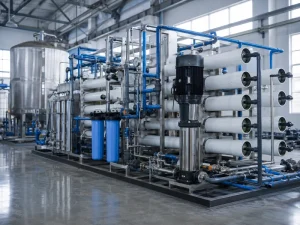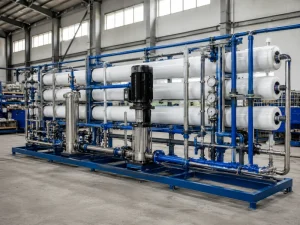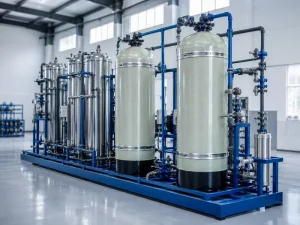
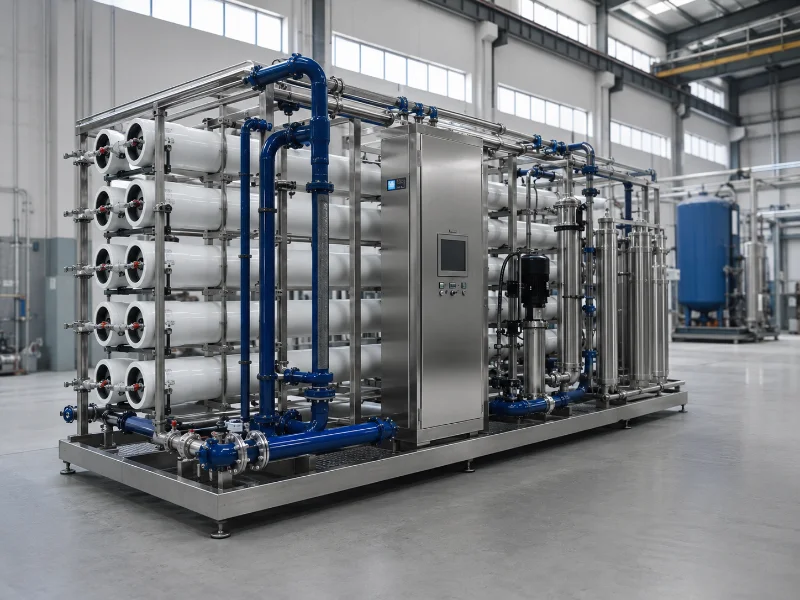
A reverse osmosis water filter for microplastics removes them by physical size exclusion. The membrane blocks particles thousands of times larger than the water molecules that pass through it, so it does not rely on adsorption or surface charge. Reported reduction rates still vary with the device, the particle size, the membrane’s condition, and the test method. A credible figure is tied to a stated particle-size range and a tested model, not a blanket “99%” claim. That qualifier matters more than the headline number. Removal at the outlet tracks membrane integrity, feed-water load, and replacement discipline, not the nominal rating on its own.
We design and fabricate reverse osmosis systems as a manufacturer, not a trading desk. As the maker, we review the variables behind any reduction figure before we confirm a configuration. This guide covers how RO blocks microplastics and where it reaches real limits. It also compares RO with carbon and other membranes, and shows what evidence verifies performance when you specify a system rather than buy a countertop unit.
Microplastic size ranges and the pore size that decides removal
Microplastics span a wide size range, and the smallest fraction sets the pore size a filter must clear. A barrier that catches coarse fragments can still let the fine end through. Definitions also vary by authority. Many drinking-water references treat microplastics as particles below 5 mm, and they call the sub-1-micron fraction nanoplastics. Any removal claim should therefore state the particle-size range it was tested against.
Nanoplastics below roughly 1 micron are the hard case. They are where filtration technologies separate. Media that catch coarse fragments rarely reach this range. A useful specification names a target particle size instead of a generic “removes microplastics” claim. We check a project’s target particle range against membrane capability before we treat any stage as a microplastic barrier. The particle spec drives the membrane choice, and the membrane choice drives how we verify it.
Why carbon filters and micron ratings miss microplastics
Carbon filters and nominal micron ratings should not be assumed to block microplastics, unless the specific model carries a verified reduction claim. Carbon works by adsorption, and a nominal rating lets a share of particles through. Granular activated carbon and standard blocks are built to hold dissolved organics, chlorine, taste, and odor. Their pore structures sit around 0.5 to 1 micron, which is far too coarse to exclude sub-micron fragments.
The nominal-versus-absolute distinction is where many “microplastic-rated” claims weaken. A nominal rating describes a typical capture rate, not a guaranteed cutoff, so some fine particles pass even when the cartridge is new. Some solid carbon-block products do carry a verified microplastics reduction claim, with proven reduction across the tested band. The deciding evidence is that listed claim and the tested particle range for the exact model, not the word “carbon” itself. In service, a nominal cartridge can channel or shed fines as it ages, and then it passes the very particles the system was meant to stop. That is why we check whether a pre-filter rating is absolute or nominal before we count it as a barrier.
How reverse osmosis membranes block microplastic particles
Reverse osmosis blocks microplastic particles by size exclusion at the membrane surface. Feed pressure drives water molecules across a semipermeable barrier, while far larger particles are rejected into the concentrate stream. Buyer-facing specifications often describe the membrane as having an effective rating near 0.0001 micron. Read that number as an effective comparison value, not a literal drilled pore. Thin-film composite membranes reject particles through membrane selectivity, not through a fixed sieve opening. Microplastics are far larger than that threshold either way, so the result is the same: they do not pass.
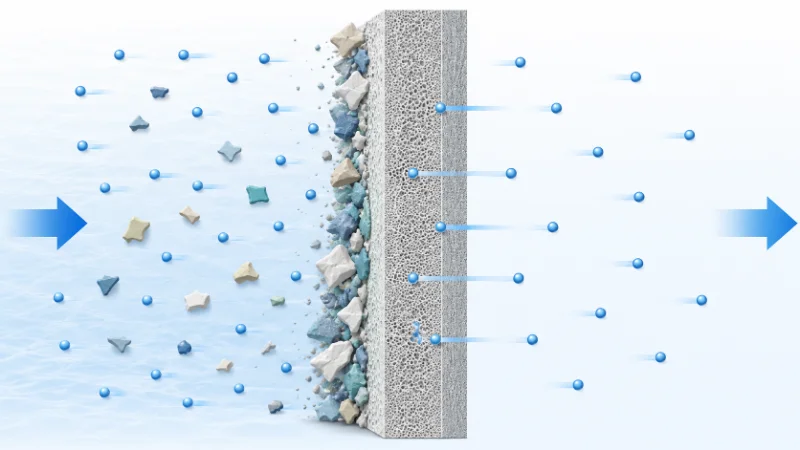
Size exclusion, the mechanism behind how reverse osmosis works, is more durable than adsorption. It does not saturate the way a carbon bed does, because the membrane rejects particles by geometry, not by holding capacity. Membrane condition is still a variable. Research has flagged that degraded or fouled polyamide membranes can shed fragments under certain conditions. Integrity checks and replacement intervals therefore belong in the specification, not in a set-and-forget plan. We design the sediment and carbon pre-treatment stages that hold the membrane in the condition its rejection rate assumes. Feed-water fouling shortens membrane life and lets rejection drift if it is not handled upstream.
Reverse osmosis compared with ultrafiltration, microfiltration, and carbon
Membrane and media technologies remove microplastics to very different degrees. The deciding variable is pore size relative to the smallest particle a project must clear. The table below maps the main membrane filtration methods to their approximate pore size, microplastic performance, and the limit that most affects a buying decision.
| Technology | Approx. pore size | Microplastic performance | Main limit |
|---|---|---|---|
| Reverse osmosis | ~0.0001 micron (effective rating) | Blocks microplastics and most nanoplastics | Needs feed pressure, pre-treatment, concentrate handling |
| Ultrafiltration | ~0.01–0.1 micron | Blocks most microplastics, many nanoplastics | Passes dissolved solids; lower particle floor than RO |
| Microfiltration | ~0.1–0.5 micron | Captures larger microplastics | Misses sub-micron fragments |
| Carbon (GAC / block) | Adsorption media, not size-rated | Inconsistent unless a model carries a verified claim | Channels and sheds fines with age |
Reverse osmosis is the right barrier when the application also needs dissolved solids, salts, or metals removed alongside particles. Where the job is particle capture without demineralization, ultrafiltration can meet a microplastic spec at lower pressure and with no concentrate stream to manage. We match the membrane class to the contaminant profile and the recovery target. We do not default to RO when ultrafiltration would clear the particle spec, because over-specifying adds energy and water cost the application may not need.
Certifications and lab evidence that verify microplastic removal
Microplastic-removal claims are verified at two levels: the system standard and the specific reduction claim. NSF/ANSI 58 and NSF/ANSI 401 cover different things, and neither is a blanket microplastic guarantee. NSF/ANSI 58 addresses reverse osmosis system performance overall. NSF/ANSI 401, the standard for emerging and incidental contaminants, now includes a dedicated Microplastics Reduction claim.
The scope of that 401 claim is where verification has to be precise. The claim is built on the NSF/ANSI 42 Class I particulate method. A listed product verifies at least 85% reduction of particles in the 0.5 to 1 micron range. It is not tested below 0.5 micron. A 401 microplastics listing therefore proves performance across that defined band. On its own, it does not certify removal of the sub-micron and nanoplastic fraction, where membrane integrity and system design carry the result. Both RO systems and some non-RO products hold 401 microplastics listings, so read the claim model by model rather than infer it from the technology name.
A 401 listing alone leaves a gap, so a buyer should require evidence before accepting a removal claim:
- The exact model number, confirmed in the certification database rather than by brand name
- The NSF/ANSI 58 listing for RO system performance
- The NSF/ANSI 401 Microplastics Reduction claim, where applicable, and the particle band it was tested against
- A third-party lab report stating particle size distribution, challenge concentration, and percent reduction
- The flow rate and capacity at which the claim was tested
- Whether each pre-filter stage carries an absolute or a nominal rating
- Feed-water turbidity, SDI, TDS, chlorine, and hardness for the intended source
- The membrane integrity check and replacement schedule that keep rejection stable over the membrane’s life
We check a model’s listing and its particle data against the destination market’s requirements before we issue a specification. A claim that holds on a test bench still has to hold on the customer’s source water.
System variables that determine real-world microplastic removal
Real-world microplastic removal in an engineered system depends on four variables: feed-water load, pre-treatment, membrane integrity, and recovery rate. A fixed catalog number cannot resolve them on its own. A 401 listing only proves the 0.5 to 1 micron band. Capturing the sub-micron fraction in service depends on keeping the membrane intact, and that comes from pre-treatment and replacement discipline, not from the data sheet.
On inquiries from high-turbidity or high-TDS source regions, the membrane is rarely the part that fails first. Under-sized or skipped RO pre-treatment shortens membrane life. It lets rejection drift toward the fine particles a microplastic spec is meant to stop. We review source-water data first for that reason, including turbidity, SDI, TDS, chlorine, and hardness, before we confirm a configuration.
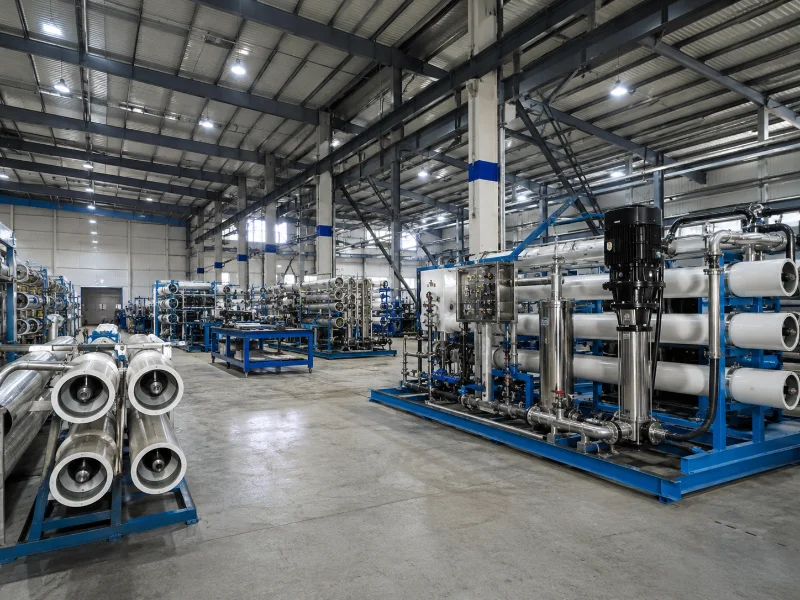
Our 21,000 m² enclosed workshop fabricates and pressure-tests the system skids, membrane housings, and pre-treatment trains under our own engineering and QC oversight. A team of 28 engineers and 78 technicians handles each stage through to final hydraulic pressure testing. Specifying the membrane array, pre-treatment train, and recovery rate for a given feed water is a project-level engineering decision, not something to read off a general guide. It belongs to the same water-chemistry review that decides whether RO is even the right barrier.
Choosing a reverse osmosis water filter for microplastics
The choice comes down to three variables. You need the particle range you must clear, the membrane class that clears it without over-specifying, and the verification path that proves it on your feed water. The headline removal percentage is only as good as the evidence and the pre-treatment behind it. A 401 listing proves a defined band, not the full sub-micron range.
As a manufacturer, we run fabrication and final hydraulic pressure testing under our own engineering and QC oversight. We therefore treat the rejection figure as something to verify against a real source water, not a catalog claim. Where the smallest nanoplastic fraction, the recovery target, or the feed-water load is uncertain, those stay project-level variables that we confirm before we issue a specification.
The practical next step is simple. Share your source-water report and your application requirements, including flow, recovery target, and destination-market standards, and our engineering team will review them and confirm a configuration. We build industrial reverse osmosis water systems to match a verified feed water rather than a generic part number. That review is where microplastic removal is secured, through a configuration whose performance you can verify rather than a number you have to trust.
FAQ
Yes. Reverse osmosis is the most reliable route for microplastics, because it blocks them by particle size rather than by adsorption. For any specific system, ask for the tested particle range and a third-party report instead of trusting the “RO” label on its own.
Yes, but only within a defined band. A 401 listing confirms a Microplastics Reduction claim across a set particle range, so it does not, by itself, prove removal of the finest fraction. Treat it as one input, then check the membrane and system design for the sub-micron particles the standard does not test.
Usually not on its own. Standard carbon targets chlorine, taste, and odor, and only a carbon model with its own verified microplastics claim should count as a barrier. In most systems carbon sits ahead of the membrane to protect it, not to remove the plastic particles.
Reverse osmosis rejects particles well below 1 micron, so microplastics and most nanoplastics stay far above what can pass. The smallest sub-micron particles are the variable part, and capturing them in service depends on membrane integrity and maintenance more than on the rated number.
Aging or fouled polyamide membranes can shed fragments under certain conditions. The practical guard is a schedule, not a one-time install. Integrity checks and timed membrane replacement keep the membrane from becoming a particle source itself.