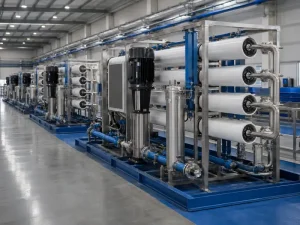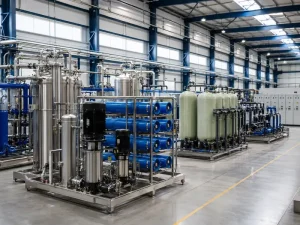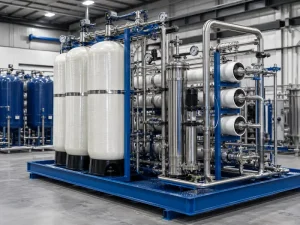
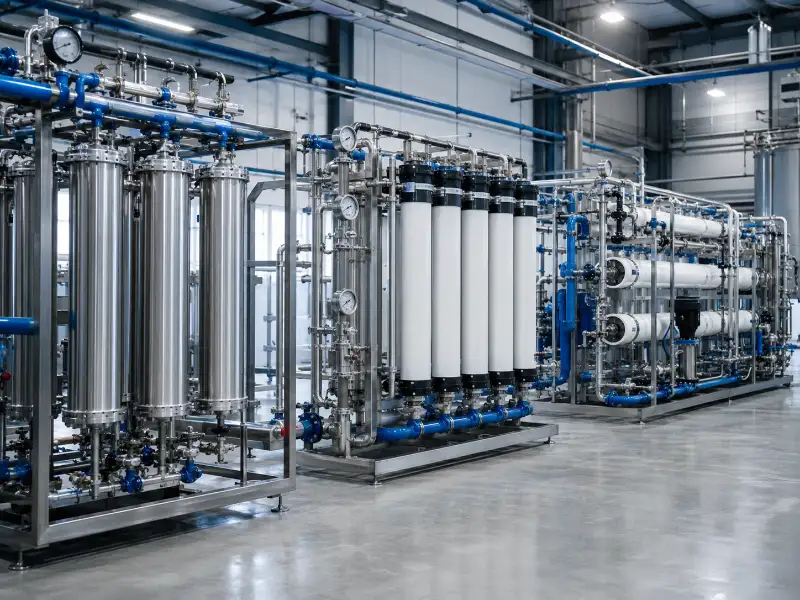
The four membrane filtration methods used in most water treatment projects are microfiltration (MF), ultrafiltration (UF), nanofiltration (NF), and reverse osmosis (RO). What sets them apart is the contaminant each one holds back, not which sounds most advanced. They sit on one scale, from coarse to fine. Broader categories like sand, activated carbon, mechanical, and chemical filtration exist too, and you can see how they fit among the different types of water treatment. But for membrane treatment, these four are the set that buyers and engineers actually compare. We design and build systems on all four, so we frame them the way a project engineer reads a spec: by what enters the membrane, not by a favorite product.
What the Four Membrane Filtration Methods Separate
The four membrane filtration methods separate contaminants by more than pore size alone. The mechanism changes across the scale, so a single pore rating does not tell the whole story. MF and UF work mainly by size exclusion. They strain out particles too large to pass. NF adds another factor. It also sorts by ion charge and molecular weight, which is why it rejects divalent ions on its own. RO works differently again. It behaves like a dense semi-permeable membrane, not a screen with holes, and rejects dissolved salts by solution-diffusion rather than simple sieving.
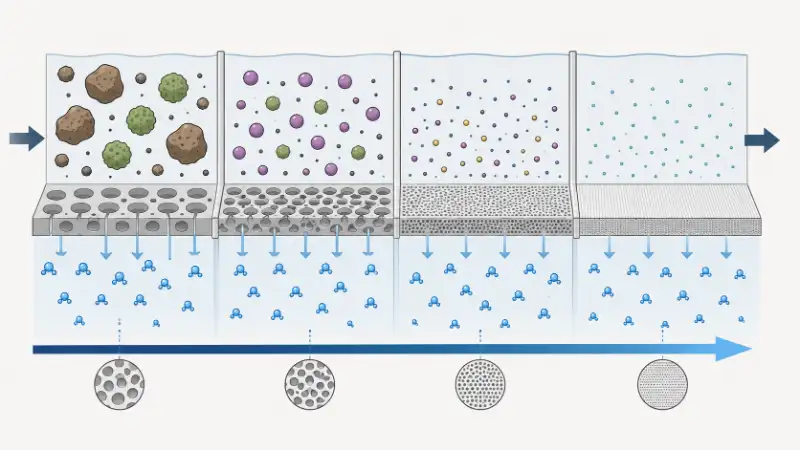
Read the scale by what each method lets through. Microfiltration passes nearly all dissolved material and stops only particles and most bacteria. Reverse osmosis stops almost everything, including dissolved salts. Ultrafiltration and nanofiltration fall in between. Each is defined by the smallest contaminant it can reliably hold back.
We check the required output quality against the source water before we place a project on this scale. The right method is the coarsest one that still meets the target, not the finest one available.
Why Finer Filtration Is Not Always the Correct Specification
A finer membrane does not always give a better result. Each step down in separation range adds pressure, energy cost, and pretreatment demand, and only some applications justify that. The variable that decides the method is the contaminant band you need to remove. Over-specify, and you pay in higher running cost and faster fouling. The check that prevents it is reading the source water report before you choose the membrane.
In our review of incoming inquiries, the most common error is a request for reverse osmosis where ultrafiltration would already meet the target. The finer membrane then fouls early. The suspended solids and organics upstream were never removed first.
Choosing a method is not the same as designing the full system. Pretreatment sizing, piping, and skid layout depend on the source water report and site conditions. We treat those as a separate project-level review, not something the method choice settles on its own.
The Four Filtration Methods and Their Typical Applications
The four membrane filtration methods each target a defined contaminant band. The right one for a project depends on the smallest particle or dissolved species that must leave the water. The table below maps them against the factors buyers usually weigh.
| Method | Typical nominal/effective separation range | Removes | Passes | Common application |
|---|---|---|---|---|
| Microfiltration (MF) | ~0.1–10 µm | Suspended solids, sediment, most bacteria, protozoa | Dissolved salts and most low-molecular-weight dissolved organics | Pretreatment, clarification, prefilter ahead of finer stages |
| Ultrafiltration (UF) | ~0.01–0.1 µm | Bacteria, colloids, larger macromolecules; can reduce viruses | Dissolved salts, smaller organics | Pretreatment for RO, potable polishing, process water |
| Nanofiltration (NF) | MWCO ~200–1,000 Da | Divalent ions (hardness, sulfate), larger organics | Much of the monovalent salt | Selective softening where some minerals stay |
| Reverse Osmosis (RO) | Dense membrane, <~0.001 µm equivalent | Dissolved salts, monovalent ions, near-total TDS | Very little | Desalination, high-purity and low-TDS output |
Ranges vary by membrane material, molecular weight cut-off, test solute, feed chemistry, pressure, and temperature. Treat the figures as orientation, not specification values.
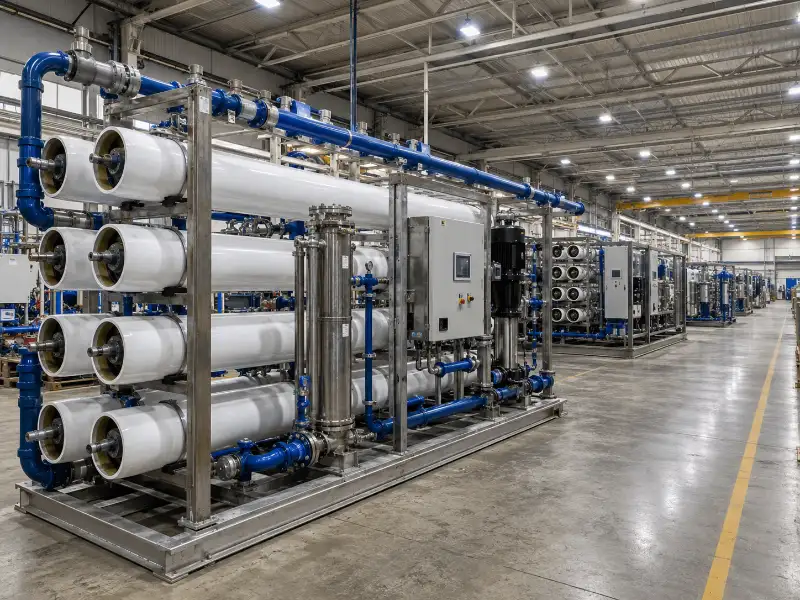
We build MF, UF, NF, and RO skids in our Qingdao workshop. We match the membrane stage to the contaminant band, not to a fixed product line.
Microfiltration (MF)
Microfiltration removes suspended solids and most bacteria but leaves dissolved content untouched. That makes it a clarification and pretreatment step, not a purification stage. It runs at low pressure and handles higher solids loads than the finer membranes. So it often sits at the front of a treatment train to protect what follows.
Ultrafiltration (UF)
Ultrafiltration holds back bacteria and colloids and can reduce viruses. But virus removal in drinking water depends on integrity testing and validation, not on membrane type alone. Where the goal is microbial and turbidity control without changing mineral content, validated ultrafiltration systems usually meet the target. They also draw far less energy than a finer membrane. For potable virus control, we treat integrity checks and disinfection as part of the design, not a standalone guarantee.
Nanofiltration (NF)
Nanofiltration holds back divalent ions like hardness and sulfate while letting some monovalent salts through. That makes it selective rather than a full barrier. Projects that need softening but want to keep some minerals, instead of stripping the water bare, fall into the nanofiltration range.
Reverse Osmosis (RO)
Reverse osmosis removes dissolved salts and nearly all remaining TDS. That makes it the method of choice for desalination and high-purity output. The trade-off is the highest pressure of the four and a strict need for clean feed water. So RO almost always needs a coarser stage in front of it, and our reverse osmosis systems are configured with that pretreatment in mind.
Selecting a Filtration Method by Source Water and Output Target
Method selection follows the source water analysis and the required output quality. The same contaminant can point to different methods, depending on the target. Hardness, for example, may call for nanofiltration in one project and full reverse osmosis in another. It depends on the destination TDS and how much mineral content the application can keep. The same logic plays out in more detail in our guide to membrane technology for water treatment.
A short decision path covers most cases:
- High turbidity or suspended solids, minerals can stay → microfiltration or ultrafiltration.
- Microbial and turbidity control, minerals can stay → validated ultrafiltration.
- Hardness or sulfate reduction, some minerals retained → nanofiltration.
- Low-TDS, desalination, or high-purity output → reverse osmosis, with UF or MF pretreatment.
To run this selection well, we ask for a source water report. It should cover the parameters that actually move the decision: TDS, turbidity, SDI (silt density index), hardness, iron and manganese, and total organic carbon, plus the target output quality. We check each inquiry against these values, the site electrical standards, and the destination-market requirements before we confirm a configuration. A method that fits the chemistry on paper can still fail if the feed water or local standard was never checked.
Standards and Validation Points to Check Before Specifying
Standard and validation references for membrane filtration depend on the application and the destination market. They differ between a drinking-water system and an industrial process line. We check which ones apply to your market before we issue a specification.
A few reference families come up often. Confirm which apply to your specific use case:
- NSF/ANSI 58 applies to reverse osmosis drinking-water treatment systems; NSF/ANSI 42 and 53 cover other point-of-use treatment units.
- EPA membrane filtration guidance (LT2ESWTR) addresses pathogen removal credit for membranes in surface-water drinking systems. It matters where microbial credit, not just turbidity, is the goal.
- AWWA M53 (MF/UF) and M46 (RO/NF) serve as engineering design and operation references.
These define quality goals and validation paths, not equipment line items. So the version, scope, and acceptance criteria should be verified against the destination market and the water source.
How the Four Methods Combine in a Treatment Train
The four methods often work in sequence, not alone. A fine membrane like RO depends on coarser stages upstream to strip the solids and organics that would foul it within weeks. A typical train puts microfiltration or ultrafiltration ahead of nanofiltration or reverse osmosis, with pretreatment filtration such as sand or activated carbon often first in line. Each stage hands cleaner water to the next.
On high-turbidity or high-silt feed water, the stage to recheck first is almost always the pretreatment ahead of RO, not the RO membrane itself. The fouling shows up at the final stage. The cause usually sits earlier in the train.
We design treatment trains as a sequence and align each stage to the one downstream. So the membrane that does the final separation gets water already inside its tolerance.
Conclusion
Three variables decide which of the four membrane filtration methods a project needs: separation range, source water, and required output quality. Read in that order, they turn an open question, which method is best, into a clear match between contaminant band and membrane stage.
As the manufacturer rather than a trading intermediary, we review water chemistry, site conditions, and destination-market requirements before we issue any specification. We hold the variables that need project-level confirmation open until that review is done: feed water quality, pretreatment load, and target TDS. That review is also where the line between method selection and full system design gets settled.
The practical next step is simple. Send your source water report and application requirements, and our engineering team can confirm the right method and configuration. As one of the direct wastewater treatment equipment manufacturers serving importers, distributors, and EPC contractors across more than 20 countries, we size each system against the project in front of us, not a catalogue default.
FAQ
The four membrane filtration methods, ordered from the coarsest to the finest pore size, are microfiltration, ultrafiltration, nanofiltration, and reverse osmosis. As a quick guide: MF and UF clean up particles and microbes, NF softens selectively, and RO handles dissolved salts and desalination.
Judged by what stays in the treated water, the four methods split clearly. MF and UF leave dissolved salts and minerals in place while removing particles and microbes; NF keeps part of the monovalent salt but strips most hardness; RO produces water with almost no dissolved content left.
Reverse osmosis removes the widest range, including dissolved salts and most TDS, which is why it anchors desalination and high-purity systems. The cost is higher pressure, more energy, and a firm need for upstream pretreatment.
Ultrafiltration can reduce viruses by size, but for drinking water you should ask the supplier for integrity-test data and validated log-removal figures rather than rely on the membrane rating alone. Reliable virus control also pairs UF with disinfection instead of treating the membrane as a standalone barrier.
Reverse osmosis is necessary only when the target requires low TDS or desalination, not for every water problem. Where the goal is turbidity or microbial control with the minerals left in place, ultrafiltration usually meets the target at lower pressure and lower running cost.