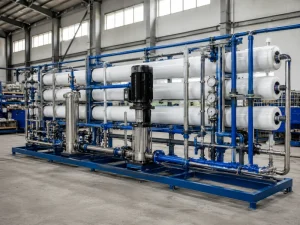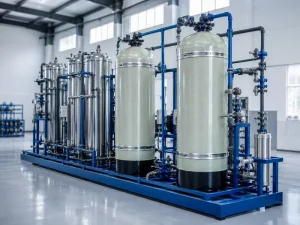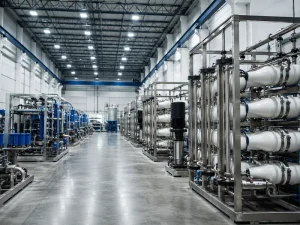
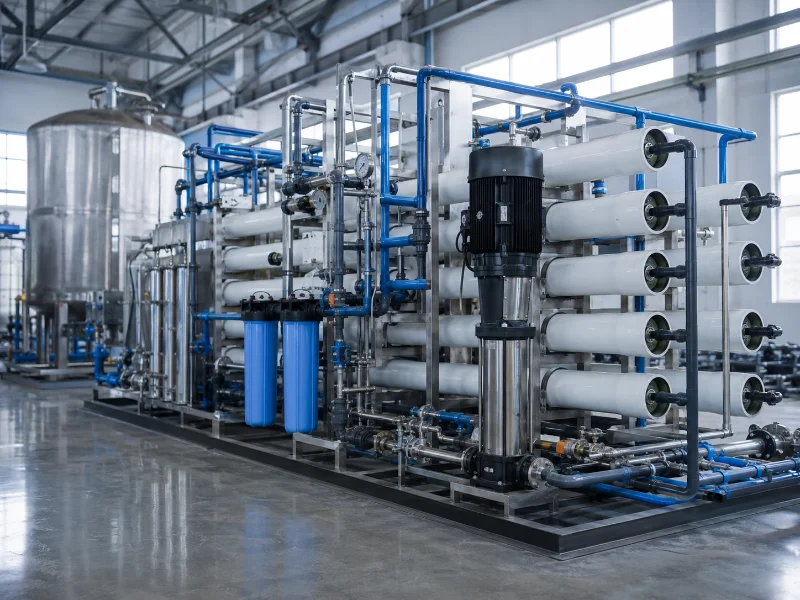
Reverse osmosis works by forcing water through a semi-permeable membrane under pressure. The membrane blocks dissolved salts, organics, and most other contaminants. What passes through is purified water; what stays behind is a concentrated reject stream. How well the process performs comes down to three things: the pressure applied, the chemistry of the feed water, and the pre-treatment ahead of the membrane. We are a water treatment equipment manufacturer, and we build RO systems around each customer’s source water. This guide explains the mechanism the way our engineers look at it — from the physics at the membrane to the variables that set recovery and water quality.
Osmosis vs. Reverse Osmosis: Reversing the Natural Flow
Osmosis is the natural movement of water across a semi-permeable membrane. Water flows from a dilute solution toward a more concentrated one until both sides reach balance. The same effect lets plant roots draw water from soil and moves water from the gut into the body. Direction is the key detail: in osmosis, water moves toward the saltier side on its own.
Reverse osmosis turns that flow around. We apply pressure to the concentrated side, enough to beat the solution’s natural osmotic pressure. That pressure pushes water molecules backward through the membrane and leaves the dissolved load behind. The saltier the feed water, the more pressure it takes. This is why seawater desalination systems run at far higher pressure than brackish-water units.
We clarify this point early with buyers, because the most common misconception is treating RO as a finer version of a sediment or carbon filter. A conventional filter strains particles by size, and it runs mostly on line pressure. An RO membrane works differently. It separates at the molecular level, and it only works when applied pressure drives the process against osmosis.
How an RO Membrane Separates Water From Contaminants
A reverse osmosis membrane separates contaminants by both molecular size and electrical charge, so what it rejects depends on the feed water chemistry. Most modern membranes are thin-film composite (TFC) polyamide. They separate at a scale often described as near 0.0001 microns. In practice, though, the membrane acts as a dense selective layer, not a fixed-pore sieve. Real performance depends on membrane chemistry, pressure, temperature, salinity, and recovery — not on any single pore figure.
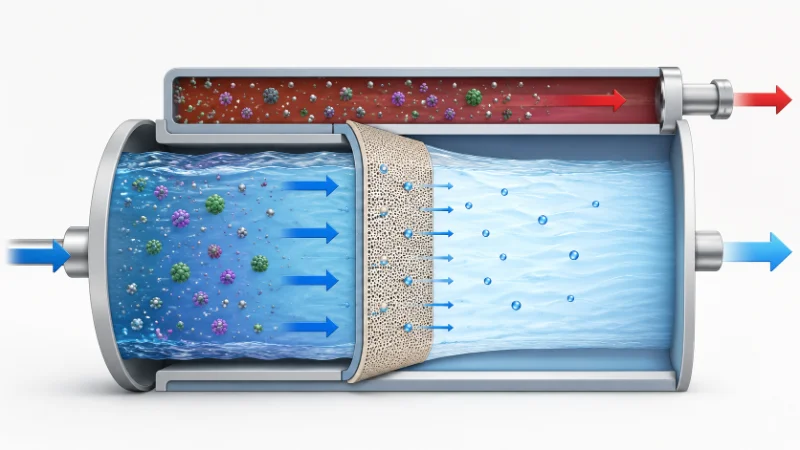
Charge matters as much as size. The higher a contaminant’s ionic charge, the harder it is to cross the membrane. That is why a divalent calcium ion is rejected better than a monovalent sodium ion. Solutes above roughly 200 molecular weight are also more likely to be rejected. Neutral organics are less predictable: their rejection shifts with size, charge, polarity, hydrophobicity, membrane type, pH, temperature, and fouling. Weakly ionized gases such as carbon dioxide are an exception, and they pass through with the permeate.
We check rejection in practice by comparing total dissolved solids (TDS) before and after the membrane. That ratio is the most direct read on whether the membrane is holding its rated performance. When the gap between feed TDS and permeate TDS narrows over time, that drift is our signal to inspect the membrane — not to assume the source water changed.
The Stages a System Uses to Produce Purified Water
A complete RO system runs feed water through several stages built around the membrane. The pre-treatment filters matter as much as the membrane itself, because they set how long the membrane holds its rated rejection. A typical system moves through this sequence:
- Sediment pre-filter — removes sand, rust, and suspended particles that would otherwise scratch or clog the membrane.
- Carbon pre-filter — removes chlorine and organics that attack the polyamide layer.
- RO membrane — the main separation stage, where pressurized feed water splits into permeate and concentrate.
- Storage and post-treatment — RO produces water slowly, so treated water collects in a tank. It then passes through a post-filter or an optional remineralization stage before use.
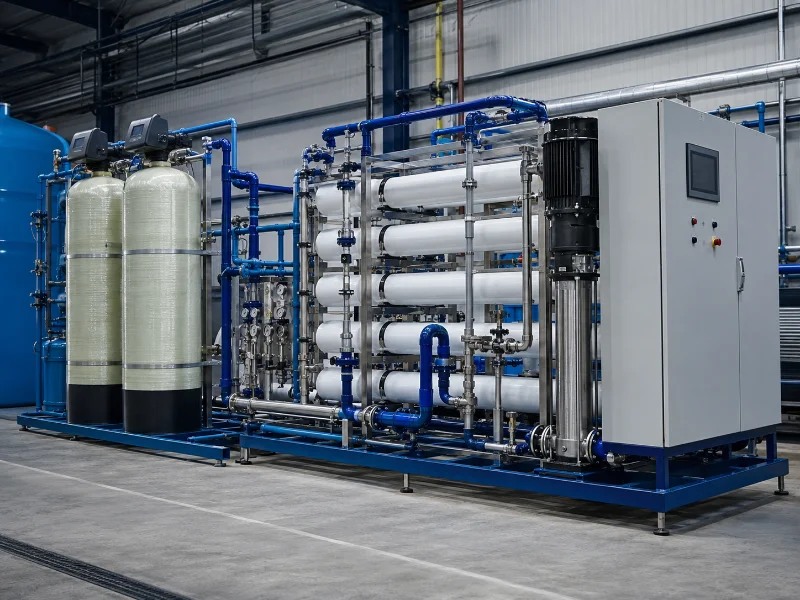
Most early failures start here, in pre-treatment. When pre-treatment is sized without first checking chlorine and hardness in the feed water, the polyamide layer fouls or degrades early. Rejection then falls before the membrane reaches its rated life. For that reason, we review the feed water report before choosing the pre-treatment stages, instead of shipping a fixed configuration. How the skid is then piped and installed on site is a separate job. It depends on the site’s layout and electrical standards, not on the separation mechanism covered here.
Feed Pressure, Recovery Rate, and Why More Isn’t Always Better
Feed pressure and recovery rate are the two variables that shape RO performance the most. Push recovery higher than the feed water chemistry allows, and you trade water quality and membrane life for a small gain in output. Recovery rate is just the share of feed water that leaves as permeate. A feed of 100 gpm that produces 80 gpm of permeate runs at 80% recovery; the other 20 gpm leaves as concentrate.
Recovery targets differ sharply by scale. Small point-of-use systems often run at low recovery. They send several gallons of reject water to drain for every gallon they produce. Industrial systems can reach much higher recovery when the array is designed for it. Multi-stage arrays make that possible: the concentrate from the first stage feeds the next, and booster pumps make up for the pressure lost along the way. We match the array and the recovery target to the feed water’s salinity, rather than reaching for the highest number on a datasheet.
There is a physical reason for that restraint. As recovery climbs, the concentrate stream grows saltier. Once it crosses solubility limits, minerals drop out as scale on the membrane, which lowers rejection and shortens membrane life. In high-TDS feed water, the front elements of the first stage are usually where we look first when rejection starts to drift, because scaling pressure climbs fastest there. Our engineers design each industrial reverse osmosis water system around a recovery rate the source water can sustain — not the highest number the hardware could reach.
What Reverse Osmosis Removes, and What It Doesn’t
A properly selected and tested reverse osmosis system reduces 95–99% of dissolved salts, along with many metals, minerals, and microorganisms. It does not reliably remove dissolved gases, though, and it is not a standalone disinfection step for unsafe water. A correctly specified system can reduce:
- Dissolved salts and total dissolved solids
- Heavy metals such as lead and arsenic
- Nitrates, fluoride, and many PFAS compounds
- Bacteria and viruses, which are blocked by size
The limits matter as much as the capabilities. Weakly ionized gases like carbon dioxide pass through with the permeate, so RO alone does not handle them. Bacteria and viruses are too large to cross the membrane. Still, a damaged seal or membrane defect can let organisms slip through. That is why water that is not already safe to drink needs its own disinfection step.
Performance for any single contaminant varies by membrane and operating conditions. So a claim for a specific contaminant should be confirmed against the membrane data sheet — and, for drinking-water systems, against NSF/ANSI 58 certification — not assumed from how RO works in general. For each project, we compare the target contaminant list against the membrane’s rejection profile. Where pathogen control is the goal, we pair RO with UV sterilization instead of relying on the membrane alone.
What Reverse Osmosis Comes Down To
Reverse osmosis comes down to a balance of three variables: the pressure that drives water through the membrane, the pre-treatment that protects it, and the recovery rate the feed water can sustain. Get the three aligned, and the system holds its rejection for its full service life. Get them wrong, and rejection drifts long before the hardware wears out.
None of these can be set from a datasheet alone. They depend on the source water, the site conditions, and the contaminant targets for the job. That is why our engineers review each inquiry against the real feed water report before they confirm a configuration. The membrane mechanism is universal; the right system around it is project-specific.
If you are weighing RO for a specific application, the most useful next step is to send us your source water analysis and your output requirements. From there, our engineers can check the feed water against pressure, recovery, and pre-treatment needs, then align a system specification to what your water and your site actually call for.
FAQ
Osmosis moves water on its own toward the saltier side of a membrane. Reverse osmosis does the opposite: it uses applied pressure to push water the other way, which is the part that purifies. The practical point is that RO cannot run on its own. It needs enough pressure, and therefore energy, to work against osmosis.
The share sent to drain as concentrate is set by the recovery rate the system is designed for, not by a fixed ratio. Small residential units waste more per gallon produced. Larger industrial systems recover much more by using multi-stage arrays — but only as far as the feed water chemistry safely allows.
A correctly selected RO system reduces many PFAS compounds, since most are larger and more charged than the membrane will pass. Removal is not automatic for every compound, though. For drinking-water use, confirm the specific PFAS claim against the membrane data sheet or NSF/ANSI 58 certification rather than assuming it.
Reverse osmosis blocks most bacteria and viruses by size, but it is not a certified disinfection method on its own. A damaged seal or membrane defect can let organisms through. Water that is not already safe to drink should be paired with UV or another disinfection stage.
Reverse osmosis produces low-mineral, low-TDS water that is widely used for drinking. Because it strips beneficial minerals along with contaminants, some systems add a remineralization stage for taste and balance. Whether you need that is a water-quality preference, separate from how the membrane works.
Reverse osmosis works on both, but the pre-treatment in front of it changes with the source. Well water often carries more sediment, iron, manganese, or hardness, so it usually needs heavier pre-treatment to protect the membrane. We size that pre-treatment from a feed water test, not from the supply type alone.