A cation is a positively charged ion and an anion is a negatively charged ion. The difference comes down to electrons: an atom that loses one or more electrons becomes a cation, while an atom that gains electrons becomes an anion. That single change in charge sign decides a lot. It controls how each ion bonds, which way it moves in an electric field, and which water treatment process can remove it. At Hiju, we handle both categories whenever we review a customer’s water analysis before specifying an ion exchange or filtration system. The chemistry behind that difference is simple enough. What changes from one source to the next is which water treatment methods a given water actually needs.
What Is a Cation?
A cation is a positively charged ion that forms when a neutral atom loses one or more electrons. The number of electrons it loses sets the size of its charge. Metals form cations most easily, because their outer electrons are loosely held and break away when the atom bonds. Sodium loses one electron to become Na⁺, calcium loses two to become Ca²⁺, and aluminium loses three to become Al³⁺. The charge appears after the symbol, so the superscript shows how many electrons left the atom.
In water, the cations we review first in a source analysis are calcium (Ca²⁺) and magnesium (Mg²⁺), because together they create hardness. When hardness is high, those cations form scale on pipes, membranes, and heat-transfer surfaces. That scale risk is the variable that decides whether a water softener system belongs at the front of the train.
What Is an Anion?
An anion is a negatively charged ion that forms when a neutral atom gains one or more electrons. The number it gains sets the size of its negative charge. Non-metals form anions instead, since they complete their outer electron shell by pulling in electrons. Chlorine gains one electron to become chloride (Cl⁻), and oxygen gains two to become oxide (O²⁻). Free oxide, though, is a textbook example rather than something you would see on a water analysis. Groups of atoms can also carry a shared charge as polyatomic anions, such as sulfate (SO₄²⁻), nitrate (NO₃⁻), and bicarbonate (HCO₃⁻). These are the forms that show up in real source water.
The anions we verify in a water report are usually chloride, sulfate, nitrate, bicarbonate (reported as alkalinity), and silica reported as SiO₂. Silica behaves as a weakly ionized, weak-acid species in demineralization rather than a simple standalone anion. That is why it sits at a specific point in the process. Each anion points to a different requirement. Nitrate may call for targeted anion exchange in potable water. Silica matters most when the goal is high-purity water, the kind feeding DI water systems for electronics and pharmaceuticals. The anion profile, not just the total, shapes that part of the design.
What Are the Key Differences Between Cations and Anions?
The core difference between a cation and an anion is the sign of its charge. That sign governs how the ion forms, which electrode it moves toward, and which ion exchange resin can capture it. A common mistake is to assume that knowing an ion is dissolved tells you how to remove it. The sign is what matters in practice. A cation exchange resin captures only positive ions, and an anion exchange resin captures only negative ones. So removing everything means handling both.
We often have to clarify why a single cation exchange step cannot reach a demineralization target on its own. When only the positive ions are exchanged, the negative ones stay in solution. The treated water still carries dissolved salts and never reaches the conductivity the buyer expected. That gap between charge and removal path is the difference that carries real cost consequences.
| Property | Cation | Anion |
|---|---|---|
| Electrical charge | Positive (+) | Negative (−) |
| How it forms | Loses one or more electrons | Gains one or more electrons |
| Usually formed from | Metals | Non-metals |
| Moves toward | Cathode (negative electrode) | Anode (positive electrode) |
| Common examples | Na⁺, Ca²⁺, Mg²⁺, Fe²⁺ | Cl⁻, SO₄²⁻, NO₃⁻, OH⁻ |
| Removed from water by | Cation exchange resin | Anion exchange resin |
How Do Cations and Anions Behave in Water Treatment?
Cations and anions behave as opposites in water treatment, because the charge sign decides which resin attracts them. Cation exchange resins hold positive ions, and anion exchange resins hold negative ions. A cation exchange resin in the sodium form swaps hardness ions for sodium. It softens the water by trading Ca²⁺ and Mg²⁺ for Na⁺. An anion exchange resin pulls out chloride, sulfate, nitrate, and silica, depending on the resin type and the load it has to handle.
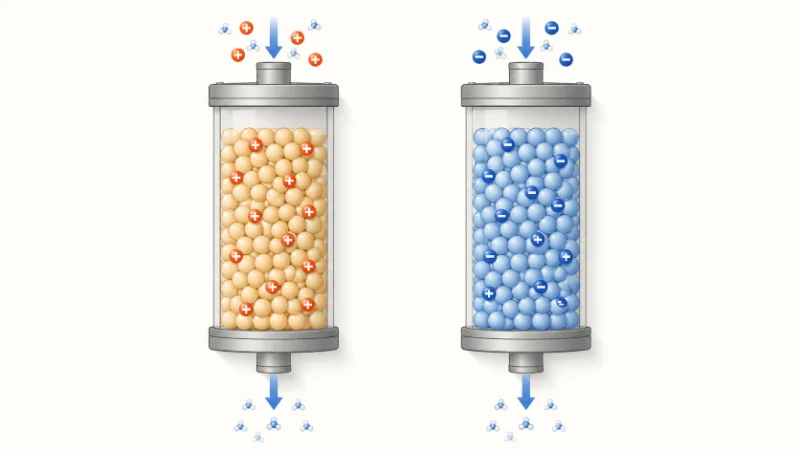
Softening on its own lowers hardness but does not meaningfully reduce TDS or conductivity. It replaces calcium and magnesium with sodium rather than removing dissolved solids. That distinction matters whenever the target is low-conductivity water rather than scale control. A softener and a demineralizer solve different problems.
When we design a system, we match the resin to the ions in the water analysis. A high-hardness feed needs cation exchange capacity sized for the scale risk. A high-nitrate or high-silica feed needs anion exchange capacity placed where it does the most good. The dominant ion sets the impact to prevent, and the resin choice answers it. That is also where softening, demineralization, and deionization begin to separate.
Which Ion Exchange Setup Does Your Water Need?
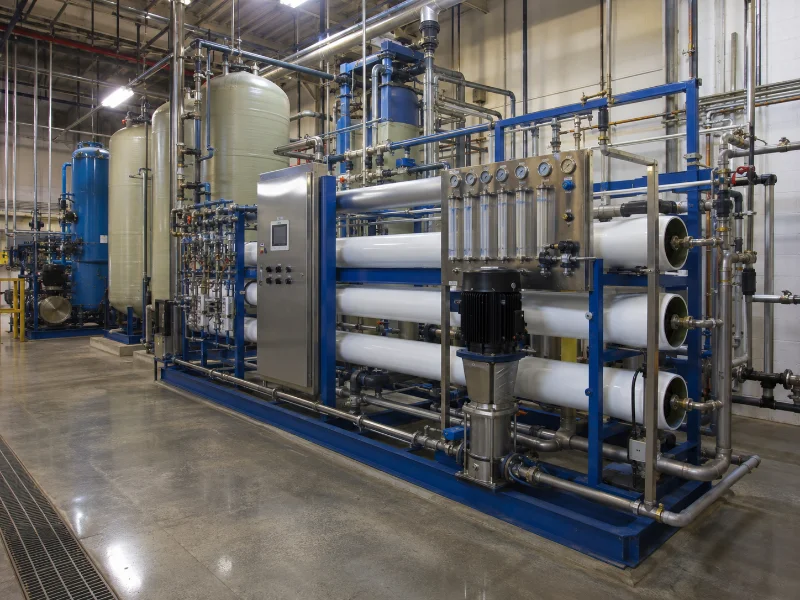
The right ion exchange setup depends on which ions dominate your source water and the quality you need to reach. The cation and anion distinction alone does not settle it. Softening uses cation exchange by itself to remove hardness. Full demineralization runs cation and anion exchange in sequence to strip most dissolved ions. It is the usual route to low-TDS boiler feed water treatment. Deionization combines both resins in a mixed bed to polish water to very high purity.
| Process | Resin used | Removes | Typical goal |
|---|---|---|---|
| Softening | Cation exchange (Na⁺ form) | Hardness (Ca²⁺, Mg²⁺) | Scale prevention |
| Demineralization (two-bed) | Cation, then anion | Most dissolved ions | Low-TDS, boiler feed |
| Deionization (mixed bed) | Cation and anion combined | Nearly all ions | Ultrapure, polishing |
Where the dissolved load is high, ion exchange alone would regenerate too often. In that case, industrial reverse osmosis systems usually carry the bulk of the removal and leave the resin to polish what remains. Before we size any of these, we review the water analysis against the target water quality. The parameters below are the ones that move the design. Each maps to a specific capacity or staging decision rather than a general preference:
| Parameter | How it’s reported | What it decides |
|---|---|---|
| Total hardness | mg/L as CaCO₃ | Whether a softening stage is needed, and its size |
| Calcium / magnesium | mg/L | Cation exchange load |
| Alkalinity (bicarbonate) | mg/L as CaCO₃ | Dealkalization vs full demineralization |
| Conductivity / TDS | µS/cm or mg/L | How deep the demineralization must go |
| Silica | mg/L as SiO₂ | Boiler and high-purity feasibility, anion staging |
| Nitrate | mg/L as NO₃⁻ or NO₃-N | Anion resin selection for potable water |
| pH and temperature | measured value | Resin efficiency and regeneration conditions |
| Flow rate | m³/h, peak and continuous | Vessel size, bed depth, service velocity |
| Target water quality | conductivity, resistivity, or hardness leakage | Softening vs two-bed vs mixed bed vs RO + IX |
A feed water that combines high hardness with elevated nitrate, for instance, loads the cation and anion stages differently at the same time. That trade-off is something we resolve from the analysis rather than from a standard model.
In feed water with high silica, dissolved CO₂, natural organic matter, or heavy sulfate and nitrate loading, the anion stage is often the limiting one. Strong-base anion resin is where silica and organic fouling tend to concentrate. This is the point where the cation and anion distinction stops being enough on its own. The specific resin grades, vessel sizing, and regeneration setup depend on your full water analysis. We confirm them during engineering review, not from the charge sign.
How Should the Cation and Anion Difference Guide Your System?
The difference between a cation and an anion comes down to one variable: the sign of the charge. That sign drives every downstream decision in ion exchange. Cation exchange captures positive ions and drives softening. Anion exchange captures the negative ones. Reaching low-TDS or ultrapure water means handling both. Knowing which ions dominate your source water, along with the quality target you need, turns the chemistry into a treatment specification.
In practice, we treat the charge sign as the starting point rather than the answer. Before confirming a configuration, we review the source water analysis against the target water quality. The same nitrate or hardness reading can call for different resin staging. The choice depends on flow rate, regeneration access, and the rest of the ion profile. Where a value has not been measured, we flag it as a project-level variable to verify instead of assuming it.
If you are scoping an ion exchange, softening, or deionization system, the most useful next step is to put the numbers side by side. Compare hardness, alkalinity, silica, nitrate, conductivity, and your target water quality. Then decide between softening, two-bed demineralization, mixed-bed polishing, or RO combined with ion exchange. Working through that comparison is also where it helps to work with water treatment equipment manufacturers that review water chemistry in-house rather than trading companies. That way, the people who specify the system are the same ones who design and fabricate it. When your analysis is ready, our engineering team can confirm the configuration against your conditions.
FAQ
A cation is positive because it has more protons than electrons, and an anion is negative because it has more electrons than protons. An atom turns into a cation when it loses electrons and into an anion when it gains them. How many it loses or gains sets the size of the charge.
Metals usually form cations, and non-metals usually form anions. On the periodic table, elements on the left and center lose electrons to become positive, while those toward the upper right gain electrons to become negative. The further an element sits from a stable electron configuration, the higher the charge it tends to carry.
Sodium is a cation. It gives up one electron to become Na⁺, a single positive charge. In water treatment, sodium is also the ion a sodium-form softener releases in exchange for the calcium and magnesium it removes.
Cation exchange removes positively charged ions such as calcium and magnesium, while anion exchange removes negatively charged ions such as chloride, sulfate, and nitrate. Softening uses cation exchange alone, and full demineralization uses both. We confirm which split a given water needs against its analysis before specifying resin volumes.
A standard water softener does not remove anions. It runs only cation exchange, swapping calcium and magnesium for sodium, so chloride, sulfate, and nitrate stay in the water. Taking those out needs a separate anion exchange stage.
Nitrate is removed by a strong-base anion exchange resin, since nitrate carries a negative charge. The resin trades chloride or hydroxide ions for nitrate as the water passes through. Because trace contaminants and high sulfate can affect how it performs, nitrate removal is matched to the full water analysis rather than to the nitrate reading alone.