Water treatment methods fall into three families: physical, chemical, and biological. Membrane separation and disinfection work across more than one of them. Which method or combination fits a site depends on what the source water contains and what the treated water has to do. How advanced the method is matters far less.
This guide explains how the methods are grouped, what each one removes, and how to read a source-water report to match them. Sizing and engineering a built system is a separate, project-specific task that follows from that report. The focus here stays on method selection, not on configuring a specific machine.
Types of Water Treatment Methods
Water treatment methods divide into physical, chemical, and biological categories. Most working systems draw on more than one, because each category clears a different class of contaminant. Membrane separation and disinfection are better treated as processes that cut across these categories, not as a fourth and fifth family. A membrane is itself a physical barrier, and disinfection can be either chemical or physical.
| Method | Primary target | When it is typically chosen |
|---|---|---|
| Media filtration (sand, multimedia) | Suspended solids, turbidity | Pretreatment ahead of membranes or disinfection |
| Activated carbon | Chlorine, taste and odor, selected organic compounds | Polishing and dechlorination before RO membranes |
| Membrane filtration (MF, UF, NF, RO) | Particles through to dissolved salts, by pore size | When dissolved solids or fine pathogens must be removed |
| Ion exchange and softening | Hardness ions and specific target ions | When scaling hardness or one ion governs |
| Chemical disinfection (chlorine, chloramine) | Bacteria and viruses, with a lasting residual | When a residual is needed across a distribution network |
| UV disinfection | Bacteria, viruses, protozoa, in clear water | When pathogen control is needed without a chemical residual |
| Aeration and oxidation | Iron, manganese, dissolved gases | When groundwater carries iron, manganese, or odor |
| Biological treatment | Organic load, nitrogen, certain contaminants | Mainly wastewater and reuse, some drinking-water cases |
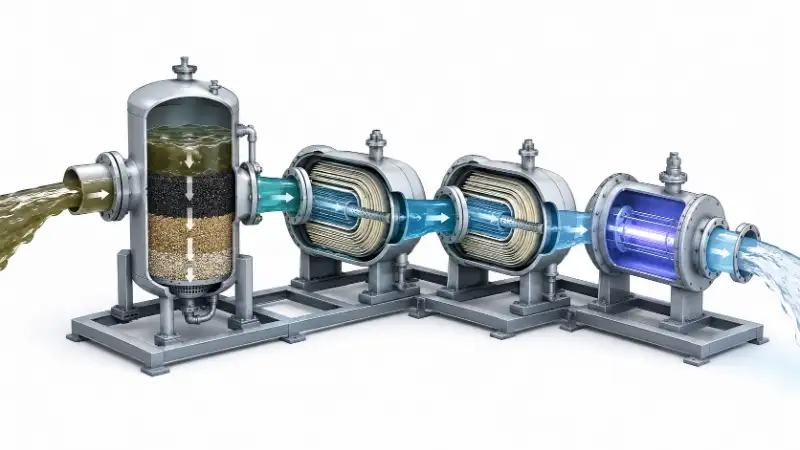
Physical and membrane methods
Physical separation removes contaminants by holding them back or settling them out. The right barrier depends on particle size. Media filtration handles turbidity and suspended solids, and it usually sits at the front of a train to protect what follows. Membrane filtration spans a wide range, from microfiltration for particles to reverse osmosis for dissolved salts. The membrane grade is selected against the smallest thing that has to be removed.
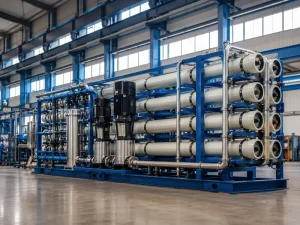
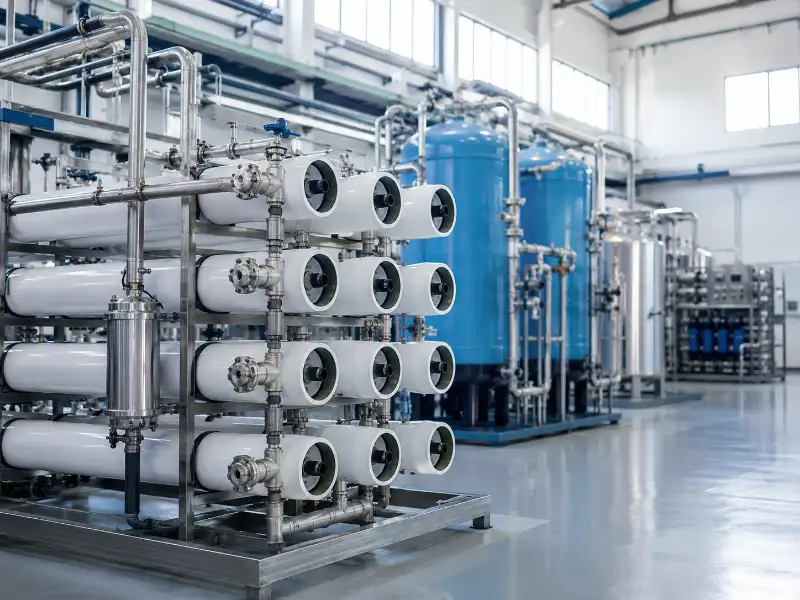
We design and fabricate reverse osmosis trains, multimedia and cartridge filtration, and the pressure vessels and membrane housings that contain them. We size each stage to the contaminant the water report flags as governing. Where feed water carries scaling hardness, we add antiscalant dosing or upstream softening. That pretreatment protects the membrane from work it would otherwise foul on.
Chemical methods
Chemical treatment changes a contaminant’s form so it can be separated or rendered harmless. The dose tracks the contaminant’s concentration, not a fixed recipe. Coagulation and flocculation bind fine particles into settleable flocs ahead of sedimentation. Ion exchange swaps unwanted ions such as calcium and magnesium for sodium or hydrogen ions, depending on the resin type and regeneration chemistry. This swap underpins softening and several targeted ion-removal steps.
pH adjustment and oxidation support the rest of the train rather than standing alone. They correct corrosivity or convert dissolved iron into a filterable solid. Because these reactions are concentration-driven, we verify the governing levels in the source-water report before setting any dosing logic.
Biological methods
Biological treatment uses microorganisms to break down organic load. It appears most often in wastewater and water-reuse projects, less so in standard drinking-water trains. The common forms include activated sludge, membrane bioreactors, and biofilters. All of them are governed by oxygen demand, sludge handling, and the discharge or reuse target set in a water report. Selected drinking-water systems also use biological processes for specific contaminants such as iron, manganese, or nitrate. The method is not limited to wastewater. Its design still follows from the organic and nutrient load measured in the report, not from a category label.
Disinfection methods
Disinfection inactivates or kills pathogens. The choice among methods turns on two things: whether the treated water needs a lasting residual, and how clear it is at the disinfection stage. Chlorine and chloramine leave a residual that keeps protecting water through the distribution network. Chloramine is more stable but slower-acting, and free chlorine can form disinfection by-products. UV and ozone leave no residual, so they suit in-plant or point-of-use duty. UV in particular depends on adequate UV transmittance, low turbidity, lamp dose, and clean quartz sleeves to deliver its rated performance.
We build UV sterilizer units for the residual-free case and align them to the upstream filtration. UV only acts on the pathogens that reach it in clear water. Where source water is cloudy, filtration has to come first, or the disinfection stage underdelivers. Where pathogens such as protozoa are a concern, the required log reduction decides whether we add a membrane barrier.
Why No Single Method Is Best
No single water treatment method removes every class of contaminant. “Which method is best” only has an answer once the source water and the end-use are defined. A method that excels at dissolved salts does nothing about turbidity, and a disinfection step does nothing about hardness. Ranking methods in the abstract tends to mislead more than it helps.
In feed water with high turbidity or a scaling tendency, the membrane stage is usually the first element that needs protection. Fine particles and hardness foul or scale the membrane surface long before the rest of the train shows strain. When a system is specified from a generic “best method” assumption, the actual dissolved solids, hardness, and pathogen load go unverified. The result is often a process that either underperforms on the contaminant that mattered or carries pretreatment it never needed. In our experience, fixing the mismatch after installation costs more time and money than getting the match right on paper. We compare methods only after reviewing the source-water report and the intended use, not before.
Key Water Quality Parameters
A method choice is only as good as the water-quality data behind it. A source-water report should cover a defined set of parameters before any method is compared. We ask for these parameters in a source-water analysis before we propose a method set. We treat any single out-of-range value as a reason to verify, not to assume.
| Parameter | What it decides |
|---|---|
| pH and alkalinity | Corrosion, scaling, coagulation, and iron/manganese oxidation |
| TDS and conductivity | Whether RO, NF, or ion exchange is needed for dissolved solids |
| Turbidity, TSS, SDI | Pretreatment load and membrane protection |
| Hardness (Ca, Mg) | Softening, antiscalant dosing, and RO scaling risk |
| Iron and manganese | Aeration, oxidation, and catalytic filtration |
| TOC, COD, BOD | Activated carbon, biological treatment, or oxidation |
| Free chlorine / chloramine | Dechlorination needs and RO membrane protection |
| Microbiology (E. coli, coliform) | Disinfection method and required log reduction |
| Silica, sulfate, nitrate, fluoride, heavy metals | Specialty membranes, ion exchange, or adsorption |
| Flow rate and recovery target | Equipment size, energy use, and concentrate handling |
| Intended use | The final quality target: drinking, boiler, process, irrigation, or reuse |
Manganese is worth singling out. Iron and manganese removal usually leans more on pH, contact time, and a catalytic medium or oxidant than iron does on its own. A report that shows manganese without those supporting figures is not yet ready to design against.
Matching Methods to Source Water
Matching a method to your water starts from the contaminant that sits furthest above its target limit. That governing parameter usually dictates the core process, and everything else supports it. We match the method set to that parameter, then verify it against your intended use and destination market before we confirm a configuration.
| Source water issue | Governing parameter | Suitable method | Verify before design |
|---|---|---|---|
| High turbidity | Turbidity, TSS, SDI | Coagulation, sedimentation, media filtration, UF | Seasonal peak turbidity and particle load |
| High TDS / brackish | TDS, conductivity, chloride | RO, NF, desalination | Recovery, scaling risk, brine disposal |
| Scaling hardness | Ca, Mg, alkalinity, silica | Water softening, antiscalant, NF | Scaling potential at target recovery |
| Iron and manganese | Fe, Mn, pH, dissolved oxygen | Aeration, oxidation, catalytic filtration | Oxidation conditions and filter capacity |
| Pathogens | E. coli, coliform | UV, chlorine, ozone, membrane barrier | Required log removal and residual need |
| Taste, odor, chlorine | Free chlorine, TOC | Activated carbon | Contact time, carbon life, replacement |
| Organic wastewater load | BOD, COD, ammonia | Biological treatment, then filtration | Oxygen demand, sludge handling, discharge limit |
| Specific ions | Nitrate, fluoride, arsenic | Ion exchange, RO, adsorption | Media selection and waste stream |
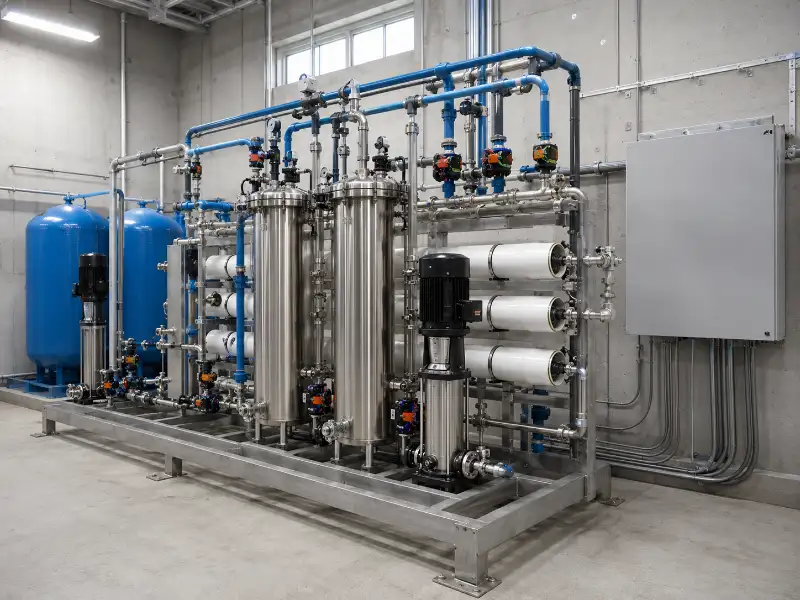
The quality target the train has to reach is set by the intended use and the destination market. The same source water can call for different methods, depending on whether the output is drinking water, boiler feed water, process water, or treated water for reuse. Drinking-water work follows the applicable local drinking-water regulations and references such as the WHO guidelines. Reuse or discharge follows the local permit and reuse standard. Exported equipment has to meet the destination market’s electrical and pressure-equipment requirements. We confirm which framework applies to your project before finalizing a method set, because the limits it sets can move the design. Because we fabricate the separation equipment in-house, the engineers who read the report are also the team that builds and pressure-tests the result.
Choosing the Right Method
The decision behind any water treatment system reduces to three things: the source water, the contaminant class that governs, and the end-use the treated water has to meet. Methods are tools matched to those inputs, not a ranking to pick from.
In practice, the systems that hold up over years are matched to a real water report at the start, not adjusted after commissioning. The variables that decide the match are project-specific, not universal: dissolved solids, hardness, pathogen load, and intended use. We confirm those variables against the source-water analysis and the destination market before committing a configuration. We revise the method set whenever the report calls for it.
The next step on your side is straightforward. Send us your source-water analysis and your application requirements, including flow rate and intended use. Our engineering team will review them and confirm a method set and configuration that fits. If you do not yet have a full water analysis, we can provide a testing checklist before that review. Working with water treatment equipment suppliers that fabricate and verify in-house keeps that confirmation accountable from specification through testing.
FAQ
The main methods divide into physical, chemical, and biological families, with membrane separation and disinfection running across them. Physical methods remove solids by filtration or settling. Chemical methods alter or react with contaminants. Biological methods use microorganisms to break down organic load. Most systems combine several to cover the full contaminant mix.
Conventional surface-water treatment moves through coagulation, flocculation, sedimentation, filtration, and disinfection in that order. Each stage prepares the water for the next. Low-turbidity groundwater often skips the early clarification stages, while heavily loaded or brackish water needs added steps such as oxidation or reverse osmosis.
No method is best in every case, because the right choice follows from the source water and the end-use. A reverse osmosis system suits dissolved salts, while disinfection suits pathogen control. The two solve different problems. Defining the governing contaminant first is what makes the comparison meaningful.
Physical treatment removes contaminants by a barrier or by settling, without changing their chemistry. Examples include filtration and sedimentation. Chemical treatment changes a contaminant’s form through a reaction, as in coagulation, oxidation, or ion exchange. Many trains use both, with chemical steps preparing solids for physical removal.
Most real water sources need more than one method, because a single method covers only one contaminant class. A typical train pairs pretreatment, a separation or chemical step, and disinfection. The exact combination follows from what the source-water report shows. We review that report before recommending a train.