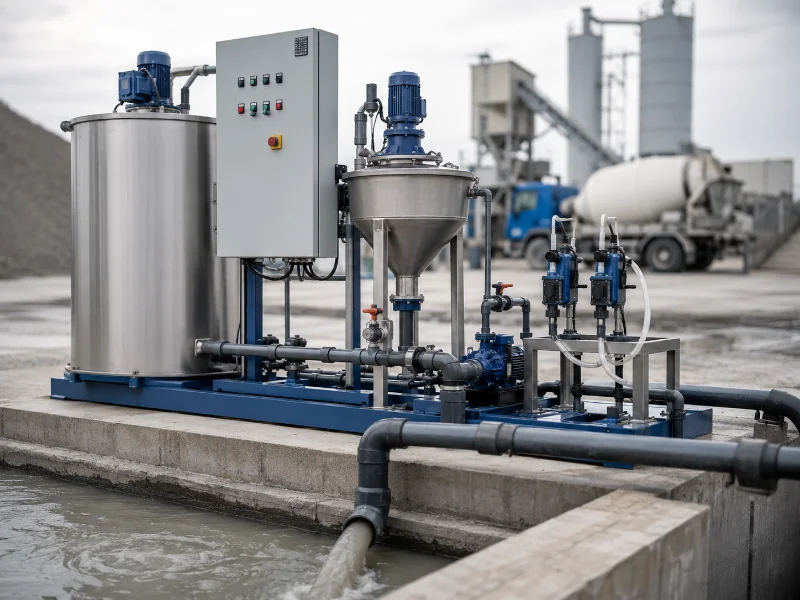
Concrete wastewater treatment removes suspended cement solids and lowers the high alkalinity in washout, slurry, and process water. The goal is a stream that meets a discharge limit or can be reused on site. Which method fits depends on flow rate, incoming pH, and the discharge target in your permit. Plants that produce ready-mix, precast, or cut-and-cored concrete all generate this water. The solids load and pH vary enough that no single configuration fits every site.
We design and fabricate the treatment equipment for these streams, and we review the source water before specifying anything. A mixer-chute washout behaves differently from hydrodemolition slurry or yard stormwater. This article covers how the water is treated and how to match equipment to it. The civil layout and piping on a specific site is a separate engineering step. It depends on your footprint and drainage routing, so we keep it distinct from the treatment decision.
What Concrete Wastewater Contains and Why Disposal Is Restricted
Concrete wastewater carries dissolved hydroxides and fine cement particles that push pH to roughly 11–13 and add a heavy load of suspended solids. How you treat it depends on both the alkalinity and the solids concentration coming off the operation. The coarse sand and aggregate settle quickly. The cement fines stay in suspension and keep the water cloudy and caustic.
Three sources usually feed the stream: mixer-drum and chute washout, slurry from cutting, grinding, and coring, and stormwater that contacts cement on the yard. Each carries a different mix of solids and admixture chemistry, so we check the actual source before sizing a clarifier or a pH stage.
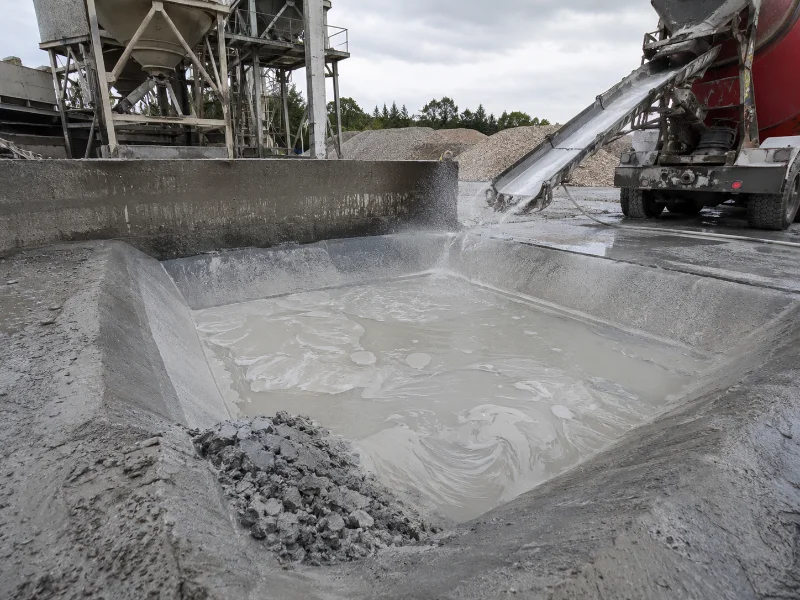
Beyond pH and suspended solids, concrete wastewater can also carry dissolved solids, sulfates, chlorides, alkalis, oil and grease, admixture residues, and trace metals such as chromium. These rarely control the first treatment step. But they can decide discharge approval, sewer acceptance, or later reuse, so we check them when the discharge route or reuse plan calls for it.
The high pH is what restricts disposal. Discharging caustic water to a watercourse harms aquatic life and is usually not permitted. Suspended solids can clog fish gills and smother breeding areas. The variable that drives the whole design is the gap between your incoming pH and solids and the limit you verify at the discharge point.
Why Settling Ponds Alone Miss Discharge Limits
Settling ponds remove coarse aggregate and sand, but they leave the stream alkaline. The dissolved hydroxides and the lightest cement fines that raise pH stay in suspension long after the heavy particles drop out. A pond can clear the water visually while the discharge still reads above pH 10. That is a common reason a site fails an inspection it expected to pass.
In our experience reviewing incoming setups, the stage operators most often find undersized is pH control, not solids handling. The pond, pit, or holding tank does its job on the visible solids. The alkalinity problem only surfaces when someone meters the outflow against the permit.
Dilution is not a workaround either. Lowering concrete wash water from around pH 13 to pH 9 with clean water would take thousands of liters of fresh water per liter of washout. That is neither practical nor compliant in most places. We close the gap with active neutralization and outlet pH checks, not a larger pond.
Neutralizing High-pH Concrete Wastewater With CO2 or Acid
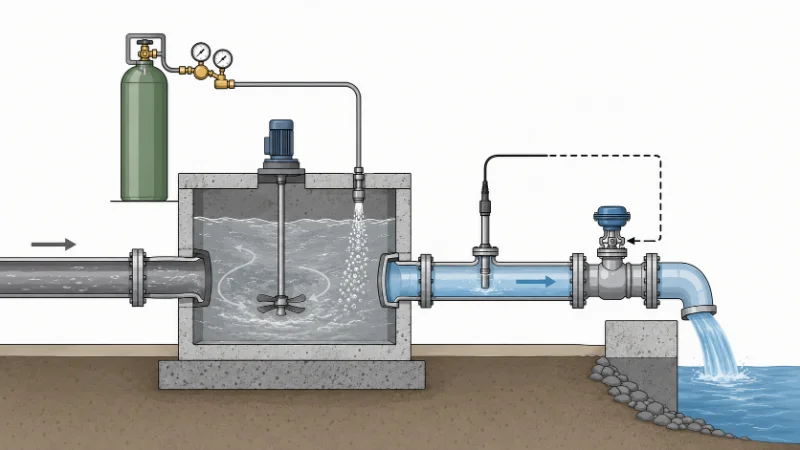
pH neutralization for concrete wastewater means adding a controlled acid source to the dissolved hydroxide. The choice between carbon dioxide and a mineral acid depends on two things: whether the flow is continuous or batched, and how much hazardous-chemical handling the site can manage. We compare these options against your flow pattern and operator skill before recommending one.
| Neutralizing agent | How it works | Overdose risk | Handling and footprint |
|---|---|---|---|
| Carbon dioxide (dissolved/injected) | Forms carbonic acid in water; buffers near neutral | Lower than strong acid, but still depends on contact time, flow swings, and control | No concentrated acid on site; suits inline continuous flow |
| Sulfuric / hydrochloric acid | Strong acid directly lowers pH | Higher; overshoot below pH 6 is possible without tight control | Requires hazardous storage, dosing control, and PPE |
| Weak organic acid (e.g. citric) | Mild controlled reduction for small volumes | Low to moderate | Simpler for occasional small batches, costlier per volume |
Carbon dioxide carries a lower over-acidification risk than strong mineral acids. It forms carbonic acid, buffers near neutral, and removes the need to store concentrated acid on site. That lower risk is not automatic, though. The system still needs pH probes, control valves, enough mixing and contact time, and regular calibration to hold the setpoint as flow and alkalinity vary. Mineral acid can be cheaper per unit treated, but it adds overshoot risk and handling hazards that you control with monitoring. For intermittent batch washouts, controlled dosing in a stirred tank can work. The condition is continuous pH monitoring, so the outflow does not swing below the lower discharge limit.
Separating and Dewatering Cement Fines and Slurry
Solids separation for concrete wastewater handles the cement fines and aggregate that settling alone leaves behind. We match the clarifier and dewatering stage to the slurry’s solids concentration and particle size, not to flow alone. A high-solids slurry from cutting or coring produces far more sludge than dilute chute washout. Undersize this stage and you face constant manual cleanout.
After primary settling, a filter press dewaters the concentrated sludge. The plant then handles it as a cake instead of pumping and re-pumping a slurry. We size the clarifier and the dewatering stage together, because the cake volume and dryness decide how often the plant disposes of solids, and at what hauling cost.
The variable to verify is the total suspended solids your permit allows at discharge. When the target TSS is tight, the clarifier and any multimedia filtration have to match it. We then align the solids stage with the pH stage so neither becomes the bottleneck.
Selecting a Concrete Wastewater System by Site Variables
System selection for concrete wastewater rests on a short set of site variables. Skip any one and you tend to get a system that is undersized at peak or oversized and idle. We match the water treatment system components to those variables, starting with the inputs below rather than an average.
| Design input | How to express it |
|---|---|
| Flow rate | m³/h or gpm; separate average, peak, and batch volume |
| Influent pH | normal range plus worst-case high |
| Alkalinity | mg/L as CaCO₃ (used to estimate CO₂ or acid dose) |
| TSS | mg/L; distinguish coarse solids from cement fines |
| TDS / conductivity | relevant for discharge approval and any reuse |
| Sludge load | m³/day or kg dry solids/day |
| Target pH | the setpoint your permit or sewer consent specifies |
| Target TSS | mg/L per permit or sewer authority |
| Treatment mode | batch tank / inline neutralization / clarifier / filter press |
| Monitoring | pH probe location, calibration frequency, data logging |
Those inputs map onto a configuration. The combinations below are typical starting points that we then verify against the actual data:
| Scenario | Typical configuration |
|---|---|
| Small batch washout | settling tank + batch pH dosing + outlet pH verification |
| Ready-mix plant | reclaimer + clarifier + CO₂ pH control + reuse tank |
| Hydrodemolition slurry | grit removal + coagulant/polymer + clarifier + filter press + pH adjustment |
| Surface-water discharge | equalization + solids removal + neutralization + polishing filtration + monitoring |
| Sewer discharge | solids reduction + pH adjustment + local sewer-authority approval |
These inputs interact. A small batch plant discharging to sewer under a relaxed pH ceiling needs far less than a plant discharging to surface water under an NPDES-style permit. Where flow swings widely, equalization in intermediate tanks smooths the load before neutralization. We verify the worst-case flow and pH, not the average, because the system has to hold compliance at the peak.
Reusing Treated Water and Meeting Discharge Targets
Reusing treated concrete wastewater is practical for controlled equipment washdown and dust suppression, where local rules permit it. Whether it suits a given use depends on the residual pH and solids after treatment. Treating on site reduces hauling and disposal costs. It also supports a lower-discharge operation where regulations push that direction.
Reuse for irrigation or as concrete mixing water is a separate question. Treating the stream for discharge does not cover it. It needs added testing for pH, TSS, TDS, salts, metals, and admixture residues. Mixing-water reuse in particular falls under standards such as ASTM C1602. That standard sets limits on chloride, sulfate, and total solids, and it calls for verification of strength and setting time. We align the treatment target with the intended end use, because discharge-grade water is not automatically fit for every reuse.
Matching the Treatment Method to Your Discharge Goal
Choosing a concrete wastewater system comes down to three variables: the incoming alkalinity, the solids load, and the discharge target you verify at the outlet. Get those right and the method follows from them, whether that is CO2 neutralization, controlled acid dosing, or staged solids separation.
We are a water treatment equipment manufacturer. Our engineering team reviews each project against the source water, the site electrical standards, and the destination-market discharge requirements before confirming a configuration. Several factors stay project-specific and have to be verified case by case. These include the worst-case flow, the actual incoming pH, and the limit set by your permitting authority. We treat them as inputs to confirm, not assumptions carried over from another site.
The next step is straightforward. Send us your influent pH range and worst case, peak flow and batch volume, TSS and TDS, discharge route, target limits, available footprint, and power supply. Our engineers will then match the neutralization, clarification, and dewatering stages to your operation. Working directly with the manufacturer rather than with intermediary water treatment equipment suppliers means the people specifying your equipment are the same people who fabricate and test it.
FAQ
Concrete wastewater usually runs between pH 11 and 13 from dissolved cement hydroxides, while treated discharge is normally required near neutral, often pH 6–9. EPA guidance on concrete washout cites aquatic-life ranges around pH 6.5–9 for freshwater and 6.5–8.5 for saltwater. The enforceable number is set by your NPDES permit, sewer authority, or discharge consent, so you verify the outflow against that specific limit.
One system can treat both washout water and yard stormwater when it is sized for the combined worst-case flow, and when the more contaminated stream sets the treatment level. Stormwater adds swings in volume, so equalization ahead of the neutralization stage keeps the system stable. We confirm whether to combine or separate the streams from your flow data and discharge route.
Neither CO2 nor acid is better outright; the right choice follows from flow continuity and on-site handling capacity. CO2 suits continuous flow and avoids storing concentrated acid on site. A mineral acid can serve batch operations when dosing is tightly controlled against overshoot.
Treated concrete wastewater can often be reused for equipment washdown or dust suppression where permitted, depending on its residual pH and suspended solids. Reuse as irrigation or concrete mixing water is a different case that needs separate testing and approval. Discharge-grade water is not automatically fit for those uses.
A concrete wastewater system needs pH monitoring at the outlet, handled by water quality instruments placed so they read the treated stream and calibrated on a regular schedule. Continuous logging and a low-pH or high-pH alarm confirm the discharge stays inside the permit limit between manual checks. The right monitoring frequency depends on flow variability and how tight the permit is.
Whether a small plant needs a system depends on its discharge route and permit limits, not on its size alone. A plant discharging to sewer under a relaxed pH ceiling may need only basic settling and dosing. One discharging to surface water usually needs full neutralization and solids control.