A new water treatment system costs anywhere from a few hundred dollars for a point-of-use filter to several million for a high-capacity industrial plant. The spread comes down to three things: flow rate, source water chemistry, and the quality target for treated water. No single figure applies. Two facilities with the same daily volume can need very different equipment once their raw water is tested.
This guide covers commercial and industrial systems, where the buyer is a business, importer, distributor, or contractor. Residential point-of-use units, which run from a few hundred to a few thousand dollars, sit outside its scope. Among water filtration equipment manufacturers, Hiju sits on the manufacturing side rather than the trading side. We frame cost the way our engineering team frames it during a quote: capacity first, water chemistry second, output standard third.
What a Commercial Water Treatment System Quote Includes
A commercial water treatment system carries four cost layers, plus a fifth for export buyers: equipment, engineering, installation support, commissioning, and the freight and documentation to ship and clear the system. The equipment is the visible cost. But the engineering that sizes and sequences it often decides whether the system performs at the quoted capacity.
Engineering scope is the layer buyers most often underestimate. Skip the process design and a system can clear the wrong contaminant set. That failure surfaces during commissioning rather than at the design stage, where it is far cheaper to correct. We verify the treatment train against a source water analysis before confirming any equipment list. That way we price all five layers against real conditions, not assumptions.
What Makes Water Treatment System Costs Vary
A fixed price for a water treatment system rarely holds because cost is set by the source water, not by the system name. Two buyers specifying industrial reverse osmosis systems of the same capacity can receive very different quotes once a lab analyzes their feed water. The label tells you the technology; the water tells you the price.
In our work across more than 20 export markets, the feed water is where most quote surprises originate. Brackish source water, high silica, or variable turbidity push a system toward extra pretreatment stages. Pretreatment is where cost climbs without changing the headline capacity. When a buyer compares two quotes on capacity alone and ignores the pretreatment difference, the cheaper system often fails earliest in the field.
One boundary is worth setting early. The figures in this guide cover the treatment system as engineered and fabricated. They do not cover the civil works, foundation, or site piping at the destination. Those depend on local conditions, and the buyer’s own contractor usually handles them. We clarify this split on the quote, so no one confuses the equipment budget with the total installed cost at site.
Cost factors that move a water treatment quote up or down
Five variables drive most of the movement in a water treatment quote, and each one shifts cost independently of the others:
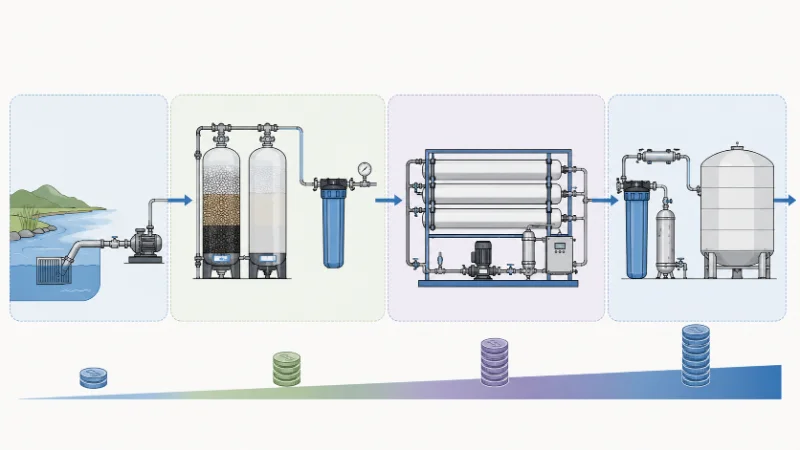
- Flow rate (capacity): Higher GPD or m³/day raises pump sizing, membrane count, and vessel volume. Cost rises with capacity, though rarely in a straight line, since base engineering and controls are partly fixed.
- Source water quality: A more contaminated or variable feed adds pre-treatment filters, which raise cost without changing rated output.
- Treated-water target: Stricter output standards, whether potable, process, or ultrapure, add polishing stages such as a second RO pass or post-treatment.
- Materials of construction: Stainless steel vessels and corrosion-resistant components cost more than coated carbon steel or plastic, but extend service life in aggressive or high-chloride water.
- Automation and controls: PLC control, remote monitoring, and automated cleaning add to the panel cost while reducing manual operating labor over the system’s life.
The source-water variable is the one buyers can quantify in advance. Specific values in a water analysis map directly to cost. We review each of these values against the destination standard before pricing:
| Water-report value | Why it moves the quote |
|---|---|
| Flow rate / peak flow | Sizes pumps, membrane count, vessels, and pipe diameter |
| TDS / conductivity | Sets RO pressure, number of passes, and achievable recovery |
| Turbidity / TSS / SDI | Decides multimedia filtration, ultrafiltration, and cartridge stages |
| Hardness / alkalinity | Drives softening, antiscalant dosing, and cleaning frequency |
| Silica | High silica caps recovery and adds pretreatment or reject handling |
| Iron / manganese | Adds oxidation and filtration; raises membrane-fouling risk |
| Chloride / sulfate | Influences material selection and corrosion allowance |
| COD / BOD / oil & grease | On wastewater projects, sets biological, flotation, or oxidation stages |
Typical price ranges by system type and cost boundary
Price ranges for water treatment systems span several tiers, set by capacity and treatment complexity rather than by brand. Each figure means little until you know whether it covers equipment only or a fully installed plant. The brackets below come from published industry cost guides. Read them as planning ranges, not quotes.
Which tier you need starts with the treated-water target. That target is usually a named standard, not a generic “clean water” goal. Potable projects may reference EPA Maximum Contaminant Levels in the United States, the EU Drinking Water Directive (2020/2184), WHO-based national guidelines, or NSF/ANSI/CAN 61 for materials in contact with drinking water. Discharge projects tie instead to the local permit or effluent limit, such as an NPDES-style permit in the US, rather than a universal number. We align the output stages to the destination standard before sizing, because a stricter target adds polishing steps and cost.
| System type | Capacity basis | What the figure typically covers | Reported planning range* |
|---|---|---|---|
| Commercial system | Low–mid flow (GPM) | Skid equipment + basic integration; excludes site civil works | From ~$45,000 for simpler systems, per industry guides |
| Industrial RO / process skid | ~10,000–100,000+ GPD | Skid equipment; pretreatment and installation often separate | ~$15,000–$300,000+, widening with staging and pretreatment |
| Engineered raw / process water plant | Higher flow (GPM) | Engineered system, often including process engineering | Mid-six to seven figures; large raw-water systems are reported into the $1–3M range |
| Zero liquid discharge (ZLD) | 1–20 up to 1,000–3,000 GPM | Fully installed, including evaporator / crystallizer | ~$250,000–$2M (small) up to $25–50M (large), per industry references |
*Planning brackets from published industry cost guides, not Hiju quotes. Actual price is set by water chemistry, materials, and installation scope.
These brackets overlap on purpose, because a small industrial RO skid and a large commercial system can land in the same range. We size against your actual flow and water report rather than a tier label, since the label alone does not set the price.
Installation, shipping, and ongoing operating costs
The equipment price is one part of total cost of ownership. Shipping, installation, consumables, and energy form the rest. For export buyers, the landed and operating costs can rival the equipment line over a system’s life. Reading only the equipment number understates what the system will cost to run.
For export orders, freight, insurance, and documentation move with system size and destination. We prepare that documentation in-house as part of the order. On-site installation cost depends on local labor and site conditions. We scope our role as supply, installation support, and commissioning guidance, not local civil works. Every system clears a final hydraulic pressure test before it ships. That test is where we catch fabrication faults at the factory, not at the buyer’s site.
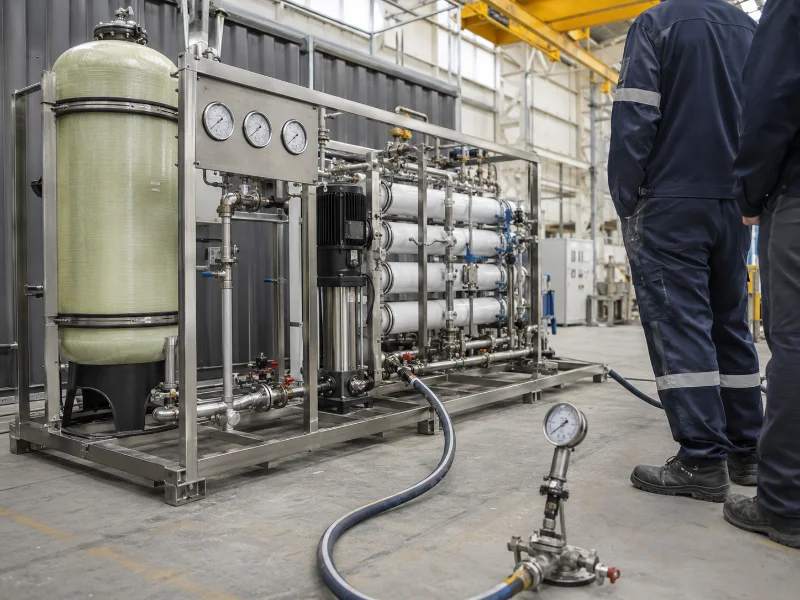
Consumables and energy drive most of the operating cost. Membranes, media, and cartridges follow a replacement schedule that depends on feed water and load. Higher-recovery or higher-pressure systems draw more power. We design recovery and staging to keep these running costs predictable, rather than minimizing them at the expense of membrane life.
How to get an accurate water treatment system quote
An accurate quote depends on a short set of inputs from the buyer. A quote issued without them is an estimate, not a price you can budget against. We cannot confirm the treatment train until we know the source water, the flow, and the destination standard.
We ask for these before our engineering team confirms any configuration, because each one changes the system. To return a budgetary quote, send your source water analysis, required flow rate, operating hours, inlet pressure, target output standard, and destination voltage. We review every inquiry against source water conditions, site electrical standards, and destination-market requirements before confirming a configuration. That review is what keeps a quote from drifting once the order is placed.
Conclusion
The cost of a new water treatment system traces back to three decisions: capacity, source water, and output standard. Read a quote against those three and the wide price ranges start to make sense. Every stage in the system maps to one of them.
As a manufacturer shipping to more than 20 markets, we have seen the cheapest quote become the most expensive system. The cause is usually pretreatment cut to hit a number. Our engineering team, working from our Qingdao facility, reviews source water and destination requirements before issuing a specification. The right configuration depends on water chemistry that a price list cannot capture.
If you are budgeting a system, the next step is to send your source water analysis and application requirements. We will review them against your flow and destination standard and return a configuration and quote you can plan around. Contact our team to start that review.
FAQ
A commercial RO system near 10,000 GPD usually lands in a five-figure range in published cost guides. The figure moves with feed TDS, the recovery target, and how much pretreatment the water needs. We price it against the water report, not the capacity alone.
The cost gap between commercial and industrial systems comes from flow, pretreatment, and output standard, not the label. Commercial systems start lower because they handle lower flow and simpler water. The gap widens as capacity, pretreatment needs, and the purity target climb.
Brackish water RO systems cost more to run than low-TDS municipal RO because higher TDS raises operating pressure, adds membranes, and lowers recovery. A brackish feed also tends to need more pretreatment, so the same rated output costs more to produce.
Pretreatment cost varies with the feed water and is not a fixed share of the system price. The cost climbs when the source carries high silica, iron, turbidity, or organics, because each one adds a dedicated stage ahead of the membranes.
You can reduce system cost by right-sizing capacity and matching materials to your actual water, not by thinning the pretreatment that protects the membranes. We compare configurations against your water report to drop stages you do not need while keeping the ones that hold operating cost down.