
Industrial Water Treatment Solutions —
Engineered for Your Application.
We assess source water type, TDS, turbidity, and daily demand before specifying a single component. The treatment route we design for your application follows your actual water conditions — not a fixed catalog. Our engineering team designs each industrial water treatment solutions package around your process water analysis, not a standard spec.
*available on request for applicable pressure-rated components
Match the treatment route to your actual water — not a catalog spec.
The eight routes below summarise the treatment paths and engineering thresholds we apply when specifying industrial water treatment solutions for each major application. Select the route that matches your sector.
Route: Softener → BWRO → Vacuum degas → Chemical dosing.
Threshold: Hardness < 0.03 mmol/L (M-HP class; confirm with boiler OEM).
Route: MMF → Activated C → RO → UV (+ optional O₃).
Threshold: RO permeate < 50 ppm TDS; free Cl < 0.1 ppm at membrane inlet.
Route: MMF → Softener → 2-pass RO → EDI → UF.
Threshold: Pharma PW ≤ 1.3 µS/cm (USP/Ph. Eur.); Electronics UPW ≤ 0.1 µS/cm.
Route: Softener → Precision filter → RO (if TDS required) → UV.
Threshold: Softener outlet < 1 ppm CaCO₃ for hot-water and commercial steam circuits.
Route: Coag/Floc → MMF → Cartridge → SWRO → Remineralisation → UV.
Threshold: SWRO 55–70 bar; ERD required; ASME-compliant pressure vessels where project spec requires.
Route: Softener → UF → RO (for process water) + Coag/DAF → MBR → RO (for effluent reuse).
Threshold: Dye bath hardness 3–5 mg/L as CaCO₃; reuse TDS gate confirmed by dye class and batch trial.
Route: Sediment/MMF → Softener or BWRO (per TDS) → UV (+ optional O₃).
Threshold: Irrigation TDS < 1,000 ppm for salt-sensitive crops; UV dose validated from UVT and peak flow.
Route: Coag/Floc → MMF → Activated C → UV or Cl₂ (+ optional BWRO).
Threshold: Local drinking-water standard governs TDS target; disinfection non-negotiable for surface water.
Water Treatment Requirement Assessment — Five-Step Engineering Process.
Before recommending any configuration, our engineers work through a structured five-step assessment so the system performs to spec from commissioning — not after a redesign cycle.
| Variable | Typical Range | Design Significance | Configuration Approach |
|---|---|---|---|
| Feed water TDS | Fresh / low-TDS to seawater; TDS target set by local regulation, not WHO standard | Determines RO membrane class, operating pressure class, and pre-treatment depth. | Brackish: standard BWRO at 6–12 bar. Seawater: SWRO at 55–70 bar. Low-TDS: filtration + disinfection may suffice. |
| Silt Density Index (SDI) | < 5 at RO inlet | Governs pre-treatment depth and media filtration design; SDI > 5 fouls membranes within weeks. | Surface water: coagulation + MMF + 5 µm cartridge. Groundwater: MMF + cartridge for most sources. |
| RO permeate TDS | < 50 ppm food / < 5 ppm pre-EDI | Sets number of RO passes and polishing requirements. | Single-pass for most applications; double-pass for pharma PW and pre-EDI; EDI for ≤ 1.3 µS/cm. |
| Permeate conductivity | Pharma PW / WFI: ≤ 1.3 µS/cm (USP / Ph. Eur.; confirm by applicable pharmacopoeia). Electronics UPW: ≤ 0.1 µS/cm / 18.2 MΩ·cm where fab spec requires. | Pharma requires EDI after double-pass RO; electronics UPW may require additional mixed-bed polishing stage. | Confirm target by pharmacopoeia edition and application; EDI is mandatory above ≤ 1.3 µS/cm target. |
| System recovery rate | 50–85% BW · 35–45% SW (typical ranges; final set from feed TDS, scaling index, brine disposal capacity, and membrane selection) | Affects concentrate volume, discharge planning, and water-scarce site economics. | Confirmed after reviewing source TDS, brine disposal constraints, and product demand. |
| Boiler feed hardness | < 0.03 mmol/L for medium- to high-pressure boilers (preliminary screening reference; confirm with boiler OEM specification and applicable national boiler water standard) | Combined softener + RO sizing; insufficient hardness removal causes scale inside boiler tubes. | Softener → BWRO → degas → chemical dosing for M-HP class boilers. |
| Community daily demand | 50–150 L per person per day for basic supply | Undersized system creates supply gaps at peak demand; insufficient storage causes unfiltered bypass during maintenance. | Total daily volume from population × per-capita; storage sized for 8–12 hours output. |
| Irrigation TDS limit | < 1,000 ppm for most salt-sensitive crops; adjust per crop, soil, and irrigation method | Above threshold, dissolved ions suppress yield, accelerate soil salinisation, and clog drip emitters. | BWRO where source TDS exceeds crop tolerance; softener alone for hardness-only correction at low TDS. |
Softener vs RO — the routing decision
A softener removes Ca·Mg hardness through ion exchange but does not reduce TDS. Groundwater at 800 ppm TDS treated by a softener: scaling risk gone, TDS stays ~800 ppm. Targets below 500 ppm — drinking water, food process, M-HP boiler feed — require RO. Where scale prevention is the only goal and total dissolved load is acceptable, softening alone suffices — this is the routing logic for any industrial water treatment solutions engineering review.
Sizing from design flow, not rated capacity
A system specced at 10 m³/h for continuous duty runs at design max from day one. If real demand fluctuates, intermittent full-load operation without pressurised storage and auto control creates short-cycling, membrane pressure stress, and accelerated pump wear. Size to peak demand plus margin, with storage and control logic for intermittent demand profiles. For community water stations: 8–12 hours of treated storage eliminates source-pump dependency at peak morning draw.
Industrial water treatment solutions — manufactured and certified in Qingdao.
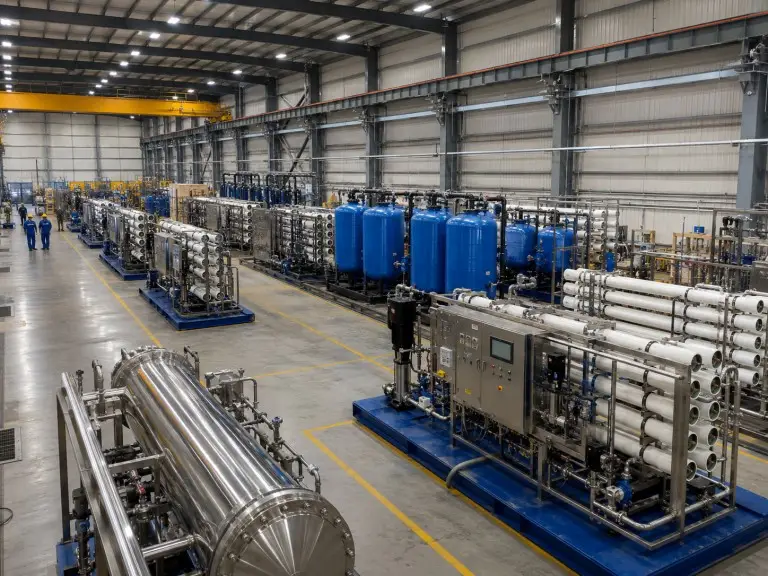
Founded in 2016, Qingdao Hiju Thermal Power Co., Ltd operates from a 70,500 sqm facility with 21,000 sqm of dedicated production workshop space. Hiju is an industrial water treatment company with manufacturing in Qingdao since 2016 — our engineering team comprises 78 technicians and 28 engineers structured to handle full project scope from design review through factory testing to export documentation.
We hold CE, ISO 9001 and ASME-related manufacturing documentation for applicable pressure-rated components. ASME-compliant documentation can be supplied on request where project specifications or local regulations require it. CE and ISO 9001 are standard compliance documentation for industrial water treatment equipment exports across Southeast Asia, the Middle East, Africa, South America, and Central Asia — reviewed at tender stage and supplier qualification audits.
Our systems have been exported to clients in more than 20 countries and regions. Review our completed engineering projects to verify project type, application, and export geography without relying on marketing claims, or browse the full range of industrial water treatment solutions by application sector.
Submit your water treatment requirements.
Our engineering team reviews water parameters and application before recommending a configuration. You don’t need complete data at first contact — partial information is enough to open the review.
Water & process inputs
- Water source — Municipal, groundwater (with depth), brackish, seawater, surface, or industrial recycle.
- Water quality data — TDS, turbidity, hardness, iron, manganese, SDI, pH; full laboratory analysis report if available.
- Target output quality — TDS limit, conductivity target, or industry standard (WHO, USP, HACCP, boiler OEM spec).
- Application & industry — Boiler, pharma, F&B, textile, hotel, aquaculture, irrigation, municipal.
- Design flow rate — m³/h or m³/day; peak and average if variable.
Site & project inputs
- Site operating conditions — Voltage / Hz, footprint, ambient temperature, altitude if relevant.
- Concentrate & backwash disposal — Drain capacity, TDS discharge limits, ZLD requirement if applicable.
- Downstream equipment — Boiler pressure class, process line material, distribution minimum pressure.
- Project destination — Country / region (voltage, certification requirements, shipping).
- OEM / ODM scope — White-label, custom branding, integration, process flow docs for tender.
For rapid dialogue in Southeast Asia, the Middle East, Africa, or Central Asia, contact our engineering team via WhatsApp or email with your source water data and application details.
For coastal and island communities where the water source is seawater or high-salinity coastal bore, our seawater desalination and remote area supply solutions address that scenario with purpose-built SWRO and energy recovery configuration. desalination plant seawater
For pharmaceutical, laboratory, and electronics facilities requiring sub-µS/cm conductivity and TOC below 10 ppb, our pharmaceutical and electronics ultra-pure water systems address the higher purity specification pathway. d i water system