
Tank Self-Cleaning Sterilizers
Stored water re-contaminates in the tank. Our tank self-cleaning sterilizers maintain active disinfection inside the stored volume without draining and without external chemical dosing — because inlet disinfection alone cannot maintain microbial control in stagnant corners and low-turnover zones. This equipment does not physically remove sediment, scale, or established biofilm, and does not eliminate the need for scheduled tank inspection and cleaning.
When the Tank Becomes the Risk Point
A UV sterilizer at the inlet pipe treats water as it flows past the lamp — it does nothing for the volume already sitting in the tank. A chlorine dosing point may create a localized residual near the inlet zone, but as that residual depletes over hours, far corners and lower zones receive diminishing protection. Manual cleaning removes visible accumulation and then leaves the tank unprotected until the next scheduled event.
Coliform Regrowth
During 6-18 hour stagnation intervals between peak demand periods, total coliform counts climb in unprotected rooftop tanks, underground cisterns, fire water reserves, and ingredient water holding vessels.
Biofilm and Algae
Algae establish biofilm on tank walls and internal surfaces. In low-circulation dead zones, biological growth accelerates between manual cleaning events — invisible from outside the tank.
Legionella Conditions
Warm (25-45°C), stagnant water with biofilm surfaces and insufficient residual disinfection creates conditions Legionella can exploit. Hotel and hospital water supply rooms are high-risk scenarios.
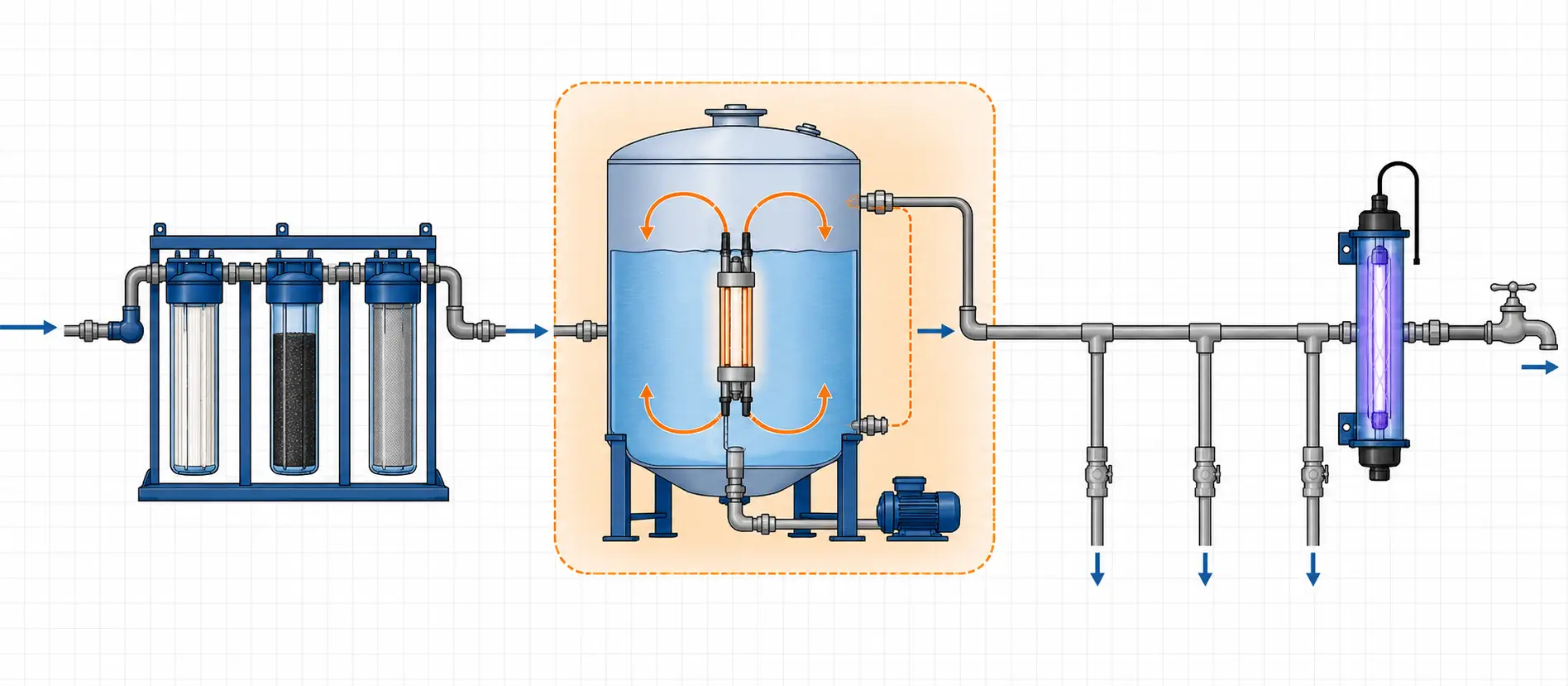
This equipment does not compete with inline flow-through disinfection. It occupies a distinct position in the treatment train: between the point where treated water enters the storage volume and the point where it exits into the distribution system.
We build around active recirculation combined with disinfectant generation. Our circulation unit draws water from the tank interior, exposes it to ozone, electrochemically generated oxidants, or UV radiation, and returns it in a pattern engineered to reduce dead corners. The control cabinet runs the cycle continuously or on a programmable timer, including overnight off-peak windows when draw demand is zero.
Two Configurations, One Decision Logic
The decision between built-in WTS and external SCII depends on tank geometry, available external pipe space, maintenance access requirements, and ozone contact time needs. Our engineers apply the following logic when reviewing buyer inquiries.
| Decision Factor | Built-in (WTS Type) | External (SCII Type) |
|---|---|---|
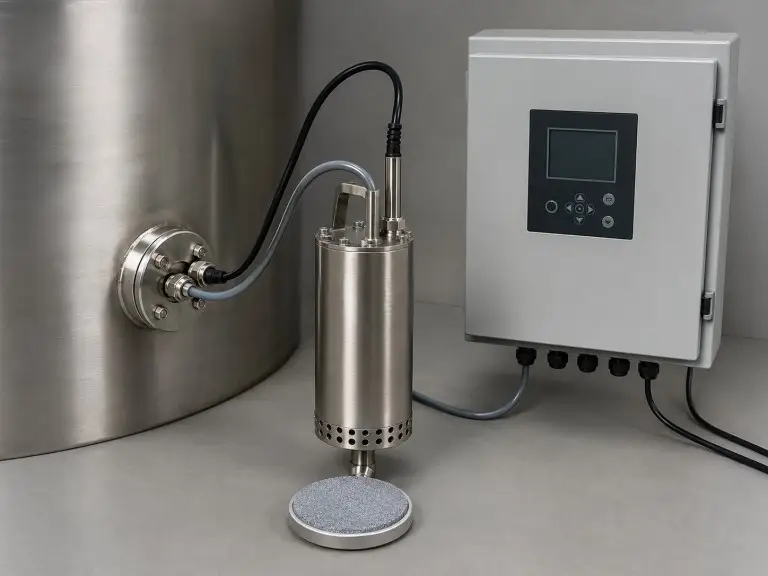
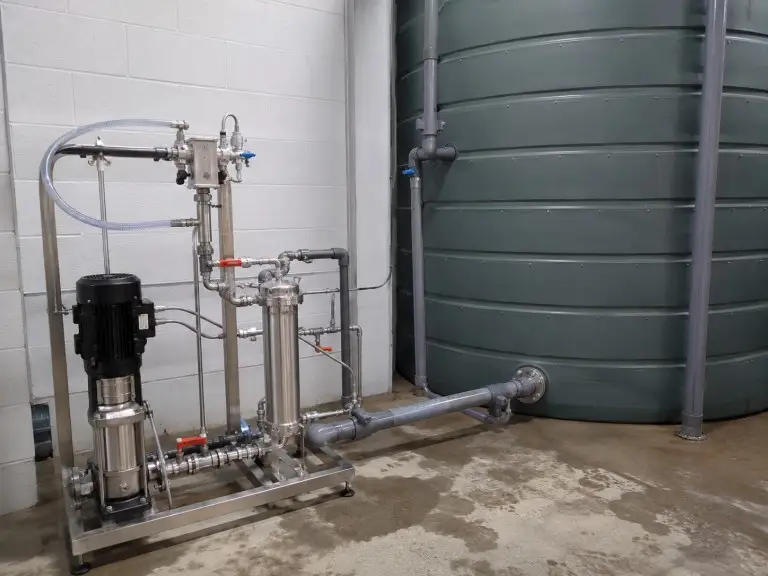
| Operating Principle | Submersible circulation unit and ozone aeration diffuser installed inside the tank; microcomputer control cabinet mounted externally; cable and air pipe pass through the tank wall. | Pump extracts water from the tank bottom, routes it through an external ozone contact unit, and returns treated water through a top or side inlet. |
| Best Fit Conditions | Rooftop tanks with limited pipe routing space, underground tanks where an external loop is impractical, or retrofits requiring minimal external equipment footprint. | Sites with frequent maintenance access needs, demanding compliance review, and enough adjacent equipment space for pump, injector, and contact unit. |
| Ozone Contact | Ozone releases directly into the stored volume; effective contact time equals the full tank residence time. | Ozone contact time is extended and controlled in the external contact unit before water returns to the tank. |
| Installation Requirements | Cable and air pipe penetration through tank wall; dry ventilated control cabinet location; standard access port required. | Two pipe connections on the tank: bottom extraction plus top or side return; external pump loop positioned beside the tank. |
| Maintenance Access | Generator output and diffuser checked through tank access port; annual circulation pump impeller check; no tank draining required. | Pump, ozone injector, and contact unit remain fully accessible from outside the tank; routine service requires no tank entry. |
| When We Recommend It | Space-constrained rooftop installations, fire water tanks without pipe loop access, or retrofits into existing tanks with only a single wall access port. | Hotel, hospital, food plant, and municipal tanks where maintenance audit frequency is high and an equipment room allows an external loop. |
Both configurations use 304 stainless steel water-contact components. We confirm the final configuration during sizing review of tank dimensions, wall access, pipe connections, and service access.
Three Disinfection Paths, Which One Fits Your Tank
Technology selection is confirmed at quote stage based on tank volume, source water type, daily turnover, application risk, and downstream constraints.
Ozone (Corona Discharge) Standard Option
High-voltage corona discharge generates O₃ from ambient air. Ozone carries an oxidation-reduction potential of 2.07 V, compared with 1.36 V for chlorine, and reacts with bacterial cell membranes significantly faster than chlorine at equivalent applied concentration. After disinfection, dissolved ozone decomposes primarily back to oxygen and leaves no persistent ozone residual under normal operating conditions.
Our ozone units are sized from 5 g/h to 100 g/h against tank volume, exchange cycle frequency, and organic load. For potable water or bottled water storage, bromide concentration should be reviewed before ozone-based disinfection because bromate formation may require dose or process-control limits.
Micro-Electrolysis for Smaller or Air-Limited Sites
Micro-electrolysis fits sites where gas routing, an air compressor, or a separate ozone generator would make the installation too complex. For tanks below approximately 10-20 m³, confirmed during engineering review, the system generates mixed oxidants in the recirculating water depending on water conductivity, chloride content, electrode configuration, and operating current. We confirm water chemistry before recommending this option.
The key check is whether the full stored volume can recirculate through the electrolysis cell within the programmed cycle.
UV-C Floating + Ozone for Specialist Applications
For pharmaceutical water storage, semiconductor rinsing water, deionized water holding tanks, or strict chemical-free service, we can pair a UV-C floating element with an ozone stage. The UV-C element operates at 254 nm and is specified around a reference dose target, but final log-reduction expectations must be validated against target organisms, UVT, turbidity, lamp position, and tank mixing conditions.
This option requires pre-filtered, low-turbidity water because suspended solids scatter UV radiation and reduce delivered dose.
Final compliance for pharmaceutical or semiconductor applications must be confirmed against the user’s process specification, validation protocol, and applicable local standard.
| Technology | Mechanism | ORP | Speed vs Chlorine | Residual |
|---|---|---|---|---|
| Corona discharge ozone | O₃ generated from air, injected into recirculating tank water. | 2.07 V | Significantly faster than chlorine at equivalent applied concentration | Decomposes primarily to oxygen; no persistent residual. |
| Micro-electrolysis | Electrochemical generation of HOCl, ClO₂, O₃, and active oxygen in water. | Mixed oxidant system | Project-dependent | No gas supply or compressor required. |
| UV-C + ozone | 254 nm UV-C inactivation plus ozone oxidation in stored water. | Ozone-assisted | Dose-dependent | Chemical-free specialist configuration. |
Technical Specifications and Operating Boundaries
These parameters apply to both configuration types unless noted.
| Parameter | Value / Range |
|---|---|
| Configuration type | Built-in (WTS) / External (SCII) |
| Disinfection technology | Ozone corona discharge / Micro-electrolysis / UV-C + ozone combination |
| Ozone output | 5 g/h – 100 g/h, project-matched to tank volume and cycle requirement |
| Power supply | 220V/50Hz standard; 110V/60Hz available for export |
| Operating pressure | <=0.6 MPa |
| Water temperature operating range | 0°C – 50°C |
| Sterilization rate | >=99.5-99.9% for E. coli, total coliforms, and Staphylococcus aureus under standard test conditions; field performance depends on water quality, ozone dose, and contact cycle |
| Algae removal rate | >=99% under standard test conditions; field results depend on organic load and exposure cycle |
| Control mode | Microcomputer timer with adjustable schedule; PLC option for BMS/SCADA integration |
| Water-contact parts material | 304 stainless steel |
| Ozone generator element service life | Model- and duty-cycle dependent; confirmed in quotation with recommended inspection and replacement interval |
| Tank volume sizing | Project-specific; confirmed at engineering review |
| Maintenance requirement | Periodic intake filter mesh cleaning; annual pump impeller and ozone generator output check |
| Tank draining required for installation or maintenance | No |
Operating boundary conditions: ozone decomposition accelerates as water approaches 50°C and at elevated pH, reducing available disinfectant concentration. Systems above 0.6 MPa require separate engineering review. High organic load and elevated suspended solids spike ozone demand and reduce effective disinfection dose.
Where This Equipment Fits, and Where It Does Not
Suited for
- Stored stagnant water in covered rooftop tanks, underground cisterns, fire water reserves, hotel and hospital water supply rooms, food processing ingredient tanks, and community distribution storage.
- Retrofit installation into existing tanks. Built-in WTS uses a standard wall access port; external SCII connects to existing or newly installed pipe fittings.
- Automated ongoing disinfection between manual cleaning cycles with programmable scheduling via microcomputer timer.
- Export markets requiring CE and ISO 9001 certified equipment from a documented manufacturer (ASME documentation available on request).
When the tank has accessible wall penetration or pipe-loop conditions, we can usually configure the sterilizer without structural tank modification.
Requires review or is not suited for
- Raw source water without upstream pre-treatment: high organic load spikes ozone demand, while turbidity in the UV-C option scatters radiation.
- Water temperatures consistently above 50°C: ozone decomposition accelerates and reduces disinfection efficacy in the stored volume.
- System pressures above 0.6 MPa: standard units are not rated for high-pressure lines without engineering review.
- Substitution for inline point-of-entry pipe treatment. This equipment protects the stored volume; it does not extend protection into the downstream network.
For source water that needs upstream treatment before storage, review our water disinfection systems scope before sizing a tank sterilizer.
Six Scenarios Where Stored Water Becomes the Risk
Each scenario below identifies a specific water quality risk condition, not just an industry category; configuration type and key operating conditions are noted for each.
| Scenario | Specific Risk | Recommended Config | Key Operating Condition |
|---|---|---|---|
| High-rise residential rooftop tank | 8-16 hour overnight stagnation; total coliform and algae counts climb; tank surfaces develop biofilm without ongoing disinfection. | Built-in WTS | Timer set for overnight off-peak cycle; decomposition window before early-morning peak demand. |
| Hotel water supply room | 6-18 hour low-occupancy intervals; plant room ambient 30°C+ in warm climates; conditions that may support Legionella risk when warm temperature, stagnation, and insufficient disinfectant residual are present. | External SCII | Compliance audit access; project-specific Legionella validation required for documentation. |
| Hospital or school potable storage | Duty-of-care compliance, Legionella audit trail requirements, and manual cleaning shutdowns that disrupt facility operations. | External SCII with PLC option | PLC log available for hygiene audit records; BMS/SCADA integration option. |
| Industrial process water and fire reserves | Zero-draw months; biofilm and algal growth degrade quality and accelerate corrosion on tank interior surfaces. | Built-in WTS | No process shutdown for installation or maintenance; confirm fire engineering specification. |
| Food and beverage ingredient water | Bacterial contamination triggers production shutdown and batch rejection; algae growth accelerates between production shifts. | External SCII or WTS per layout | Ozone decomposes primarily to oxygen with no persistent residual; daily turnover above 80% lowers demand versus low-turnover reserves. |
| Municipal or community secondary storage | Partial drain-refill contamination cycle throughout the day; tightening secondary storage regulations across Southeast Asia, the Middle East, and Africa. | External SCII for large tanks / WTS for smaller points | PLC option for utility management integration; timer synchronized with refill cycles. |
Food processing operations with ingredient water hygiene documentation requirements can find further context on our drinking water bottling plant solutions page.
Where Tank Self-Cleaning Sterilizers Fit in Your Treatment Train
Upstream of the Tank
Source water should arrive pre-filtered and, where required, pre-softened or pre-conditioned. High turbidity or high organic load entering the tank directly spikes ozone demand and reduces the effective disinfection dose available for target organisms.
At the Tank
Our equipment maintains active disinfection across the stored volume, including dead corners and low-turnover zones that inlet treatment cannot reach regardless of inlet disinfectant concentration.
At the Distribution Point
For applications requiring a final barrier at the point of entry into a distribution network, UV disinfection water treatment systems treat flowing water in the pipe. UV provides no ongoing protection to the stored volume upstream, so the systems are complementary.
For Large-Scale Ozone Dosing
Where a plant requires sustained ozone injection into a main treatment train rather than in-tank sterilization of a storage vessel, ozonators for water treatment are the correct product class.
For municipal and community secondary distribution storage projects, further application context is available on our water filtration system for drinking solutions page.
Engineering Boundaries to Check Before Every Installation
Skipping pre-treatment on high-turbidity or high-organic-load water
We see this on sites where source water assessment was skipped: organic matter competes directly with bacteria and algae for available ozone dose. Ozone may be depleted before reaching target organisms at adequate concentration, and the problem can remain invisible until water quality testing reveals inadequate disinfection coverage.
Built-in WTS specified without confirming wall penetration feasibility
Our engineers have reviewed installations where built-in WTS was specified without confirming wall penetration feasibility. Built-in installation requires cable and air pipe through the tank wall. Sealed concrete or FRP structures with no penetration provision often require pivoting to external SCII, provided two pipe connections can be made on the tank exterior.
Timer programmed for peak demand hours instead of off-peak windows
We regularly catch timer schedules programmed for peak demand hours rather than off-peak windows. Ozone injected during active draw is carried into distribution at higher concentration than during resting tank conditions. For a rooftop residential tank, a 2:00-5:00 AM overnight cycle typically provides decomposition margin before early-morning demand.
Treating the sterilizer as a substitute for physical tank cleaning
We address this misapplication directly at the inquiry stage. The sterilizer suppresses biological growth and maintains water quality. It does not physically remove sediment, scale, or established biofilm already adhered to tank surfaces. The practical outcome is an extended cleaning interval, not an eliminated cleaning requirement.
Selecting output capacity from a catalog without engineering review
Our engineers have seen catalog-selected outputs cause inadequate field performance more often than any other single factor. Ozone output requirement is a function of tank volume, exchange cycle frequency, source water organic load, and tank geometry. A 200 m³ fire reserve tank with zero daily turnover needs different coverage than a 200 m³ ingredient water tank cycling much of its volume daily.
Tank Sterilizer Quote Inputs
We calculate ozone output for every inquiry response rather than selecting from a published table.
- Tank dimensions and volume — m³; rooftop, underground, fire reserve, ingredient, distribution
- Wall access / pipe loop conditions — single wall port or two pipe connections available
- Source water type and pre-treatment — pre-filtered, softened, raw; bromide if potable
- Daily turnover or exchange cycle — high turnover, batch, fire reserve (low/zero turnover)
- Application risk — Legionella documentation, F&B hygiene audit, fire reserve, drinking water
- Configuration preference — Built-in WTS or External SCII (or request engineering recommendation)
- Technology preference — ozone, micro-electrolysis, or UV-C + ozone
- Control integration — local timer, PLC, BMS/SCADA
- Power supply — 220V/50Hz standard; 110V/60Hz for export markets