
Stainless Steel Cartridge Filter Housings
We position the stainless steel cartridge filter housing as the last particle barrier before the RO feed pump, not an optional upgrade. Once particles bypass this stage, they reach membrane surfaces that cost orders of magnitude more to replace. We supply SS304 and SS316L cartridge filter stainless steel housings in single-cartridge and multi-cartridge configurations, from point-of-use single-element units through to large industrial assemblies accommodating 150 or more cartridges, compatible with 2.5″ standard and 4.5″-6″ high-flow elements.
The Last Barrier Before Your Membranes
We position the stainless steel cartridge filter housing as the last particle barrier before any RO or membrane system – its function is terminal protection, not general upstream clarification. After bulk suspended solids have been reduced by multi media filter in the upstream pretreatment train, the cartridge housing catches residual fine particles – typically at 5 μm and above – before they reach membrane surfaces. At this stage, a particle that bypasses filtration goes directly to the membrane element, not to another filter bed downstream.
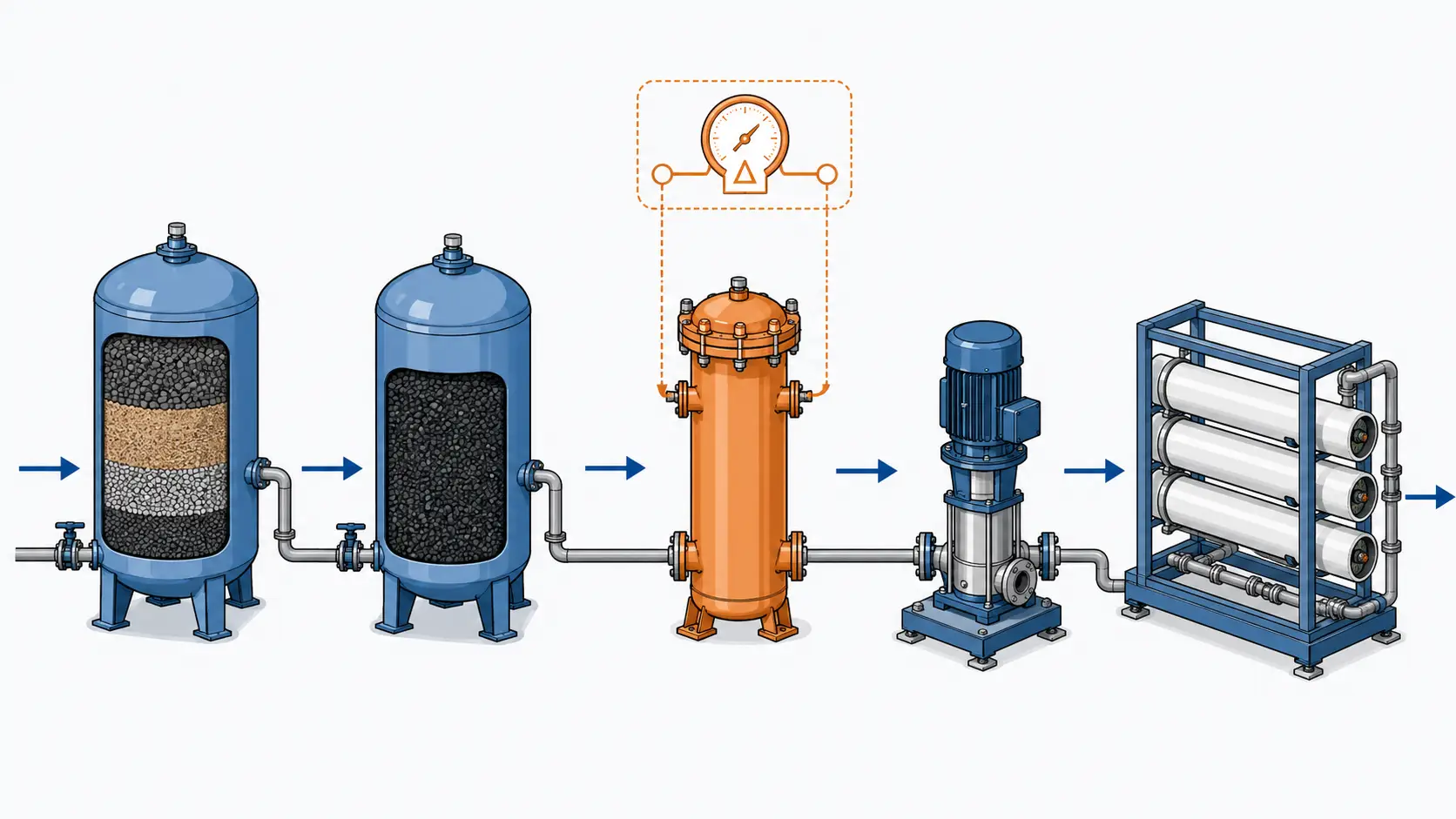
A 5 μm breach at this stage reaches RO membranes – not a downstream sand bed.
The cost logic behind treating this housing as a required system component rather than an optional polishing step is concrete: RO membrane elements cost orders of magnitude more than the cartridges that protect them. Particles that abrade or foul a spiral-wound element cause irreversible flux reduction or physical damage. We treat premature membrane replacement as the primary risk this housing prevents – not an abstract downstream concern to be addressed after the membranes begin to underperform.
The standard pre-RO pretreatment sequence we supply runs from raw water intake through carbon media filter for chlorine and organics reduction, then into the stainless steel cartridge filter housing at 5 μm absolute before the high-pressure RO feed pump. Each stage in this sequence removes a specific fouling mechanism; the cartridge filter addresses fine suspended particles that upstream media beds pass in variable amounts depending on backwash cycle timing, seasonal water quality, and feed water fluctuation.
Correct Selection When:
- The system delivers feed water to RO membranes, UF membranes, or other filtration assets with fine pore structures downstream.
- The feed water after upstream media filtration still carries suspended particles at 5 μm or larger.
- The installation requires a corrosion-resistant, certifiable pressure vessel for food-grade, pharmaceutical, seawater, or chemically aggressive process water service.
Route Elsewhere When:
- Feed water turbidity at the housing inlet consistently exceeds 5 NTU, compressing cartridges to replacement ΔP within days.
- The project needs a standalone treatment step for microbiologically contaminated source water or a chemical dosing / reaction vessel.
- The stream is high-turbidity industrial effluent better served by self-cleaning strainer filters or backwashable pressure filters.
Sized to Your Flow: Single Cartridge to 150-Plus Element Assemblies
Cartridge filter housing capacity is a function of total filter area – cartridge count multiplied by element length and OD – not the nominal model flow rating, and sizing must account for feed water particle loading and the target service interval between cartridge change-outs. For 2.5″ OD, 20″ length cartridges, a preliminary flow estimate is approximately 1 m³/h per cartridge at normal differential pressure under moderate feed water conditions. For 4.5″-6″ high-flow elements, a single cartridge handles significantly higher flow, reducing total element count for the same system capacity – relevant where housing footprint, installation headroom, or cartridge replacement frequency drives the selection.
When we size a multi-cartridge housing, we start with the customer’s actual flow rate, feed water SDI or turbidity record, and the target service interval. A housing undersized for the actual particle load will reach replacement ΔP in weeks instead of months, converting a low-cost filter stage into a frequent operational burden that interrupts system output. We add a 20-30% safety margin to the calculated minimum cartridge count to account for the gradual ΔP increase as elements load progressively over their service cycle.
| Configuration Type | Cartridge OD | Typical Flow Range | Typical Cartridge Count | Typical Application |
|---|---|---|---|---|
| Single-cartridge | 2.5″ | Up to ~2 m³/h | 1 | Small RO unit, point-of-entry, laboratory system |
| Standard multi-cartridge | 2.5″ | 2-50+ m³/h | 3-150+ | Municipal RO pretreatment, food processing, industrial feed water |
| High-flow multi-cartridge | 4.5″-6″ | 10-500+ m³/h (fewer elements) | 3-50 | Large industrial RO, seawater desalination pretreatment, space-constrained installations |
Connection type follows housing size: NPT threaded connections for smaller housings where flow is modest and pressure class is standard, and flanged connections (ANSI or DIN) for industrial-scale housings at higher flow rates. Vertical installation is standard for easiest cartridge change-out access; horizontal orientation is available where site headroom restricts vertical placement.
Operating Variables and Specification Range
The ranges below represent what we configure and supply. Custom specifications – different cartridge counts, non-standard connections, skid mounting – are specified in the inquiry form. Standard SS304 and SS316L housings cover industrial, food-grade, pharmaceutical, and high-pressure water treatment applications from single-element configurations through large multi-cartridge industrial assemblies.
| Parameter | Standard Range | Notes |
|---|---|---|
| Housing material | SS304 / SS316L | SS316L for seawater, chemical, food, or pharmaceutical service |
| Operating pressure | 0.6-1.0 MPa (87-145 PSI) | Ultrahigh-pressure configurations available on request |
| Operating temperature | 5-80°C | High-temperature designs require project-specific review; not a standard RO pretreatment configuration |
| Micron rating (cartridge-dependent) | 1, 5, 10, 25 μm standard; 0.2 / 1 μm for validated high-purity applications | Rating is a property of the cartridge, not the housing body |
| Cartridge length | 10″, 20″, 30″, 40″ standard; 60″ large-capacity | Selected per project flow requirement and target service interval |
| Cartridge OD | 2.5″ standard; 4.5″-6″ high-flow | Higher OD reduces total element count at equivalent system flow |
| Cartridge end type | DOE, SOE-222, SOE-226 | End type must match between the housing and the selected cartridge |
| Connection type | NPT threaded (small sizes), ANSI / DIN flanged | Flanged for industrial flow rates and higher pressure classes |
| Installation orientation | Vertical (standard), horizontal | Vertical preferred; horizontal for headroom-constrained sites |
| Interior surface finish | Standard or electropolished | Electropolished finish commonly specified for hygiene-sensitive food, beverage, and pharmaceutical service |
| Replacement ΔP trigger | ≥ 0.1 MPa differential (≈15 PSI) | Common reference value; final limit per cartridge datasheet |
Specifications above are standard ranges. Hiju supplies custom configurations – specify your requirements in your inquiry.
SS304 or SS316L – and Which Micron Rating Your Application Requires
Material grade and micron rating are the two selection variables that define whether the cartridge filter housing will provide adequate membrane protection under your feed water conditions – and both require feed water data to determine correctly.
Housing Material
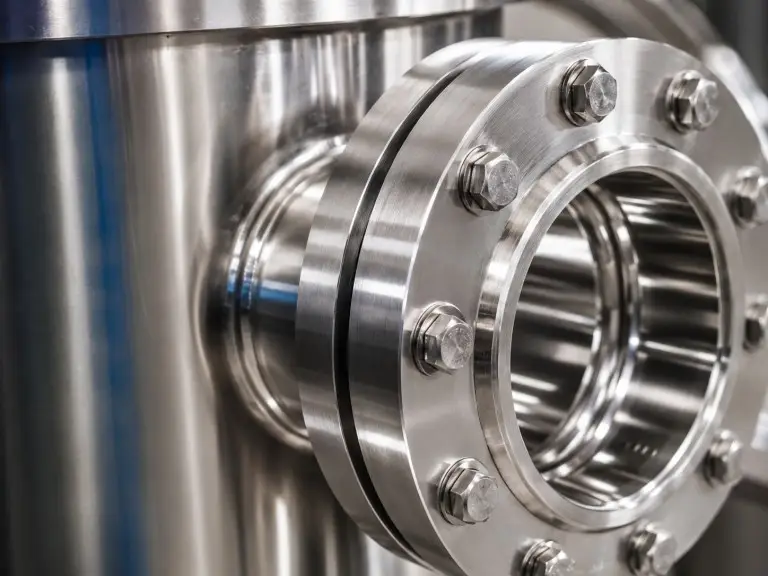
SS304 is appropriate for clean groundwater, treated municipal water, and general industrial applications where chloride concentration is consistently low. For seawater desalination pretreatment, brackish water with elevated chloride content, coastal groundwater, food-grade or pharmaceutical process water, and chemical process streams where chloride concentration may cause pitting corrosion in SS304, we specify SS316L. Pitting corrosion at the pre-membrane stage is not a cosmetic problem: corrosion products enter the RO feed water as particle contamination – the precise outcome the housing is designed to prevent.
In food and beverage bottling lines, we use electropolished SS316L housings with interior surfaces finished to food-grade surface finish standards. The interior surface quality at cartridge seating surfaces and housing walls matters in these applications as much as the alloy selection: an unpolished interior can retain biofilm in dead zones between cartridge change-outs when the water stream contacts food or beverage products directly.
Cartridge Micron Rating
When buyers ask what micron rating the housing provides, we clarify upfront: the housing holds no rated micron – the cartridge does. This matters because specifying the wrong housing for a given cartridge end type or cartridge OD creates a compatibility mismatch before any filtration conversation begins. The housing provides the pressure vessel, sealing surfaces, and end-cap connections; the cartridge defines the filtration barrier and rated retention efficiency.
RO pretreatment is generally reviewed in the sub-10 μm absolute range, with 5 μm absolute a common final guard-filter selection rather than a single fixed standard. The final micron rating should follow the membrane manufacturer’s pretreatment requirement, feed water SDI and turbidity, differential-pressure margin, and operating records. Nominal-rated cartridges can allow higher and less predictable particle passage than absolute-rated cartridges under surge or variable flow – acceptable for an upstream roughing filter where a subsequent stage provides final protection, but not adequate as the sole pre-membrane barrier. For ultrapure water or pharmaceutical RO, finer 1 μm or 0.2 μm absolute cartridges are commonly specified, and the housing must be specified to accommodate the higher differential pressure those ratings generate under normal operating flow.
Nominal-rated cartridges can allow higher and less predictable particle passage than absolute-rated cartridges under surge flow – acceptable upstream, unacceptable at the pre-membrane stage.
ΔP-Triggered Replacement, Not a Scheduled Calendar
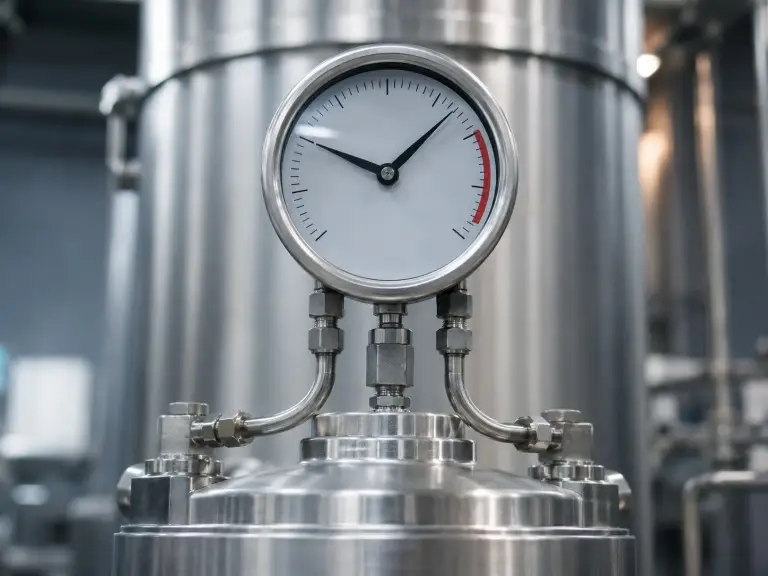
We specify ΔP-triggered replacement, not calendar-based. A calendar interval calibrated to average feed water turbidity will either replace cartridges prematurely during clean-water periods – wasting cartridge cost and installation labor – or allow elements to remain in service past the safe threshold during high-turbidity events, at which point under-filtered water reaches the downstream membranes. A commonly used replacement-review reference is ΔP ≥ 0.1 MPa (approximately 15 PSI differential) across the housing inlet and outlet. A differential pressure indicator or gauge mounted at the housing provides real-time monitoring and removes guesswork from the replacement decision.
When ΔP Reads Low
A ΔP reading that remains lower than expected under normal operating flow should prompt inspection rather than complacency. When a housing is not building ΔP at the rate consistent with known feed water turbidity, the likely cause is cartridge bypass from a seating failure rather than exceptionally clean feed water. A bypass path around the cartridge O-ring sealing surface passes unfiltered feed water to the RO feed pump while the system appears to be in normal operation – the membrane is unprotected despite the filter housing being present and pressurized.
Nominal vs Absolute
A common mistake is treating nominal-rated cartridges as equivalent to absolute-rated cartridges at the pre-membrane stage. Melt-blown PP cartridges with a nominal 5 μm rating are cost-effective as upstream roughing elements where a subsequent absolute-rated stage provides the final barrier. At the pre-membrane position – where there is no further filtration between the housing outlet and the membrane inlet – absolute-rated pleated cartridges maintain their rated retention efficiency as they progressively load, while melt-blown media filtration efficiency degrades under increasing particle burden. This performance difference is not visible in day-to-day ΔP readings; it appears in membrane differential pressure data and element cleaning frequency over the following months.
Cartridge End-Type Mismatch
Cartridge end-type mismatch is a failure mode worth confirming at every change-out. When a DOE cartridge is used in a SOE-222 or SOE-226 housing without correct O-ring engagement, or when an SOE type is installed in the wrong end-cap configuration, a bypass channel forms at the seating area. The housing may operate at apparently normal pressure with no visible alarm while unfiltered water routes around the cartridge element. Confirming end-type compatibility and proper O-ring seating are checks we include in installation documentation and first-change-out procedures.
Where Stainless Steel Cartridge Filter Housings Are Specified
Stainless steel cartridge filter housings are specified across RO pretreatment, seawater desalination, food and beverage processing, pharmaceutical water, and power generation boiler feed – with materially different material grade, micron rating, and surface finish requirements for each application.
| Industry / Application | Typical Feed Water | Recommended Cartridge Micron | Recommended Housing Material | Key Specification Note |
|---|---|---|---|---|
| Municipal RO pretreatment | Treated groundwater or surface water | 5 μm absolute | SS304 | Vertical installation; duplex arrangement for continuous operation |
| Seawater desalination pretreatment | Seawater, high chloride | 5-10 μm absolute | SS316L | Flanged connections; SDI < 5 at housing inlet recommended |
| Food & beverage bottling | Municipal or treated well water | 5 μm absolute, DOE pleated | SS316L, electropolished | Electropolished SS316L interior; food-contact cartridge required |
| Pharmaceutical process water | Purified water, pre-WFI | 0.2-1 μm absolute | SS316L, electropolished | Validated cartridge media; microbial / endotoxin control reviewed at full validated-system level |
| Power plant boiler feed | Demineralized or softened water | 5-10 μm | SS304 or SS316L | Sized with margin for condensate return turbidity events |
| Chemical / industrial process | Process streams, variable quality | 5-25 μm (chemical compatibility review required) | SS316L | Cartridge media chemical compatibility must be confirmed per stream |
SS304 selection assumes low chloride, non-aggressive chemistry, and normal ambient water temperature; elevated chloride, residual oxidants, low pH, or coastal sources should be reviewed for SS316L.
For bottled water plants in Southeast Asia, Middle East, and Africa, the most common specification we supply is an electropolished SS316L multi-cartridge housing with absolute-rated pleated cartridges integrated into a complete pre-RO pretreatment skid. Housing surface finish is confirmed against the sanitary requirements of the specific production line before the housing is specified.
For seawater desalination projects where chloride concentration at the housing inlet regularly exceeds 20,000 mg/L, SS316L is the minimum material specification and SDI at the housing inlet is confirmed to be below 5 before the housing flow and cartridge count are finalized.
For water filtration system for drinking projects, SS304 multi-cartridge housings at 5 μm absolute are the standard pre-membrane configuration, often in a duplex parallel arrangement to allow cartridge change-out without system shutdown or supply interruption.
Final compliance must be confirmed against the user’s process specification, validation protocol, and applicable local standard.
Built and Certified to Industrial Standards
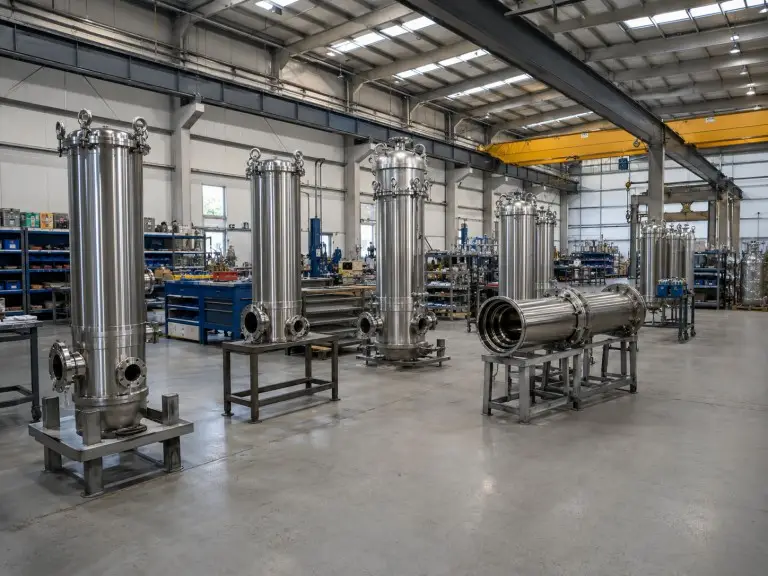
Our cartridge filter housings are designed, manufactured, and tested at our production facility in Qingdao, China. Qingdao Hiju Thermal Power Co., Ltd, established in 2016, operates a facility covering 70,500 sqm total area with 21,000 sqm of dedicated workshop space. Our engineering team includes 28 engineers and 78 technicians. We hold CE and ISO 9001 certifications; ASME-related pressure-vessel documentation is available on request, and documentation scope is confirmed during order review. This directly supports project specifications where pressure vessel compliance documentation is required by the buyer’s engineering or procurement standards.
Export Reach & OEM Supply
We export to more than 20 countries and regions, with active supply into Southeast Asia, Middle East, Africa, South America, and Central Asia. OEM and ODM production is available for buyers sourcing stainless steel filter housings for branded filtration systems, system integrator packages, or private-label EPC supply. Custom housing configurations – non-standard cartridge counts, special connection flanges, skid-mounted assemblies, and specific surface finish requirements – are handled within our standard production scope.
One Facility, the Full Train
We treat the cartridge filter stage as a dependent stage – its performance is only as consistent as the upstream media filtration it receives. When upstream media filter stages are overloaded, the cartridge stage absorbs that excess particle load at significantly higher cost per unit of solids removed, and planned service intervals shorten proportionally. We supply the industrial water pretreatment from a single manufacturing facility, which means the cartridge filter housing, the upstream media filters, and the connecting pipework are designed with aligned pressure ratings, flow capacities, and system integration requirements.
Full-System Engineering
For projects requiring complete pretreatment system design – from source water intake through to RO feed – our engineering team reviews the full treatment sequence, not just the cartridge filter stage in isolation. This is relevant where multiple quality treatment steps must be coordinated to meet product safety specifications or regulatory output requirements, and where continuous operation with duplicate treatment trains is required.
High-Turbidity Pre-Filtration
In high-turbidity source water applications where coarse bulk turbidity removal is required before the activated carbon and cartridge filter stages, sand filter tank are specified as the first-stage treatment step, reducing the particle load that reaches downstream stages and extending service life across the full pretreatment train.
Configuration Review Checklist
Send your flow rate, feed water type, and site constraints for a supply-scope recommendation.
- Design flow rate — m³/h or GPM; peak and average values
- Feed water type — municipal, groundwater, surface, seawater, brackish, or process
- Feed water SDI / turbidity record — for cartridge sizing margin
- Target service interval — between cartridge change-outs
- Downstream system — RO, UF, EDI, polishing, or process
- Material requirement — SS304 or SS316L; electropolished if needed
- Connection type — NPT threaded or ANSI / DIN flanged
- OEM / ODM scope — branding, skid integration, or private-label supply