
Industrial Reverse Osmosis
for Every Source & Purity Target.
We engineer industrial RO configurations matched to your feed water source, TDS level, output purity and project capacity. Six routes cover tap water RO, brackish water RO, seawater desalination, double-pass RO, EDI and ultrafiltration — all manufactured in our Qingdao facility.
Your source water and purity target decide the configuration.
Every industrial RO system starts from two inputs — the TDS and quality profile of your inlet water, and the purity level your application demands at the outlet. A 500 ppm municipal feed and a 35,000 ppm seawater intake follow the same three-step sizing sequence; only membrane class, operating pressure and pretreatment scope change.
Not sure which range your water falls into?
Share a water-quality report, or describe the source. Our engineering team identifies the correct industrial reverse osmosis configuration for you before any quote is drafted.
Classify source water
TDS measurement determines which membrane class and operating pressure range apply: low-pressure for tap water, BW-grade for brackish, SW-grade for seawater.
Confirm output purity
Output purity decides whether a single-pass configuration is sufficient or whether double-pass RO, EDI polishing — or both — are required downstream.
Lock capacity & format
Our engineers finalize system capacity, operating hours, peak demand, footprint, pre-treatment scope and project format before fabrication.
Industrial RO system configurations.
Six membrane configurations sized by inlet water TDS and output purity target. Select a route to view its process flow, engineering parameters and quote inputs.
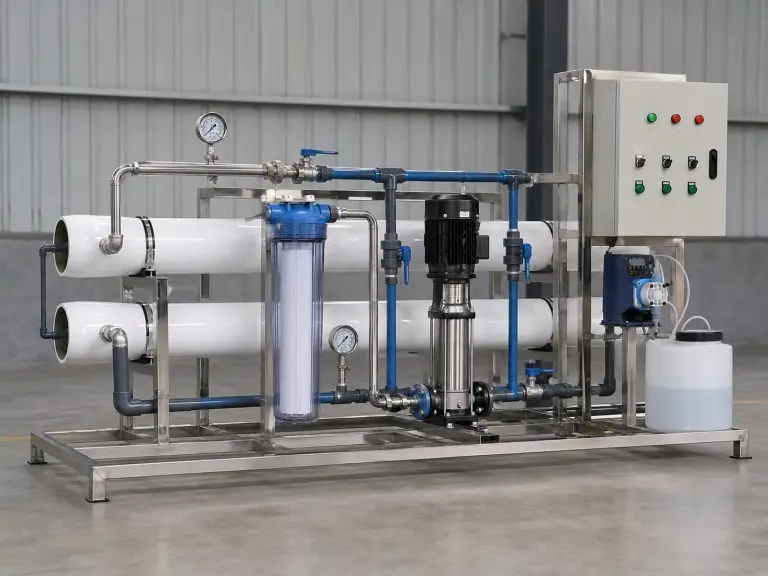
Tap Water RO Systems
Standard low-pressure RO for municipal supply sources. Industrial process water, commercial purification and drinking water production.
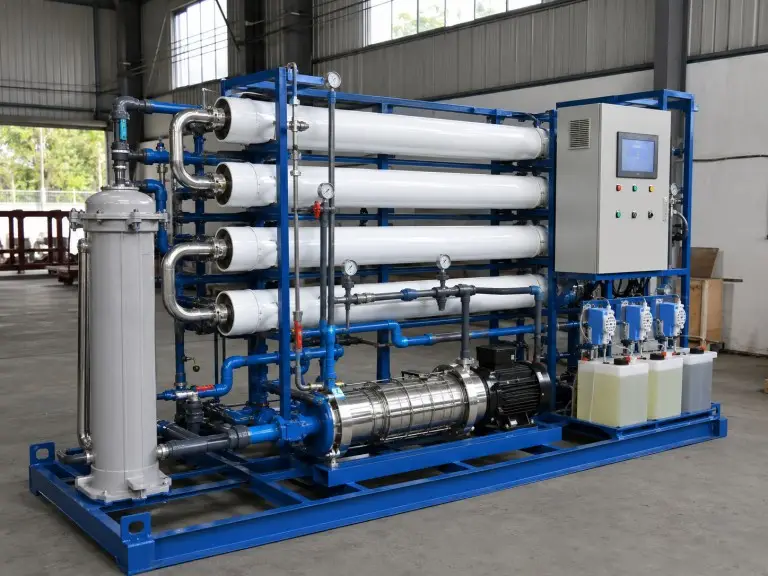
Brackish Water RO Systems
Medium-pressure RO for groundwater and well water with elevated mineral content. Inland desalination and industrial process water.
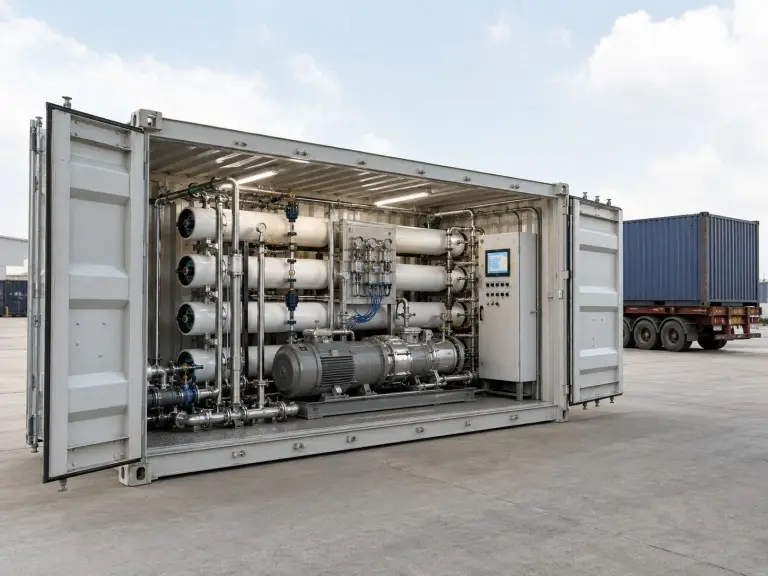
Seawater RO Desalination
High-pressure seawater desalination for coastal plants, island communities, remote operations and offshore applications.
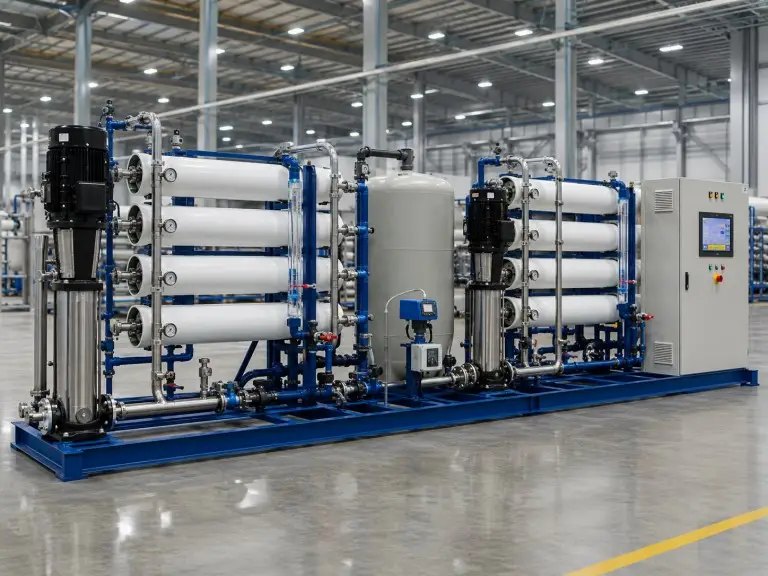
Double-Pass RO Systems
Second-pass membrane stage for pharmaceutical, electronics and food & beverage applications requiring output purity beyond single-pass capability.
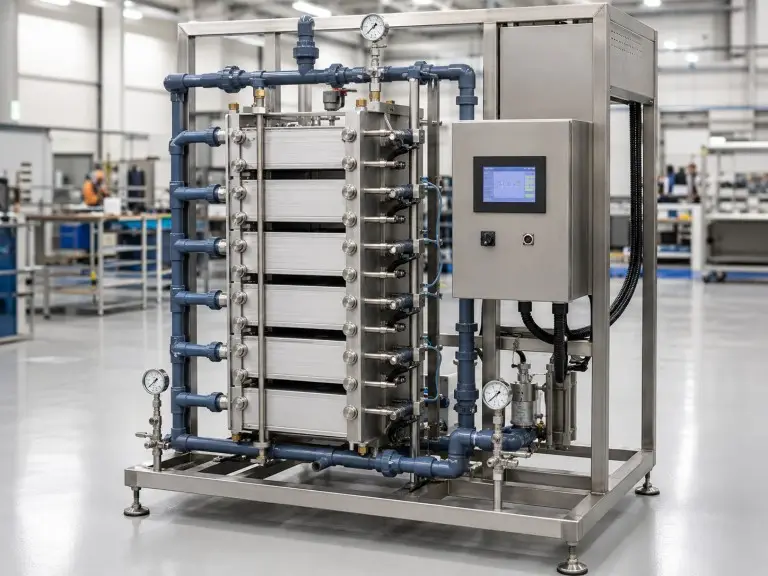
EDI Electrodeionization
Final polishing stage for ultra-pure water production. Pharmaceutical, electronics, laboratory and power plant applications.
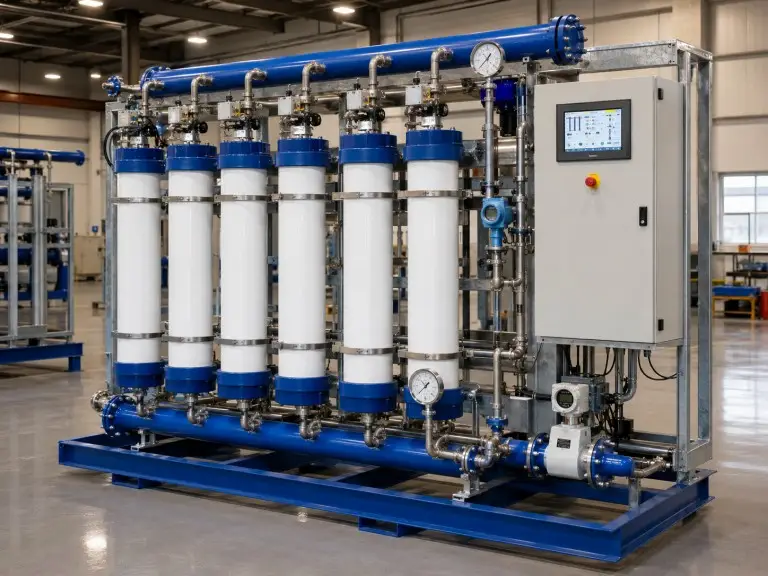
Ultrafiltration (UF) Systems
Pre-treatment for RO systems handling surface water, river water or turbid groundwater. Reduces SDI and protects downstream membranes.
Source water TDS & system selection at a glance.
TDS and source water type are the first two variables that determine membrane class, operating pressure and pre-treatment scope for any industrial RO water system. The matrix below provides preliminary engineering references for each category.
| Source Water Type | TDS Reference | Pressure Range | Recovery | Membrane Class | Pretreatment Trigger | Recommended Route |
|---|---|---|---|---|---|---|
| Municipal tap / pipeline | < 1,000 ppm | 8–15 bar | 70–80% | LP-TFC | Cartridge + antiscalant; softening if hardness > 200 ppm CaCO₃ | Tap Water RO |
| Brackish groundwater / well | 1,000–10,000 ppm | 15–30 bar | 65–80% | BW-TFC | Antiscalant required; softening if LSI > 0; Fe removal if > 0.3 ppm | Brackish Water RO |
| Seawater / coastal source | 15,000–45,000 ppm | 55–70 bar | 35–50% | SW high-rejection | Coagulation + MMF or UF; Cl/de-Cl for biofouling control | Seawater RO |
| Surface water / river / turbid | Variable; SDI concern | Post-UF dependent | Set after UF | UF hollow-fiber + RO | UF when SDI > 5 or NTU > 5; coagulant dosing upstream | UF Systems |
| High-purity target | < 10 µS/cm inlet | 8–12 bar (2nd pass) | 85–95% (2nd pass) | LE-TFC + EDI | 2nd-pass feed < 20 µS/cm; EDI inlet < 1 µS/cm, SDI < 1 | 2-Pass RO / EDI |
Pressure, recovery and pretreatment values above are routing references, drawn from common project configurations — not guaranteed operating parameters. Final design values for operating pressure, recovery rate, membrane array, pretreatment scope and chemical dosing must be verified through feed-water analysis (temperature, pH, scaling projection, silica, ion composition), membrane manufacturer design limits and project-specific capacity and operating-hour requirements. A 10 m³/h line running 20 hours per day is scoped differently from a 10 m³/h peak-demand unit operating 8 hours, even with identical inlet water.
Single-pass · double-pass · double-pass + EDI.
Most process water and drinking water projects are served by a single-pass membrane stage. When the application demands lower conductivity — typically pharmaceutical, electronics or laboratory-grade water — additional stages are added. The three tiers below show where each configuration applies and the output quality each tier typically achieves.
Single-pass RO
One membrane stage producing permeate typically below 20 µS/cm from inlet water under 1,000 ppm TDS, or below 200 µS/cm from brackish feed up to 10,000 ppm. Covers most industrial process water and drinking water applications.
Double-pass RO
A second membrane stage reduces permeate conductivity to below 2–5 µS/cm when single-pass output exceeds your process limit. Used in pharmaceutical, electronics and food & beverage applications.
Double-pass RO + EDI
Continuous electrodeionization polishes double-pass permeate to resistivity above 10 MΩ·cm. Required when your process demands ultra-pure water without chemical regeneration cycles.
EDI inlet water quality limits. EDI feed must meet: conductivity < 1 µS/cm · SDI < 1 · hardness ≤ 0.5 ppm CaCO₃ · dissolved silica ≤ 0.5 ppm · TOC ≤ 0.5 ppm · free chlorine ≤ 0.05 ppm · Fe/Mn ≤ 0.01 ppm · turbidity ≤ 0.1 NTU. These thresholds are confirmed against the selected EDI module manufacturer’s data sheet. Note: 10 MΩ·cm is a high-purity reference and is not equivalent to 18.2 MΩ·cm theoretical ultra-pure water.
What goes before and after the membrane stage.
Pre-treatment is part of the membrane train scope, not an afterthought. Our engineers review inlet water data — turbidity, hardness, chlorine, iron, SDI and biological load — to identify foulants before the RO unit is sized. Skipping this step is the most common reason new installations foul ahead of schedule.
Key variables before the RO unit
- Inlet turbidity and suspended-solids loading
- Hardness and scaling potential — softening typically added when LSI > 0
- Chlorine / oxidant concentration — TFC membranes require free Cl < 0.1 ppm at inlet
- Iron, manganese or silica above membrane inlet limits
- SDI > 5 → UF pretreatment evaluated before the RO stage
By application after the membrane
- Process water — single-pass output typically sufficient; pH adjustment may apply
- High-purity applications — double-pass RO stage added
- Ultra-pure applications — EDI polishing downstream of double-pass RO
- Drinking water — remineralization or UV disinfection per local regulation
Where each sector fits within our system range.
Our membrane treatment lines serve four primary application sectors. Each has distinct inlet water conditions, output purity standards and regulatory requirements that shape which configuration applies.
Food & Beverage
Source water must meet process-specific purity and consistency standards before contacting product or equipment. We match F&B buyers to tap or brackish water RO depending on inlet TDS, adding double-pass RO when product-contact water specifications require lower ionic content.
Bottled water plantsPharmaceutical & Electronics
Pharmaceutical water systems (USP Purified Water, EP, CP) and semiconductor-rinse water require output purity beyond single-pass RO. We engineer double-pass RO and EDI configurations as part of the water-treatment train; final compliance with pharmacopeia or cleanroom water standards depends on system validation, monitoring and the applicable production standard at the end user’s site.
DI water systemSeawater Desalination
Feed water at 25,000–45,000 ppm TDS, seasonal temperature swings of 15–35 °C and biological fouling risk at open intakes govern high-pressure pump selection and membrane configuration. Coastal plants, island communities, remote mining operations and humanitarian supply are sized after site and source water data review.
Seawater desalination plantMunicipal & Community Drinking Water
We first confirm source water type — tap or groundwater — and the applicable drinking-water standard for the destination country. Post-treatment requirements including remineralization, pH correction and disinfection depend on both, and are scoped before quotation.
Drinking water filtrationFactory-direct engineering & manufacturing.
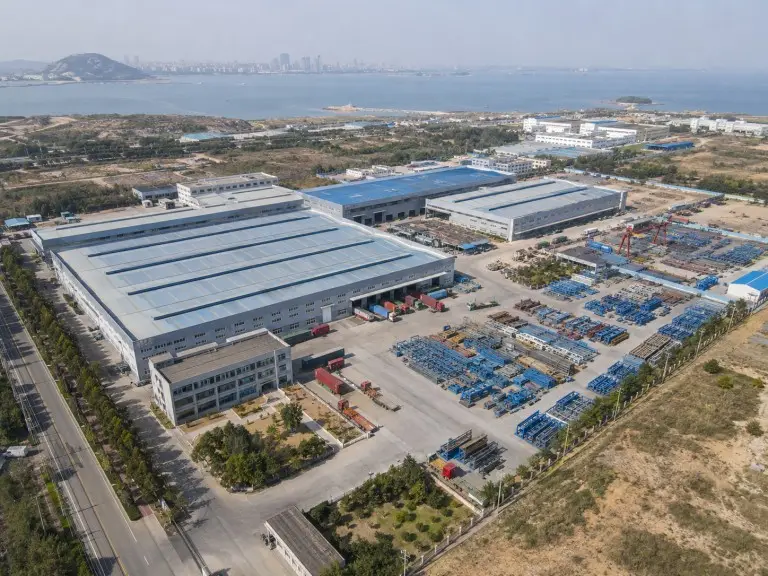
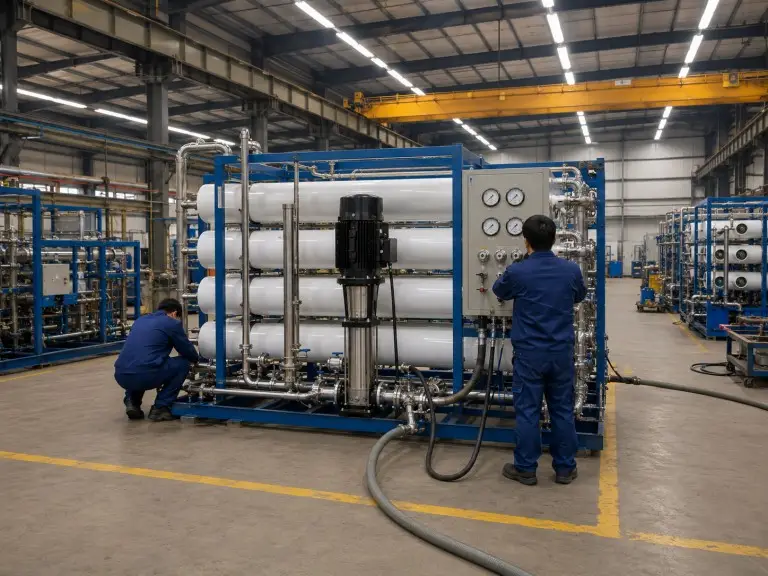
Every industrial RO system we quote is engineered and fabricated in our 70,500 m² Qingdao facility. Our engineering team reviews your water data, selects membrane configuration and oversees fabrication through pressure testing and final QC on the same production floor.
In-house engineering review
A dedicated team of 28 engineers and 78 technicians handles project scoping, P&ID design and component selection. No third-party design house sits between your requirements and the fabrication floor.
OEM & ODM production
OEM buyers supply their own specifications, labeling and documentation; ODM buyers receive a turnkey design built to their capacity and purity targets. Both formats are produced in the same facility under the same QC process.
Export to 20+ countries
Systems delivered to buyers across Southeast Asia, the Middle East, Africa, South America and Central Asia. Export packaging, voltage adaptation and destination-market documentation are scoped during project review.
Tell us what you need.
We do not publish list prices for industrial RO systems because the correct configuration depends on your inlet water, output purity, capacity and site conditions. Share the inputs below — our engineers prepare a project-specific quote.
- Source water type — municipal tap, brackish groundwater, seawater or surface water
- Water quality data — TDS reading or analysis report; turbidity, pH, hardness, Cl if known
- Required output purity or application — process water, drinking water, pharma grade, electronics grade
- Required capacity — m³/h, GPD or TPD
- Industry — food & beverage, pharmaceutical, municipal, industrial process, seawater supply
- Installation space, site layout, packaging, labeling or OEM/ODM requirements
- Certification or compliance requirements for your region or industry
Share your water data, get a configuration quote.
As a water-treatment equipment manufacturer with projects across Southeast Asia, the Middle East, Africa and South America, we size every industrial RO machine to measured water data — not catalogue assumptions.
What we need
- Inlet water source and TDS reading or water-quality report
- Target output purity or application standard (process, drinking, pharma, electronics)
- Required capacity in m³/h, GPD or TPD, plus operating hours and peak demand
- Installation footprint, project format and any regional certification or documentation needs
What we deliver
- A configuration-specific quote — not a list price — covering membrane class, pre/post-treatment scope, layout and documentation
- For buyers at a category boundary (8,000–12,000 ppm brackish, or surface water with seasonal SDI variability): an engineering note identifying parameters that must be confirmed before fabrication
CIP Membrane Cleaning Systems
Periodic CIP (Clean-in-Place) membrane cleaning is part of the maintenance routine for every RO installation. We supply RO membrane cleaning equipment as standalone accessories, designed for integration with any of our membrane configurations. Cleaning frequency, chemical compatibility and tank sizing are confirmed during the system engineering review.
Output purity standards by application.
The matrix below maps each application sector to the relevant standard or specification framework. Our RO and EDI systems are engineered as part of the water-treatment train for these applications; final compliance is determined by system validation, monitoring and the end user’s applicable regulatory requirements.
| Application | Reference Standard / Target | What This Means for System Design |
|---|---|---|
| Drinking water | Local drinking-water regulation (WHO, EPA, EU Directive, national standard) | RO permeate may require post-treatment: remineralization, pH correction, UV disinfection or chlorination depending on destination-country standard |
| Pharmaceutical | USP Purified Water / EP / CP; WFI where applicable | RO/EDI is part of a validated water system, not a standalone compliance guarantee; validation, monitoring and loop design are end-user responsibilities |
| Electronics / semiconductor | Conductivity/resistivity, silica, boron, TOC, particle count per process spec | Final purity targets defined by user’s process specification; we size membrane array and polishing stages to meet stated resistivity and contaminant limits |
| Boiler / power plant | Conductivity, silica, hardness, alkalinity per boiler pressure class | Feedwater standard depends on boiler operating pressure; higher-pressure boilers require lower silica and hardness, typically addressed by double-pass RO + EDI |
| Food and beverage | Process-specific purity, consistency and product-contact water requirements | Configuration depends on inlet TDS and whether product-contact water specifications require lower ionic content than single-pass RO can deliver |
Engineering case notes.
Representative project references drawn from factory production records. Client names are anonymized; parameters reflect actual design values from delivered systems.
| Project | Feed Water | Pretreatment | System Configuration | Design Output | Factory QC |
|---|---|---|---|---|---|
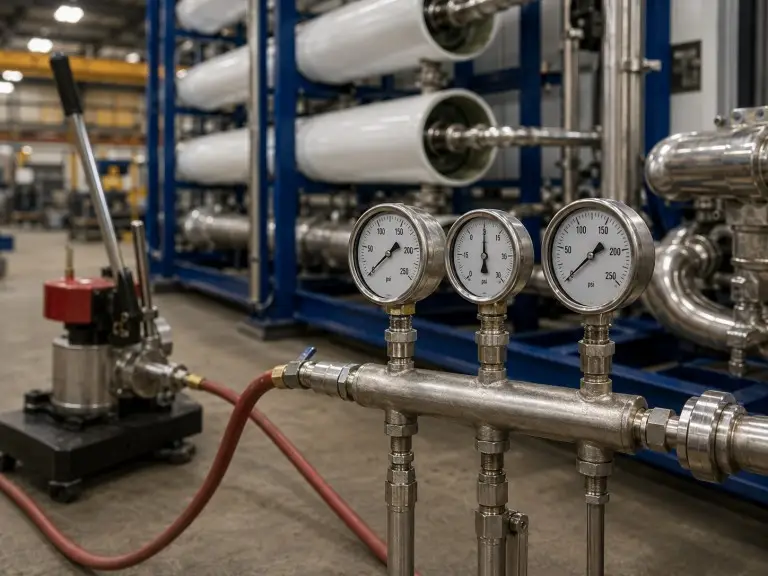
| BWRO · Middle EastBrackish groundwater | Well water TDS 3,200 ppm | MMF + activated C + antiscalant + 5 µm cartridge | Single-pass BWRO 8040 housing · Recovery 70% | < 100 ppm TDS | Hydrostatic pressure test, control panel inspection, membrane loading & flush |
| SWRO · Southeast AsiaSeawater desalination | Open intake TDS 34,000 ppm | Coagulation + MMF + cartridge + SMBS dechlorination | Single-pass SWRO HR 8040 elements + ERD · Recovery 42% | < 500 ppm TDS Post-treatment: remineralization + pH correction | High-pressure pump test, ERD commissioning, membrane integrity check |
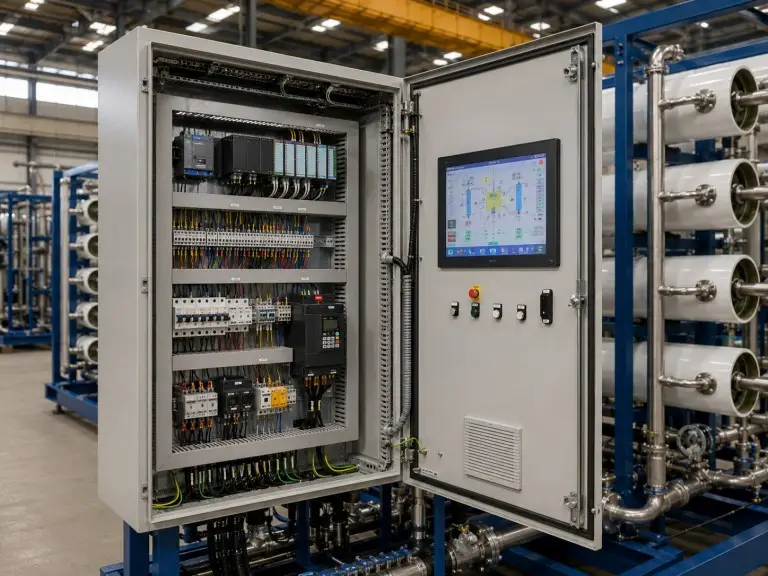
| 2-Pass + EDI · East AfricaPharmaceutical | Municipal tap TDS 280 ppm | Softener + activated C + cartridge | 1st pass LP-RO → 2nd pass LE-RO → EDI PLC + per-stage conductivity monitoring | 1st pass < 12 µS/cm 2nd pass < 1.5 µS/cm EDI > 10 MΩ·cm | Stage-by-stage conductivity verification, PLC logic test, loop piping pressure test |
| UF + BWRO · Central AsiaRiver water source | River water NTU 15–80 SDI > 6 | UF hollow-fiber (outside-in) + backwash + CEB Coagulant dosing per jar test | UF → BWRO Post-UF SDI < 3 | Industrial process water | UF integrity test, RO pressure test, automation sequence verification |
Parameters above are from delivered projects and reflect design-stage values. Actual field performance depends on site conditions, seasonal water-quality variation and operator maintenance. These are not guaranteed outcomes for future projects with different feed water.