Reverse osmosis (RO) is a pressure-driven membrane process that reduces dissolved salts and a wide range of dissolved contaminants from a feed stream. The core trade-off is direct: strong dissolved-solids removal in exchange for energy input, concentrate (reject) management, and feedwater-dependent pretreatment. RO also physically rejects many microorganisms, but where microbial safety is the main goal, it should be paired with a validated disinfection stage rather than trusted as a standalone barrier. Whether the pros outweigh the cons depends on three variables: feedwater quality (TDS, hardness, silica, SDI), required permeate specification, and recovery target. For a home under-sink unit, the question is health and convenience. For an industrial boiler-feed, food-and-beverage, or desalination line, it is throughput, uptime, and cost per cubic meter. This guide separates the two so you can weigh RO against the decision that actually applies to your project.
Reverse osmosis advantages for industrial water treatment
Reverse osmosis delivers its strongest advantage where a process needs consistently low-TDS water and the feed carries dissolved contaminants that mechanical or carbon filtration cannot touch. The payoff scales to how tight your purity spec is. An RO membrane separates contaminants at the molecular level, so it handles dissolved salts, heavy metals, nitrates, and a broad range of organics in one stage. Those are the impurities that sediment filters and activated carbon pass straight through. The reduction is broad rather than absolute: it holds when the membrane, pretreatment, and any certified performance claims match the feedwater and application.
Three benefits carry the most weight in an industrial setting. First, spec-grade consistency: a correctly sized system holds stable permeate quality across shifts, which matters when downstream equipment such as boilers, EDI polishers, or CIP loops has a hard feedwater ceiling. Second, chemical-free separation: RO does the bulk of dissolved-solids removal by pressure alone, which cuts the acid and caustic regeneration that resin-based ion exchange demands. Third, water reuse: placed at the tail of a process, RO recovers and recycles effluent, turning a discharge cost into a recovered-water asset where effluent limits are tight.
In practice, we configure the RO stage against a verified source-water report rather than a nameplate. The same membrane that runs for years on softened feed will foul in weeks on untreated hard water. The advantage holds only as far as pretreatment does, which is where most of the disadvantages below actually begin.
RO disadvantages: fixed limits versus design choices
The genuine drawbacks of reverse osmosis are capital cost, energy for pressurization, concentrate disposal, and pretreatment dependence. But the severity of each is set by system design and feedwater, not by the technology itself. This distinction matters because most published pros-and-cons lists quote residential figures that do not transfer to engineered industrial systems.
Take water waste, the most-cited con. A typical point-of-use home unit sends roughly five gallons or more of reject water to drain for every gallon it treats, and inefficient units run higher. That ratio is a property of small unpressurized home units, not a law of RO. For point-of-use systems, the EPA WaterSense specification sets an efficiency benchmark of 2.3 gallons or less to drain per gallon produced — the same technology, engineered differently. WaterSense is a point-of-use efficiency standard, not an industrial RO design standard. It earns a mention here only because it shows that reject ratio is an engineered outcome rather than a fixed property of RO. Industrial trains raise recovery through staged multi-array configurations and energy-recovery devices, and reject can often route to reuse rather than discharge.
Energy is a true operating cost, concentrated in the high-pressure pump. Seawater desalination systems (SWRO) typically run near 55–70 bar because rejecting seawater-level TDS is physically demanding, though actual pump duty depends on feed salinity, temperature, recovery, membrane selection, and energy-recovery configuration. Brackish and low-TDS feeds need far less. Capital cost is likewise real: membranes, high-pressure pumps, pressure vessels, and storage add up, and larger systems demand floor space. Neither is a defect. Both are the price of dissolved-solids removal, and both are predictable once the feedwater envelope is known.
Residential RO complaints that don’t apply industrially
The most common error in evaluating reverse osmosis is importing residential concerns into an industrial selection, where the objectives are entirely different. You have seen the complaints: it strips healthy minerals, it makes dead water, it wastes three gallons per gallon. This misframing deserves an early correction, because it steers buyers toward the wrong questions.
Mineral removal is the clearest example. For home drinking water, stripped calcium and magnesium is a taste-and-nutrition talking point, sometimes managed with remineralization. In an industrial process, low mineral content is usually the whole point. Boiler feed water treatment, pharmaceutical and electronics ultrapure water, and many food-and-beverage lines require it. Where a process needs minerals back, a controlled remineralization stage adds them to spec. The residential “con” is an industrial “pro.”
The same inversion applies to water aggressiveness and reject water. RO permeate is low in minerals and can corrode unlined metal piping. That is a real design point handled by material selection, not a reason to reject the technology. And reject water framed as pure loss at home becomes a recoverable stream at industrial scale. When a supplier weighs these trade-offs, the useful question is not “is RO good or bad.” It is “what does your feedwater and permeate spec make RO cost, and what happens to the concentrate.” We align every configuration to that question against your source water rather than a generic contaminant list.
Feedwater quality: the first variable to confirm
Among all the variables that decide whether reverse osmosis is worth it, feedwater quality should be locked down first, because it governs pretreatment, achievable recovery, membrane chemistry, and operating pressure. Every other cost follows from it. Buyers who start with membrane brand or system price, and treat feedwater as a detail, almost always re-scope later.
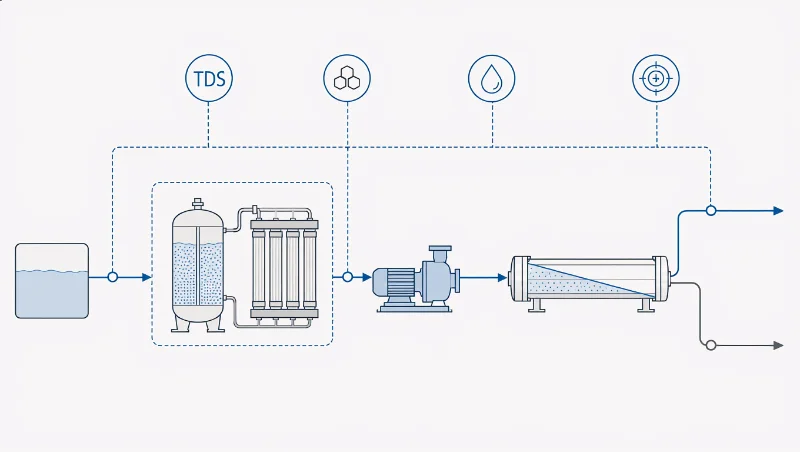
Feedwater comes first because of dependency. A defensible feedwater envelope — high and low TDS, seasonal temperature swing, turbidity events, and specific foulants such as hardness, silica, iron, manganese, and chlorine — sets the industrial water pretreatment train. Pretreatment is the single operational lever that most reliably reduces fouling and extends membrane life. High silica or high alkalinity pushes you toward lower design recovery or staged RO; heavy organics demand stronger biofouling control, such as ultrafiltration ahead of the membranes. Here is a concrete case. High hardness with measurable silica may call for antiscalant dosing, lower recovery, or a two-pass configuration, depending on target conductivity. A low-TDS municipal feed for boiler makeup may instead need carbon dechlorination and polishing rather than aggressive brine management. Get the feedwater right and the remaining variables resolve in order. Get it wrong and no membrane choice compensates.
RO standards and their scope: NSF 58, WaterSense, ASTM D4189, ASME
Reverse osmosis is governed by several standards, and each applies to a different scope. Matching the right one to your context keeps a residential certification from being mistaken for an industrial guarantee. This table maps the most-cited references to their actual scope.
| Standard / reference | Scope | How to read it for an industrial project |
|---|---|---|
| NSF/ANSI 58 | Point-of-use RO drinking-water systems: material safety, TDS reduction, recovery and efficiency ratings, contaminant-reduction claims | Covers POU and residential/commercial drinking units, not industrial process trains; useful for benchmarking claim discipline |
| EPA WaterSense (POU RO) | Point-of-use RO water efficiency (≤2.3 gal to drain per gal produced) | Shows reject ratio is an engineered outcome; not an industrial design standard |
| ASTM D4189 | Test method for Silt Density Index (SDI) of low-turbidity water; empirically correlated with RO membrane fouling tendency | Use to specify feedwater fouling potential before sizing pretreatment |
| ASME BPVC Section VIII | Construction and certification of pressure vessels above 15 psig | Applies to pressure-boundary items such as membrane housings, not to a whole RO system as a blanket certification |
For a multi-market exporter, the binding drinking or process-water standard is set by the destination market and project specification rather than a single national code. So final compliance is confirmed against the applicable local standard for each project rather than assumed from any one certification above.
RO versus ultrafiltration, softening, and disinfection
Reverse osmosis is not the default answer for every water problem. Three adjacent methods each win under specific feedwater and objective conditions that RO does not serve efficiently. Use this table to decide whether RO is your main treatment stage or only one part of a larger train.
| Method | What it removes | When to choose it over RO | Main limitation |
|---|---|---|---|
| Reverse osmosis (RO) | Dissolved salts, metals, organics, many microorganisms | Feed has high dissolved solids and process needs low-TDS permeate | Energy, reject management, pretreatment-dependent |
| Ultrafiltration (UF) | Suspended solids, colloids, bacteria | Feed problem is turbidity or colloids, not dissolved salts; also serves as RO pretreatment | Does not reduce dissolved salts or TDS |
| Water softening (ion exchange) | Hardness (Ca, Mg) only | Sole goal is scale control on otherwise acceptable water | Adds sodium; no contaminant-spectrum removal |
| Disinfection (UV / ozone / chlorination) | Microorganisms | Goal is microbial safety on already low-solids water | No removal of dissolved solids or chemicals |
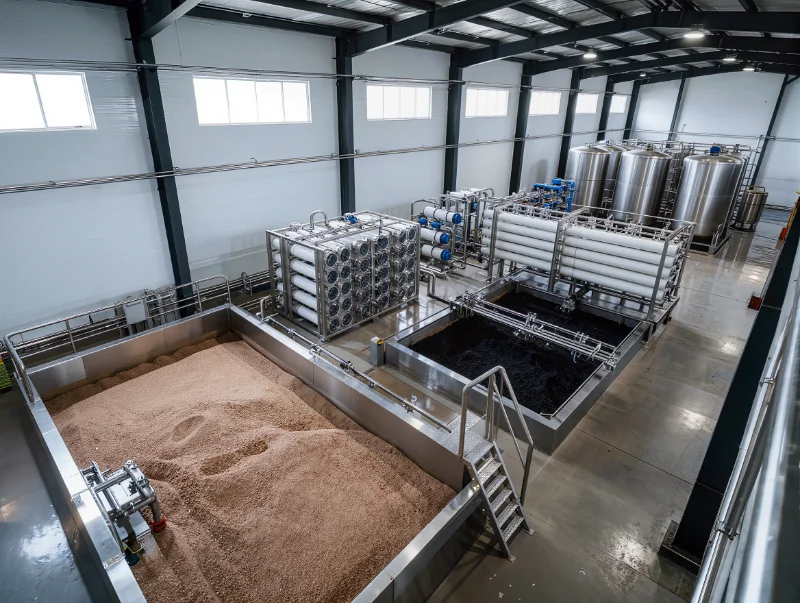
The practical pattern is worth noting. Ultrafiltration systems and water softener systems often sit alongside RO as pretreatment rather than replacing it, while UV closes the microbial gap that RO alone is not designed to validate. We clarify at the design stage whether RO is the process or only one stage within it, so you specify the whole train rather than a single unit. Installation and piping design — material choice, layout, and hydraulic sizing — fall outside method selection and should be confirmed separately against your site conditions and the equipment manual.
RO selection: confirming feedwater, permeate, and recovery
The reverse osmosis decision rests on three variables in order: feedwater envelope, required permeate specification, and recovery target. Confirm those and the pros-and-cons debate resolves into a concrete configuration. The advantages — molecular-level rejection, spec-grade consistency, chemical-free separation, reuse potential — are real. So are the costs of energy, capital, concentrate management, and pretreatment dependence. Which side dominates is set by your application, not by a generic list.
In our own project work, the failure mode we see most is a system sized against a nameplate flow instead of a verified worst-case feedwater report. The result is early fouling and recovery that never reaches design. We review and configure each RO stage against your actual source water and confirm the pretreatment train before quoting performance. Final compliance and performance are confirmed against your process specification, validation protocol, and applicable local standard.
To move from evaluation to a quote, send the feedwater analysis and target permeate conductivity first. Without those two inputs, any RO quote is a capacity estimate, not a performance specification. The full input set:
- Feedwater analysis: TDS, hardness (as CaCO₃), silica, iron/manganese, chlorine, turbidity/SDI, and seasonal temperature range
- Required permeate specification (target TDS or conductivity, and any downstream equipment ceiling)
- Target flow rate (m³/h) and daily production requirement
- Target recovery and any effluent or discharge constraints on concentrate
- Application (boiler feed, F&B, ultrapure, desalination, wastewater reuse, etc.)
- Site constraints: available footprint, power supply, and existing pretreatment
For dissolved-solids removal at plant scale, our industrial reverse osmosis system range is configured to the feedwater envelope above. CE and ISO 9001 certified; ASME construction documentation for pressure-boundary items such as membrane housings is available on request per project.
FAQ
A membrane breach or downstream recontamination goes undetected, and unsafe water reaches the point of use. An RO membrane rejects most bacteria and viruses by size, but it is not a monitored disinfection barrier, so a hairline seal failure or post-membrane biofilm can pass through without an alarm. That is why microbial-critical processes add a UV or ozone stage after RO: the disinfection step is verifiable in a way membrane integrity alone is not.
The achievable value is capped by feedwater chemistry, not by a single headline number. Scaling risk from silica, hardness, and alkalinity sets a practical ceiling, and so do temperature, concentrate-disposal limits, and the membrane maker’s own guidance. Brackish systems designed with staged arrays and antiscalant dosing reach much higher recovery than a home unit, while seawater RO stays more constrained because osmotic pressure climbs with every point of recovery. The number is a design output, not an input you pick first.
Ultrafiltration, in that case. If the problem is turbidity or colloids rather than dissolved solids, UF removes them at far lower energy and without the reject penalty RO carries. RO becomes worth its cost only once you need to pull down dissolved salts or TDS. Often the two run together, with UF as pretreatment protecting the RO membranes downstream.
Membrane life depends on feedwater and pretreatment quality rather than a fixed calendar. Performance-certified point-of-use membranes are validated to last at least one year. Industrial element life under a given worst-case feedwater should be confirmed with manufacturer data at the design stage, since aggressive fouling can shorten it and clean feed can extend it well beyond a year.
Low-mineral RO permeate can be aggressive toward unlined metal pipe, so the fix is material selection, not avoidance. Stainless, lined, or suitable plastic materials handle permeate without trouble. Treat this as a piping specification detail confirmed against your layout, not a reason to reject RO.