An industrial pure water process removes suspended solids, dissolved salts, organic compounds, and microorganisms from raw water through multiple treatment stages. Each stage targets a different class of contaminant, and the final water quality must match the application’s purity standard.
Target output varies by industry. Conductivity below 10 µS/cm may suffice for general manufacturing rinse water. Pharmaceutical or semiconductor applications demand far stricter specifications defined by their own standards and regulations.
These commonly used terms are not interchangeable. In many industrial equipment specifications, “pure water” means RO permeate with conductivity in the 1–10 µS/cm range. “Purified water” in a pharmaceutical context must comply with a pharmacopeia — USP, EP, or CP — covering conductivity (USP <645>), TOC (USP <643>), microbial limits, and validated storage and distribution. Semiconductor fabs specify “ultrapure water” against ASTM D5127, SEMI F63, or internal fab specifications. These systems target resistivity near 18.2 MΩ·cm at 25 °C, with tight controls on TOC, particles, silica, dissolved metals, and boron.
We at Hiju design and manufacture systems across this purity spectrum. The most common issue we clarify for buyers is which purity grade their application actually needs. Over-specifying drives up capital cost. Under-specifying leads to product quality failures or regulatory non-compliance.
This article covers the pure water process from pretreatment through polishing, the variables that shape system design, and the specification decisions that drive long-term performance. It does not cover municipal drinking water, residential purification, wastewater recycling, or detailed pharmaceutical/semiconductor compliance procedures — those topics need dedicated guides tied to the applicable standard.
Why Feed Water Quality Reshapes Every Downstream Stage
Feed water quality is the variable that most often reshapes a pure water system’s configuration, cost, and performance. Many buyers approach procurement with a fixed process in mind — usually single-pass RO — and expect it to work on any source water. That assumption drives more specification failures than membrane brand, component selection, or automation level combined.
Feed water sets the pretreatment requirements, determines whether single-pass or double-pass RO can reach the target purity, and dictates which polishing technologies are needed. The critical variables include TDS, hardness, silica, free chlorine, temperature, and SDI (Silt Density Index). A municipal supply at 200 mg/L TDS with low silica is a different design problem than a well water source at 1,500 mg/L TDS with high hardness and seasonal temperature swings.
When we verify source water data before system design, a full analysis changes at least one major design parameter — membrane type, recovery rate, or antiscalant selection. When buyers skip this step and size a system on assumed feed quality, the consequences appear fast. Membranes foul ahead of schedule, reject rates climb, or product water drifts off specification within the first year.
No pure water system should be designed without a current, lab-certified feed water analysis. Seasonal variation adds risk. A single grab sample taken in summer may miss winter conditions, when lower temperatures cut RO flux by 15–25% and shift the recovery-scaling balance.
Core Stages in a Pure Water Process
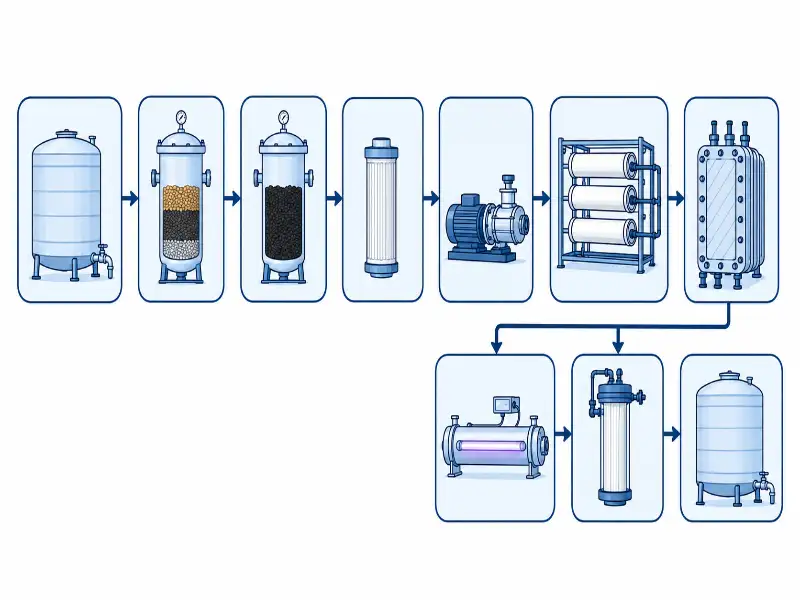
A typical industrial pure water process has three stages: pretreatment, core desalination, and post-treatment polishing. Each stage protects the next. Skipping or under-sizing any stage speeds up degradation downstream.
Pretreatment: Protecting the RO Membranes
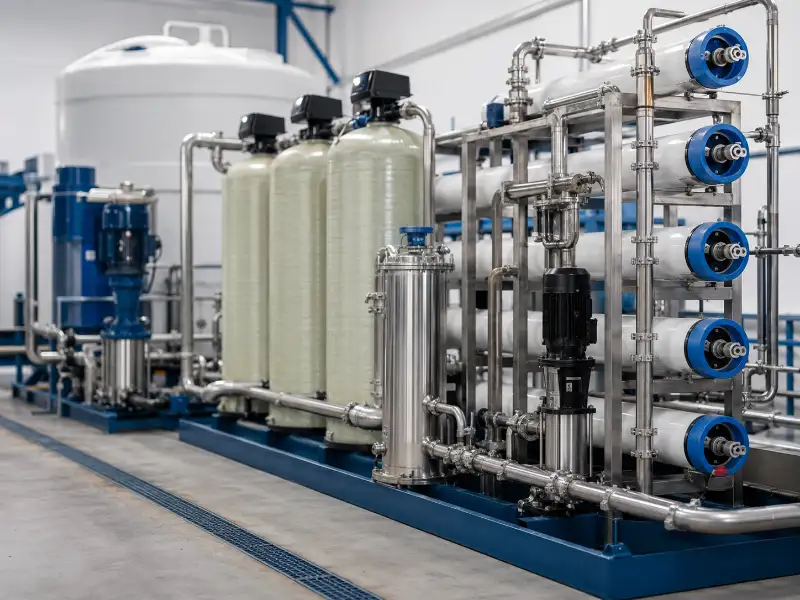
Pretreatment removes contaminants that would foul, scale, or chemically damage RO membranes. The exact combination depends on feed water quality, but most systems share three core elements.
A multimedia filter (quartz sand and anthracite) cuts suspended solids and turbidity. An activated carbon filter adsorbs residual chlorine and organics. Most polyamide TFC RO membranes tolerate very little or zero continuous free chlorine, so carbon filtration or sodium bisulfite dosing must remove chlorine before the RO inlet. Operators should confirm removal with ORP or free chlorine monitoring. A 5 µm cartridge filter then acts as a final guard for the high-pressure pump and membranes.
Source water may also call for softening, antiscalant dosing to block calcium carbonate or silica scaling, and pH adjustment to improve RO salt rejection. We size pretreatment to the actual feed water analysis, not a default package. An undersized softener or missing antiscalant system is still the most common root cause of early membrane replacement in the projects we review.
Reverse Osmosis: The Core Desalination Stage
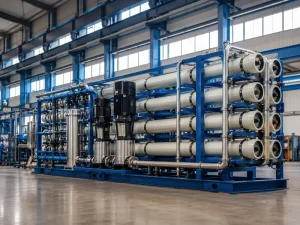
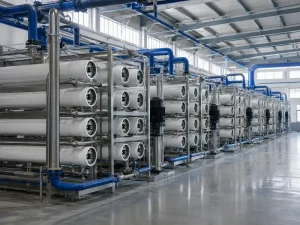
RO forces pre-treated water through semi-permeable membranes under pressure. The membranes reject 95–99% of dissolved salts, most organics, and nearly all bacteria and particles. Two streams exit the system: permeate (purified water) and concentrate (reject water carrying the removed contaminants).
Single-pass or double-pass RO selection depends on target purity and feed TDS. As screening ranges — not guaranteed values — single-pass RO often yields permeate conductivity of 2–10 µS/cm. Double-pass RO can push below 1 µS/cm. Actual output depends on feed ion makeup, membrane type, recovery rate, temperature, CO₂ passage, and whether the system uses degassing or pH adjustment between passes.
Other key design variables include membrane element type (brackish water, low-energy, or high-rejection), recovery rate, and array layout. Industrial RO recovery typically falls between 50% and 75% for conservative designs. Well-controlled systems with favorable feed water can run higher. The recovery target must weigh water savings against scaling risk, concentrate chemistry, and local discharge rules.
Post-Treatment Polishing: Reaching Target Purity
When RO permeate alone falls short of the required purity, polishing removes residual ions, organics, and microorganisms.
EDI (electrodeionization) pairs ion-exchange resins with a DC electric field to strip residual ions without chemical regeneration. It is widely used after RO where continuous, chemical-free operation is preferred. Mixed-bed ion exchange reaches similar purity but needs periodic acid/caustic regeneration, which adds handling cost and waste.
UV at 254 nm controls microbial counts. UV at 185 nm breaks down trace organics to lower TOC. Point-of-use UF (ultrafiltration) membranes catch particles and endotoxins that may enter the distribution loop.
Not every application needs every polishing step. General process water may only require UV and a storage tank. Pharmaceutical or semiconductor systems call for extended polishing trains with validated distribution and monitoring. The full configuration depends on the applicable standard, TOC target, microbial requirements, and point-of-use conditions. We confirm the end-use purity standard before sizing polishing equipment — this prevents both over-spending and compliance gaps.
How to Match Process Configuration to Application Requirements
Choosing the right configuration starts with three inputs: target purity standard, feed water quality, and daily volume. The table below gives screening-level guidance. Final configuration must be checked against the applicable standard and a site-specific feed water analysis.
| Application | Typical Target | Recommended Process Baseline | Applicable Standards |
|---|---|---|---|
| General industrial rinse / process water | Conductivity ≤10 µS/cm | Pretreatment + single-pass RO | Site-specific product quality limits |
| Boiler make-up water | Conductivity, hardness, silica, dissolved oxygen per boiler pressure class | Pretreatment + single or double-pass RO ± degassing | ASME / EPRI guidelines; boiler manufacturer specs |
| Pharmaceutical Purified Water | Per pharmacopeia: conductivity, TOC, microbial limits | Double-pass RO + EDI + UV + validated storage/distribution | USP <643>, USP <645>, EP, CP, GMP |
| Pharmaceutical WFI | Per pharmacopeia: endotoxin, conductivity, TOC, microbial | Distillation or membrane-based WFI (per regional regulation) + validated loop | USP, EP (permits membrane-based WFI since 2017), regional GMP |
| Semiconductor / electronics UPW | Resistivity near 18.2 MΩ·cm; strict TOC, particles, silica, metals, boron | Double-pass RO + EDI + mixed-bed + 185 nm UV + UF + POU polishing | ASTM D5127, SEMI F63, fab owner specification |
| Laboratory pure water | Per lab standard grade (Type I / II / III) | RO + DI or EDI ± UV | ASTM D1193, ISO 3696, CLSI |
Two specification mistakes show up more than any others. First, using semiconductor-style resistivity targets for pharmaceutical water. Pharmaceutical water should be defined by its pharmacopeia, not by resistivity alone. Second, assuming single-pass RO will hit every target without checking feed TDS and CO₂ levels.
Specification Variables That Affect System Performance and Cost
Recovery rate, membrane flux, and automation level shape long-term cost more than the initial equipment price. Knowing how each one interacts with the process chain helps buyers compare proposals fairly.
Recovery rate sets how much feed water becomes product versus reject. Pushing above 75% saves water but concentrates scaling ions in the reject stream. That demands stronger antiscalant programs or concentrate recycling. The right target depends on feed chemistry, discharge rules, and local water cost.
Membrane flux — permeate volume per unit membrane area — affects sizing and membrane life. High flux cuts the number of elements needed but speeds up fouling. Low flux extends membrane life but grows the footprint and capital cost. The balance depends on feed SDI, temperature range, and the plant’s tolerance for cleaning frequency.
Automation level spans basic PLC control with manual valves to full remote monitoring, auto-flush, CIP sequencing, and predictive maintenance. More automation reduces operator load and off-spec risk, but raises upfront cost. Payback depends on the facility’s labor cost, downtime cost, reject water cost, membrane replacement rate, and compliance exposure. No single payback figure fits every plant.
When comparing proposals, we suggest normalizing to cost per cubic meter of product water at the target purity over a five-year span. A cheaper system with aggressive flux and thin automation often costs more in total than a properly sized alternative.
Conclusion
A reliable pure water process matches each treatment stage — pretreatment, RO, and polishing — to the specific feed water, target purity standard, and operating needs of the application. The variables that matter most are not always visible on a quotation: feed water variability, flux assumptions, recovery targets, and automation levels all drive total cost of ownership more than the equipment price tag.
When buyers skip the feed water analysis or default to single-pass RO without verifying the target standard, systems drift off spec under real conditions. We have seen this repeatedly. One well water project sized from a single summer sample scaled its RO membranes within months — the antiscalant program could not handle the winter hardness spike that doubled feed calcium.
Every Hiju pure water system starts with a verified feed water analysis and a clear product water specification. As experienced water treatment equipment manufacturers, we size each process stage to your actual feed water and target standard — not a default template. Send us your feed water report, target conductivity or resistivity, TOC requirement, daily flow rate, operating schedule, and applicable standard. Our engineering team will confirm whether single-pass RO, double-pass RO, EDI, mixed-bed polishing, UV, UF, or a validated distribution loop is right for your facility.
FAQ
Industrial “pure water” usually means RO permeate at 1–10 µS/cm conductivity. Pharmaceutical “purified water” is defined by a pharmacopeia (USP, EP, or CP) and must meet conductivity, TOC, and microbial limits — resistivity alone does not define it. Semiconductor “ultrapure water” targets resistivity near 18.2 MΩ·cm with strict TOC, particle, silica, and metals controls, typically per ASTM D5127 or SEMI F63.
Rarely on its own. Single-pass RO seldom meets pharmacopeial standards for conductivity and TOC on a consistent basis. Most pharmaceutical systems pair double-pass RO with EDI, UV, and a validated storage and distribution loop. The exact setup depends on feed water quality and the pharmacopeia in force.
That depends on feed water quality, pretreatment performance, operating flux, and cleaning frequency. With good pretreatment and regular CIP cleaning, industrial RO membranes typically last three to five years. Challenging feed water — high silica, high hardness, or variable quality — can shorten life if fouling or scaling outpaces cleaning.
A lab-certified analysis should cover TDS, conductivity, pH, temperature range, hardness (Ca and Mg), alkalinity, silica, iron, manganese, free chlorine, turbidity, and SDI at minimum. Pharmaceutical or semiconductor projects may also need TOC, microbial counts, and specific ion data. Seasonal sampling is recommended — one grab sample may not reflect year-round conditions.
The most common cause is a feed water change that exceeds pretreatment capacity — seasonal TDS spikes or chlorine breakthrough. Membrane fouling from weak pretreatment, scaling from wrong antiscalant dosing, and O-ring leaks that let feed bypass the membranes are also frequent culprits. Tracking permeate conductivity, differential pressure, and normalized flow catches most problems early.
Yes. RO produces a concentrate stream that carries rejected contaminants. At 50–75% recovery, 25–50% of feed water leaves as concentrate. Some plants reuse this stream for cooling or landscaping. Others treat it for discharge. Local regulations vary. Build concentrate disposal into the system design from the start — it affects both operating cost and environmental compliance.
The water must meet the applicable pharmacopeia. USP systems typically reference USP <643> (TOC), USP <645> (conductivity), and USP <1231> (water system management). EP and CP have matching requirements. Compliance goes