
Aquaculture & Irrigation
Water Treatment Systems.
Fish farms and irrigated fields share one dependency: the water going in determines the output that comes out. A shrimp operation drawing brackish coastal groundwater at 4,000 mg/L TDS faces a fundamentally different challenge from a citrus grove on canal water at 800 mg/L — yet both fail when water quality is left unmanaged. We configure the system to the water, not the water to a catalog spec.
Fish Farm, Hatchery or Irrigation Site — Find Your Configuration.
Read the descriptions below. Find the one that matches your site and water source. You do not need a water analysis report to start — our engineers ask for that after you make contact.
Freshwater fish farm
River, dam, or freshwater borehole
- Water source is a river, dam, or freshwater bore — not salty
- Growing tilapia, catfish, carp, trout, or freshwater shrimp
- No documented pathogen pressure has been identified — facility is not a hatchery, broodstock, or high-biosecurity operation
Remove sediment → Filter fine particles → Kill bacteria & protozoa → Store clean water ready for use
After you submit — an engineer reviews within 24–48 h. No complete water analysis required to start; send available data and we identify what is still needed.
Hatchery or broodstock facility
Eggs, larvae, or high-value breeding fish
- Raising eggs, larvae, or breeding fish — not a grow-out pond
- A disease outbreak would be very costly — biosecurity matters
- Viral disease has occurred nearby or your vet has flagged the risk
Remove sediment → Filter fine particles → Kill bacteria & viruses at hatchery dose → Biosecure storage
After you submit — an engineer reviews within 24–48 h. No complete water analysis required to start; send available data and we identify what is still needed.
Coastal or saltwater-source farm
Brackish borehole or open sea intake
- Water source is salty or brackish — coastal bore or sea intake
- Farming shrimp, barramundi, sea bass, or other marine species
- The farm needs pathogen control, solids removal, and stable water quality — salinity reduction is not required for this species
Screen and filter → Kill pathogens (UV / ozone) → Adjust dissolved oxygen and organic load → Store in biosecure tank
After you submit — an engineer reviews within 24–48 h. No complete water analysis required to start; send available data and we identify what is still needed.
Canal or tap water — crops grow normally
Water is not salty, crops are not struggling
- Water comes from a canal, municipal supply, or a clean borehole
- Water is not visibly salty, turbid, or covered in algae
- Crops grow normally — no signs of salt stress or tip burn
Remove sediment → Filter particles and algae → Store → Deliver at the right pressure
After you submit — an engineer reviews within 24–48 h. No complete water analysis required to start; send available data and we identify what is still needed.
Salty groundwater — crops are struggling
Borehole water damages or stresses crops
- Borehole water tastes salty or leaves white residue on soil
- Crop leaves show tip burn, stunted growth, or poor yield
- Using drip lines, drip tape, or other precision irrigation
Filter debris → Remove salt through membranes → Blend to the right concentration → Store → Irrigate
After you submit — an engineer reviews within 24–48 h. No complete water analysis required to start; send available data and we identify what is still needed.
River or canal water — muddy or sensitive crops
Turbid source, algae, or high-value fruit crops
- Water comes from a river or seasonal canal — brown or turbid after rain
- Or: growing citrus, strawberry, or stone fruit and yield quality is critical
- Or: drip lines clog frequently or algae is blocking filters
Settle out mud and algae first → Filter fine particles → Remove salt if needed → Store → Irrigate
After you submit — an engineer reviews within 24–48 h. No complete water analysis required to start; send available data and we identify what is still needed.
Not sure which scenario fits, or your situation involves both aquaculture and irrigation on the same site? Describe your project in a few sentences below — our engineers will work out the right configuration and come back to you.
Aquaculture makeup water — the biosecurity treatment chain.
The treatment train for aquaculture makeup water is a biosecurity chain. Each stage has a defined function and a defined failure mode if omitted or undersized.
| Stage | Key Operating Parameter | Engineering Consequence if Undersized / Omitted |
|---|---|---|
| Pre-filter (100–150 µm) | Replace before SDI rises above design threshold. | SDI > 5 accelerates UF fouling; CIP intervals compress from months to weeks. |
| Multimedia filter | Suspended solids < 1 mg/L; SDI < 5 before membrane. | Membrane flux decline, elevated replacement frequency, increased operating cost. |
| UF membrane (0.01–0.1 µm) | Turbidity < 0.1 NTU output; barrier to bacteria & protozoa. | Without UF, turbidity shields pathogens from UV and effective dose drops below design. |
| UV sterilizer / ozone boundary | ≥ 40 mJ/cm² bacteria / parasites · ≥ 100 mJ/cm² viral in hatchery & broodstock. | Undersized UV leaves active virus at inlet; ozone overdose creates residual stress risk in live-stock systems. |
| UV sleeve maintenance | Quarterly cleaning under normal service; earlier if UVT decline measured. | A skipped cleaning cycle reduces effective dose below design without any visible alarm. |
| BWRO (brackish source only) | Operating pressure 8–15 bar; recovery 70–80%. | Omitting BWRO on a brackish source leaves salinity incompatible with freshwater species. |
| Water storage / buffer tank | 4–24 hours makeup volume buffer. | Insufficient buffer creates supply gaps during peak demand, forcing unfiltered water bypass. |
UV dose decision
The UV dose decision is not a product selection — it is a species and pathogen risk evaluation. Grow-out and non-hatchery RAS: ≥ 40 mJ/cm² for bacteria control. Hatchery, broodstock, or facilities with documented viral pressure (IHN / VHS): a validated dose around 100 mJ/cm² or above is commonly specified — confirmed from target pathogen, measured UVT, peak flow rate, quartz sleeve fouling allowance, and end-of-lamp-life output. Our UV sterilizers are configured to your flow rate, UVT measurement and target dose — not to a nameplate that ignores water-quality variation.
Stocking density drives flow demand
Intensive RAS systems at 30–80 kg/m³ replace 5–30% of tank volume per day. A 500 m³ production system at 10% daily replacement requires 50 m³/day of treated makeup as a minimum design basis; undersizing forces dilution with raw water and collapses the biosecurity chain regardless of equipment quality.
For hatchery and broodstock systems, biosecure storage requires sanitary tank design, filtered vent screens, and periodic disinfection — UV at the inlet alone does not prevent recontamination in open or poorly maintained post-treatment storage tanks.
Our ultrafiltration membranes serve as the standard pre-treatment stage before UV sterilization — a 0.01–0.1 µm barrier that removes turbidity, protozoa and bacterial load, reducing UV demand and protecting downstream disinfection performance from fouling-driven variability.
Irrigation water treatment — from source salinity to emitter-ready quality.
Agricultural irrigation systems fail at the emitter, at the crop root zone, or both. The treatment train works backward from those failure points: what quality must reach the emitter, and what quality must reach the root zone.
Filtration fineness by irrigation method
| Irrigation Method | Minimum Filtration Fineness | Consequence of Coarser Filtration |
|---|---|---|
| Flood / furrow | 80 mesh (180 µm) | Debris blocks distribution valves and furrow controls. |
| Sprinkler / rotor head | 80 mesh (180 µm) | Nozzle wear, reduced throw radius, uneven application. |
| Drip emitter | 120 mesh (130 µm) | Emitter blockage, dry zones, crop stress. |
| Drip tape | 155 mesh (100 µm) | Tape occlusion, pressure loss, whole-row failure. |
The pre-filtration standard at the distribution end is separate from the pre-RO standard. A BWRO system requires SDI < 5 at the membrane inlet, achieved through multimedia filtration and UF upstream. At the distribution end, emitter type governs fineness; fine drip tape demands clean water plus tightly controlled EC at the outlet.
BWRO TDS removal
Our brackish water reverse osmosis systems typically achieve TDS removal of 95–99% under defined feed conditions with correct antiscalant dosing — sufficient to substantially reduce source salinity. EC reduction from > 3.0 mS/cm to < 0.5 mS/cm is achievable; actual output depends on ionic composition, recovery rate, operating temperature, and membrane selection. Irrigation suitability is not determined by TDS alone — final blending targets must be set from EC, SAR, sodium, chloride, boron, bicarbonate, crop tolerance, soil drainage, and leaching requirement. For sensitive crops such as strawberry, citrus, and stone fruit, boron and sodium control may be more critical than TDS reduction alone.
Boron is a separate crop-safety variable
We flag boron as a separate design variable on every irrigation project — not a footnote to TDS. Standard single-pass BWRO achieves partial boron removal, but citrus, strawberry, bean and several stone fruits are sensitive above 0.5–1.0 mg/L; two-pass RO or post-treatment blending may be required after full ionic water analysis.
Antiscalant & CIP boundary
We calculate antiscalant dosing against the Langelier Saturation Index or Stiff & Davis Stability Index for each project’s feed-water ionic profile. Brackish groundwater from calcareous formations carries high CaCO₃ and sulfate scaling potential. Without matched antiscalant dosing, BWRO membrane scaling begins within the first weeks of operation. On projects where antiscalant was absent or undersized by a previous supplier, we have seen membrane fouling demand CIP within the first month of commissioning; under a correctly matched program, we target CIP intervals of every 3–6 months.
Engineering variables reference.
These variables decide whether the project routes to filtration only, UF + UV, BWRO, two-pass RO, or a full treatment train with storage and distribution controls.
| Parameter | Typical Range | Engineering Consequence | Configuration Approach |
|---|---|---|---|
| Source water TDS | 200–8,000 mg/L (groundwater range) | Determines whether BWRO is required and at what recovery rate. | Full ionic analysis required; TDS alone is insufficient. |
| EC output · irrigation | < 0.5 mS/cm greenhouse / sensitive; < 1.5 mS/cm field crops | Drives permeate blending ratio and BWRO recovery design. | Target by crop species & growth stage; blending adjustable after commissioning. |
| EC output · aquaculture | < 0.5 mS/cm freshwater (species-specific) · Marine: 32–35 ppt / PSU salinity — major-ion balance, alkalinity, pH and hardness confirmed against species requirements | Freshwater and marine species use entirely different treatment paths. | Species confirmed at intake; trains must not be shared without engineering review. |
| UV dose · bacteria | ≥ 40 mJ/cm² | Below threshold, standard bacteria not reliably inactivated at design flow. | Validated design dose confirmed from pathogen target, measured UVT, peak flow, sleeve fouling allowance, and end-of-lamp-life output. |
| UV dose · viral pathogens | ≥ 100 mJ/cm² | Viral inactivation (IHN / VHS) requires higher dose; 40 mJ/cm² is not a substitute. | Hatchery and broodstock systems are commonly designed to a validated dose around 100 mJ/cm² or above — confirmed against pathogen risk, site UVT, peak flow, and system validation basis. |
| UV sleeve cleaning | Quarterly · earlier per UVT decline | A skipped cleaning cycle reduces effective dose below design without alarm. | Tracked by transmittance measurement, not calendar alone. |
| SDI pre-membrane | < 5 | SDI > 5 causes accelerated membrane fouling, reduces design flux. | Achieved via MMF + UF; confirmed before membrane commissioning. |
| BWRO recovery | 70–80% | Lower wastes water; higher increases scaling risk without antiscalant adjustment. | Set by feed TDS, ionic profile and antiscalant program. |
| BWRO operating pressure | 8–15 bar | Higher TDS requires higher pressure; pump sizing & power follow. | Calculated per feed TDS and recovery target during design. |
| Iron in feed water | < 0.3 mg/L at emitter · < 0.05 mg/L pre-membrane | > 0.3 at emitter causes clogging; > 0.5 pre-membrane causes fouling. | Pre-oxidation + MMF before membrane; iron form decides oxidant selection. |
| Boron in feed water | < 0.5 mg/L citrus / strawberry · < 1.0 mg/L most crops | Single-pass BWRO partial removal only; sensitive crops may need two-pass. | Boron concentration confirmed in analysis; removal varies by membrane / recovery. |
| Antiscalant | LSI or S&DSI > 0 triggers scaling risk | Without matched antiscalant, CaCO₃ and sulfate scaling begins within weeks. | Type and dose calculated per ionic analysis; dosing pump specified with skid. |
| DO · aquaculture | > 7 mg/L cold-water salmonids · > 5 mg/L warm-water | DO below species minimum triggers mortality at high stocking density. | Makeup train delivers pathogen-controlled water; aeration is downstream stage. |
| Filtration mesh · drip tape | 155 mesh (100 µm) at emitter | Coarser filtration causes tape occlusion and uneven field application. | Screen or disc filter at distribution end per emitter manufacturer spec. |
| Storage buffer volume | 4–24 hours of treated water output | Insufficient buffer forces bypass during peak irrigation / maintenance events. | Sized to irrigation cycle or RAS makeup schedule during design. |
Engineering credentials & export capability.
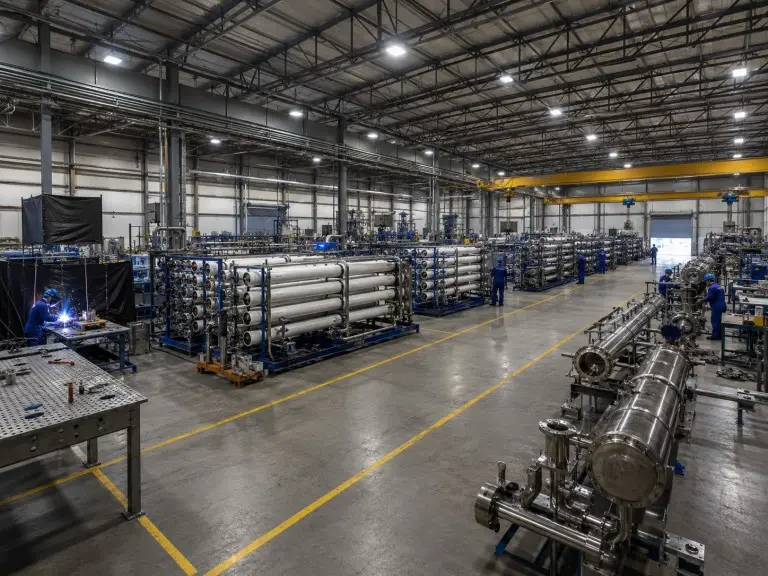
Founded in 2016, Qingdao Hiju Thermal Power Co., Ltd operates from a 70,500 sqm facility with 21,000 sqm of dedicated production workshop space. Our engineering team comprises 78 technicians and 28 engineers structured to handle full project scope — from design review through factory testing to export documentation.
We hold CE, ISO 9001 and ASME certifications. These carry specific relevance to aquaculture and irrigation buyers: CE and ISO 9001 are standard documentation in European-spec export projects and tenders issued by international development finance institutions active in agricultural water infrastructure, while ASME pressure-vessel documentation is available on request for applicable pressure-rated components where project specification requires it.
Our systems have been exported to clients in more than 20 countries and regions, with primary markets in Southeast Asia, the Middle East, Africa, South America and Central Asia. Review our completed engineering projects to verify project type, application and export geography without relying on marketing claims.
Submit your water treatment requirements.
Our engineering team reviews each project against your water analysis and operating conditions before recommending a system configuration. Send the inputs below to receive a specification recommendation.
Water & flow inputs
- Water source & analysis — TDS, EC, iron, boron, turbidity, microbial load if tested, full ionic profile if available.
- Flow rate target — m³/h or m³/day; peak vs. average demand if irrigation.
- Target output quality — EC target, TDS target, species for aquaculture or crop type / growth stage for irrigation.
- Application type — RAS, pond makeup, hatchery, drip, sprinkler, flood, or greenhouse.
- Operating conditions — site elevation, ambient temperature range, required operating pressure.
Site & project inputs
- Backwash & drain — available drain capacity, discharge constraints, local permit requirements.
- Downstream equipment — existing distribution lines, tank sizes, drip tape spec, emitter model if known.
- Power supply — grid or generator, voltage, available amperage at pump station.
- Destination — country, region, climate zone.
- Project stage — new facility, capacity expansion, replacement, or feasibility study.
For rapid dialogue in Southeast Asia, the Middle East, Africa or South America, contact our engineering team via WhatsApp or email with your water report and flow target.
If your water source is seawater or a high-salinity brackish source above the range that BWRO can address economically, our seawater desalination & remote area supply solutions address that scenario with purpose-built membrane and energy-recovery configuration.
For industrial process water applications where wastewater reuse, color removal and discharge compliance are the primary design drivers, our textile & dyeing water treatment solutions handle the COD reduction and effluent challenges specific to that sector.
Explore by product category
Every piece of equipment used in the configurations above belongs to one of these six product families. Browse the full range, specifications, and configuration options.