
High Pressure Pump for RO Systems
We match high-pressure pump type and specification to the actual transmembrane pressure your RO membrane array requires, not the nearest catalog size. Qingdao Hiju Thermal Power Co., Ltd, established in 2016, holds CE documentation and ISO 9001 certification; ASME qualification scope is available on request. Our engineering team reviews each pump inquiry against water source data, permeate target, and site operating conditions before recommending pump type, pressure range, and material grade.
Role of High Pressure Pumps in the RO Treatment Train
The high-pressure pump is the only active pressure-generating component in a reverse osmosis treatment sequence. Its position in the train determines whether the downstream membrane array can achieve the target permeate quality and recovery rate the project was designed around.
Pre-Treatment Stage
Sand filtration, activated carbon filtration, cartridge filtration, and softening reduce suspended solids, chlorine, and scale-forming ions before the pump sees the water.
High Pressure Pump
Raises feed water from supply-side inlet pressure to the transmembrane pressure required across the membrane in reverse osmosis in the downstream array.
RO Membrane Array
Pressurized feed water contacts the membrane surface, producing low-TDS permeate while concentrated brine exits on the high-pressure side.
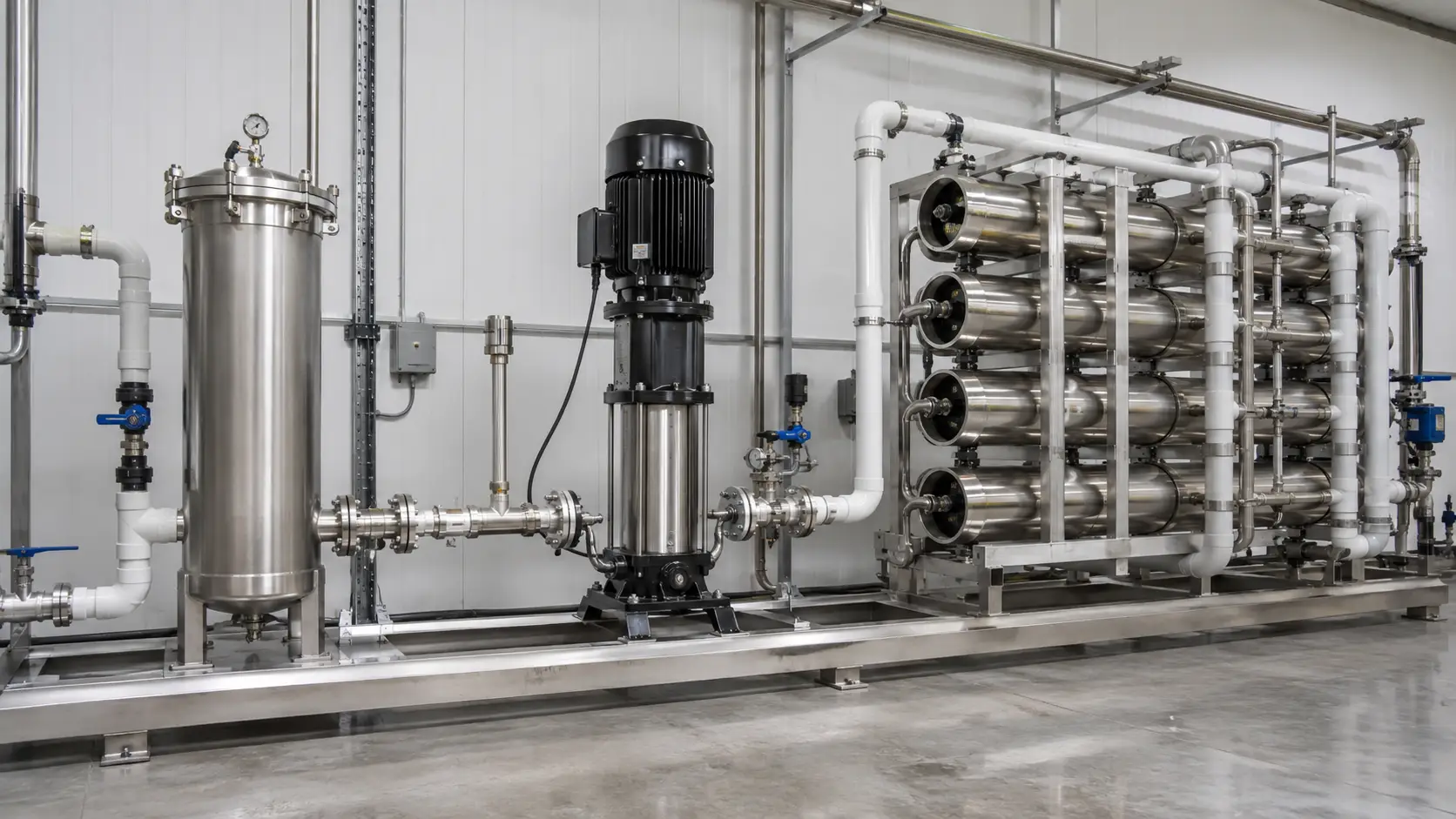
Consequence of undersizing
An undersized pump cannot sustain the required differential across the membrane. When transmembrane pressure falls short of the osmotic pressure of the feed water, permeate TDS rises, recovery drops, and concentration polarization pushes fouling beyond the maintenance schedule.
RO High Pressure Pump Types: Multistage vs Axial Piston
Most industrial pump suppliers serving RO projects stock one type and apply it everywhere. We supply across four pump types because the correct boundary is set by feed water TDS, required outlet pressure, flow range, and material grade.
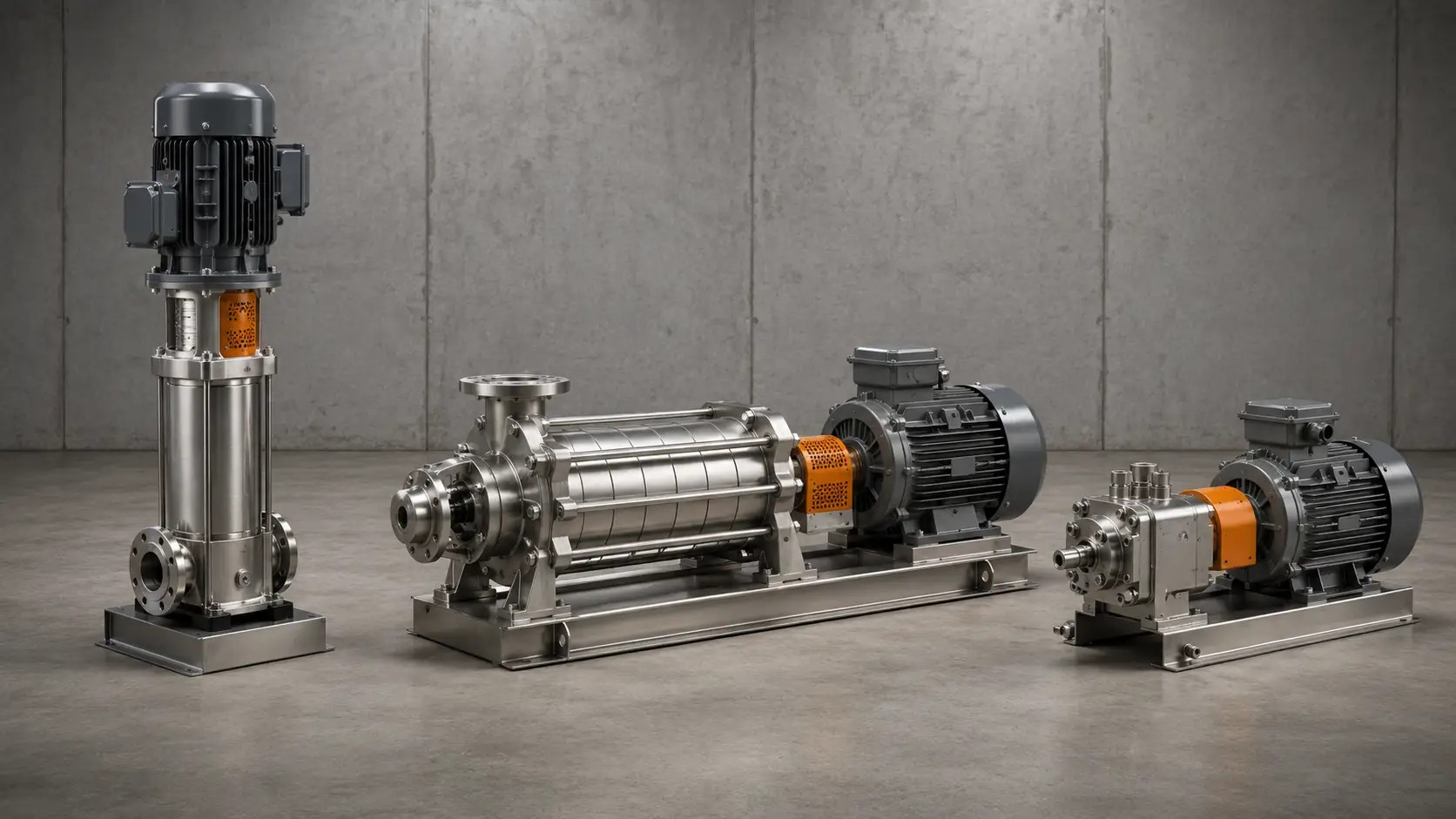
| Pump Type | Operating Pressure | Feed TDS Boundary | Typical Flow Range | Standard Material |
|---|---|---|---|---|
| Vertical multistage centrifugal | 6-25 bar | Up to ~5,000 mg/L | 1-50 m3/h | SS304 / SS316L |
| Horizontal multistage centrifugal | 10-45 bar | Up to ~8,000 mg/L | 50-100+ m3/h | SS316L / Duplex 2205 |
| Axial piston / positive displacement | 55-85 bar | >5,000 mg/L / seawater | 0.7-40 m3/h per unit | Duplex 2205 / Super Duplex 2507 + PEEK |
| Pre-booster / feed boost pump | 2-6 bar | Any | Feed-flow matched | SS304 / SS316L |
Engineering principle. For feed TDS below 5,000 mg/L, a vertical multistage centrifugal pump at 10-25 bar outlet is the right specification for most industrial brackish RO plants. At the opposite end, running a standard centrifugal design continuously above 40 bar accelerates mechanical seal degradation, while seawater duty above 55 bar requires positive displacement stability to keep pressure pulse variation near 2-5% instead of roughly 15%.
The pre-booster is a separate upstream component, not a substitute for the main high-pressure pump. We specify it when incoming supply pressure cannot reliably deliver the minimum 2 bar the main pump needs at its suction port; otherwise cavitation at the first impeller stage can cause significant reduction in impeller service life — typically 30–60% under sustained cavitation, depending on pump design and operating conditions.
RO Pump Selection Parameters: Pressure, Flow, TDS, Chloride
The table below describes the variables we confirm before model selection. Specific model curves, motor sizing, and connection orientation are finalized during application review from the data you submit.
| Variable | Range / Options | Engineering Note |
|---|---|---|
| Outlet pressure | 6-25 / 10-45 / 55-85 bar | Set by feed TDS and membrane osmotic pressure boundary. |
| Inlet pressure | Optimal 2-4 bar; minimum 0.5 bar | Pre-booster required if supply consistently falls below 1 bar. |
| Flow rate | 1-100+ m3/h | Sized from permeate target divided by recovery rate. |
| Motor speed | 1,400-1,500 rpm; 700-1,700 rpm axial piston VFD | 4-pole motor standard for industrial centrifugal on 50 Hz. |
| Material options | SS304 / SS316L / Duplex 2205 / Super Duplex 2507 + PEEK | Determined by feed water chloride concentration, not TDS alone. |
| Drive type | Direct drive / VFD | VFD recommended for variable production load or remote sites. |
| Power supply | Single- or three-phase; 50 or 60 Hz | Voltage, frequency, and phase count confirmed at inquiry. |
| Mounting | Inline vertical / skid-mounted / base-plate | Space envelope and pipe connection orientation submitted at inquiry. |
| Protection | Low-pressure cutoff / pre-filter DP / VFD monitoring | Low-pressure cutoff set at 2 bar inlet is our baseline supply rule. |
Pressure is a derived requirement, not a starting guess
We do not begin pump selection from a requested outlet pressure alone. Feed TDS, target recovery rate, membrane array design, and concentrate-side osmotic pressure determine the pressure the pump must sustain. A buyer may request 20 bar because a previous plant used that number, but if the new source water has higher TDS or a higher recovery target, that pressure can be insufficient. The reverse error also matters: overspecifying pressure for low-TDS brackish water increases motor power, seal stress, bypass heat, and maintenance cost without improving permeate quality.
Inlet pressure decides whether the main pump can stay healthy
The main high-pressure pump should see stable suction conditions, not only adequate discharge requirements. We treat 2-4 bar inlet pressure as the normal operating window and use a pre-booster when site supply drops toward 1 bar or when tank elevation and suction pipe length create an inlet deficit. Cavitation damage often appears as a pump quality complaint after commissioning, but the root cause is usually supply-side pressure depression or a blocked cartridge filter, both visible from the inquiry data if they are submitted.
Motor and power supply are export engineering items
For export projects, voltage, frequency, and phase count are not administrative details. A motor built for a 380V/50 Hz factory standard may run hot, at the wrong speed, or not start at all on a different site power standard. We ask for destination country and site power before quotation because changing motor winding, adding transformer allowance, or selecting a compatible VFD is simple before production and expensive after the pump arrives at the installation site.
Mounting and connection orientation affect field installation
Vertical inline pumps save floor space and fit compact RO skids, while horizontal multistage pumps suit larger flow rates and base-plate installations. We ask for available footprint, suction line length, discharge pipe direction, maintenance aisle, indoor or outdoor placement, and any skid integration requirement because a technically correct pump curve can still create site problems if pipe connection orientation, lifting access, or motor service clearance is wrong.
Pump Sizing: Flow, Pressure, and Drive Calculation
Required pump flow = target permeate output divided by recovery rate
If your system target is 10 m3/h of permeate at 75% recovery, the required pump flow is 10 / 0.75 = 13.3 m3/h. A pump rated at 11.5 m3/h is only 14% undersized, but that gap is enough to prevent target recovery at full operating pressure.
Undersizing raises TDS and fouling risk
As feed flow through the membrane array falls short, transmembrane pressure drops below the osmotic pressure threshold of the concentrated feed side. Permeate TDS rises, and membrane fouling rate exceeds the design cleaning schedule because the concentration polarization layer builds faster at below-design flux.
Pre-filter DP protects the pump after commissioning
Once differential pressure across the upstream cartridge filter exceeds roughly 1 bar, the pressure depression at the pump suction port crosses the cavitation threshold *(typical risk range; actual damage rate depends on pump model, seal design, and liquid temperature)*. We recommend a DP gauge across the upstream cartridge filter and replacement when the reading reaches 0.8-1.0 bar during operation.
VFD drive control is both an energy and protection decision
In plants with variable throughput, VFD control avoids wasting excess flow through a bypass valve. Pump motor energy savings of 20–40% are typical in variable-load facilities compared with fixed-speed throttle operation; actual results depend on load profile and system configuration. Continuous current/vibration monitoring often justifies VFD economics above approximately 5.5 kW.
Pump for RO System: Configuration by Application Duty
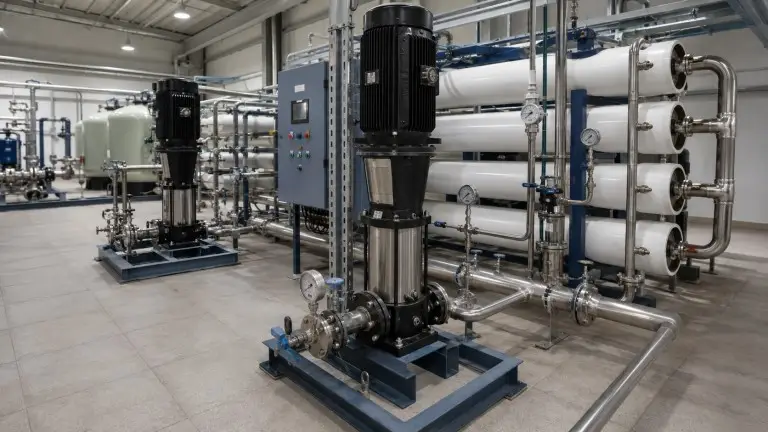
Brackish Water Industrial RO
Recommended type: vertical multistage centrifugal up to 50 m3/h; horizontal multistage above 50 m3/h.
The majority of industrial RO applications across Southeast Asia, the Middle East, and Central Asia involve groundwater or surface water in the TDS range of 2,000-5,000 mg/L, the core operating zone for vertical multistage centrifugal pumps at 10-25 bar outlet pressure. Motor speed for this configuration is 1,400-1,500 rpm using a standard 4-pole motor on 50 Hz supply. Material selection depends on chloride, not TDS alone: sources above 500 mg/L chloride require SS316L as the minimum casing grade. Feed water temperature must be submitted because NPSH available at pump suction falls as temperature rises, so a pump correctly specified at 20 C may cavitate in summer at 40 C if the suction configuration sits at the margin.
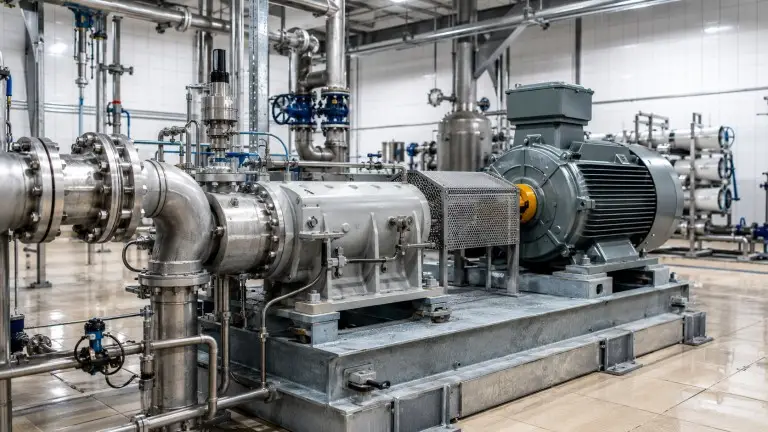
Seawater Desalination (SWRO)
Recommended type: axial piston / positive displacement.
Seawater above 30,000 mg/L TDS requires 55-80 bar outlet pressure to overcome osmotic pressure at the membrane surface. We size single units in the 0.7-40 m3/h envelope at full operating pressure and use parallel pump trains for larger capacities rather than forcing one oversized unit to the edge of its curve. Axial piston positive displacement designs keep discharge pressure stability within 2-5% pulse variation, protecting membrane-to-housing seals and element glue lines from cyclic stress. Wetted-part material for continuous seawater duty is Super Duplex 2507 with PEEK wear components; feed chloride above 8,000 mg/L eliminates SS316L and Duplex 2205 from the shortlist.
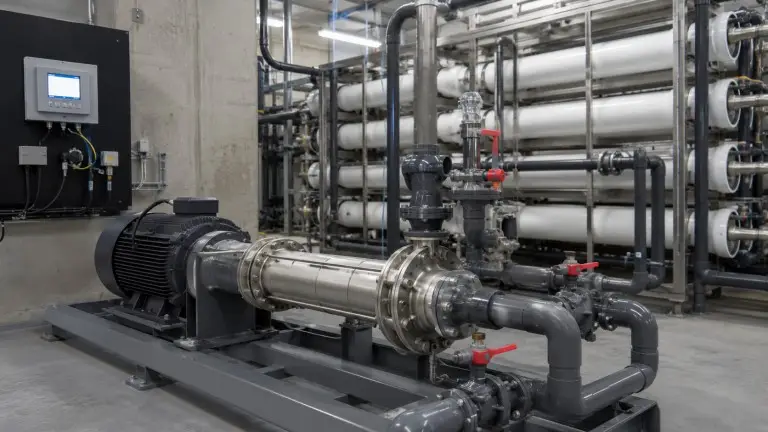
Boiler Feed Water Pre-Treatment
Recommended type: vertical multistage centrifugal; horizontal multistage for larger flow.
For boiler feed water treatment, RO pre-treatment removes dissolved silica, residual hardness, and TDS before feed water enters the boiler circuit. We usually review 8-18 bar outlet pressure, 75-85% recovery, softened feed in the 200-1,000 mg/L TDS range, and SS316L as the standard material grade. Pump discharge on boiler feed RO trains is managed with high-pressure control valves so the RO section can be isolated during boiler maintenance without draining the membrane array; we review pump and valve pressure classes together at inquiry.
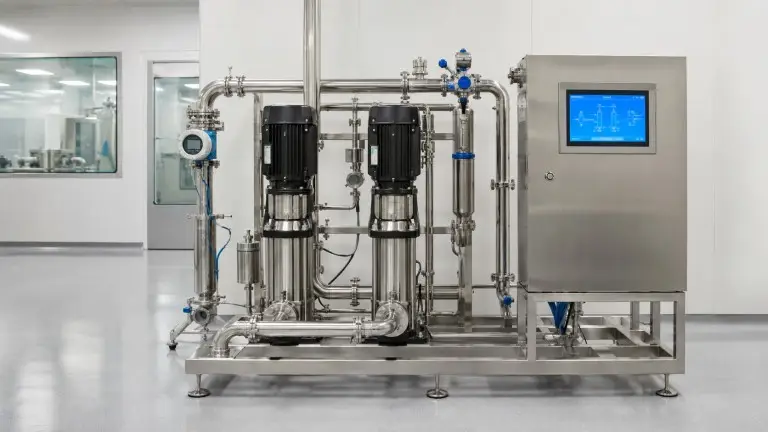
Pharmaceutical and Electronics UPW
Recommended type: vertical multistage centrifugal, with two pump stages for double-pass RO.
deionized water filtration system projects often use double-pass RO to reach permeate conductivity below 0.1 uS/cm before downstream EDI or mixed-bed polishing. The first-pass pump normally operates at 8-18 bar against pre-treated feed, while the second-pass pump sees much lower TDS, often below 50 mg/L after first pass, and operates at 6-14 bar. We size both stages together so first-pass output matches second-pass rated flow and downstream polishing capacity. Wetted-part materials are reviewed against site CIP and SIP protocol requirements, with SS316L as our standard pharmaceutical-grade starting point. Final compliance must be confirmed against the user’s process specification, validation protocol, and applicable local standard.
Material and Protection Selection for High-Chloride RO Feed Water
Feed water TDS alone is not sufficient for pump material specification. Chloride concentration drives stress corrosion cracking in stainless steel under operating pressure, while protection settings decide whether the pump survives abnormal suction-side conditions.
| Preliminary Material Screening by Chloride Level | Recommended Material | Typical Source Context |
|---|---|---|
| < 500 mg/L Cl- | SS304 | Clean fresh water; low-mineral groundwater |
| 500-3,000 mg/L Cl- | SS316L | Industrial brackish water; our standard brackish RO grade |
| 3,000-8,000 mg/L Cl- | Duplex SS 2205 | Coastal brackish; high-chloride industrial sources |
| > 8,000 mg/L Cl- | Super Duplex SS 2507 + PEEK | Seawater; continuous high-pressure service |
At feed chloride above 500 mg/L, SS304 casing can develop stress corrosion cracking within 12-18 months of continuous operation under pressure. We hold material recommendation until the submitted water analysis confirms chloride, especially for Arabian Peninsula and coastal Southeast Asia groundwater. Final material selection also depends on operating temperature, pH, oxidant levels, CIP chemicals, crevice risk, and applied pressure; contact our engineers to confirm grade for your water chemistry.
| Protection Feature | Trigger Condition | Consequence of Absence |
|---|---|---|
| Low-pressure cutoff switch | Inlet pressure below 2 bar | Motor winding damage within 3-5 minutes of dry operation *(typical risk range; actual damage rate depends on pump model, seal design, and liquid temperature)* |
| Pre-filter DP monitoring | DP across cartridge pre-filter exceeds 1 bar | Cavitation and significant reduction in impeller service life — typically 30–60% under sustained cavitation, depending on pump design and operating conditions |
| VFD current monitoring | Current draw below minimum motor load | Dry-run shutdown before winding damage |
| VFD vibration monitoring | Vibration signature exceeds cavitation threshold | Speed reduction and alert before structural erosion |
Three minutes of dry running causes irreversible motor winding damage in a direct-drive multistage centrifugal pump. The mechanical seal between the motor shaft and wet-end casing relies on pumped liquid for lubrication and cooling; without liquid, that interface overheats within minutes. Dry-run events usually come from an unmonitored supply tank that empties, an inlet valve left closed after maintenance, or a failed low-pressure switch. Every pump we supply includes a low-pressure cutoff switch factory-set at 2 bar inlet as a baseline protection measure. On VFD-equipped systems, the drive adds secondary shutdown via current and vibration signatures before winding or impeller damage escalates.
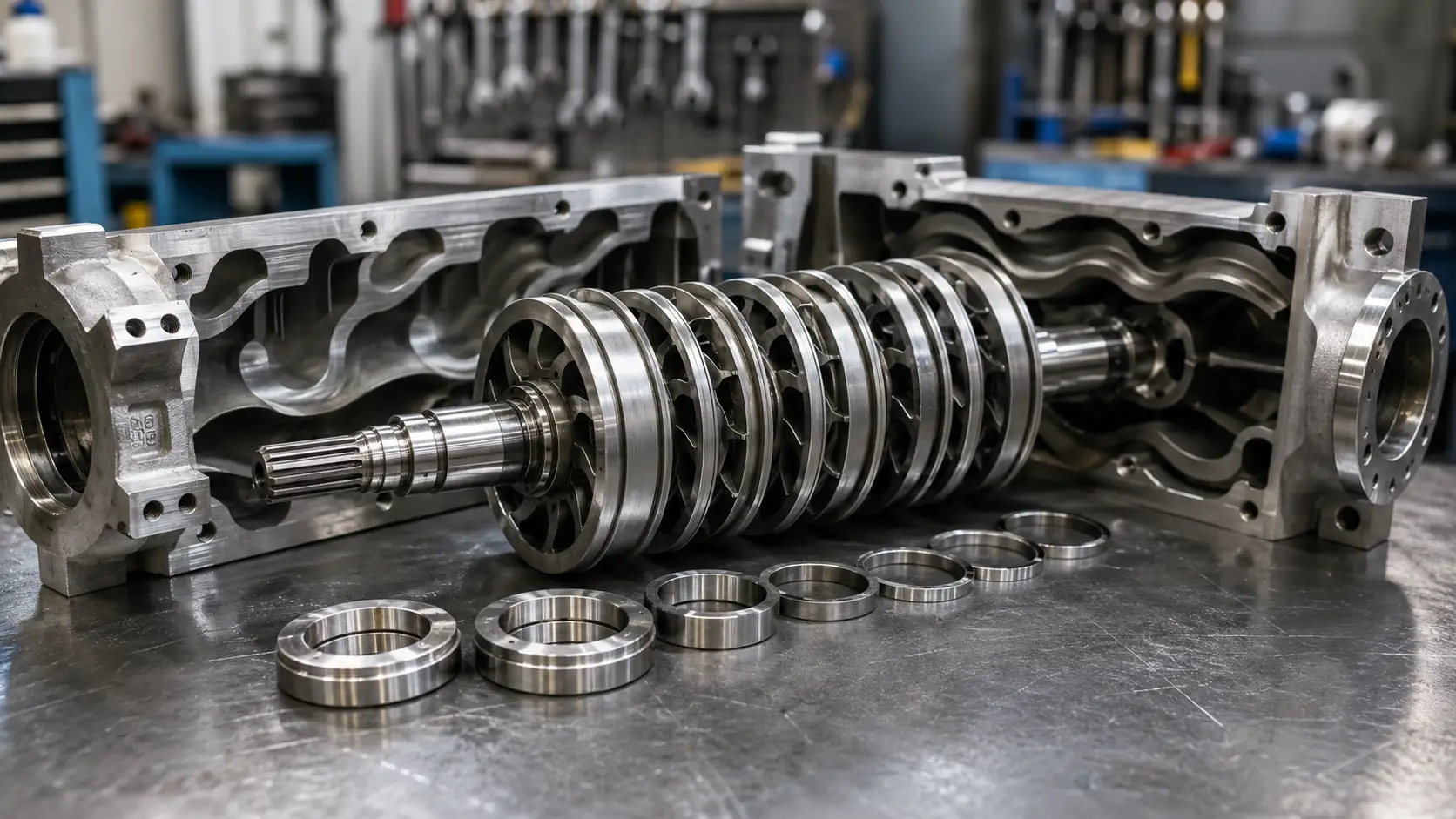
Why chloride overrides bulk TDS
Different groundwater sources at the same TDS can have dramatically different chloride levels depending on source geology. We have reviewed well fields where water around 2,000 mg/L TDS carried 400 mg/L chloride in one formation and 1,800 mg/L chloride in another formation nearby. That difference changes pump material even though the headline TDS looks similar. This is why we ask for the ion balance or at least measured chloride instead of accepting a single conductivity-derived TDS number as the material basis.
Why SS316L is our brackish default
At feed chloride above 500 mg/L, SS304 casing is exposed to stress corrosion cracking under pressure. SS316L is our standard specification for industrial brackish RO because many export-market groundwater sources sit above the SS304 threshold even when the total TDS number appears moderate. We upgrade to Duplex 2205 when submitted water analysis confirms chloride consistently above 3,000 mg/L, especially coastal groundwater and high-chloride industrial reuse sources.
Why protection cannot be optional
A correctly sized pump cannot protect itself from a blocked pre-filter or an empty feed tank. Low-pressure cutoff, pre-filter DP monitoring, and VFD current/vibration monitoring each catch a different failure mode. We treat these protections as part of the pump specification because the cost of a switch, gauge, or drive setting is far lower than replacing a damaged mechanical seal, impeller stack, or motor after dry running or cavitation.
For replacement projects, we also ask why the previous pump failed before matching the old nameplate. If the failure came from dry running, high chloride, wrong power supply, or blocked pre-filter suction, copying the previous model repeats the same failure path. We review the old duty point, water analysis, suction layout, and protection history before confirming whether the replacement should keep the same hydraulic range or change material, drive control, or inlet protection. This is especially important for overseas plants where pump failure is often discovered only after the site has already lost production time and local service access is limited. A replacement pump should remove the old failure mechanism, not simply restore the same operating risk, so we ask for photos of the failed wet end, motor plate, inlet pipework, upstream cartridge filter, and control cabinet settings when available. Those details often explain whether the quote should include a different protection package and revised commissioning note for the next operating season.
Compliance & Documentation Scope
| Item | Scope |
|---|---|
| CE | Available for applicable pump and control packages; confirm model and destination market before order |
| ISO 9001 | Quality management system certification covers manufacturing and inspection processes |
| ASME | Applicable to pressure vessels and pressure components only; not applicable to every pump model — scope available on request |
| Factory test | Rated flow and discharge pressure, motor current under load, mechanical seal leakage, vibration and noise, insulation resistance |
| Documents supplied | Pump curve, motor datasheet, wiring diagram, factory inspection record; additional validation documents available on request |
Six Pump Selection Errors to Resolve Before Quotation
Material grade cannot be confirmed from outlet pressure alone.
Outlet pressure is derived from feed TDS and recovery. When an inquiry specifies outlet pressure without declaring feed TDS and chloride concentration, we hold the material recommendation until the water analysis is submitted. Selecting a pump to hit a pressure number without chloride data can produce the right pressure capability in the wrong material grade, and SS304 failures above 500 mg/L chloride consistently show stress corrosion cracking within 12-18 months of continuous pressure service.
Feed flow is not equal to permeate target.
If a plant requires 20 m3/h permeate at 70% recovery, the correct pump feed flow is 28.6 m3/h. We flag this before recommending a model because the operating penalty is higher water consumption per m3 of product, larger concentrate disposal volume, or pressure forced above design point to compensate. That accelerates concentration polarization and raises chemical cleaning frequency beyond the project maintenance budget.
Temperature must include seasonal minimum and maximum.
NPSH available falls as feed water temperature rises. A pump specified against winter water temperature may cavitate in summer if site operating temperature reaches 40 C and NPSH available has dropped 15-20% below the pump NPSH required at the same suction configuration. In warmer climates and industrial facilities with preheated feed, this margin can disappear if an average temperature is used.
Power supply must match the destination site.
Voltage, frequency, and phase count are mandatory fields because a 380V/50 Hz motor shipped to a 415V/60 Hz site can overheat unless correction is designed before shipment, while a three-phase motor connected to single-phase supply will not start at all. We request destination country power standard on every export inquiry because correction is straightforward at specification time and costly after the pump reaches site.
Axial piston pumps belong above 55 bar.
For brackish water at 15 or 20 bar, axial piston selection adds first cost and maintenance complexity without useful performance benefit. Field-service technicians with axial piston experience are harder to source in many Southeast Asian and Middle Eastern markets, and the discharge-stability advantage becomes meaningful only above roughly 40-45 bar. We usually advise vertical multistage centrifugal below 40 bar.
Pre-filter DP monitoring is non-negotiable.
Installing a pump without a differential pressure gauge across the upstream cartridge filter removes the primary early-warning signal for cavitation risk. By the time cavitation becomes audible at the pump casing, impeller erosion has begun. We include a DP monitoring recommendation and 0.8-1.0 bar replacement trigger in our installation note because the small installation cost prevents significant reduction in impeller service life — typically 30–60% under sustained cavitation, depending on pump design and operating conditions.
Quote-Input Checklist for a Single-Response Sizing Review
Submitting a complete dataset allows our engineering team to confirm pump type, outlet pressure range, material grade, protection configuration, and power specification in a single response. Incomplete submissions require a follow-up exchange before sizing can proceed.
| Input | Details Required |
|---|---|
| Feed water TDS | mg/L; water analysis report if available |
| Feed water chloride concentration | mg/L; separate from bulk TDS declaration |
| Feed water source type | Groundwater / surface water / seawater / municipal |
| Target permeate output | m3/h or m3/day |
| System recovery rate | Percent target; we advise if unknown |
| Feed water temperature | Minimum and maximum in C if seasonal variation exists |
| Application type | Brackish RO / SWRO / boiler feed / pharma UPW / other |
| Power supply | Voltage / frequency / single- or three-phase |
| VFD requirement | Yes / no / request our recommendation |
| Material preference | SS316L / Duplex / Super Duplex / advise from water analysis |
| Installation environment | Indoor or outdoor; climate zone; space limits; suction line length and diameter |
| Downstream equipment | Membrane type and housing configuration if known |
| Destination country | For power standard and certification confirmation |
Related Components Reviewed Alongside the Pump
Membrane housings
Pressure vessels contain the RO membrane elements immediately downstream of the pump. Housing pressure rating must be compatible with the pump outlet operating range, and both components are reviewed together in skid-assembly projects.
Control valves
Flow regulation downstream of the pump requires that bypass and isolation valves on the high-pressure circuit are pressure-class matched to the pump rated outlet, from brackish RO at 10-25 bar through SWRO at 55-80 bar.
Pump and housing pressure classes are reviewed as one circuit
The pump outlet pressure is not an isolated pump value once the equipment is installed. The downstream membrane housings, end ports, adapters, pressure gauges, bypass lines, and relief arrangements must all be compatible with the operating pressure and the abnormal pressure states that can occur during start-up, shutdown, flushing, or valve misoperation. In skid-assembly projects, we review the pump and housing pressure ratings together because a pump that is technically correct for osmotic pressure can still be wrong for the installed pressure vessel assembly if the housing rating, connection pressure class, or valve bypass arrangement is lower than the selected pump envelope.
Valve arrangements affect pump stability and maintenance access
Bypass and isolation valves around the pump discharge and membrane array are not selected only by pipe diameter. We check pressure class, throttling position, maintenance isolation, flushing path, and whether the operator needs to isolate the RO section without draining the membrane housings. In boiler feed and ultrapure water projects, this matters during production windows because maintenance access often has to be planned around process downtime. When the valve layout forces excess flow through a bypass on a fixed-speed pump, we also review whether VFD control is the better energy and protection choice.