
Industrial FRP and Stainless Steel Membrane Housings – 300 to 1200 PSI
We engineer and manufacture membrane housings in FRP epoxy/glass composite and stainless steel, from standard BWRO at 300 PSI through high-pressure SWRO at 1200 PSI, supplied as standalone components or custom-specification vessels for system builders.
FRP, SS304, or SS316L – The Selection Depends on Pressure and Process Chemistry
Material selection for a membrane housing is driven by operating pressure, process-water chemistry, and compliance documentation. The wrong material choice is not recoverable without full housing replacement, so we confirm this before manufacturing.
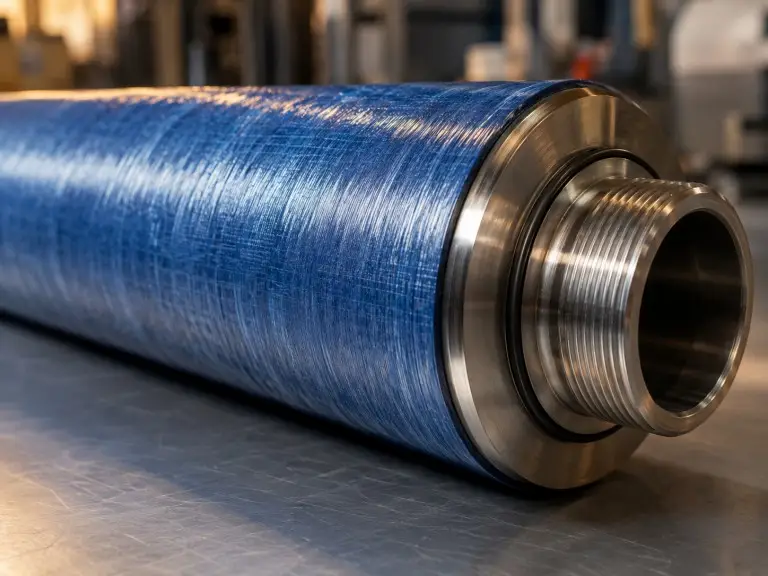
FRP – Epoxy/Glass Composite
FRP covers 150 PSI through 1200 PSI, with standard 300, 450, 600, 800, 1000, and 1200 PSI increments. It is chemically resistant to standard BWRO and SWRO feed and concentrate streams, and it is significantly lighter than stainless steel at equivalent pressure rating.
Specify FRP when operating pressure exceeds 300 PSI, especially 450-600 PSI for high-recovery BWRO or 600-1200 PSI for seawater desalination and SWRO. For an 8040 SWRO system operating at 800-1000 PSI, FRP epoxy/glass composite is the correct structural choice. Stainless steel housings at that pressure class are structurally feasible in some configurations, but cost-prohibitive compared with epoxy/glass composite at equivalent pressure rating.
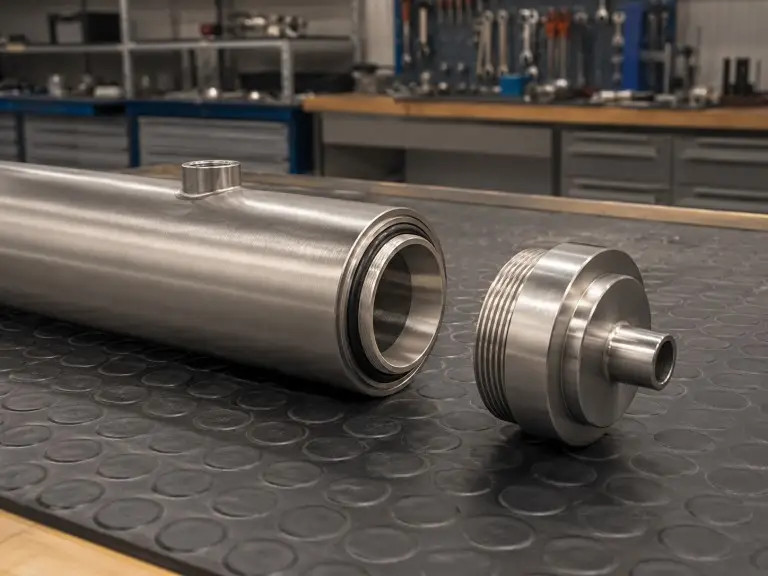
SS304 – General-Purpose Stainless Steel
SS304 is appropriate for general industrial BWRO systems where no GMP or pharmaceutical-grade compliance is required. Threaded end caps simplify field access for element replacement and seal maintenance in small-to-medium 4040 systems with 1 to 4 elements per vessel.
Specify SS304 when operating pressure is at or below 300 PSI, feed water TDS is below 2,000 mg/L, and NaCl is not the dominant dissolved salt. Beyond 300 PSI, SS304 loses its cost advantage relative to FRP. We do not recommend SS304 for SWRO pressure classes, peak pump outlet pressure above 300 PSI, or chloride-rich feed where pitting corrosion would shorten service life.
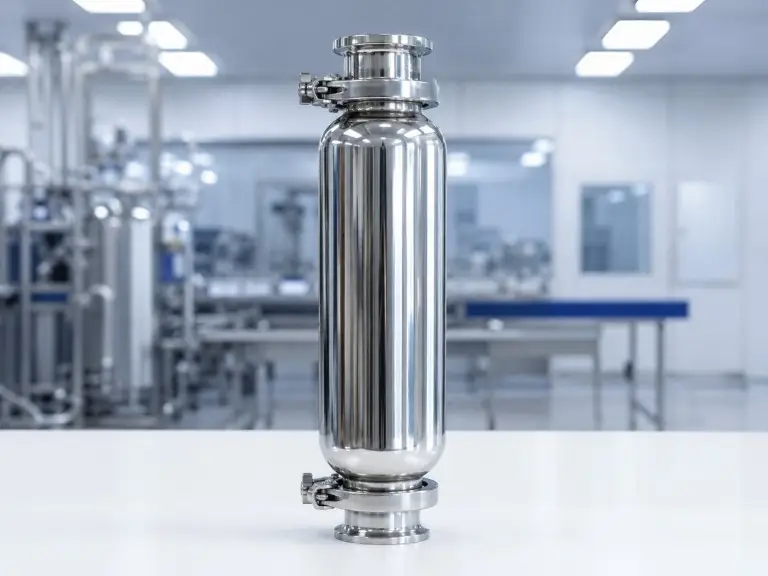
SS316L – Chloride, Pharmaceutical, and High-Hygiene Applications
SS316L offers improved pitting resistance in chloride-containing environments compared with SS304. It is commonly specified for pharmaceutical PW, WFI pretreatment, electronics UPW, food processing, and coastal or estuarine NaCl-dominant sources.
Specify SS316L when feed water or concentrate contains elevated chloride, when the application requires food-contact material compliance, or when semiconductor and pharmaceutical qualification records are required. Material certification documentation, including EN 10204 3.1 or equivalent where applicable, is available on request for validation dossiers and supplier qualification.
Five Variables to Confirm Before Every Housing Order
Once material is selected, we complete the housing specification by checking diameter, element count, pressure class, port type, and operating temperature against the actual RO train design.
| Variable | Range | Selection Trigger |
|---|---|---|
| Diameter | 2.5″ (2540) / 4″ (4040) / 8″ (8040) | Matched to membrane element diameter; 4040 for mid-scale systems, 8040 for large industrial |
| Elements per vessel | 1-7 | Set by flow rate, cross-flow velocity target, and recovery – not maximized by default |
| Pressure class | 300 / 450 / 600 / 800 / 1000 / 1200 PSI | Confirmed at or above peak operating pressure, not just nominal design point |
| Port type | End port / Side port | End port for two-end piping; side port for manifold-integrated skid design |
| Operating temperature | -7°C to 49°C | Standard FRP and SS operating envelope; confirm if process water deviates from this range |
Cross-flow velocity and element count: For systems producing below 10-15 m³/h permeate, 1 to 3 elements per 4040 vessel is typically the correct range – higher element counts at low flow produce insufficient cross-flow and accelerate fouling on trailing elements. For large 8040 industrial trains producing 50 m³/h and above, 6 to 7 elements per vessel in a 2:1 or 3:2 staged array is the standard configuration.
The instinct to maximize elements per vessel to reduce vessel count frequently produces the wrong outcome in low-flow systems. At low total feed flow rate, loading five or six elements per vessel reduces volumetric flow per element cross-section below the turbulence needed to sweep concentration polarization away from the membrane surface. Fouling then accumulates faster on trailing elements than it would in a shorter vessel with the same total element count distributed across more vessels.
If you have operating pressure, source water type, and element size in hand, contact our engineering team for a fast housing specification review before placing your order.
Match Pressure Class to Peak Operating Conditions, Not the Nominal Design Point
The pressure class must be set against peak operating pressure, including start-up surge, partial fouling, and seasonal source-water variability. The table below is a preliminary reference; final class must be confirmed by pump curve, feed TDS, recovery, temperature, fouling margin, and safety factor.
| Pressure Class | Equivalent | Primary Application |
|---|---|---|
| 300 PSI | 21 bar | Standard municipal BWRO, groundwater TDS < 2,000 mg/L, light industrial process water |
| 450 PSI | 31 bar | Higher-recovery BWRO, groundwater TDS 2,000-5,000 mg/L |
| 600 PSI | 41 bar | High-salinity BWRO (TDS 5,000-15,000 mg/L), second-pass nanofiltration |
| 800 PSI | 55 bar | Selected high-salinity brackish or low-pressure SWRO applications after salinity, temperature, recovery, and pump curve review |
| 1000 PSI | 69 bar | Standard open-ocean SWRO, coastal seawater desalination |
| 1200 PSI | 83 bar | High-pressure SWRO, elevated-salinity seawater, offshore desalination |
The most common pressure class specification error in BWRO projects is treating 300 PSI as a safe default for all groundwater applications. Groundwater TDS above 2,000 mg/L routinely requires transmembrane pressures of 350-420 PSI at design recovery. When seasonal variation increases hardness and TDS, or when the high-pressure pump is rated to 400 PSI at peak outlet, a 300 PSI housing operates above its rated class under real field conditions. Our engineers default to 450 PSI as the minimum pressure class for any BWRO system where feed TDS exceeds 2,000 mg/L or where the specified pump delivers more than 300 PSI at peak outlet pressure.
The consequence is not always immediate failure, which is why the pressure margin matters before the order is placed. A housing rated exactly at nominal design pressure carries no allowance for start-up surge, partial fouling, seasonal salinity increase, or a pump curve that can exceed the normal operating point. We size against the conditions the system actually sees in the field.
What a Membrane Housing Does Inside the RO Pressure Train
A membrane housing – also called a pressure vessel – is a cylindrical containment body that holds one to seven spiral-wound membrane elements in series under operating pressure. Feed water enters through the housing’s port, flows axially across the element surfaces, and separates into permeate, the filtered stream, and concentrate, the high-TDS reject that exits the opposite end of the vessel.
The housing is not the filtering element. It is the engineered enclosure that allows the membrane element to function under sustained pressure. Without a correctly rated housing, the membrane cannot hold pressure, the system cannot generate cross-flow velocity, and permeate cannot separate reliably from concentrate. We confirm operating pressure range, material compatibility with both feed and concentrate streams, and port type for the skid piping layout before recommending a housing configuration.
The housing must maintain structural integrity across the full operating pressure range, survive pressure cycling between start-up and shutdown, and provide a leak-free seal at each element interconnector and at both end caps. It must also be chemically compatible with both feed water and the more concentrated reject stream leaving the trailing element.
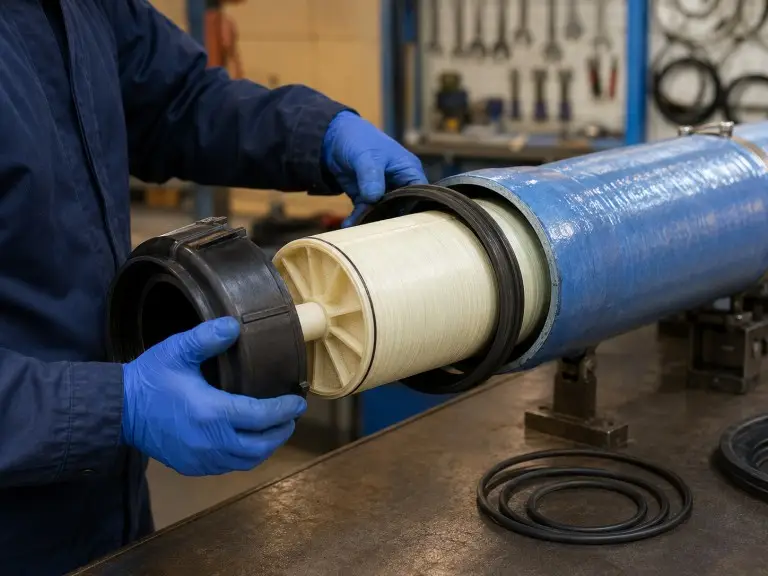
You need a membrane housing when:
- You are building or expanding an RO, NF, or UF system using 2.5″, 4″, or 8″ spiral-wound elements.
- You are replacing failed or end-of-service housings and need exact-match or upgraded-pressure-class vessels.
- You are designing a custom RO skid and need material, pressure class, and port configuration matched to membrane selection and pump outlet pressure.
Our membrane housings are available within our full range of water treatment parts and are reviewed with membrane elements, pumps, and valves as part of the complete RO train.
Four Inquiry Types That Belong in a Different Product Category
Cartridge Filter Housings and Multimedia Filter Vessels
Cartridge filter housings operate at 20-150 PSI and are designed for different element formats and replacement cycles, not spiral-wound elements under RO operating pressure. Our stainless steel cartridge filter housing page covers that product category in full.
Residential or Small Commercial RO Housings
Small-scale RO units for home or light commercial use operate on municipal tap water at low pressure with 50-100 GPD elements. Our housings serve industrial-scale systems starting at the 4040 element format.
Pressure Storage and Accumulator Tanks
A pressure tank for treated water storage is not a membrane housing. Pure water tanks, FRP tanks, and PE storage vessels are separate categories outside this page’s scope.
Hollow-Fiber and Tubular UF Membrane Modules
MF and UF systems using hollow-fiber or tubular element formats use a different mechanical housing design than spiral-wound pressure vessels. This page covers spiral-wound element housings only.
If you are unsure whether your application falls within this product scope, describe the system to our engineering team. We will route the inquiry to the correct category before you spend time collecting the wrong specification data.
How the Housing Connects High-Pressure Pump Output to Staged Membrane Arrays
The membrane housing is the structural midpoint of the RO pressure train. Upstream, pumps for RO systems pressurize pretreated feed water to the operating pressure your source water TDS and recovery target require – typically 300 PSI for standard brackish water RO and up to 1200 PSI for high-pressure seawater desalination.
That pressurized stream enters the housing through the feed port, distributes across the loaded membrane elements, and generates the cross-flow velocity needed to maintain mass transfer at each element surface. Inside the housing, each spiral-wound element is sealed at its permeate tube junction by brine seals that prevent feed bypass around the element OD. Element interconnectors link permeate tubes in series, while concentrate exits the opposite end at near-feed pressure minus the pressure drop across the element train – as determined by membrane element model, feed flow, temperature, and fouling allowance per the membrane manufacturer’s datasheet.
Per-element pressure drop across the housing train is determined by membrane element model, feed flow, temperature, and fouling allowance per the membrane manufacturer’s datasheet.
The housing must hold all of this under sustained load, without flex, seal extrusion, or end-cap movement. Multiple housings are arranged in staged arrays. First-stage vessels receive pretreated feed at full operating pressure; second-stage vessels receive concentrate from the first stage at reduced volume and slightly reduced pressure. Staging ratios of 2:1 are standard for 4040 BWRO systems, while large 8040 industrial trains may run 3:2 or 4:2 staging ratios. Flow sequencing and bypass routing through the staged array are managed by control valves that coordinate the RO operating cycle.
Five RO System Applications for Industrial Membrane Housings
Brackish Water RO – Municipal and Industrial Groundwater
Housing: FRP or SS304 4040 · Pressure: 300-450 PSI · TDS: up to 5,000 mg/L
For standard municipal BWRO at 300 PSI with groundwater TDS below 1,500 mg/L, FRP 4040 end-port housings in 2:1 staged arrays with 3 elements per vessel are standard. For harder groundwater at TDS 3,000-5,000 mg/L, where operating pressure runs at 450-600 PSI, FRP 4040 or FRP 8040 housings at the corresponding pressure class replace the 300 PSI units. For the same application with smaller footprint and low feed TDS, SS304 4040 end-port housings are a practical alternative where accessible end caps simplify element replacement in field-service environments with limited maintenance infrastructure.
Seawater Desalination – Coastal and Offshore Plants
Housing: FRP 8040 · Pressure: 800-1200 PSI · Elements: 6-7 per vessel
Open-ocean SWRO at TDS 32,000-40,000 mg/L requires 800-1000 PSI to sustain the cross-flow and driving pressure conditions at which 4040 or 8040 SWRO elements operate at rated output. Elevated-salinity intakes above 40,000 mg/L TDS or high-pressure designs may require FRP 8040 housings at 1200 PSI. Stainless steel housings are not our recommendation for standard SWRO operating pressures; above 600 PSI, FRP epoxy/glass composite is the correct structural and weight-efficient material. Our Middle East and coastal Southeast Asia export projects concentrate demand for this configuration.
Boiler Feed Water Pre-Treatment
Housing: FRP or SS304 4040 · Pressure: 300-450 PSI · Feed: municipal or light industrial
RO membrane housings for boiler feed water treatment remove hardness, silica, TDS, and scale precursors before make-up water enters the boiler. Standard feed below 1,500 mg/L TDS fits 300 PSI FRP or SS304 4040; harder feed or elevated silica may require 450 PSI. For boiler pre-treatment, we commonly supply FRP 4040 or SS304 4040 end-port housings depending on site maintenance access preference and element replacement frequency.
Pharmaceutical and Electronics Ultra-Pure Water
Housing: SS316L 4040 · Pressure: 300-450 PSI · Compliance: GMP material cert
For pharmaceutical PW, WFI, or electronics UPW production, the first RO pass typically operates at 300-450 PSI. At this pressure class, SS304 and FRP are both structurally adequate, but SS316L is commonly required where regulatory validation requires traceable material certification. We supply SS316L 4040 end-port or side-port housings with material certificates, hydrostatic test records, and conformity declarations for deionized water filtration system projects. Operating temperature in cleanroom environments rarely departs from the standard -7°C to 49°C envelope, so documentation and material qualification usually drive the specification more than pressure class.
Final compliance for pharmaceutical or semiconductor applications must be confirmed against the user’s process specification, validation protocol, and applicable local standard.
Industrial Process Water and High-Recovery Cooling Tower Make-Up
Housing: FRP 4040 · Pressure: 450-600 PSI · Feed: hard industrial supply
For process water and cooling tower make-up RO, source water and recovery target drive housing pressure class. Feed from municipal supply or low-TDS groundwater at standard pressure fits the same FRP or SS304 4040 specification as municipal BWRO. High recovery to minimize reject discharge, increasingly common in water-stressed regions across the Middle East and Central Asia, pushes specification toward 450-600 PSI FRP. In high-recovery BWRO, second-stage concentrate TDS can reach 10,000-20,000 mg/L, requiring higher-pressure housings on the second-stage array. Pairing housing pressure class with the correct membrane in reverse osmosis elements at each stage is part of our engineering review.
Four Selection Mistakes to Identify Before Every Housing Order
Pressure Class Set Against Nominal Design Point, Not Peak Operating Conditions
A 300 PSI housing specified for a pump rated to 350-400 PSI at peak outlet can operate above class under seasonal TDS and fouling conditions. The specification may look acceptable at the nominal design point, but the same pump against a partially fouled membrane train at elevated seasonal TDS can deliver instantaneous pressure above 370 PSI. O-ring seals extrude, end-cap threads fatigue, and FRP laminate microcracks under repeated overpressure cycling before visible failure appears. Any BWRO system with feed TDS above 2,000 mg/L or pump rating above 300 PSI needs 450 PSI as the minimum pressure class.
SS304 Specified in a Chloride-Rich Application
SS304 pitting resistance is insufficient when feed or concentrate contains elevated chloride. At high recovery, chloride concentration in the reject stream can be several times higher than feed concentration. For SS304 housings, chloride-rich concentrate increases pitting and crevice-corrosion risk, especially at elevated temperature, low-flow zones, or welded areas. In coastal or estuarine applications where TDS is NaCl-dominated, premature housing failure is an expected long-term outcome, not an exceptional failure mode. In pharmaceutical or food-contact applications, corrosion products can contaminate the process stream. SS316L is the correct specification.
End Port Selected for a Manifold Skid Designed for Side Port
End-port housings connect feed and concentrate piping at the vessel ends. Side-port housings connect at lateral shell ports for multi-vessel manifold assemblies where housings share common feed and concentrate manifolds along the skid length. Installing end-port vessels on a side-port skid adds field piping, extra connections, leak points, and maintenance access constraints not accounted for in the original skid design. Port type must be locked during design and is not reversible after manufacturing without rework or replacement.
Element Count Per Vessel Maximized Without Confirming Cross-Flow Velocity
In a 4040 system sized for 8 m³/h permeate, loading five or six elements per vessel can reduce feed velocity below the turbulence needed to sweep concentration polarization from membrane surfaces. Fouling accumulates faster on trailing elements than it would in a shorter vessel distributing the same total element count across more vessels. Service intervals shorten, chemical cleaning frequency increases, and element lifetime falls. Those costs exceed the capital saving from fewer vessels, so we calculate minimum cross-flow velocity before confirming element count.
Certified Manufacturing and Hydrostatic Testing for Every Housing Shipped
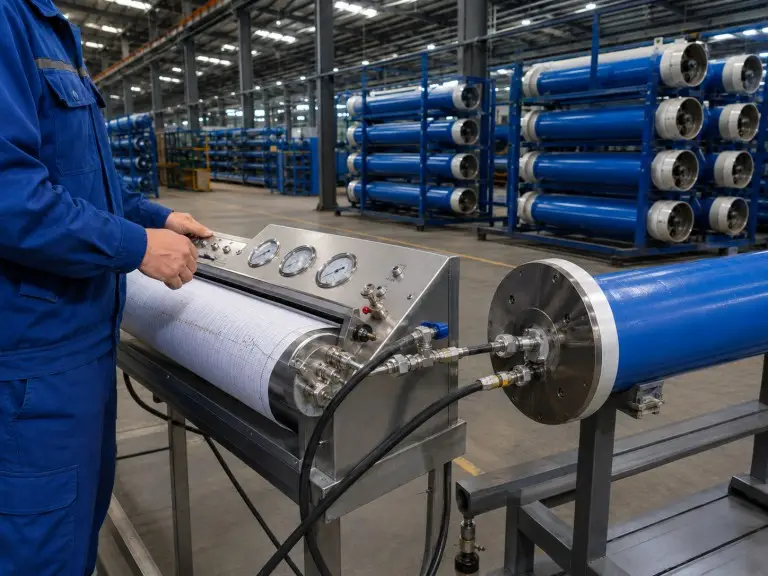
Every membrane housing we manufacture is hydrostatically tested according to the applicable product specification and pressure class before shipment. Test pressure, hold time, and acceptance criteria are confirmed in the quotation package. Certification documentation and test records – including CE and ISO 9001 certificates – are available. ASME pressure vessel documentation is available on request where project scope requires it and is provided as part of the shipment package or as a standalone document set for supplier qualification review.
Hiju was established in 2016 and operates from a 70,500 sqm facility in Qingdao, China, with a 21,000 sqm production workshop. Our team includes 78 technicians and 28 engineers covering material preparation, vessel fabrication, hydrostatic testing, and final quality inspection before shipment.
Global Export Record
We have shipped membrane housings and water treatment component packages to projects in Southeast Asia, the Middle East, Africa, South America, and Central Asia – more than 20 countries and regions in total. Established 2016, Qingdao, China.
OEM and ODM Manufacturing
OEM and ODM manufacturing is available for system builders requiring custom housing dimensions, non-standard element counts, custom port positioning, specific surface finishes, or branded product specifications.