
Single Valve Single Tank Water Softener
When your process can tolerate a scheduled regeneration window of one to two hours, a single valve single tank water softener is usually the right starting point. It delivers hardness removal with the lowest capital cost, smallest footprint, and simplest installation path in our water softener systems range.
We use this configuration for small boiler feed systems, commercial building water supply, hotel laundry circuits, HVAC cooling tower make-up, and food processing pre-treatment where regeneration can be scheduled during low demand.
When We Recommend This Configuration
The first question we ask is not flow rate — it is whether the downstream process can accommodate a scheduled regeneration window. This page covers applications where the answer is yes.
Right for This Configuration
- Regeneration can be scheduled overnight, during a shift gap, or on weekends.
- A 60–120 minute service gap is operationally acceptable.
- Inlet hardness is within the single-vessel review range, often up to about 8 mmol/L as CaCO₃ equivalent.
- Budget and space favor the simplest design.
- The downstream process has a buffer tank or planned replenishment window.
Not Required Here
- No second tank is required for the service cycle.
- No bypass tank or alternating manifold is required for normal operation.
- No independent valve assembly is required per tank.
- Flow-meter demand control is optional; time-clock control remains suitable when daily demand is predictable.
When to Step Up to a Different Configuration
If your operation cannot tolerate any regeneration downtime, the single-tank design is not the right fit. A single valve double tank water softener keeps one vessel in service while the other regenerates — this is the standard route for 24/7 boiler plants and hotels.
Where both high flow and independent valve-level redundancy are needed, a double valve double tank water softener provides full isolation per vessel. For flows above 100 m³/h or multi-point distribution, a multi tank water softener array applies.
How the Single Control Valve Runs the Cycle
One automatic multi-port control valve governs every phase of service and regeneration. One valve body, multiple internal flow paths, programmable cycle timing: no second valve, no bypass tank, and no additional pipe manifold for normal operation.
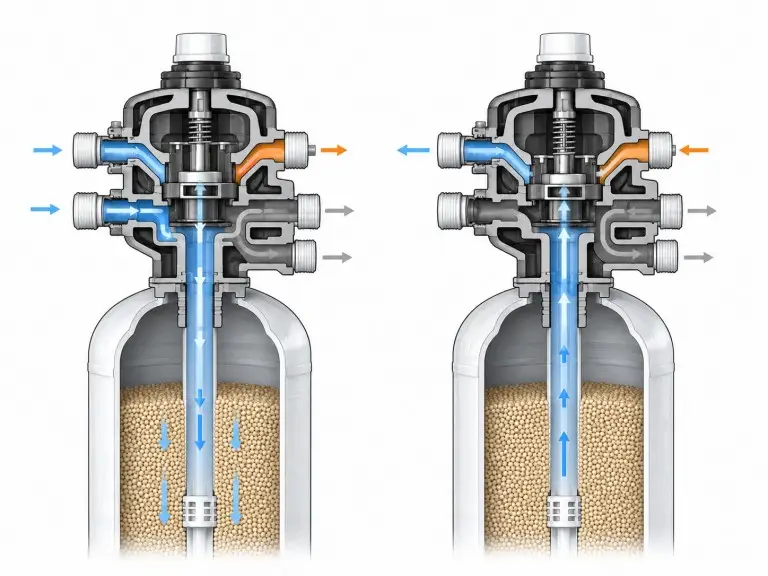
During service mode, raw water enters through the valve inlet, flows down through the resin bed, and exits through the valve outlet as softened water. The resin vessel contains a bed of strong-acid cation exchange resin in sodium form. As raw water passes through, calcium and magnesium ions — the hardness-forming minerals — are exchanged for sodium ions held on the resin surface, producing softened water at the outlet. When the resin bed approaches its exchange capacity, the control valve initiates the regeneration sequence. The brine tank sits passively to the side with dissolved salt solution waiting for the regeneration command.
When the regeneration trigger fires, either from a programmed time-clock interval or from a flow meter measuring exhausted exchange capacity, the valve steps through five positions without operator intervention.
Brine tank sizing
The atmospheric brine tank holds pre-dissolved sodium chloride solution. We size tank volume and salt inventory to resin volume and expected regeneration frequency, not to a generic catalog accessory size.
The Five-Phase Regeneration Cycle
Understanding the regeneration sequence matters for scheduling design and downstream buffer sizing. Total cycle time is typically 60 to 120 minutes depending on resin volume, brine concentration, and controller programming.
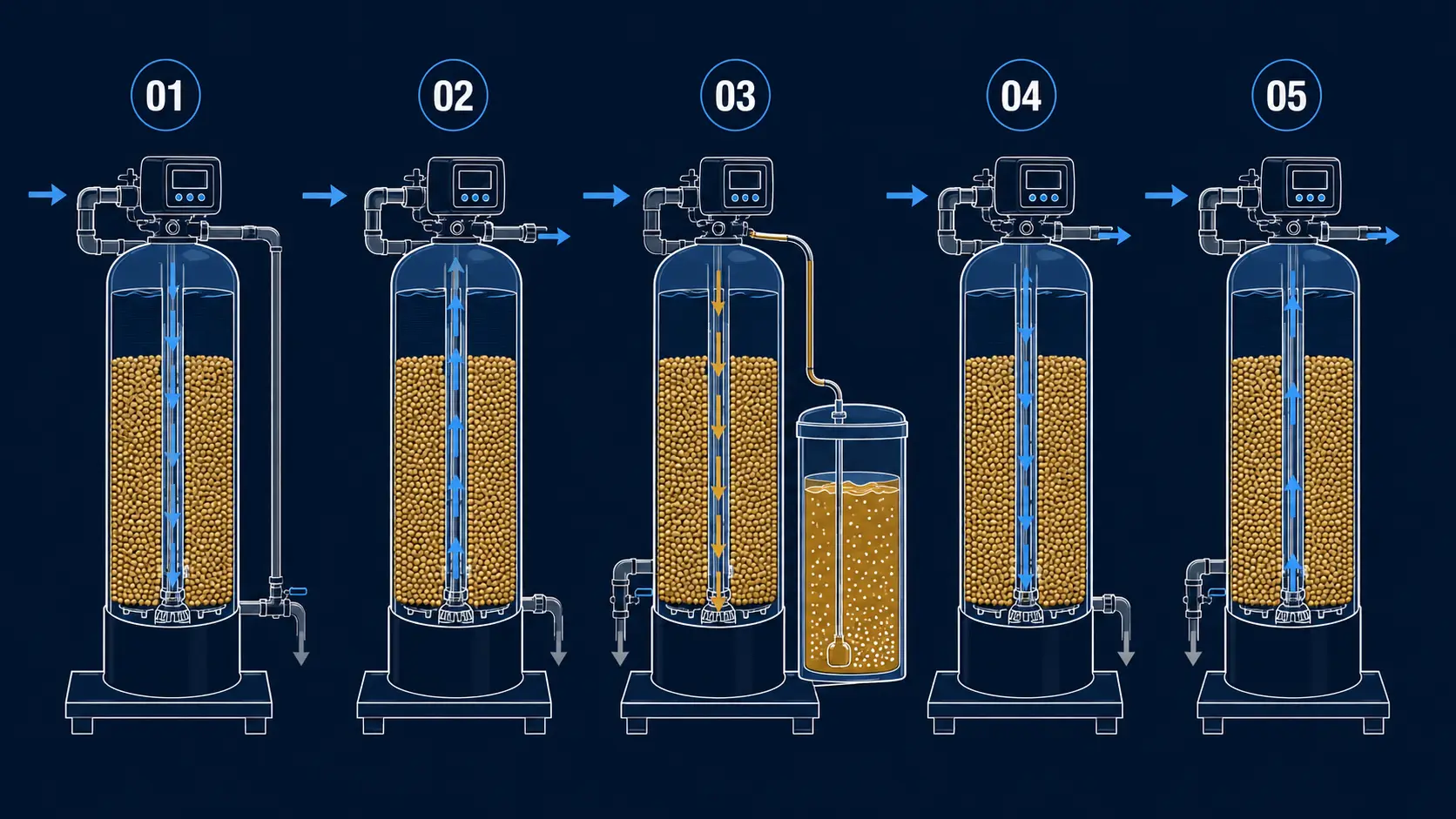
- 01
Service
Raw water flows through the resin bed from top to bottom and exits as softened water until exchange capacity is exhausted.
- 02
Backwash
Water reverses upward for 5–15 minutes to loosen the bed, remove trapped solids, and discharge them to drain.
- 03
Brine Draw
Concentrated salt solution enters the vessel and displaces calcium and magnesium ions from resin exchange sites.
- 04
Slow Rinse
Fresh water slowly displaces residual brine and hardness ions without disturbing the restored bed structure.
- 05
Fast Rinse
A higher rinse flow removes final brine traces before the control valve returns the unit to service.
Operating Variables Confirmed Before Sizing
We do not publish fixed catalog grain capacities because correct sizing depends on inlet hardness, daily consumption, peak flow, and regeneration frequency tolerance.
| Parameter | Operating Range / Reference | Review Dependency |
|---|---|---|
| Operating pressure | 0.2–0.6 MPa (29–87 psi) | Confirmed against site supply pressure. Higher pressure ratings reviewed by vessel material and destination requirements |
| Inlet water temperature | 5–50°C | Confirm for hot process makeup applications |
| Inlet hardness | ~8 mmol/L (467 mg/L as CaCO₃) upper operating reference | Confirmed from water analysis |
| Service flow rate | ~5 gpm/ft³ continuous; ~7.5 gpm/ft³ peak | Drives resin vessel sizing |
| Outlet hardness target | ≤0.03 mmol/L (≤1.76 mg/L as CaCO₃) | Confirmed against inlet composition |
| Resin type | Standard strong-acid cation exchange resin | Grade specified per project |
| Resin exchange capacity | Commonly estimated around 21,000–32,000 grains/ft³ depending on salt dose and resin grade | Confirmed from resin supplier data |
| Regeneration initiation | Time-clock or demand-initiated | Customer-specified at order |
| Regeneration cycle time | 60–120 minutes typical | Function of resin volume and programming |
| Regeneration salt dose | Project-specific | Determined by resin volume and efficiency setting |
| Resin service life | Feed-water dependent | Affected by iron, chlorine, and regeneration frequency |
| Electrical supply | 220V AC single-phase or 380V AC three-phase panel supply | Control valve actuator voltage confirmed by selected valve model and control-panel design |
| Pipe connection size | Matched to project flow | Specified in engineering |
| Resin vessel material | FRP, epoxy-lined carbon steel, or stainless steel | Custom branding option; confirmed per project |
| Brine tank | Atmospheric tank with float valve | Sized to resin volume and regeneration frequency |
Reviewed proposal, not catalog selection
When you send water analysis and daily volume data, we specify resin vessel diameter, resin volume, valve size, brine tank volume, and regeneration schedule as a reviewed proposal.
Where Scheduled Regeneration Fits the Operating Pattern
Each scenario below shares one characteristic: a predictable low-demand window that aligns with a 60–120 minute regeneration cycle.
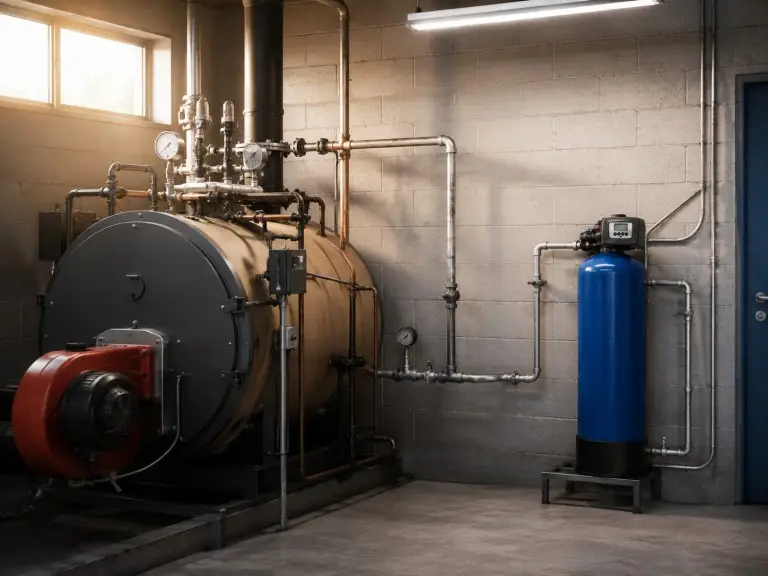
Small and Medium Boiler Feed
Day-shift boiler systems regenerate overnight and return to service before start-up. For full system context, review boiler feed water treatment.
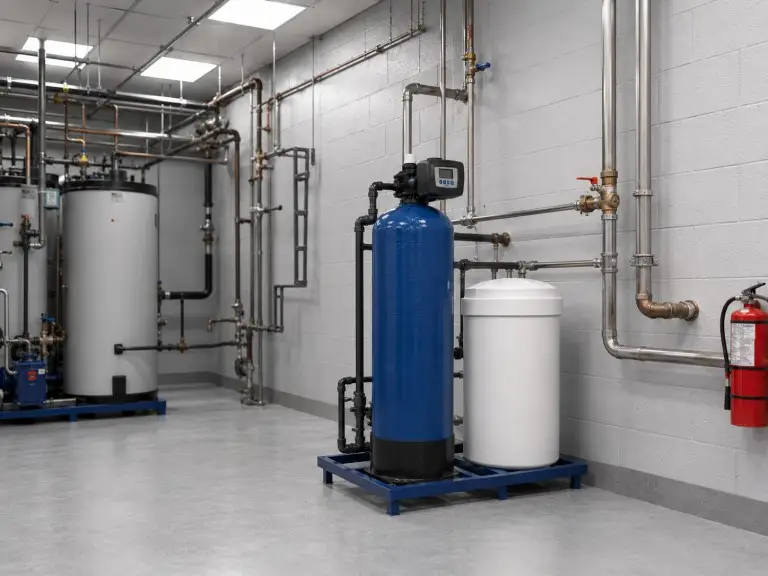
Hotel and Commercial Buildings
Regeneration between 2 and 5 AM is common when occupant demand is low. Broader building treatment scope is covered in water filtration systems for commercial use.
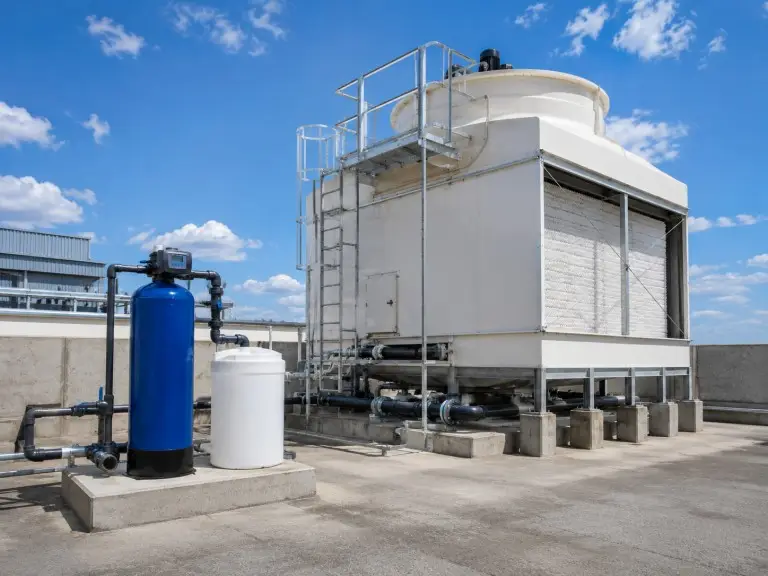
HVAC Cooling Tower Make-Up
Cooling tower softening fits single-tank operation when makeup demand follows a standard industrial schedule and the system has predictable maintenance windows.
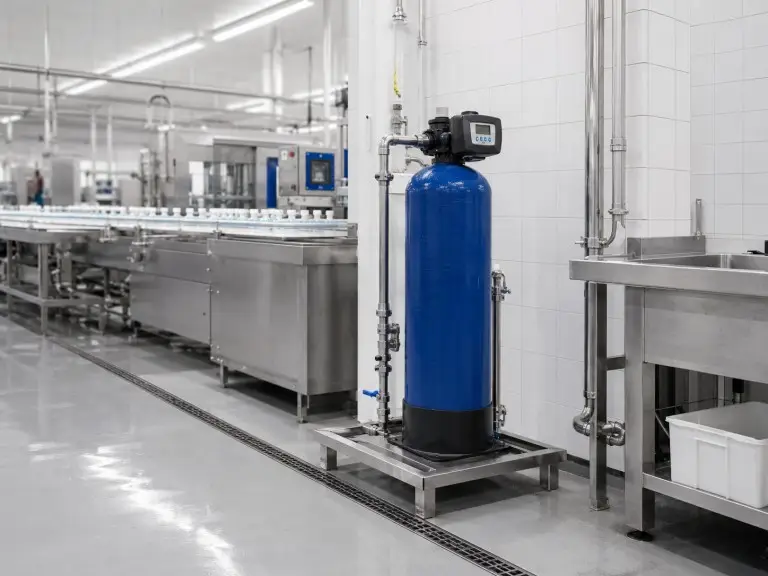
Food and Beverage Pre-Treatment
Facilities with defined production schedules align regeneration with shift changeovers or CIP windows. We confirm outlet quality and schedule sensitivity before finalizing the specification.
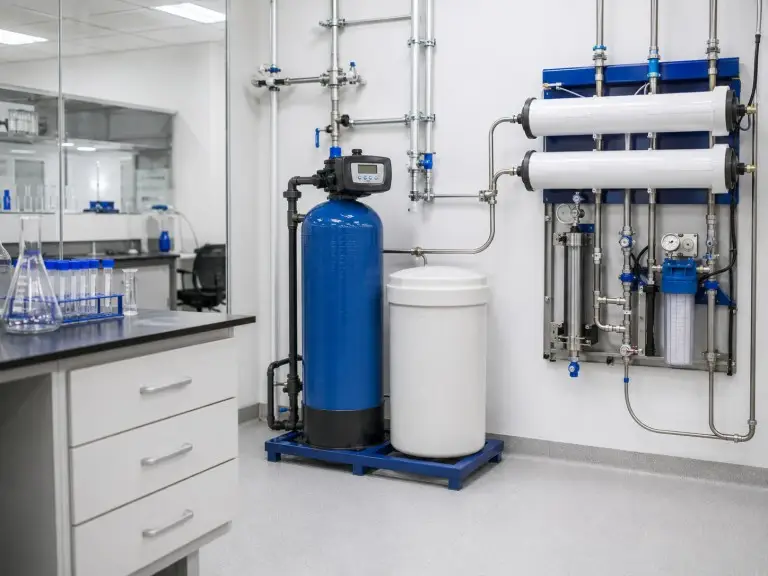
Laboratory and Pharmaceutical Pre-Treatment
Lower-volume softening protects downstream demineralizers or RO membranes from hardness scaling. Daily throughput and intermittent operation often make the single-tank design appropriate.
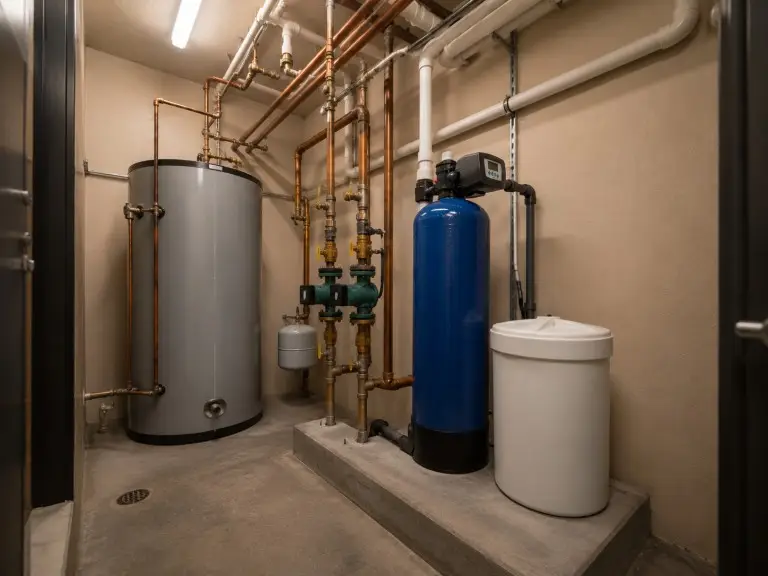
Office Buildings and Small Commercial Premises
Single-shift HVAC, washing equipment, and domestic hot water circuits typically have low daily volume and planned downtime, so the single-tank system is the standard starting point.
Common Specification Errors Checked Before Quotation
In export softener inquiries, the most common mistakes create undersized systems or configuration mismatches that only become visible after installation.
Peak Flow Without Daily Load
A buyer may request 10 m³/h, but resin sizing depends on daily volume multiplied by inlet hardness and divided by resin capacity. We ask for operating hours, not only peak flow.
No Current Water Analysis
Regional averages are unreliable in many export markets. We confirm actual hardness and source variation before sizing a single resin vessel.
Missing Iron or Manganese
Iron fouling reduces exchange capacity and is not reversed by normal brine regeneration. We check iron and manganese before finalizing the resin specification.
Fixed Outlet Hardness Claim
Our target of ≤0.03 mmol/L is reviewed against inlet composition, resin volume, regeneration efficiency, and service flow instead of stated as an unconditional catalog claim.
Export Voltage Discovered Too Late
Control valves are configured for 220V AC or 380V AC variants. We confirm voltage, phase, and frequency before order release to avoid site-stage delays.
Inputs Required for a Fast Configuration Review
Missing any of these inputs usually requires a follow-up exchange before we can issue a meaningful proposal.
Inlet Water Hardness
Send mg/L as CaCO₃ or mmol/L from a current water analysis report.
Daily Water Use or Peak Flow
Provide m³/day and m³/h if available so resin volume and valve size are not estimated from peak flow alone.
Operating Hours per Day
We use the hours to calculate actual daily grain loading and regeneration frequency.
Regeneration Window
Confirm whether a 60–120 minute off-hours window is acceptable for this simplex configuration.
Power Supply
Voltage, phase, and frequency decide the export valve and control-panel path.
Downstream Application
Boiler feed, cooling tower makeup, building service, or food process use changes the acceptable risk of downtime.
Destination Country
Import documentation, voltage, frequency, and packing requirements change by market.
Special Requirements
Tank material, connection standard, valve brand, custom label, and packaging scope should be declared before proposal release.
Where the Single-Tank System Sits in the Range
All configurations use ion exchange softening; the difference is operating continuity, redundancy, footprint, and cost.
| Decision Factor | Single Valve Single Tank | Single Valve Double Tank | Double Valve Double Tank | Multi-Tank |
|---|---|---|---|---|
| Soft water supply continuity | Interrupted during a 60–120 minute regeneration cycle | Continuous alternating supply | Continuous with independent tank isolation | Continuous and scalable by tank group |
| Regeneration downtime impact | Acceptable only when an off-hours window exists | No downstream interruption under normal operation | No interruption; one tank can be isolated for maintenance | Managed by staged or rotational regeneration |
| Capital cost | Lowest | Moderate | Higher | Project-specific |
| Physical footprint | Smallest footprint with one vessel and one brine tank | Two vessels plus shared valve and brine system | Two vessels, two valves, and more pipework | Multiple vessels and central pipe manifold |
| Operational complexity | Simplest valve logic and maintenance routine | Shared-valve alternating sequence | Independent valve control and service isolation | Requires coordinated control logic |
| Typical application scale | Light to medium industrial and commercial loads | Continuous commercial and process lines | Critical utilities needing redundancy | High-capacity or multi-point water networks |