
Double Pass RO Systems for Sub-5 µS/cm Product Water
When your product water conductivity specification falls below what a single-pass RO can reliably deliver — typically below 5 µS/cm — a double-pass configuration routes the first-pass permeate through a second independent pressure loop. We design and manufacture both passes as a matched system, sizing the second-pass membranes, high-pressure pump, and interstage conditioning to your confirmed purity target, not to a generic assumed output.
When a Second RO Pass Is the Right Choice
A double-pass RO system is the correct process route when your product water conductivity target falls below what a single-pass industrial reverse osmosis system can deliver — typically below 5 µS/cm, or when contaminants such as boron or dissolved CO₂ require interstage conditioning before the second membrane pass. All conductivity values on this page are specified as temperature-compensated at 25 °C unless otherwise noted.
Not every project needs two pressure loops
Before we configure a double-pass system, we review your feed water analysis, downstream process requirement, and target specification to confirm the added capital and operating cost of a second pressure loop is justified. For many municipal or lightly brackish feed sources with a standard industrial purity target, a well-engineered single-pass RO meets the specification at lower cost.
| Application / Purity Target | Single-Pass RO Typically Sufficient | Double-Pass RO Recommended | Engineering Notes |
|---|---|---|---|
| Product conductivity target 50-200 µS/cm | Yes | No | Standard industrial and general commercial use. |
| Product conductivity target 10-50 µS/cm | Usually yes | Not usually | Confirm feed TDS; high-TDS feed may shift the boundary. |
| Product conductivity target < 5 µS/cm | No | Yes | Typical second-pass target range; exact value feed-water dependent. |
| Product conductivity target < 2 µS/cm | No | Yes | Second pass required; EDI downstream may also be specified. |
| Boron specification (pharmaceutical, semiconductor) | No — poor rejection at neutral pH | Yes | Interstage NaOH dosing to pH 9.5–10.2 raises borate rejection from ~50% to >90%; dosing rate set from feed boron concentration. |
| Silica specification with elevated silica in feed | Marginal | Preferred | Single-pass silica rejection is feed-chemistry-dependent. |
| Pharmaceutical PW generation | Possible with single-pass + EDI | Preferred as pre-EDI step | Pharmaceutical PW route must be confirmed against applicable USP/EP/CP requirement, validation strategy, microbial control plan, and end-user URS. Double-pass RO provides a more stable EDI feed and wider quality margin. |
| Pharmaceutical WFI pretreatment | No | Yes | Double-pass RO may serve as upstream pretreatment before the final WFI generation stage (distillation or validated membrane process). WFI compliance depends on the complete validated water system and applicable pharmacopeia. |
| Electronics / semiconductor UPW | No | Yes — EDI downstream typically also required | Typical target: RO-2 permeate < 1 µS/cm feeding EDI to reach > 10 MΩ·cm; downstream train confirmed from process specification. Final compliance must be confirmed against the user’s process specification and applicable local standard. |
| High-pressure boiler makeup | No | Yes | Typical target: conductivity < 1 µS/cm, silica < 0.02 mg/L; exact limits set by boiler pressure class (typically > 60 bar drum pressure). |
| Battery manufacturing process water | No | Yes | Typical requirement: conductivity < 2 µS/cm with tight controls on sodium, chloride, and metallic ions; confirmed from cell chemistry specification. |
| High-purity food and beverage blending water | Conditional | Preferred when strict ionic purity is required | Confirm regulatory and product recipe specification. |
The boundary values above are Hiju preliminary design targets for double-pass RO projects. Final limits depend on membrane model, feed-water analysis, recovery target, temperature, scaling projection, and pretreatment design.
Municipal or clean surface feed
When your feed is municipal tap water and your conductivity target sits in the standard industrial range (50–200 µS/cm), a single-pass configuration typically meets the specification at lower capital cost — see our commercial RO water filter system page for that route.
Brackish or moderate-TDS feed
When your primary challenge is salinity reduction from a brackish source rather than achieving sub-5 µS/cm purity, the brackish water reverse osmosis route uses a different membrane and pressure design.
Seawater-level TDS feed
When your raw water source is seawater-level TDS and the primary engineering challenge is desalination energy and recovery rather than downstream purity polishing, the seawater desalination system route applies a different pressure envelope.
“Double Stage” and “Double Pass” Are Not the Same System
The terms “double stage RO” and “double pass RO” describe two different configurations. The distinction changes the pump count, the pressure loop architecture, and the achievable product water conductivity.
Stage
A stage uses a single high-pressure pump and a single pressure loop. Concentrate from the first array of membrane vessels feeds directly into the second array in series — same pump, same loop. This improves water recovery from a given feed volume but does not reprocess the permeate through a separate membrane loop. The product water conductivity is not substantially improved over a single-stage array.
Pass
A pass is a complete, independent pressure loop with its own high-pressure pump and its own set of membrane vessels. The permeate from the first pass (RO-1) becomes the feed water to the second pass (RO-2). This second rejection step removes residual ions, dissolved CO₂, and trace contaminants that survive the first pass.
| Term | Feed to second section | Pump configuration | Primary purpose |
|---|---|---|---|
| Two-stage RO | First-stage concentrate | One shared pressure loop | Increase water recovery |
| Two-pass RO | First-pass permeate | Two independent pressure loops | Improve permeate purity |
How we identify the system at inquiry stage. Our double-pass RO systems are two separate, independent pressure loops — not two stages on one pump. If you receive a quotation described as a “double-stage system” in response to a conductivity target below 5 µS/cm, the system architecture does not match the specification. We identify this at the start of every inquiry, before configuration and before quoting.
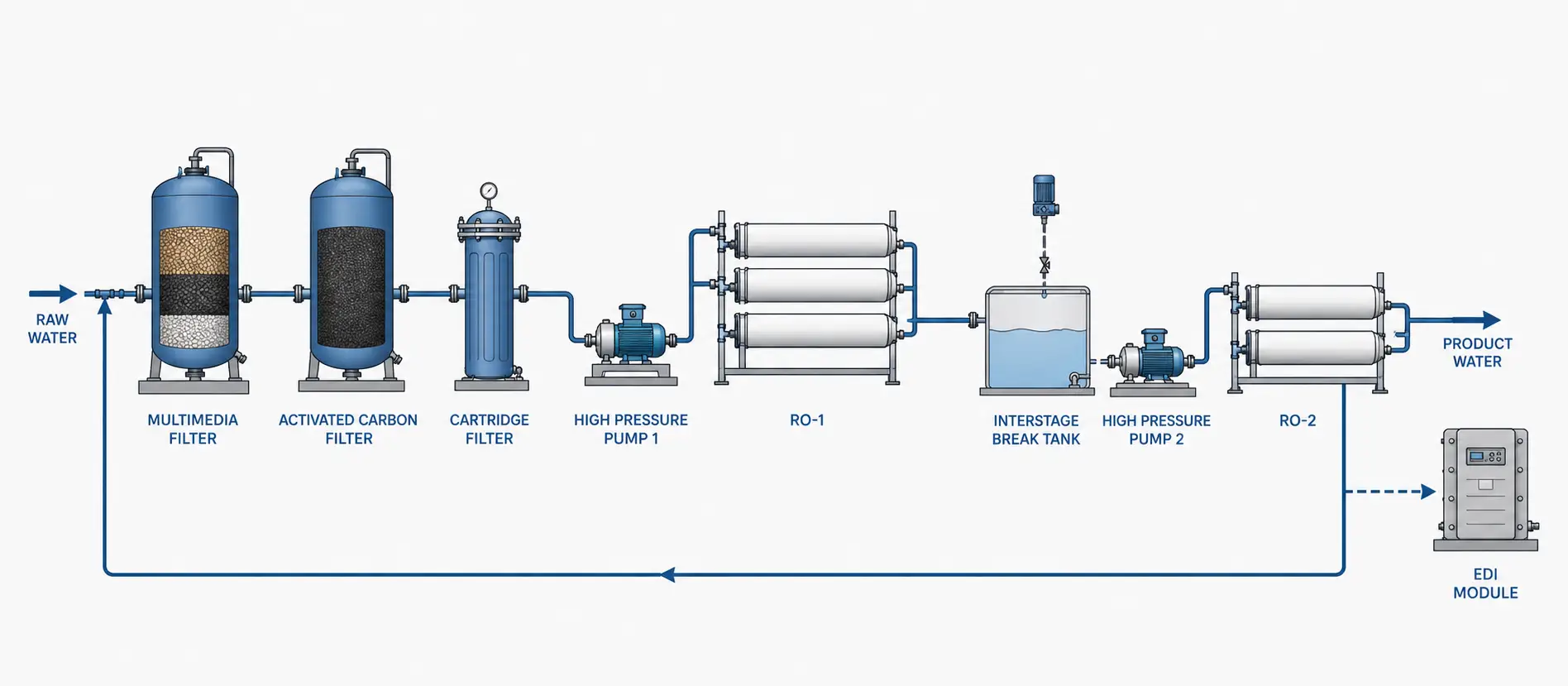
The Two-Pass Process: Feed Water Through Two Independent Pressure Loops
This configuration achieves product water purity below what a single-pass array can deliver by subjecting the first-pass permeate to a second independent membrane separation step. We engineer each loop separately — sized to the water quality entering it and the output it must meet.
Pretreatment Train
Feed water enters our pretreatment train before reaching the first-pass high-pressure pump. The pretreatment configuration — multi-media filtration, activated carbon filtration, antiscalant dosing, and cartridge filtration — is determined by your feed water analysis: specifically SDI, total hardness, free chlorine, turbidity, iron, and organic content. We do not apply a fixed pretreatment template across all feed sources; we size the pretreatment train from your water report.
First-Pass RO (RO-1)
From the pretreatment system, pressurized feed water moves through the first array of RO membrane pressure vessels. The first-pass permeate — substantially reduced in TDS and conductivity relative to the raw feed — collects in the interstage break tank. First-pass concentrate disposition (drain, partial recycle, or secondary use) is confirmed during engineering review.
Interstage Break Tank and Optional pH Conditioning
The interstage break tank decouples the two pressure loops and provides a buffer volume for stable second-pass pump operation. For applications requiring boron control or CO₂ reduction — pharmaceutical purified water, semiconductor UPW — we configure optional NaOH dosing at this stage to elevate pH before the second-pass membranes.
Interstage chemistry review. Raising pH converts dissolved CO₂ to carbonate and bicarbonate ions that the second pass rejects more effectively, and shifts boron from the poorly-rejected neutral boric acid form toward the ionized borate form. Whether interstage pH adjustment is included depends on your ionic purity targets. pH increase must be checked against calcium carbonate scaling risk in the second pass, dosing control accuracy, and downstream pH requirement; confirmed during engineering review.
Second-Pass RO (RO-2)
The first-pass permeate — now the second-pass feed — reaches the second-pass high-pressure pump. Because second-pass feed TDS is substantially lower than the original raw water, the second-pass pump operates at lower pressure, reducing the energy demand of the second loop relative to the first. We specify higher-flux membrane elements for the second pass to make effective use of the lower-TDS feed. Second-pass concentrate is recycled back to the first-pass feed tank, raising overall system water recovery without degrading second-pass product quality.
EDI, UV, and Final Polishing Optional downstream
For ultrapure water applications in electronics fabrication, pharmaceutical manufacturing, and related high-purity industrial uses, the two-pass RO system is typically the feed stage of a longer treatment train. We configure the RO-2 product as the feed to a downstream EDI unit, UV sterilization system, and final-stage polishing membrane. The downstream train specification is confirmed from your target resistivity, TOC, and microbial quality requirements — these targets are not fixed product outputs of the RO system itself; they depend on the full downstream configuration.
Operating Variables and Configuration Parameters
These systems are configured from your confirmed feed water analysis, target product quality, flow rate, and downstream application. The values below are engineering reference ranges, not guaranteed product outputs. Every row marked “Engineering review required” must be confirmed from your specific water data before we finalize a system design or a quotation.
How to use this table
Share your feed water analysis, target product quality, required flow rate, and downstream equipment. Our engineers work through these variables before selecting membrane arrangement, pump class, and instrumentation — confirming whether a second pressure loop is justified or whether a single-pass system meets your specification.
| Parameter | Typical Reference Range | Configuration Note |
|---|---|---|
| Feed water TDS or conductivity | Any range appropriate for RO | Determines first-pass membrane selection, pressure, and pretreatment scope. |
| First-pass permeate conductivity | 5-50 µS/cm (indicative) | Dependent on feed TDS, temperature, and membrane type; confirmed during engineering design. |
| Second-pass product conductivity | < 1-5 µS/cm (indicative target range) | Dependent on first-pass output and second-pass membrane selection; not a guaranteed output. |
| Total system water recovery | Up to approximately 85–90% with second-pass concentrate recycle — feasible only under suitable feed-water chemistry and scaling risk | Final overall recovery calculated from first-pass recovery, second-pass recovery, reject recycle ratio, and scaling limits (LSI, silica, barium sulfate). Subject to antiscalant design and concentrate discharge constraints. |
| First-pass operating pressure | Variable — feed TDS and temperature dependent | Reference: 8–15 bar for municipal tap feed; 15–30 bar for brackish; higher for elevated-TDS sources. Confirmed from feed TDS and temperature. |
| Second-pass operating pressure | Lower than first pass | Typically 5–12 bar — substantially lower than first pass because feed TDS is already reduced to 5–50 µS/cm range. |
| Interstage pH adjustment | Optional — NaOH dosing for CO₂ and boron control | Included when boron or CO₂ targets are specified; dosing rate confirmed with application requirements. |
| Second-pass membrane element type | Low-energy or high-rejection LP/ULP elements (e.g., flux ≥ 40 L/m²·h at standard test conditions) | Engineering variable; element selection confirmed during design. |
| Pretreatment configuration | Multi-media filter, carbon filter, antiscalant, cartridge filter | Determined by feed water SDI, hardness, chlorine, turbidity, iron, and organics. |
| System design flow rate | Configured to your specified production requirement | State required flow rate in m³/h or GPD and peak demand. |
| Feed water temperature | Affects membrane permeability and operating pressure | Provide typical and seasonal maximum; critical for pressure sizing. |
| Downstream EDI integration | Optional — RO-2 product must meet EDI feed specification | When EDI is specified, we design RO-2 output to match the EDI manufacturer’s feed requirement. |
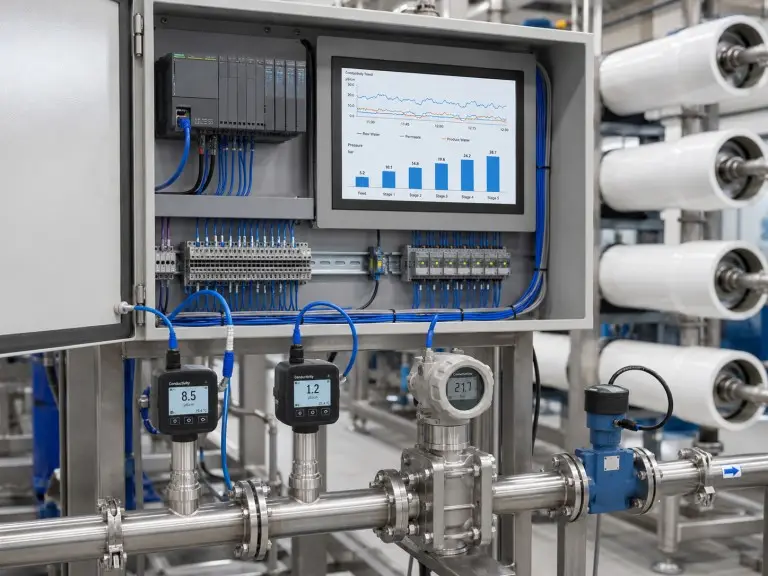
| Instrumentation and control | Online conductivity, TDS, pressure gauges, flow meters, PLC control panel | Panel specification and interface type confirmed during engineering design. |
| Power supply and electrical standard | Confirmed at order stage | Provide local voltage, frequency, and available connected load. |
The reference ranges above are Hiju preliminary design targets. Final values depend on membrane model, feed-water analysis, recovery target, temperature, scaling projection, and pretreatment design.
Double Pass RO for High-Purity Industrial Applications
We configure each system differently per application, because the engineering variables — conductivity target, interstage conditioning, downstream train integration — differ materially between a pharmaceutical purified water system and a high-pressure boiler makeup application. The common trigger across all of these is that the product water ionic purity, conductivity, TOC, boron, or resistivity target exceeds what single-pass membrane rejection can consistently deliver.
Pharmaceutical PW and WFI Pretreatment
For pharmaceutical purified water generation, we configure the second-pass RO to reduce conductivity below 2 µS/cm and TOC below 500 ppb upstream of any EDI or distillation polishing step — requirements aligned with a full deionized water filtration system train. Where WFI-grade water is required, the double-pass RO provides the essential upstream membrane pretreatment before final evaporation or membrane distillation. Regulatory compliance validation is the responsibility of the end-user.
Electronics and Semiconductor UPW
Semiconductor fabrication and electronics manufacturing require process water at resistivity levels that single-pass RO cannot achieve alone. We configure double-pass RO as the high-purity feed stage upstream of EDI, UV sterilization, and membrane polishing — designing the second-pass output TDS and conductivity to match the feed water tolerance of the EDI unit already specified, a figure that varies by EDI manufacturer and model.
Food and Beverage Blending Water
For food and beverage manufacturing where blending water ionic content requires controlled mineral profiles and low conductivity, a double-pass configuration provides the consistency margin that single-pass systems may not deliver under variable feed conditions. We configure the system to your specific blending water specification — a capability also relevant to bottled water plants requiring regulatory compliance.
High-Pressure Boiler Makeup Water
For high-pressure boiler makeup water, we configure double-pass RO to bring conductivity below 1 µS/cm and silica below 0.02 mg/L — typical requirements for drum pressures above 60 bar that single-pass RO cannot consistently meet when feed TDS or silica is elevated. We size the system from your boiler design data sheet and local feed water analysis.
Battery Manufacturing Process Water
We configure double-pass RO for battery manufacturing applications where electrode preparation, washing, or slurry mixing steps require conductivity below 2 µS/cm with tight controls on sodium, chloride, and metallic ion concentrations. We confirm the specific ionic limits from your cell chemistry and process water specification.
Chemical Processing and General Industrial UPW
Where chemical processing requires low-conductivity feed water for reactor, cooling, or dilution applications with ionic purity targets below 5 µS/cm that single-pass RO cannot consistently meet, a double-pass configuration provides the correct process route. We confirm feed water chemistry, target ionic limits, and downstream compatibility from your process data before finalizing the system design.
Manufacturing and Engineering Background
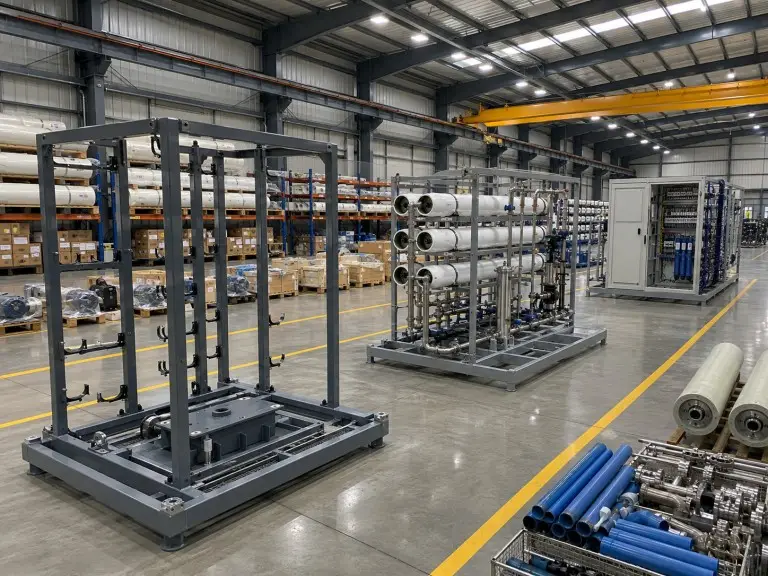
Qingdao Hiju Thermal Power Co., Ltd has manufactured industrial water treatment systems since 2016, supplying two-pass RO systems and high-purity water equipment to customers across Southeast Asia, the Middle East, Africa, South America, and Central Asia.
Established 2016
Manufacturing industrial water treatment systems from our Qingdao facility since 2016.
70,500 sqm factory · 21,000 sqm workshop
Fabrication, assembly, pressure testing, and final inspection under one roof.
78 technicians · 28 engineers
Permanent in-house team handles project scoping, P&ID design, and component selection.
20+ export markets
Systems delivered across Southeast Asia, the Middle East, Africa, South America, and Central Asia.
Certifications and compliance. We hold CE and ISO 9001 certifications. Our standard pre-shipment practice for double-pass RO systems includes configuration verification, pressure vessel testing, and conductivity testing at agreed conditions before dispatch. ASME certification is available on request — confirm this requirement at the quotation stage so we can verify the applicable vessel scope.
OEM and ODM available. We supply OEM and ODM double-pass RO skids to system integrators and EPC contractors. For OEM configurations, we work from your skid envelope dimensions, utility connection interface, power supply standard, and control system requirement. For ODM configurations, we adapt the system design to your engineering specification and nameplate standard. Contact us to confirm scope and feasibility.
What We Need to Configure Your Double Pass RO System
The more specific your feed water and application data, the faster we can return a system configuration and a budgetary estimate. We work from your actual feed water analysis and confirmed process requirement — not from assumed reference values.
- Source type — municipal, well water, surface water, brackish, process effluent, or other
- TDS or conductivity — µS/cm or mg/L
- pH
- Total hardness, calcium hardness, magnesium hardness — mg/L as CaCO₃
- SDI or turbidity — NTU
- Free chlorine — mg/L
- Silica — mg/L SiO₂ when a silica specification applies
- Boron — mg/L when a boron limit is specified
- Iron and manganese — mg/L if elevated in local source water
- Temperature — typical operating and seasonal maximum
- TOC — mg/L or µg/L for pharmaceutical and electronics applications
- Target conductivity — µS/cm or TDS (mg/L) at system outlet
- Target resistivity — MΩ·cm for electronics or semiconductor applications
- TOC limit at system outlet — if applicable
- Boron limit at system outlet — if applicable
- Microbial or endotoxin specification — if applicable
- pH requirement at product water delivery point
- Required production flow rate — m³/h or GPD, average and peak
- Operating schedule — continuous, batch, or intermittent
- Downstream equipment already specified — EDI, UV, storage, polishing membrane, or distillation
- Interstage conditioning requirement — pH adjustment or CO₂ degassing
- Available inlet pressure — if feed arrives pre-pressurized
- Application industry — pharmaceutical, electronics, food and beverage, power generation, battery manufacturing, chemical processing, or other
- Project country and region — for electrical standard, export logistics, and applicable compliance
- OEM or ODM requirement — if you need a skid configured to your own dimensions, interface, or nameplate
- Preferred contact method — WhatsApp, Email, or online inquiry form