
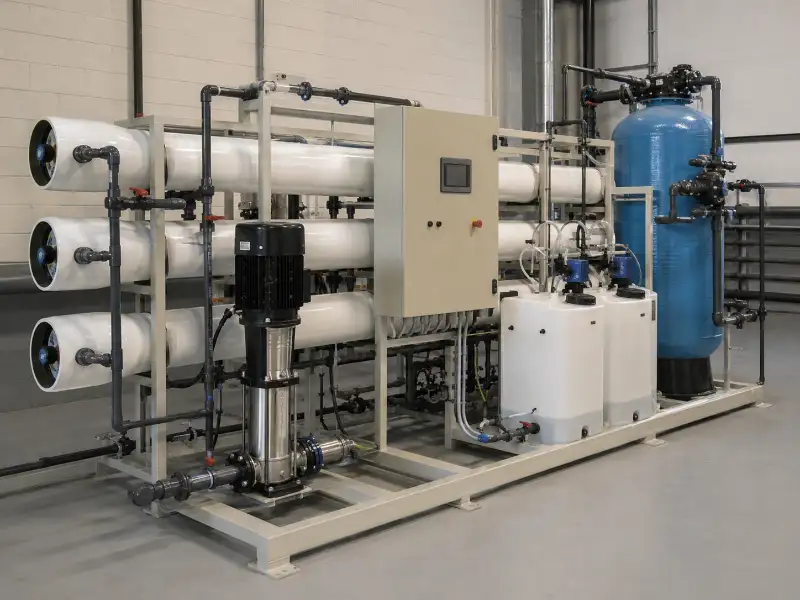
| Project basis | Value |
|---|---|
| Source water | Brackish deep well, ~1,750–1,900 ppm TDS; iron, manganese, hardness |
| Application | Bottled drinking water (low-mineral RO) |
| Product capacity | 5 m3/h (~100–110 m3/day, two extended shifts) |
| System type | Two-stage brackish water RO (BWRO) |
| Recovery | ~68% |
| Region | North-coast Java, Indonesia |
| Commissioned | June 2025 |
| Standards | Permenkes No. 2/2023; AMDK SNI category per the producer’s product registration |
This is a 5 m3/h brackish water RO system Indonesia project. On the north coast of Java, a bottled-water producer drew its only feed from a deep well that had gone brackish. Seawater intrusion and mineralised ground had pushed TDS to around 1,800 ppm, with iron, manganese, and hard water on top. None of it could go straight into a drinking-water line. In June 2025 we commissioned the system, and it now feeds the plant’s bottling line.
The water the plant had to work with
The well sits in a coastal industrial area where over-pumping has let seawater into the aquifer. Measured feed ran 1,750–1,900 ppm TDS at 2,700–3,000 µS/cm, with chloride of 550–680 mg/L — the intrusion signature. Hardness sat at 320–380 mg/L as CaCO₃. Iron was consistently above the drinking-water limit at 0.35–0.50 mg/L, while manganese fluctuated around the limit at 0.08–0.15 mg/L and exceeded it in higher-draw samples. In the dry season the TDS drifted higher still. For a producer bottling drinking water, none of that water was usable as drawn.
What drove the design
The feed set the route. We read the well analysis before specifying anything, and sized the train against the measured water. TDS near 1,800 ppm meant brackish water RO, not softening alone. Iron and manganese meant oxidation and filtration first, or the membranes would foul within months.
The producer bottles a low-mineral product, so the low-TDS RO permeate is the product as-is, with no remineralisation added. Chloride of 550–680 mg/L concentrates to roughly 1,700–2,100 mg/L on the reject side at 68% recovery, so we used 316L on the high-chloride wetted parts and FRP vessels, and kept 304 off the concentrate side; it did not call for duplex alloys. We set recovery near 68% — confirmed by a scaling projection on the hardness, alkalinity, and antiscalant limits, not pushed for its own sake.
What we delivered
We delivered a complete two-stage brackish water RO plant with its pretreatment, dosing, disinfection, and controls — fabricated and tested in our Qingdao workshop, then commissioned on site. The scope covered:
- Pretreatment — raw-water tank and pump, oxidation / pre-dosing, multimedia filter, a manganese-greensand filter for iron and manganese, and activated carbon, with free-chlorine / ORP monitoring before the membranes to protect the polyamide elements from chlorine or permanganate carryover.
- RO stage — antiscalant dosing, a 5 µm cartridge filter, the high-pressure pump, and a two-stage 8-inch (8040) brackish water membrane array, with a CIP cleaning loop.
- Disinfection — product tank, UV on the product line, ozone, and a final 0.2 µm guard filter for the bottling feed.
- Materials — 316L on the high-chloride concentrate-side wetted parts, FRP vessels and UPVC where suitable, all food-grade for drinking-water contact; 304 avoided on the reject side.
- Instruments and controls — online conductivity, flow meters, pressure gauges, and a PLC panel, with CIP connections built in.
- Support — installation guidance, commissioning, operator training, maintenance instructions, and a consumables-replacement schedule.
Brackish deep well · 1,750–1,900 ppm feed · 5 m3/h · 25–45 ppm product · ~68% recovery · low-mineral RO drinking water
System specification
| Spec | Value | Note |
|---|---|---|
| Feed water TDS | ~1,750–1,900 ppm (measured) | brackish; sets the membrane class |
| Conductivity | ~2,700–3,000 µS/cm | matches the TDS |
| Chloride | 550–680 mg/L | seawater-intrusion signature; ~1,700–2,100 on reject side |
| Hardness | 320–380 mg/L as CaCO₃ | scaling driver; sets recovery and antiscalant |
| Iron / manganese | 0.35–0.50 / 0.08–0.15 mg/L | removed in pretreatment |
| Product capacity | 5 m3/h (~100–110 m3/day) | two extended shifts, 20–22 h/day |
| Recovery | ~68% (projection-confirmed) | concentrate ~2.3 m3/h |
| Membrane array | two-stage 8-inch (8040) BWRO | brackish water elements |
| Pretreatment | oxidation + multimedia + Mn-greensand + carbon + 5 µm | Fe/Mn removal; oxidant monitored out before RO |
| Disinfection | UV + ozone + 0.2 µm guard | product line and bottling feed |
| Product TDS | 25–45 ppm (measured) | low-mineral RO drinking water |
| Materials | 316L (concentrate side) / FRP / UPVC; food-grade | chloride corrosion + potable contact |
| System power | 380 V / 3-phase / 50 Hz | Indonesian industrial supply |
| Control | PLC + HMI; CIP | dosing, flushing, cleaning |
How we commissioned it
We hydraulic-pressure-test and function-run every skid before it ships, and this one was no exception. The real work was on site. The well ran saltier than the producer’s earlier report, and iron and manganese shifted between draw times. We tuned the oxidation and stepped up the greensand backwash until the filtered feed reached the membranes within its iron and manganese limits. Then we commissioned the RO against its targets — product TDS, flow, pressure, and recovery. The treated water was sent for third-party testing against the producer’s AMDK compliance plan, including the relevant SNI category and Permenkes No. 2/2023 parameters. Because the source is intrusion-influenced and the line ozonates, bromide and bromate were included in the product-water test plan.
Results, about a year on
Since commissioning in June 2025, the system has run for roughly a year. RO product TDS holds at 25–45 ppm, product turbidity stays below 0.3 NTU, and iron and manganese come through below the producer’s detection limit. Recovery sits steady at about 68%. After UV and ozone, the line runs on clean, low-mineral RO water; full product compliance is confirmed by the producer’s third-party laboratory testing.
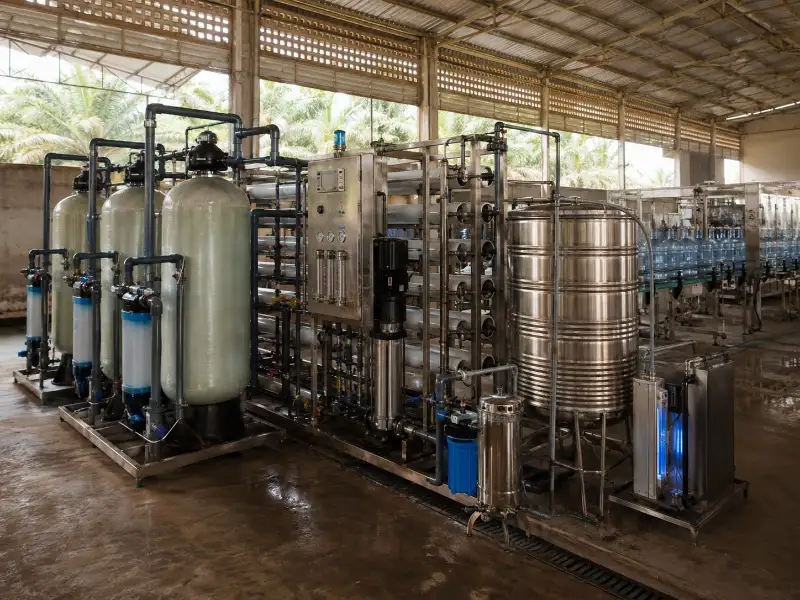
The producer reports steadier operation than its old setup: fewer stoppages, less time spent re-adjusting for the well’s salinity swings, and a more continuous bottling line. Projected membrane life is three to five years on this feed, with the pretreatment and CIP held to schedule.
Where this fits
If you bottle low-mineral RO drinking water on a brackish coastal well in the 1,500–2,500 ppm range, with iron or manganese to clear, this is close to the system you need. It is one of the brackish water RO systems we design and build for intruded coastal feed like this. The exact array, recovery, and final polishing follow your own water analysis and the SNI category you register the product under.
Hiju designs and builds brackish and seawater RO systems for bottling plants, food and beverage producers, and municipal buyers across more than 20 countries. Send us your well analysis and target capacity. Our engineering team comes back within three to four working days — with a configuration, the right AMDK SNI route (mineral, demineral, or low-mineral drinking water), and an all-in delivered cost.
